Catastrophe bonds – essentially a gamble on the likelihood of natural disasters – have been the fifth best-performing asset class since the financial crisis, according to research conducted by Deutsche Bank … If you had invested your money at the fall of Lehman Brothers in September 2008, only silver, gold, and high-yield debt from the US and the European Union would have made you more money.
Mike Riggs says catastrophe bonds have done well “because they have practically no relationship to financial markets”:
This doesn’t mean they’re particularly safe … [but] when the entire market can shift after a few comments from Federal Reserve chairman Ben Bernanke, as it did this week – or rests on the health of dubious bets from the financial industry – gambling on the likelihood of a natural disaster doesn’t sound like such a bad idea.
A Denkmal is a memorial or monument whose purpose is to remind us of something that has happened or someone who has lived. Denken is the German verb “to think,” so a Denkmal stands as a testament to something on which we have a duty to reflect. Denkmals can be bloated and grand — as in the Soviet Memorial in Berlin or Mount Rushmore in South Dakota — or sombre and respectful — as in the Vietnam Veteran’s Memorial, a black wall engraved with service members’ names, dedicated to honoring those who fought in the war.
A Mahnmal is something subtly different, and we have no readily available English translation. Mahnen means both “to admonish” and “to remind;” it is often paired with the idea of caution or observance, as when one urges someone to take caution or be vigilant. A Mahnmal, then, is something meant both to remind and to warn, it pleads for remembrance not for the purpose of glory but for the purpose of heedful acknowledgment, even shame. A Mahnmal takes the idea of “never again” and gives it shape.
Berlin has an impressive Mahnmal culture. The most famous is the Holocaust-Mahnmal, or the Memorial for the Murdered Jews of Europe, a vast grid of concrete vertical slabs arranged on rising and falling ground.
(Photo of the Holocaust-Mahnmal by Flickr user .tungl)
Charles Yu takes note that the controversial videogame Grand Theft Auto V has already crossed a billion dollars in sales, surpassing every movie this year except for Iron Man 3. An important point he makes about the value difference:
It’s not a stretch to think that the people who didn’t go to the movies this summer might have said, ‘you know what, I’m skipping a few and using the cash for a different kind of blockbuster.’ In that case, the most interesting number to keep in mind may be 100 — the approximate number of hours of gameplay that “GTA V” reportedly offers. For those diligent and conscientious enough to explore all the side quests, excursions and games-within-the-game, it provides weeks of entertainment. That makes the $60 retail price a bargain: 100 hours of gameplay at $0.60 an hour. Compare that with the price of admission to a movie, even a two-and-a-half hour megaproduction. The other advantage for video games — driving the usage cost down even further — is that buyers get to keep the game.
Joseph Bernstein finished the game in one 38-hour sitting:
The thing about this game, I’ve realized, is that people are going to see what they want to see in it, because this game quite willingly offers it up to them.
Game-culture torchbearers will see the return to ultraviolence that they want; dads looking for 30 minutes of mirth after putting the kids to bed will find just that; culture warriors looking for a game to pillory will have plenty to work with; games-are-art drumbeaters will find what they need; and the vast majority of people who play this game, people who are looking to be entertained for hours and hours, will certainly not be disappointed. How about me? I found a daring, contradictory, ambitious, huge, flawed, funny, beautiful, sometimes retrograde, and always compelling video game, unafraid to engage with the culture at large. That’s more than I can say for any of its peers. And that’s how I’ll treat it.
Despite its commercial success, Ryan Vogt pans the game as stale and predictable:
Grand Theft Auto has been on a decadelong spree of piling on “features,” hoping you won’t notice how much it’s aged. Looking back, it’s amazing how little evolution the series has experienced. Kidnap someone playing Grand Theft Auto III in 2001, bring him in a time machine to the present day to play GTA V, and the only actual gameplay differences he’ll notice are that now you can fly helicopters and ride motorcycles, and you won’t die when you touch a body of water. That’s pretty much it. And those changes were made in Grand Theft Auto: Vice City, the very next game after III.
[E]fforts to simply eradicate piracy by shutting down sites can’t work. The internet moves too quickly, and has unlimited space for infringing sites to hide. This is a very strong admission for an industry-funded report, and one that shows the extrajudicial DNS blocking that SOPA would allow can’t work. Never mind the censorship concerns—killing websites that host infringing material, unwittingly or not, won’t kill piracy. That on its own runs counter to the prevailing refrain in the copyright lobby. But what’s even more surprising is that the report offers an actual solution, as Techdirt adroitly pointed out: If you want to combat piracy, make your content available elsewhere.
Jerry Brito analyzes an MPAA study blaming search engines for enabling mass piracy:
[It’s] not surprising that, according to the report, 58% of all visits to infringing URLs that were “influenced” by a search engine came from queries for either generic or title-based terms, not from the more-clearly suspicious “domain” terms. As the report points out, this “indicat[es] that these consumers did not display an intention of viewing content illegally.”
So the question is, why did these consumers who had no illegal intent end up at infringing sites? Could it be that they did not have a legal alternative to accessing the content they were seeking? That would not excuse their behavior, and it’s the movie industry’s prerogative whether and when to make their content available. Indeed release windows are part of its business model, although a business model seemingly in tension with consumer demand as evidenced by the shrinking theatrical release window. That all said, it’s not clear to me why search engines should be in the business of ensuring other industries’s business models remain unchanged.
Vishaan Chakrabarti argues that urban areas recover from calamities more quickly than suburbs do:
In the aftermath of Sandy, higher-density neighborhoods with centralized infrastructure such as underground power and mass transit generally fared better and recovered more quickly than lower-density areas.It is particularly telling that in the aftermath of Sandy, higher-density neighborhoods – from downtown Brooklyn and Battery Park City up to Harlem – were up and running within a week. By contrast, lower density areas like Staten Island and Breezy Point – with their single-family homes, elevated power lines, timber construction, and auto-dependency – took longer to recover. Dense conditions come with a greater number of redundancies, a fundamental characteristic of resiliency. Most residents of high-density areas don’t rely on a single hospital or one grocery store. Instead, they have a network of them, allowing one or a few to malfunction without creating a system failure.
(Photo: Two days after Hurricane Sandy, New Yorkers crowd into a Chase Bank ATM kiosk one block north of where power has gone out in Manhattan. “This is the modern campfire,” one man said. By Andrew Burton/Getty Images)
Peter Gray details the connection between a decline in playtime and a rise in mental disorders:
It’s not just that we’re seeing disorders that we overlooked before. Clinical questionnaires aimed at assessing anxiety and depression, for example, have been given in unchanged form to normative groups of schoolchildren in the US ever since the 1950s. Analyses of the results reveal a continuous, essentially linear, increase in anxiety and depression in young people over the decades, such that the rates of what today would be diagnosed as generalised anxiety disorder and major depression are five to eight times what they were in the 1950s. Over the same period, the suicide rate for young people aged 15 to 24 has more than doubled, and that for children under age 15 has quadrupled.
The decline in opportunity to play has also been accompanied by a decline in empathy and a rise in narcissism, both of which have been assessed since the late 1970s with standard questionnaires given to normative samples of college students. Empathy refers to the ability and tendency to see from another person’s point of view and experience what that person experiences. Narcissism refers to inflated self-regard, coupled with a lack of concern for others and an inability to connect emotionally with others. A decline of empathy and a rise in narcissism are exactly what we would expect to see in children who have little opportunity to play socially. Children can’t learn these social skills and values in school, because school is an authoritarian, not a democratic setting. School fosters competition, not co-operation; and children there are not free to quit when others fail to respect their needs and wishes.
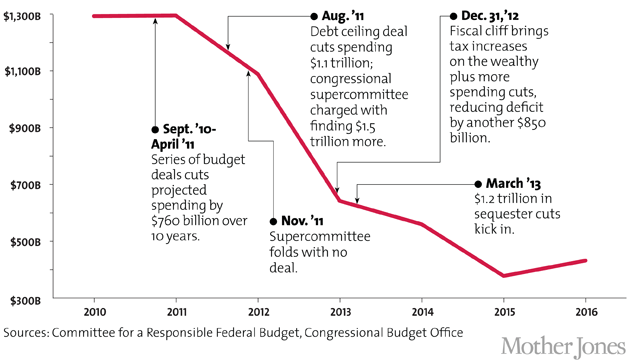
So what has austerity cost us in the United States? The full price is hard to calculate, but the Congressional Budget Office figures that sequestration alone has cut GDP growth by about 0.8 percentage points. Since sequestration accounts for less than half of total belt-tightening over the past couple of years, a rough guess suggests that our austerity binge has cut economic growth by something like 2 percentage points—about half the total growth we might normally expect following a recession.
In a follow-up, Drum looks at normal government during recoveries:
Government spending at all levels is far below the level of any other recent recovery. Sixteen quarters after the end of the recession, spending during past recoveries has been 7-15 percent higher than it was at the start. This time it’s 7 percent lower, despite the fact that the 2008-09 recession was the deepest of the bunch. Reagan, Clinton, and Bush all benefited from rising spending during the economic recoveries on their watches. Only Obama has been forced to manage a recovery while government spending has plummeted.
This context is critical to understanding the anemic recovery. To be sure, government debt desperately needs long-term structural reform on entitlements and defense – but slashing spending in the last few years has been as effective here as in Europe. Were it not for the stimulus in 2009, we might be where much of Europe is languishing today. And note too that the GOP is largely responsible, both in state and local government and at the national level. You can think of this is prudence – but without real structural reform, it’s hardly that. I think of it in much simpler terms: sabotage to make Obama first a one-term and now a failed president.
They just hate him much more than they love their country.
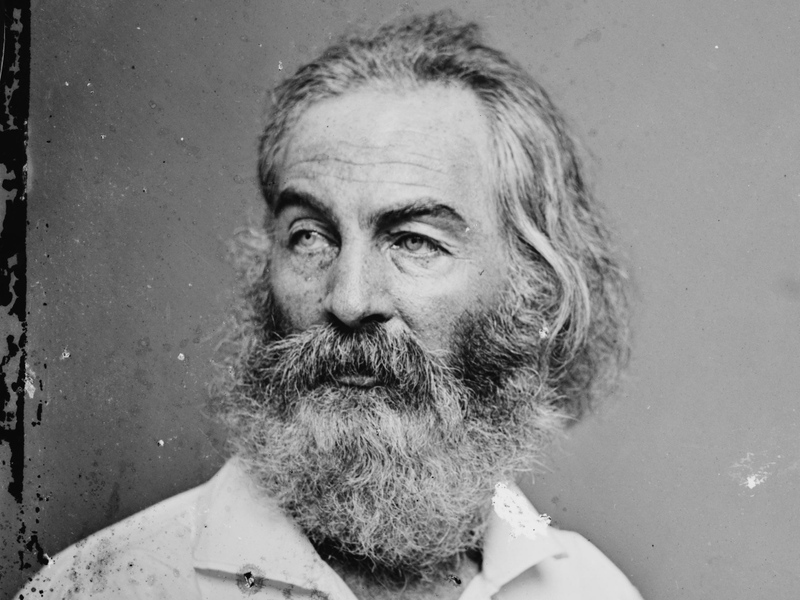
Oscar was suitably humble in the presence of Whitman, greeting him with the words, ‘I have come to you as one with whom I have been acquainted almost from the cradle.’ The contrast between the two poets could not have been more marked. Oscar was young, tall, slender and clean shaven. Whitman was in his early sixties, but looked much older. He was shorter than Oscar and wore a long, bushy white beard. Oscar was highly educated, cultivated and still in his languid Aesthetic phase. Whitman was self-taught, and robustly masculine in manner.
Could his meaning be more clear? “Hello, Daddy,” says the young dandy as he lightly crosses the threshold.
[Publisher John Marshall] Stoddart tactfully left the two poets alone. ‘If you are willing – will excuse me – I will go off for an hour or so – come back again – leaving you together,’ he said. ‘We would be glad to have you stay,’ Whitman replied. ‘But do not feel to come back in an hour. Don’t come for two or three.’ Whitman opened a bottle of elderberry wine and he and Oscar drank it all before Whitman suggested they go upstairs to his ‘den’ on the third floor where, he told Oscar, ‘We could be on ‘thee and thou’ terms.’ …
The next day, Whitman told the Philadelphia Press that the two of them had a “jolly good time” together. Did he get more specific? He did, reader. He did:
One of the first things I said was that I should call him ‘Oscar.’ ‘I like that so much,’ he answered, laying his hand on my knee. He seemed to me like a great big, splendid boy. He is so frank, and outspoken, and manly. I don’t see why such mocking things are written of him.
This is a gift. You do realize that, don’t you? History has reached out to you specifically and given you a gift. The gift is the knowledge that Oscar Wilde once put his hand on Walt Whitman’s knee and then they drank elderberry wine together; the gift is that the next day a reporter turned up and Whitman expounded at length on his big, splendid boy. Let this sink in a moment. This is like finding out Emily Dickinson once secretly stowed away on a ship bound for England and spent a weekend with Jane Austen at a bed and breakfast, doing it. This is like finding out Ernest Hemingway finally let his guard down one night in Spain and let F. Scott Fitzgerald lean across the table and kiss him. This is like finding out Gwendolyn Brooks lost her virginity to Willa Cather.
But Ortberg’s “smoking gun” on the Wilde encounter with Whitman is still to come – here.