A Poem For Sunday

lakecountry

Here’s another selection from Wordsworth’s The Prelude, or Growth of a Poet’s Mind:

Ye Presences of Nature in the sky
And on the earth!  Ye Visions of the hills!
And Souls of lonely places!  can I think
A vulgar hope was yours when ye employed
Such ministry, when ye through many a year
Haunting me thus among my boyish sports,
On caves and trees, upon the woods and hills,
Impressed upon all forms the characters
Of danger or desire; and thus did make
The surface of the universal earth
With triumph and delight, with hope and fear,
Work like a sea?
Not uselessly employed,
Might I pursue this theme through every change
Of exercise and play, to which the year
Did summon us in his delightful round.

(Photo by Glen Bowman of northwest England’s Lake Country, where Wordsworth lived for much of his most productive years.)

Quote For The Day

“I can’t see why anybody — unless he was a child, or an angel, or a lucky simpleton like the pilgrim — would even want to say a prayer to a Jesus who was the least bit different from the way he looks and sounds in the New Testament. My God! He’s only the most intelligent man in the Bible, that’s all! Who isn’t he head and shoulders over? Who? Both Testaments are full of pundits, prophets, disciples, favorite sons, Solomons, Isaiahs, Davids, Pauls — but, my God, who besides Jesus really knew which end was up? Nobody. Not Moses. Don’t tell me Moses. He was a nice man, and he kept in beautiful touch with his God, and all that — but that’s exactly the point. He had to keep in touch. Jesus realized there is no separation from God,” – J.D. Salinger, Franny and Zooey.

Evil’s Shadowy Existence

Digging deeper than many reflections on the recent film about Hannah Arendt and her book Eichmann in Jerusalem, Fr. Robert Barron reminds us of Arendt’s debt to St. Augustine:

The young Hannah Arendt had written her doctoral dissertation under the great German philosopher Karl Jaspers, and the topic of her work was the concept of love in the writings of Saint Augustine. One of the most significant intellectual breakthroughs of Augustine’s life was the insight that evil is not something substantial, but rather a type of non-being, a lack of some perfection that ought to be present. Thus, a cancer is evil in the measure that it compromises the proper functioning of a bodily organ, and a sin is evil in the measure that it represents a distortion or twisting of a rightly functioning will. Accordingly, evil does not stand over and against the good as a kind of co-equal metaphysical force, as the Manichees would have it. Rather, it is invariably parasitic upon the good, existing only as a sort of shadow.

J.R.R. Tolkien gave visual expression to this Augustinian notion in his portrayal of the Nazgul in The Lord of the Rings. Those terrible and terrifying threats, flying through the air on fearsome beasts, are revealed, once their capes and hoods are pulled away, to be precisely nothing, emptiness. And this is exactly why, to return to Arendt’s description, evil can never be radical. It can never sink down into the roots of being; it can never stand on its own; it has no integrity, no real depth or substance. To be sure, it can be extreme and it can, as Arendt’s image suggests, spread far and wide, doing enormous damage. But it can never truly be.

Recent Dish on Arendt here, here, and here.

Daily Life Without A Deity

Kimberly Winston highlights a new documentary, Hug an Atheist, that tries to put “a more human, middle-of-the-road face on American atheism”:

The 90-minute film is the project of Sylvia Broeckx, a 35-year-old Belgian who lives in England and has been an atheist and humanist since her teens. She became interested in America’s perception of nonbelievers when some American friends and fellow atheists shared their own stories of feeling marginalized. “I always assumed America was founded on freedom of religion and was very much like Europe where if you are an atheist it is no big deal,” she said. “When I discovered that in America being an atheist could be a big problem, that was really a shock to me.”

Daniel Fincke emphasizes that the film isn’t about winning arguments:

Hug An Atheist is not a polemic against theism. It’s not filled with arguments against the existence of God or complaints with religious organizations. Supernatural ideas come up more as either nuisances to deal with or paltry suggestions to dismiss than as problems. While occasionally throughout the film, the atheists in it will reflect about when they were religious and make comparisons and contrasts to their current views, there is not much discussion justifying or explaining the thought processes that made them into atheists. The film’s point is neither to justify nor advance non-belief in gods. While they take the time regularly to rebuff familiar religious answers to questions or religious challenges to atheists, the point is to show how atheists think and live in positive and honest terms, how they make sense of their lives and their values, and how they deal with some of the most central and universal questions of human life.

Revelation Begins With Routine

Jamie Quatro explains the value of rituals:

There’s a sense in which we need ritual. We crave it at a physical level; we inhabit a universe that operates according to ritual: sun up, sun down; work, rest, play, work; summer, fall, winter, spring. There is joy in the rehearsal of the known, the familiar. Raising children is a great reminder of this: they thrive on routine, love tradition. And without ritual, there can be no mystery—how can the unexpected enter into a life that is devoid of expectation? Ritual opens the door for revelation. We move through ritual and performance to access the Divine. Yoga teaches this: when we know the poses—when they become habit, motor-memory—we can more quickly access the state of heightened awareness that is beyond the physical. The ecstasy. I find the same to be true with liturgy. The more I practice it—when it becomes part of the fabric of my being—the more quickly and completely I can move through it to approach the Divine.

Curses! Ctd

Colin Burrow reviews Melissa Mohr’s Holy Shit: A Brief History of Swearing:

Mohr ends by welcoming swearing as a good thing. We need to exercise the palaeomammalian brain from time to time, and we should ‘appreciate that our language has so many such useful words that can be employed in such a wide variety of ways’. She also speculates that future swear words will probably come from some of the milder taboo areas in modern life, such as death and disability.

Should we be quite so cheery about swearing or its future? Swear words and oaths often gain their expletive force from the circumstances in which they are uttered. The badness of saying ‘whore’ or ‘God’s wounds’ or ‘bastard’ depends on who you say it to and why – as Queen Elizabeth I’s lord deputy in Ireland Sir John Perrot discovered when his secretary told on him for saying ‘God’s wounds, this it is to serve a base bastard pissing kitchen woman.’ Oaths can carry their potential to hurt or shock into normal conversation, which is why they can be used simply as intensifiers. Maybe we should just say ‘what the hell’ (or the expletive of our choice) and let this happen, because it does happen and will happen.

Previous Dish on swearing here and here.

Just The Money Shots

Amanda Hess explores the growing phenomenon of microporn, “explicit photos, videos, and GIFs that are as short as winks”:

Today, the full-length film experience has been subsumed by short clips that can be chopped, remixed, and compiled into endless sexual combinations. [Novice pornographer] David distills his exploits into six-second loops. Amateur editors cut professional porn flicks into even shorter animated GIFs, then Tumblr curators like Kayla shoot them to all their followers. It used to be that people would “watch porn by fast-forwarding through most of it to get to their favorite parts,” says Fleshbot founder and editor Lux Alptraum. But GIFs “hone in on the hottest part of the action” — on “that perfect cum shot, or those breasts bouncing, or the moment of insertion, or whatever it is that really drives you wild.” And they repeat instantly — no hands necessary.

But it’s causing problems for social networking sites:

Because microporn is so simple to shoot, edit, and share, it’s escaped the seedy bounds of the tube sites and found a home on mainstream social-networking sites. … Platforms like Vine, Tumblr, and Instagram aren’t exactly accepting microporn with open arms. Mainstream social networks are constantly inventing new strategies for blocking users from finding porn through their channels. Search for “NSFW” on Vine, and you’ll find zero results. Tumblr recently caught flak for sweeping the “gay” and “lesbian” tags from its mobile app along with more explicit filters like “porn”; Tumblr founder David Karp publicly lamented the decision, but said those identity tags are just steeped in too much sexual material to keep them active. Facebook — along with its image-sharing site, Instagram — bans nudity entirely.

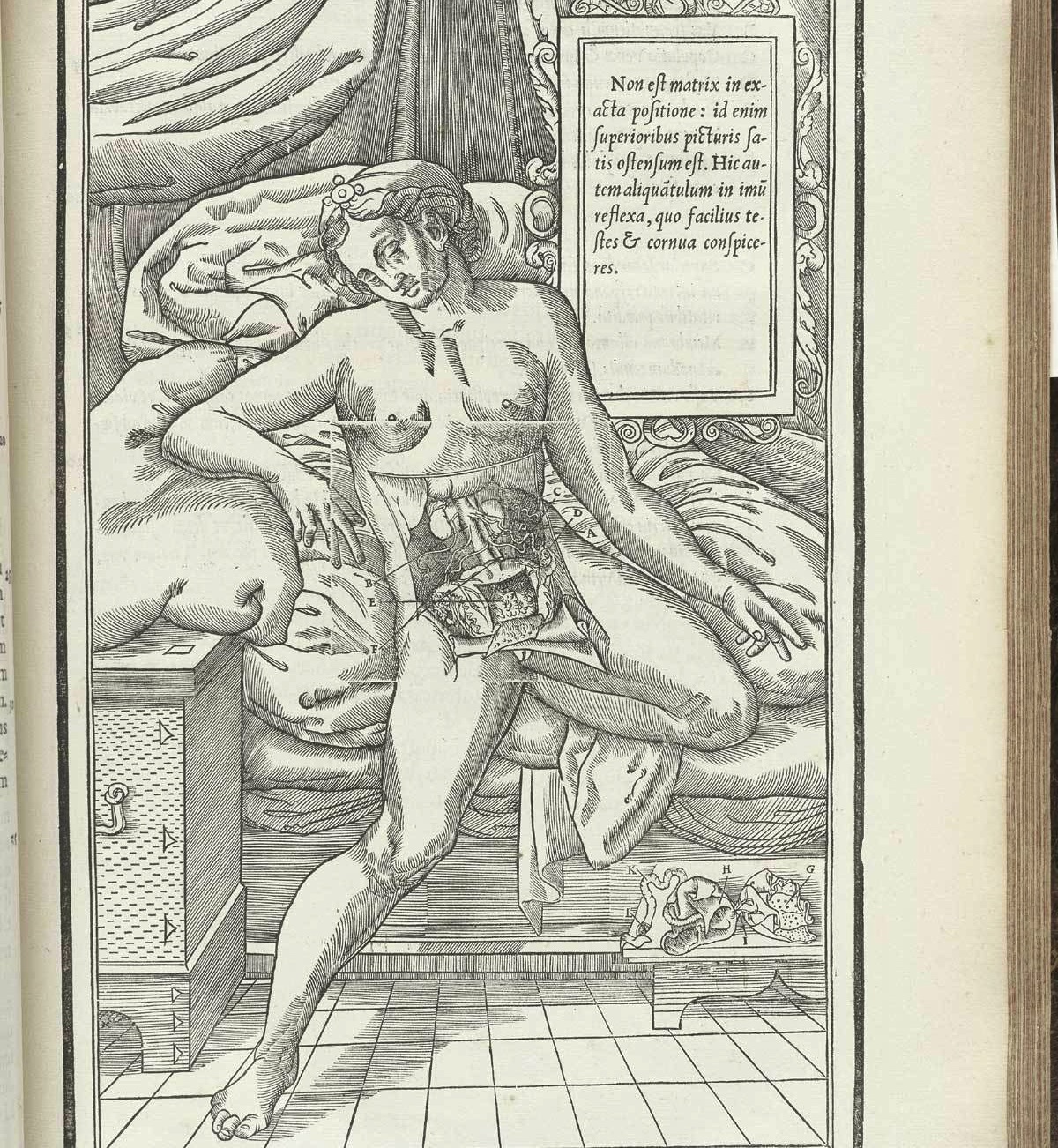
Look At The Kidneys On That One

estienne_p279

If this 16th-century woodcut print seems a little racy to you, you’re not alone. It offers a fascinating glimpse at the history of medical illustrations and pornography:

[It is possible] that the engraver of the female nude woodcuts did not have access to a model, and for the sake of expediency copied the general outlines of the female nudes from “The Loves of the Gods,” eliminating the male figures from the erotic illustrations. Another wood engraver, perhaps [Etienne de la] Rivière, would then have prepared the anatomical insert blocks showing the internal organs. Still another explanation might have been that in an era in which there was little graphic erotica available the author and the publishers deliberately exploited the erotic undercurrents of this anatomical work as a way of expanding the market beyond medical students. Perhaps because of the erotic undertones the book sold unusually well for a dissection manual and anatomical textbook, causing the publishers to issue an edition in French only one year later, in 1546.

(Hat tip: Joanna Ebenstein)

Brewing Your Own Beer … In Your Belly

Recently a man “stumbled into a Texas emergency room complaining of dizziness,” claiming that he had consumed no alcohol despite a blood alcohol concentration of 0.37 percent:

[T]he simplest explanation was that he was drinking when nobody was looking. So doctors put him in an isolated room for 24 hours, watching his blood alcohol level. Sure enough, without a drink, the alcohol level in his blood rose 0.12 percent. Turns out the man’s own stomach, colonized by brewer’s yeast, was brewing beer—a condition doctors call “auto-brewery syndrome.” The doctors described the case in the International Journal of Clinical Medicine:

Gut Fermentation Syndrome also known as Auto-Brewery Syndrome is a relatively unknown phenomenon in modern medicine. Very few articles have been written on the syndrome and most of them are anecdotal. This article presents a case study of a 61 years old male with a well documented case of Gut Fermentation Syndrome verified with glucose and carbohydrate challenges. Stool cultures demonstrated the causative organism as Saccharomyces cerevisiae. The patient was treated with antifungals and a low carbohydrate diet and the syndrome resolved. Helicobacter pylori was also found and could have been a possible confounding variable although the symptoms resolved post-treatment of the S. cerevisiae.