A Tale Of Two YA Novels

Jaya Saxena calls Mildred Taylor’s novel Roll of Thunder, Hear My Cry “a perfect response to To Kill A Mockingbird.” Below is her lesson from juxtaposing the two books – both narrated by young girls, one black and one white:

The main difference is that To Kill A Mockingbird is a book written for adults with a childishly simple moral, and Roll of Thunder is a book written for children that is powerfully adult. … To Kill A Mockingbird is a story about learning the difference between right and wrong, and then doing what’s right. It’s an important lesson, and one that everyone should definitely start thinking about as a kid. But it’s also simple.

Roll of Thunder takes that idea to the next level, showing the deep personal calculus necessary to weigh “doing what’s right” against public expectation, personal safety, and what kind of privilege is necessary to even be able to make that choice. Atticus Finch can do the right thing, have it not work, but still say “hey, at least I tried.” His children can be attacked and it’s considered a crime punishable by the full extent of the law. If the Logans do the “right thing,” everything they hold dear will be destroyed. If a Logan is attacked, no one in power cares.

A Pre-Tenderized Meal, Ctd

A reader in Alaska writes:

An average moose yields about 700 pounds of lean meat when recovered from a crash. Even if the crash is bloody and causes clotting, about 300-400 pounds of burger meat can be salvaged. Many churches, food banks and non-profits are on a call list. When a moose fatality is reported, they call folks on the list and are given an hour or so to harvest the meat. Folks consider it a privilege when it’s their turn on the list.

Another tells a story:

Early eighties and I’m at a small, rural college in Vermont.  A friend and I were bombing along the desolate road to campus and a little deer, spots and all, leapt over a snow bank and directly into my path.  The impact launched the fawn onto an icy patch on the road and it slid to a stop.  We got out, and to our surprise and horror the poor thing was still alive and making an awful whining sound.  We realized we had to put the animal out of its misery; the question was how.  My friend suggested I drive over it, an idea that I quickly rejected. A rock to the head? A tire iron? We settled on suffocation – not terribly appealing but the best of a host of bad ideas.

So there I was, in the middle of the road, strangling a baby deer.  As if on cue, another car came along, filled with fellow students coming back from – and you can’t make this shit up – a Greenpeace meeting.  So I was a deer in the headlights strangling a baby deer. Quick explanations from my friend averted a beat-down (or at least the Greenpeace version of a beat-down).  The deer let out one last breath, went limp, and all was quiet.  There were a few tears.

Meanwhile, the town game warden – an old Vermont character named Donny – had been alerted and showed up post-strangulation.  He made his way to the center of the drum circle, picked up the deer by the neck, looked at all of us and said: “Sunday Dinner.”

Another:

Great thread. I don’t have any roadkill stories to add, but I just had to write in because I’d never heard the term “car-harvested” used to describe take-home roadkill before. I laughed out loud when I read it. It’s perfect. Car-harvested! That’s why the Dish is the best.

Update from a reader:

Come on guys this is too easy – it clearly should be Carvested!

Armed With Lobbyists

Adam Ciralsky reports at length on Lockheed Martin’s troubled F-35 Lightning II program. How the project has survived:

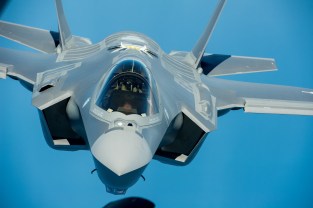
The political process that keeps the Joint Strike Fighter airborne has never stalled. The program was designed to spread money so far and F-35 Lightning II instructor pilots conduct aerial refuelingso wide—at last count, among some 1,400 separate subcontractors, strategically dispersed among key congressional districts—that no matter how many cost overruns, blown deadlines, or serious design flaws, it would be immune to termination. It was, as bureaucrats say, “politically engineered.” …

[Lockheed Martin] employs a stable of in-house and outside lobbyists and spends some $15 million on lobbying each year. When it comes to the F-35, which accounts for one of its largest revenue streams, Lockheed takes every opportunity to remind politicians that the airplane is manufactured in 46 states and is responsible for more than 125,000 jobs and $16.8 billion in “economic impact” to the U.S. economy. Signing up eight allied countries as partners provides additional insurance. “It’s quite frankly a brilliant strategy,” said General Bogdan, acknowledging that it is effective even if it is not admirable. Political engineering has foiled any meaningful opposition on Capitol Hill, in the White House, or in the defense establishment.

(Photo: A U.S. Air Force pilot navigates an F-35A Lightning II aircraft into position to refuel with a KC-135 Stratotanker over the coast of Florida on May 16, 2013. By MSgt John Nimmo Sr via Wikimedia Commons)

Don’t Hate On “Likes”

They’re covered by the Constitution now:

“Liking” something on Facebook is a form of speech protected by the First Amendment, a federal appeals court ruled Wednesday, reviving a closely watched case over the extent to which the Constitution shields what we do online. In doing so, the Fourth US Circuit Court of Appeals sided with a former deputy sheriff in Hampton, Va., who said he was sacked for “liking” the Facebook page of a man running against his boss for city sheriff. “Liking” the campaign page, the court said, was the “Internet equivalent of displaying a political sign in one’s front yard, which the Supreme Court has held is substantive speech.”

The Best Of The Dish Today

Pet Shop Boys Perform In Beijing

First off, check out Colbert later tonight. It was a blast. And I’ll be on AC360 Later in an hour with Bill Kristol. Good times.

Today, we aired various indications that Rouhani is serious about opening a dialogue with the West. Today, in an interview with Ann Curry, he has gone even further. Money quote:

“In its nuclear program, this government enters with full power and has complete authority,” Rouhani told Ann Curry, NBC News national and international correspondent and anchor at large, in his first interview with a U.S. news outlet since his election. “The problem won’t be from our side,” he said at the presidential compound in Tehran. “We have sufficient political latitude to solve this problem.” Asked whether Iran would ever build a nuclear weapon, Rouhani noted that the country has repeatedly pledged that “under no circumstances would we seek any weapons of mass destruction, including nuclear weapons, nor will we ever.”

Syria was a dress rehearsal for the real deal: a normalization of relations with Iran in return for clear and open international inspections of all its suspect sites. That would transform the current global dynamic, and lead us away from the threat of war to the possibility of a real peace between then people of America and the largely pro-American people of Iran.

We covered the developments here and here, while airing a fascinating video about Iran’s Revolutionary Guards fighting for their God in Syria – while regarding all Arabs as sub-human.

We raised Mike Allen’s publication of a press release by Fox under his own byline; we noted how bro culture keeps evolving; and how blogging has made me a better writer. Plus: the moment the US almost nuked itself.

The most popular post of the day remained Meep Meep, Motherfuckers from Sunday night. Second was this super cool political ad.

See you in the morning.

(Photo: Neil Tennant  and Chris Lowe of Pet Shop Boys perform on the stage in concert at MasterCard Center on August 22, 2013 in Beijing, China. By ChinaFotoPress via Getty Images. I’ll be posting a review soon.)

America’s Irrational Relationship To Guns

Families Of Gun Violence Join CT Congressional Reps To Call For Gun Background Checks

Gopnik urges the country to support sensible gun control laws:

Jared Diamond’s book “Collapse” is a fine study of why societies persist in obviously irrational, sometimes suicidal, behavior, even when the reality of just how suicidal it is stares them in the face. Why do they continue to deforest in the face of floods, refuse to eat fish even at the price of starvation? Most of the time, he points out, the simple sunk cost of the irrationality helps it persist: we have always believed this, and to un-believe it is to lose our faith in ourselves.

Yet sometimes things change. Diamond cites the success story of the Tikopia chiefs who presided over the decision to eliminate pigs from their tiny island, despite an ancient chieftain’s attachment to the destructive animals, and to turn instead to eating shellfish. Passionately held irrational values, even when they are hugely destructive, deserve empathy from all of us, since we all have values that are just as irrational, and just as passionately held. But it’s our job as grownups, not to mention as citizens, to learn the price of our pet irrationality and, like the Tikopians, to undo the animal forces, on our island and in our head, before they finish undoing us.

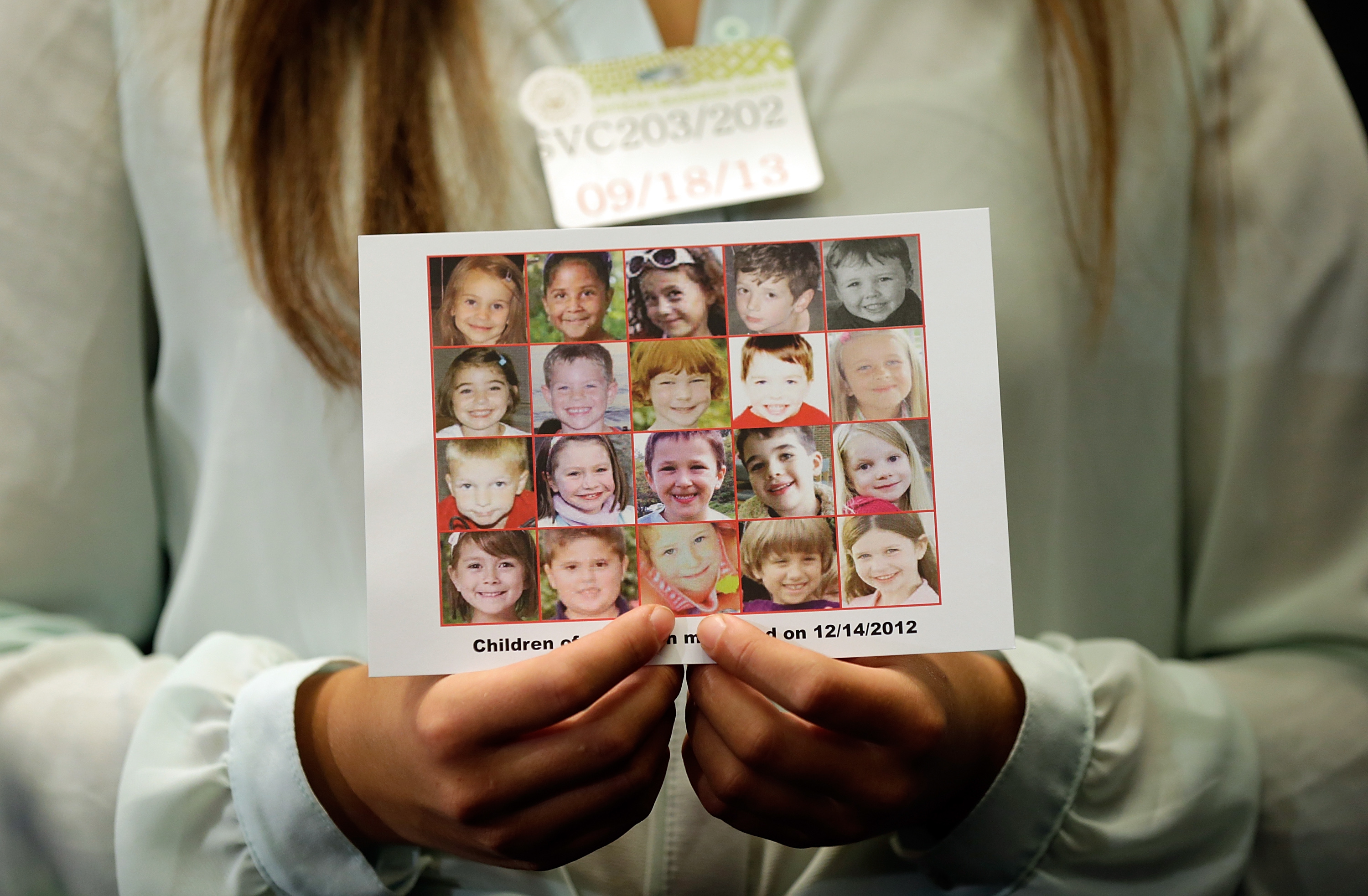
(Photo: During a press conference at the U.S. Capitol calling for gun reform legislation, Kyra Murray holds a photo of victims of the shooting at Sandy Hook Elementary School. With the shooting at the Washington Navy Yard earlier this week, gun reform activists are renewing their call for gun control laws. By Win McNamee/Getty Images)

What Wright Got Wrong

James Seaton unravels what Richard Wright was up to in Native Son:

[He] did not want his readers, certainly not his white readers, to sympathize or identify with Bigger Thomas. He did not want bankers’ daughters or anybody else to “weep over” his protagonist. He was determined to shock, frighten, and disturb. He wanted his readers to fear the possibility that they might someday run into a Bigger Thomas, whose “every thought” is “potential murder.” Wright wanted to scare his audience into considering what they otherwise would not accept, that they could never consider themselves truly safe until the United States underwent a radical transformation, specifically a revolution led by the Communist party.

In retrospect, it seems clear that the Richard Wright who wrote Native Son was wrong about many things.

In “How ‘Bigger’ Was Born,” he condemned almost all aspects of black culture and achievement as irrelevant to the reality of undeclared war. He rejected the black church as escapist,  disparaged those who, like the NAACP, “employed a thousand ruses and stratagems of struggle to win their rights,” and dismissed black singers and musicians who “projected their hurts and longings into more naïve and mundane forms—blues, jazz, swing—and, without intellectual guidance, tried to build up a compensatory nourishment for themselves.”

Those first readers of Native Son who accepted the novel as an accurate portrayal of the black experience would have been unprepared for the legal triumph of the NAACP in Brown v. Board of Education (1954) and other such cases, and entirely surprised by the leadership role of the black church in the struggle for civil rights, demonstrated most strikingly, but by no means exclusively, in the career of Martin Luther King Jr. And from the perspective of the 21st century, the folly of Wright’s denigration of the art of composers like Duke Ellington and Billy Strayhorn, musicians like Coleman Hawkins and Louis Armstrong, and singers like Bessie Smith and Billie Holiday as “naïve and mundane” is even more obvious than it was in 1940.

Making Your Characters Contain Multitudes

The novelist Paul Harding praises John Cheever’s short story, “The Jewels of the Cabots,” for teaching him how to write characters with convoluted and contradictory inner lives:

Cheever is a writer who helped teach me to think about characters like a sphere: You’ve got the north pole and the south pole, a polarity with opposite charges contained inside one whole. But then there’s these magnetic fields created between the two of them, which is where the real complexity is, where the real intermingling of those contradictory impulses take shape.

So I strive for these polarities in my own work. You have to be careful that you’re not dogmatic or schematic about it. But the more I think about it, I’m aware that—in all art forms—contradiction is the essential move or method for art.

In music it’s counterpoint. In landscape painting it’s the contrast between the foreground, which is always dark, and the background, which is light. And in writing, it’s death and life. The imminent arrival of death—what greater thing to set life in relief against? In Enon, the whole thing is just a sonata—it’s just one voice—against the threat of utter darkness. The darker it gets, when we arrives at just one remaining pinpoint of light, that pinpoint becomes all the more beautiful and resplendent for its rarity and clarity against the gloom. You put contradictory things next to each other, and in the intermingling of them you get something like the mystery of human experience.

When America Almost Nuked Itself

Michael Mechanic calls Eric Schlosser’s new book on nuclear weapons accidents “the most unsettling work of nonfiction I’ve ever read”:

Here’s the truth: Just days after JFK was sworn in as president, one of the most terrifying weapons in our arsenal was a hair’s breadth from detonating on American soil. It would have pulverized a portion of North Carolina and, given strong northerly winds, could have blanketed East Coast cities (including New York, Baltimore, and Washington, DC) in lethal fallout. The only thing standing between us and an explosion so catastrophic that it would have radically altered the course of history was a simple electronic toggle switch in the cockpit, a part that probably cost a couple of bucks to manufacture and easily could have been undermined by a short circuit—hardly a far-fetched scenario in an electronics-laden airplane that’s breaking apart.

In an interview with Mother Jones, Schlosser describes the extent of the problem:

Throughout the ’50s and ’60s, it was almost boilerplate for Defense Department officials to say that during an accident there was no possibility of a nuclear detonation, while privately, at the weapons laboratories, there were physicists and engineers who were extremely worried and were well aware that we had come close to having it happen on American soil. If you look at the official list of broken arrows that the Pentagon released in the ’80s, it includes 32 serious accidents involving nuclear weapons that might have threatened the public safety. The list is entirely arbitrary: Some of those accidents didn’t even involve weapons that had a nuclear core, so they never could have detonated. But many, many serious accidents aren’t on that list.

One document I got through a Freedom of Information Act request listed more than 1,000 weapons involved in accidents, some of them trivial and some of them not trivial. There’s somebody who worked at the Pentagon who has read this book, and one of his criticisms was that I’m so hard on the Air Force—he said that there were a great number of accidents involving Army weapons that I don’t write about.

In an interview with Rolling Stone, he discusses nuclear safety around the globe:

I am hugely concerned – and people who have more expertise than I do in this area are hugely concerned – about the possibility of terrorists getting ahold of a nuclear weapon, or the possibility of a nuclear weapons accident by one of the nuclear weapons powers. I’m critical of the management of our nuclear weapons, but we invented this technology. I think we probably build the safest weapons on Earth. And yet, when you think of countries like Pakistan and India and North Korea having nuclear weapons, a useful guide would be to look at the rate of industrial accidents in those countries, which is much higher than here, and their ability to manage this incredible, complex technology is really worrisome. People can disagree on what the best policy should be for the United States, but I think everyone should know what the options are and what the real risk is.