The perils of shaving a beard – serves him right:
Intimacy Issues
Pointing out that critics have called the new Alice McDermott novel “beautifully intimate,” “small, rich, [and] intimate,” and “intimate, elegant, and beautifully crafted,” Alexander Nazaryan begs reviewers to step away from the I-word:
Jhumpa Lahiri’s new novel, The Lowland, is written with attention to “intimate detail,” according to The Guardian. In The New York Review of Books, Joyce Carol Oates says that Karen Joy Fowler’s We Are All Completely Beside Ourselves “provides an intimate, child’s-eye look at a midwestern academic household of the 1980s” – presumably, a vantage point desired by readers. The New York Times Book Review says that Stephen King’s Joyland is narrated with an “intimate quality.” Kevin Powers’s The Yellow Birds, about the war in Iraq, is to be praised for its “intimacy,” according to The Seattle Times. …
“Intimate,” as I understand its usage in contemporary criticism, means “small.” … [McDermott’s] Someone could be a fantastic work of fiction, but the frequent reference to “intimacy” does not do the novel any favors, implying, not only a smallness of setting or overall scope, but a far more fatal smallness of ideas. This, in the end, is the problem with “intimate” fiction – the emphasis, that is, on the novel as a warm blanket to cuddle with instead of a fire that burns clean through you. Intimate reading is reading for comfort, instead of all that good stuff – beauty, truth, wisdom — that we no longer acknowledge seeking without ironic air quotes. Intimacy is too nice for any of that.
Face Of The Day

From a series by photographer Ziv Ish:
[Ish] eventually moved to south Tel Aviv, Israel, where he began creating portraits of people living on the fringes of Israeli society, including prostitutes, drug addicts, and transsexuals. “There are areas in [Tel Aviv] that drug addicts or many other extreme communities are very easy to find. I used to visit there almost every day and got to know every corner of the streets,” Ish said. “Very rough areas with an environment that is very hard to deal with, especially if you are really getting into the veins of the place and getting to know the people.” Ish added that he has always connected with marginalized communities and that “ … I felt that maybe just a little bit of luck separates us.”
(Photo: Last Portrait of Sophy, 2012, by Ziv Ish)
Government Without Politics?
Thomas Flores considers the appeal of technocrats, tracking their rise over the past half-century:
Politicians are an easy object for derision, even among themselves. Calling a decision “political” is a sure-fire way to impugn it. Technocrats promise a different style of governance, one in which expertise and objectivity matter more than venal political calculation. In a way, the desire for technocratic rule hearkens back to Plato’s conception of the philosopher king who rules with wisdom and knowledge.
Technocratic rule holds yet another promise, that of a value-free politics.
The vexing political issues of our day that enjoin us to deeply consider our political values — climate change, racial relations, and privacy in the global war on terrorism – are in part the cause of political conflict. So the prospect that these troubling questions ultimately have technical solutions remains tempting, since it allows us to evade the political act of reconciling our values to ourselves and to each other. TED talks are perhaps the most prominent public forum for such thinking, promising that technological change and creative thinking hold the key to human progress, rather than struggles over value questions such as justice and equity, as cultural critics such as Evgeny Morozov have argued.
Yet we cannot escape the political, no matter how hard we may try. All forms of politics, even anti-politics, are embedded in political values. A desire for technocratic politics constructs an ethos of rule favoring certain values – expertise as a form of political legitimacy and economic efficiency as the goal of economic policy – over others. Technocrats may offer us improved economic management, but not an escape from the importance of values in politics. Political questions are, in the end, political.
How Safe Is Home Birth? Ctd
Laura Helmuth advocates going to the hospital instead:
A meta-analysis of outcomes from home births and hospital births shows that women who give birth at home do have fewer procedures and complications—but their newborns are three times more likely to die. The American College of Obstetricians and Gynecologists advises that hospitals and birthing centers are the safest places to give birth, and they have published guidelines for how to talk pregnant women out of a home birth. Many states are considering or tightening restrictions on midwives and home births, including Idaho, North Carolina, South Carolina, and Indiana, often in response to heartbreaking and infuriating cases of women or infants dying due to incompetent treatment.
But it turns out home birth isn’t as clearly dangerous as I expected.
The Cochrane Collaboration, a highly respected organization that carefully judges medical treatments, analyzed the available evidence—which is admittedly a bit of a mess. (Among other problems, if a home birth delivery goes wrong, the woman has to be rushed to the hospital, where the complicated case may be recorded as a hospital birth rather than a home birth.) But the Cochrane Collaboration concluded that planned home births with low-risk mothers are as safe as hospital births. Once more for emphasis, though: This is only for women who have an extremely low chance of complications and who have access to emergency medical treatment if anything goes wrong.
Details of my own home-birth here. Above is the trailer for the 2008 documentary The Business of Being Born, which champions home-birthing. You can watch the entire film on YouTube. A trailer for the sequel is here.
A Novel Take On The Internet
In his review of Bleeding Edge, Jason Tanz dubs Thomas Pynchon a “prophet of the post-Snowden era”:
The book’s real accomplishment is to claim the last decade as Pynchon territory, a continuation of the same tensions—between freedom and captivity, momentum and entropy, meaning and chaos—through which he has framed the last half-century. It’s hard not to see Anonymous in one character’s desire for “good hackers around interested in fighting back” against the Web companies “screaming louder and louder about ‘Internet freedom,’ while they go on handing more and more of it over to the bad guys.” Hard not to see everything from SecondLife to BitCoin in “DeepArcher,” a virtual world in which avatars conduct encrypted transactions far from government’s reach. Hard not to see AT&T and Verizon in one character’s prediction that the Internet, once connected to cell phones, would become “a total Web of surveillance, inescapable.”
For all his famed paranoia, Pynchon never fully casts his lot with the conspiracy theorists, although it’s clear they have his sympathies — even the 9/11 truther that pops up in these pages. I guess this could be considered a spoiler, but no regular Pynchon reader will be surprised that Maxine’s mystery never gets fully defined, much less resolved. As usual, Pynchon doesn’t provide answers but teases us with the hint of closure, leaving us ultimately unsure whether the signals add up to a master plot or merely a series of sinister and unfortunate events. The overall effect is one of amused frustration, of dying to find that one extra piece of information that will help make sense of this overwhelming and vaguely threatening world. It feels a lot like life.
The View From Your Window Contest
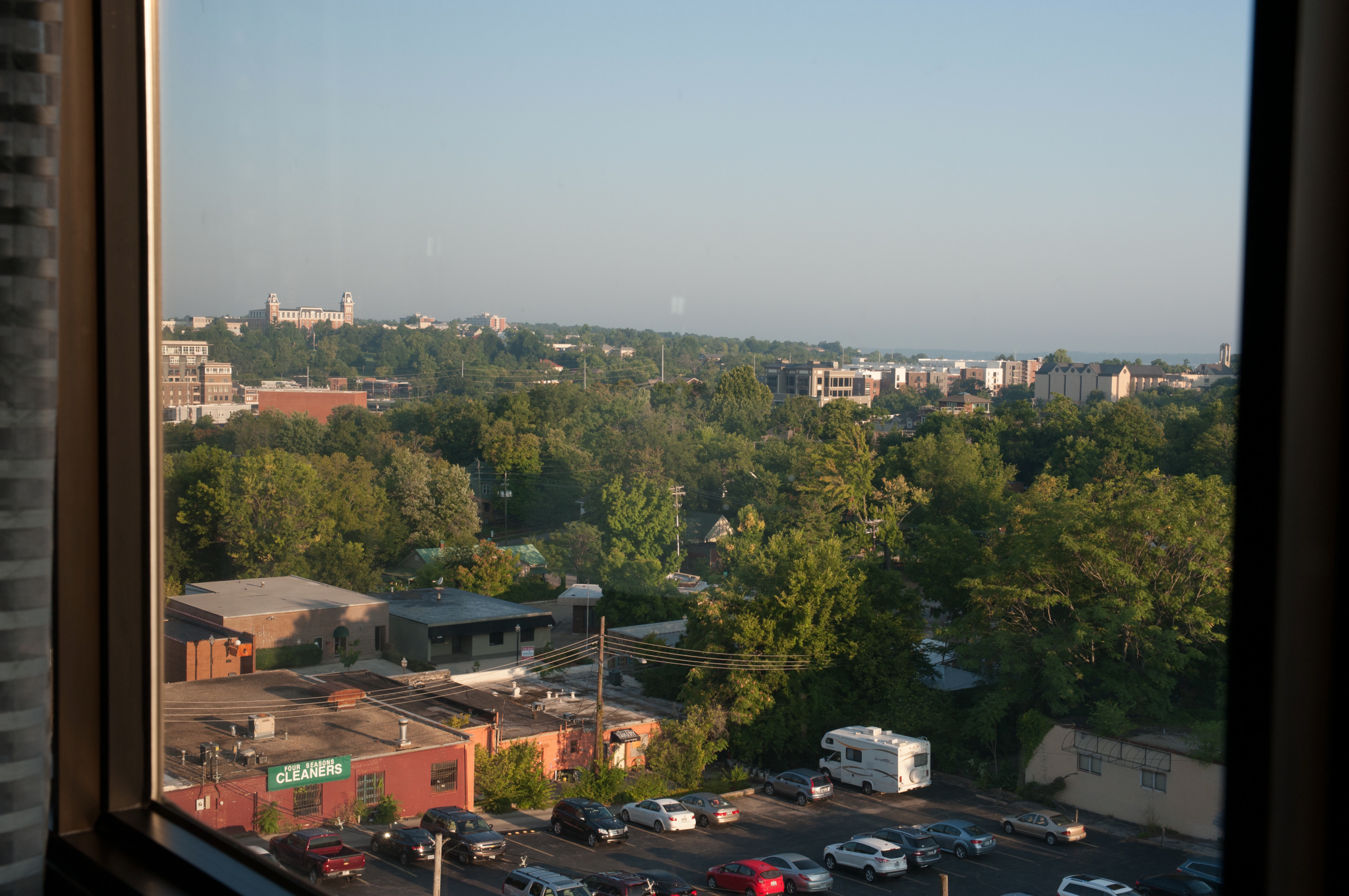
You have until noon on Tuesday to guess it. City and/or state first, then country. Please put the location in the subject heading, along with any description within the email. If no one guesses the exact location, proximity counts. Be sure to email entries to contest@andrewsullivan.com. Winner gets a free The View From Your Window book or two free gift subscriptions to the Dish. Have at it.
The Unsound Ear
The Train in the Night is Nick Coleman’s account of hearing loss and music appreciation. From Ben Hamilton’s review of the book:
[E]ventually [Coleman] was diagnosed with sudden neurosensory hearing loss, which, if you’ll excuse the phrase, is even worse than it sounds. Unable even to walk without vomiting, his life became a test of endurance. … Taunted by the “monument” of his record collection, Coleman missed music even as he craved silence. But superstar neurologist Oliver Sacks told him that the “depth” and “spaciousness” which he’d lost could be regained through imagination and memory. “One might expect,” said Sacks, “that such a power, whilst not available (or less available) voluntarily, could occur spontaneously by association with emotion, a memory.”
Hamilton considers what the book suggests about the nature of fandom:
There is inevitably something life-denying about a fan’s addiction to any art form, and Coleman only partially hides from this dilemma.
For him music is a shield, a by-product of hypersensitivity, a symptom of loneliness, and the only way to make sense of life. “I think music was the laboratory in which I learned to contain and then examine emotion,” he writes. This line of thought is followed to its bleakest conclusion: that his obsession was an escape from, rather than a refinement of, reality. But he stops before things can become utterly hopeless. Instead, burdened with what could have been a ruinous impediment, he reaffirms his love of music. It’s just that the damage to his hearing has made it accessible through “pain and exultation” rather than joy and pleasure – pain because of the buzzing mesh through which the melodies must travel; exultation because he can hear anything at all. This may seem like a bitter consolation, but it’s enough to build on. The worst has happened and yet something remains. He hasn’t changed. His body has.
A Poem For Saturday
Dish poetry editor, Alice Quinn, reflects on the recent death of Seamus Heaney, the famed Irish poet we paid tribute with these three poems:
A friend of mine who lives in Ireland sent me a copy of The Irish Times from Saturday, August 31, 2013, the day after Heaney died. This newspaper, physically huge by American standards – it’s 22 inches deep by 14 inches wide – devoted five full pages to his obituary and commentary, with beautiful photographs of him as a schoolboy in 1954, at an anti-apartheid demonstration in 1985, with his family at the Nobel Prize ceremony in 1995, and at his desk at home in Sandymount in 2009. Also included were the covers of 12 of his books published by Faber & Faber. (Here in the U.S. his work is published with great pride by Farrar, Straus & Giroux.)
“What does it take to make a great poet?,” wrote Eileen Battershy, the Times’ literary correspondent. “Heaney made it look easy, because his poetic response was so instinctive, that surefooted balance of formal eloquence and the colloquial… Many artists regard themselves as members of the elect, but Heaney was different. He looked to language as sound and meaning. His was a musician’s engagement; there was an ancient, strongly tribal purity at work.”
The Dish ran poems by him just after the tragic news of his death reached our shores. We join the tide of those who can’t stop reading his poems and reflecting on his beautiful spirit and inspiring way of being.
We will post another round of poems by Heaney over the next few days. “Mid-Term Break,” presented below, is the poem that The Irish Times chose to run the day after his death. It’s an elegy to Heaney’s little brother Christopher, who was killed in a road accident at the age of four while Heaney was on scholarship at St. Columb’s College:
I sat all morning in the college sick bay
Counting bells knelling classes to a close.
At two o’clock our neighbours drove me home.In the porch I met my father crying—
He had always taken funerals in his stride—
And Big Jim Evans saying it was a hard blow.The baby cooed and laughed and rocked the pram
When I came in, and I was embarrassed
By old men standing up to shake my handAnd tell me they were ‘sorry for my trouble’.
Whispers informed strangers I was the eldest,
Away at school, as my mother held my handIn hers and coughed out angry tearless sighs.
At ten o’clock the ambulance arrived
With the corpse, stanched and bandaged by the nurses.Next morning I went up into the room. Snowdrops
And candles soothed the bedside; I saw him
For the first time in six weeks. Paler now,Wearing a poppy bruise on his left temple,
He lay in the four-foot box as in his cot.
No gaudy scars, the bumper knocked him clear.A four-foot box, a foot for every year.
(From Opened Ground: Selected Poems 1966-1996 © 1998 by Seamus Heaney. Used by kind permission of Farrar, Straus & Giroux.)
Does Metal Make You Mellow?
“In my experience, metal isn’t for angry people,” says Leah Sottile:
And that got me thinking: Is it possible that listening to angry music could make people happier? Do hours and years of loud riffs and screeching vocals pummeling your ear drums actually mellow you out?
It’s a theory backed up in a recent study conducted by Maya Tamir and Brett Ford, researchers from The Hebrew University of Jerusalem. In one study, 175 people were asked to participate in role-playing exercises where they had to either confront a person—like a cop interrogating a suspect—or collaborate with someone. But before the role-playing began, the subjects were allowed to choose from a selection of music to aid in evoking the emotions they would need: Anger, happiness, or neutrality. It was up to them to choose what they wanted to hear. “Music is often used as a way to manipulate emotions, I just had people decide how to manipulate their own emotions,” Tamir says. The subjects were also asked questions about their emotional health, happiness, and feelings of social support.
It’s no novel idea that someone might choose to rev themselves up with aggressive music before a engaging in a tough task: A fourth quarter tie-breaker, a tense salary negotiation. And no surprise, the folks who chose angry music had no problem completing their tasks.
(Video: Judas Priest performs in 1982)

