The Sages Of Cyberspace

Henry Farrell considers what it means to be a public intellectual in the Internet age:

Many of these new public intellectuals are more or less self-made. Others are scholars (often with uncomfortable relationships with the academy, such as Clay Shirky, an unorthodox professor who is skeptical that the traditional university model can survive). Others still are entrepreneurs, like technology and media writer and podcaster Jeff Jarvis, working the angles between public argument and emerging business models. These various new-model public intellectuals jostle together in a very different world from the old. They aren’t trying to get review-essays published in Dissent or Commentary. Instead, they want to give TED talks that go viral. They argue with one another on a circuit of business conferences, academic meetings, ideas festivals, and public entertainment. They write books, some excellent, others incoherent.

In some ways, the technology intellectuals are more genuinely public than their predecessors.

The little magazines were just that, little. They were written for an elite and well-educated readership that could be measured in the tens of thousands. By contrast, TED talks are viewed 7.5 million times every month by a global audience of people who are mostly well-educated but are not self-conscious members of a cultural elite in the way that the modal reader of Partisan Review might have been.

In other ways, they are less public. They are more ideologically constrained than either their predecessors or the general population. There are few radical left-wingers, and fewer conservatives. Very many of them sit somewhere on the spectrum between hard libertarianism and moderate liberalism. These new intellectuals disagree on issues such as privacy and security, but agree on more, including basic values of toleration and willingness to let people live their lives as they will. At their best, they offer an open and friendly pragmatism; at their worst, a vision of the future that glosses over real politics, and dissolves the spikiness, argumentativeness, and contrariness of actual human beings into a flavorless celebration of superficial diversity.

Previous Dish on the subject here and here.

Shakespeare The Auteur

Shakespeare In Company author Bart van Es argues that the Bard owes a good deal of his success to the Lord Chamberlain’s Men, which allowed him unprecedented dramatic and financial freedom:

[O]ne of the things that really separates Shakespeare from his contemporaries is that his plays are all owned by the company. That was a big change from how it was for him at the start of his career. The first of his plays to be published, Titus Andronicus, didn’t even mention his name on it, just the three acting companies who had performed it. But after he joined the Chamberlain’s Men, he was an asset holder. He would get paid for plays which were performed 10 years after he’d written them. No one else was doing that.

Before that, plays were often put together by a team of writers, and then rewritten and rewritten, a bit like the Hollywood model of having screenwriters and script doctors all chipping in. But Shakespeare became an auteur, in film terms. He was a sort of Woody Allen figure. He wrote the plays, he had control over them, the same actors came back again and again. And he was clearly much more famous than any other playwright of his time.

The Reason He Wore Black

Writing on the 10th anniversary of Johnny Cash’s death, Michael Stewart Foley praises the singer’s “politics of experience and empathy, a politics that transcended political labels and polarization”:

Cash did not shy away from going on record (vinyl or otherwise) with his feelings about the Vietnam War. Like many veterans (and other country-music stars such as Merle Haggard), he continued to respect the authority of the president and, as such, pledged to support Richard Nixon’s efforts to end the war. But he also routinely pleaded for tolerance, most obviously in a song from the Man in Black LP: “Can you blame the voice of youth for asking, ‘What is truth?’”

For Cash, there was nothing inconsistent in these positions because he did not approach the war as a hawk or a dove, but from the perspective of a younger brother to a boy who had died young (Cash’s older brother, Jack, died in a table-saw accident when Cash was 12). The death in Vietnam of Jimmy Howard, son of country singer Jan Howard, hit Cash especially hard and probably prompted him to write the 1970 song, “Route 1, Box 144”—the story of a “good boy” killed in Vietnam, leaving a wife and baby. The focus of the song is not on the wider politics of the war, but on the kind of familial suffering to which Cash could relate. The following year, when he wrote “Man in Black,” he included the line about wearing black in mourning because “each week we lose a hundred fine young men.”

A Novel Take On Natural Selection

Reminding us that “[t]o affect species-wide change, a trait essentially has to help you live or get laid,” Jennifer Vanderbes considers the evolutionary purpose of great fiction:

Among the many things that set humans apart from other animals is our capacity for counterfactual thinking. At its most basic level, this means we can hypothesize what might happen if we run out of milk; in its most elaborate form—we get War and Peace. Stories, then, are complex counterfactual explorations of possible outcomes: What would happen if I killed my landlady? What would happen if I had an affair with Count Vronsky? How do I avoid a water buffalo? According to Denis Dutton, these “low-cost, low-risk” surrogate experiences build up our knowledge stores and help us adapt to new situations. (“Mirror neuron” research indicates that our brains process lived and read experiences almost identically.)  A good “cautionary tale,” for example, might help us avert disaster. Stories can also provide useful historical, scientific, cultural and geographical information. Bruce Chatwin’s Songlines illustrates this on two tiers: In armchair-travel fashion, the book acquaints readers with the Australian Outback, while simultaneously describing how Aboriginals sang stories walking at a specific pace so that geographical markers within the story would guide their journey.

In addition to travelogues, stories also offer nuanced thought maps. An imaginative foray into another person’s mind can foster both empathy and self-awareness. This heightened emotional intelligence might, in turn, prove useful when forming friendships, sniffing out duplicity, or partaking in the elaborate psychological dance of courtship…

Face Of The Day

Aging before your eyes:

This embed is invalid


Christopher Jobson explains how the incredible video was made:

Last Thanksgiving, [filmmaker Anthony Cerniello] traveled to his friend Danielle’s family reunion and with still photographer Keith Sirchio shot portraits of her youngest cousins through to her oldest relatives with a Hasselblad medium format camera. Then began the process of scanning each photo with a drum scanner at the U.N. in New York, at which point he carefully edited the photos to select the family members that had the most similar bone structure. Next he brought on animators Nathan Meier and Edmund Earle who worked in After Effects and 3D Studio Max to morph and animate the still photos to make them lifelike as possible. Finally, Nuke (a kind of 3D visual effects software) artist George Cuddy was brought on to smooth out some small details like the eyes and hair.

Who’s Happier, Extroverts Or Introverts?

Apparently the former:

Perhaps one of the most important (and consistent) findings in E/I research is that extroverts are overall happier than introverts, and this increased happiness lasts for decades. Scientists have struggled to pinpoint the cause of extroverts’ happiness, though they are certainly not without ideas.

Researchers have proposed that extroverts may feel greater happiness than introverts because they are more sensitive to rewarding social situations. On the other hand, others have suggested that extroverts are happier because they engage in more social activities. Some scientists think that extroverts’ perpetual happiness stems from their greater mood regulation abilities. Or maybe they’re happy because they hold on tightly to all of those good memories.

At the same time, however, scientists have questioned whether extroverts really are happier, or if they’re just more declarative with their feelings. There’s also the issue of how, exactly, you define and measure “happiness.” Whatever the case, extroverts and introverts likely benefit from different happiness increasing strategies, given the inherent differences in the personality types.

Previous Dish on introverts and extroverts here. Rauch-related introversion here and here.

Growing Old, Growing Human

Our species didn’t come into its own until we started living past the age of 30:

Anthropologist Rachel Caspari of Central Michigan University used teeth to identify the ratio of old to young people in Australopithecenes from 3 million to 1.5 million years ago, early Homo Venus_of_Brassempouy (1)species from 2 million to 500,000 years ago, and Neanderthals from 130,000 years ago. Old people – old here means older than 30 (sorry) – were a vanishingly small part of the population. When she looked at modern humans from the Upper Paleolithic, about 30,000 years ago, though, she found the ratio reversed – there were twice as many adults who died after age 30 as those who died young.

The Upper Paleolithic is also when modern humans really started flourishing. That’s one of the times the population boomed and humans created complex art, used symbols, and colonized even inhospitable environments. … [O]nce humans found a way to keep old people around, everything changed. Old people are repositories of information, Caspari says. They know about the natural world, how to handle rare disasters, how to perform complicated skills, who is related to whom, where the food and caves and enemies are. They maintain and build intricate social networks. A lot of skills that allowed humans to take over the world take a lot of time and training to master, and they wouldn’t have been perfected or passed along without old people.

(Photo: The Lady of Brassempouy, dating from the Upper Paleolithic ca. 23,000 B.C.)

What Works Against Terrorism?

We haven’t a clue:

The Afghanistan war has cost $657.5 billion so far, we spend $17.2 billion in classified funds a year fighting terrorism through the intelligence community, and the Department of Homeland Security spent another $47.4 billion last year. And we have very little idea whether any of it is preventing terrorist attacks. …

It’s scandalous that we spend billions every year on counterterrorism but barely spend any effort on evaluating whether what we’re doing works. The federal government is showing slightly more interest than it once did. “We’re lucky because there’s a criminologist in DHS who helps the partnership along a bit,” [criminologist Cynthia] Lum tells me. But the scale of the efforts pales in comparison the efforts to build evidence on health, education, social welfare, or crime policy. That has to change.

And I think that’s underlying public discontent with respect to Syria. The cost-benefit analysis of the last decade makes – and should make – anyone shudder at the thought of anything like those policies being continued. Obama, for the most part, has avoided them. But the huge budgets for the NSA and DHS and the post-9/11 Pentagon have no serious accounting for them in terms of benefits to the American people. I suspect Washington’s political class need to address this question – and answer it thoroughly – before they will ever get backing for war again.

Clarity Through Dark Comedy

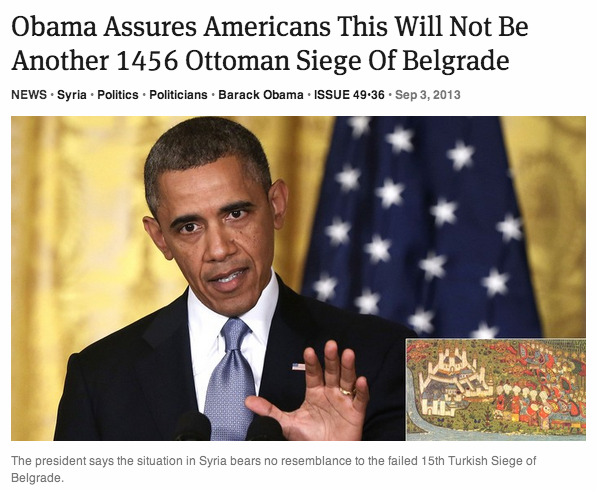
Screen Shot 2013-09-11 at 4.26.50 PM

Kabul-based journalist Tom A. Peter contends that The Onion has published some of the best commentary on Syria in recent weeks:

It can be exasperating playing it straight when you write news about a situation that regularly produces absurd scenarios. The Onion’s format allows its writers to plainly make sense of ridiculous situations that can be difficult to explain or fully appreciate in a normal news article.

During many of the trips I made into Syria, I met conservative people who supported the insurgents who used to fight Americans in Iraq, yet these same people were now calling for the same U.S. soldiers they wanted to kill six or seven years ago in Iraq to come to their aid with an intervention in Syria. Meanwhile, as of at least March, the CIA has been compiling a list of targets for potential future drone strikes inside opposition-controlled Syria, according to the Los Angeles Times. The Onion managed to explain this dark, complicated reality in just one fake headline: “Target Of Future Drone Attack Urges American Intervention In Syria.”

Head writer Seth Reiss discusses the site’s approach:

I think one thing we have tried to do with our content is humanize the Syrian people. For example, this piece isn’t calling for U.S. intervention so much as it’s saying that these are people with mothers and fathers and sons and daughters who, obviously, value their lives and relationships. It would be too easy and doing a disservice to the issue to stake out some sort of hardline resolute position i.e. “We should not intervene!” or “We should intervene!” It’s murkier than that. And in that murkiness there is comedy. Dark comedy, but comedy nonetheless.

(Screenshot from this Onion story. Recent Dish on the satire site here.)

Assad’s Terms

In an interview about the destruction of Syria’s chemical weapons, Assad declared that, “When we see the United States really wants stability in our region and stops threatening, striving to attack, and also ceases arms deliveries to terrorists, then we will believe that the necessary processes can be finalized.” Ezra focuses on Assad’s demand that America stop arming the rebels:

Assad is demanding the U.S. choose between its goals of enforcing the ban against chemical weapons and getting Assad out of power.

Right now, Assad’s got the upper hand in Syria’s civil war. The U.S. could change that in two ways. One is directly bombing Assad’s military assets. The other is aggressively training and arming the opposition — something we’re really only just beginning to do.

The discussion around the Syria disarmament deal has mostly focused on defusing the U.S.’s threat to bomb Assad. But what Assad is saying here is that’s not good enough: The U.S. also needs to stop arming his enemies. That means the real cost of destroying Assad’s chemical weapons is watching him crush the opposition and retain power.