
Red Bank, New Jersey, 5.25 pm
Red Bank, New Jersey, 5.25 pm
Beth Kephart praises memoirs that move beyond self-absorption:
[W]hat does memoir offer? What can it yield? Why am I, after all these years, still reading it, teaching it, shaping it, seeking it? The answers are many, but here I offer just one: Because memoir at its very best is the start of a conversation. It makes its interest in readers explicit, offering not just a series of life events, but a deliberate suggestion of what it is to be a human being – to experience confusion, despair, hope, joy, and all that happens in between. True memoir is a singular life transformed into a signifying life. True memoir is a writer acknowledging that he or she is not the only one in the room.
One memoir she claims gets it right:
Consider, for example, Jean-Dominique Bauby’s international bestseller The Diving Bell and the Butterfly, which later became a major motion picture. It’s a slender book – a mere 132 pages. It’s a terrifying book, written by a man who, in December 1995, suffers a massive stroke that leaves him permanently paralyzed. Bauby is “locked in,” unable to move or speak. It’s his left eye that saves him – his left eye, which he relies on to blink at the slate of letters an assistant shares. Blink by blink, letter by letter, Bauby communicates his story. He was a famous magazine editor, we learn. He is trapped, we learn. But he is still alive – and still, miraculously, hopeful. And even though each word comes slowly, even though he has no words to spare, Bauby makes the explicit effort to tell us about ourselves. He looks up from where he is and acknowledges our presence.
Ann Friedman worries that freelance reporters are entering war zones without proper preparation or support:
I confess that I’ve been watching all the coverage of Amanda Lindhout’s book [profiled above] with a bit of chagrin. Lindhout, who traveled to Somalia as an aspiring journalist in 2008, was kidnapped along with her photographer companion and their guides. She spent 15 months in captivity before her family finally hired a private security firm and raised the ransom money. Later she collaborated with established journalist Sara Corbett – “we rented a really remote house in the Bahamas together and spent seven straight days in conversation” – to write a book about her ordeal. On Twitter she describes herself as an “adventurer,” but in much of the coverage, including a recent Today show appearance, she’s identified as a journalist.
“Why her and not me?” asks veteran journalist Robert Draper, who met Lindhout in a Mogadishu hotel before she was kidnapped, in an essay in ELLE. The answer seems pretty clear. She had traveled widely as a tourist but had zero institutional support and very little experience as a reporter.
As young journalists survey the professional landscape—the layoffs, the closure of foreign bureaus—just packing up and buying a plane ticket starts to seem like a viable option. As one guy wrote to me recently, “I am interested in getting to the Middle East as some sort of war correspondant [sic] or novice freelance frontline reporter. I believe I could find the connections with publishers to make the journey successful. What are some steps I could take to set up a trip and get a sponsorship loan on equipment in order to begin preparing for a deployment?” Every single hard-bitten war correspondent has had to start somewhere. It’s just that more and more of them are trying to get that start without the support or backing of an established news organization and without the mentorship of an experienced international reporter.
Ronald Bailey digs up data on the question:
[W]ill raining missiles down on Damascus stop Assad from gassing his people in the future? Quantitative research by Michael Horowitz of the Center for Strategic and International Studies and Dan Reiter of Emory University suggests that threatening such aerial attacks works about a third of the time. In their 2001 article “When Does Aerial Bombing Work?” in the Journal of Conflict Resolution, the two define coercion as “a threat to inflict pain on a target if the target does not accede to a demand.” The two identify and analyze all attempts to use air power to coerce countries between 1917 and 1999. “Of our 53 cases of air power coercion, 19 (36 percent) were successes and 34 (64 percent) were failures,” they report.
Horowitz and Reiter define air power coercion a “success” when a target changes its behavior as demanded without being attacked. (“Successful threats are those that do not have to be carried out,” as the economist Thomas Schelling wrote in his 1966 book Arms and Influence.) Clearly, the threat of U.S. air power has failed to dissuade Assad from poison gassing his people. The researchers also count air-power coercion as successful if a target yields shortly after being attacked. With regard to Syria, that kind of “success” is still up in the air, so to speak.
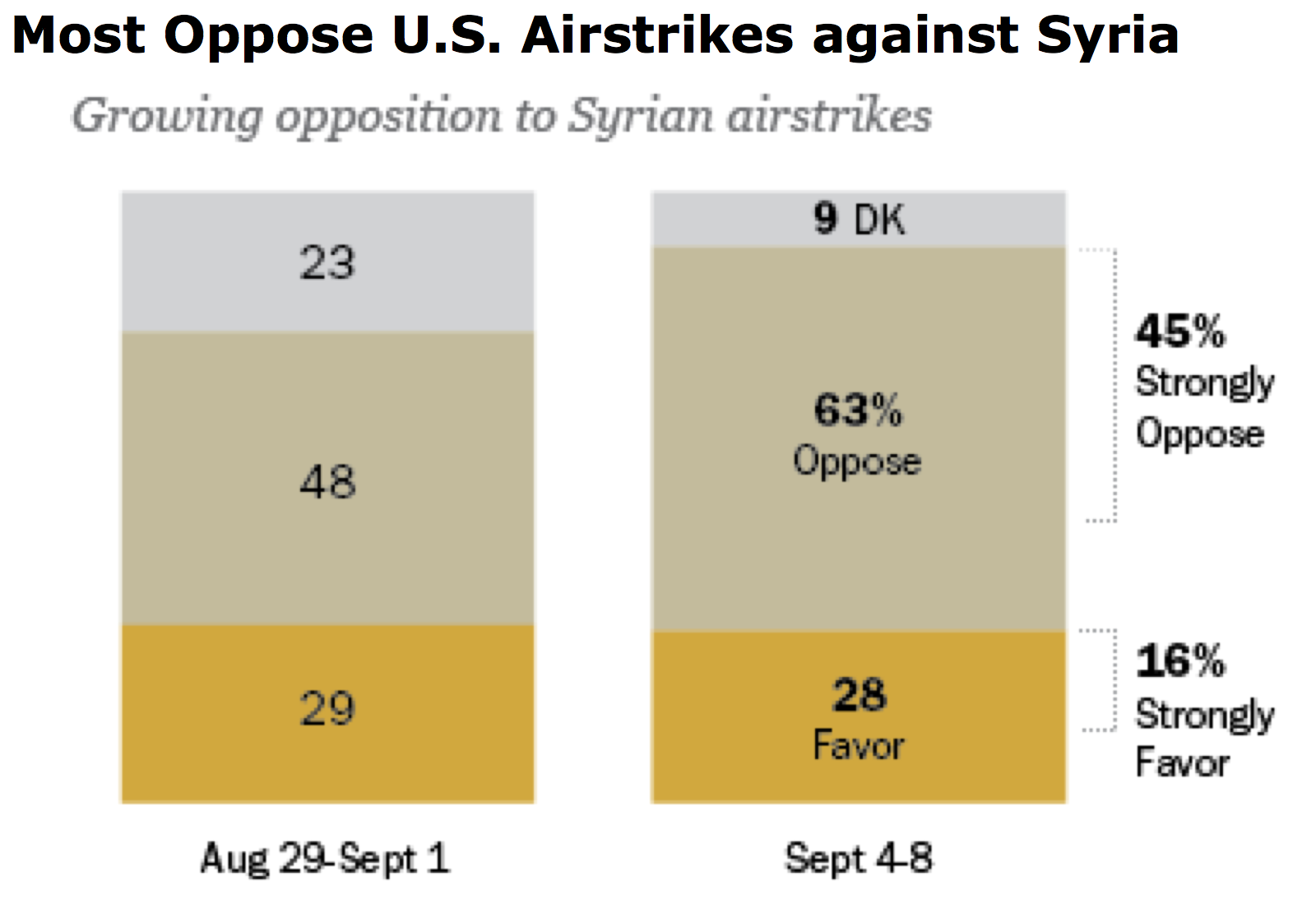
The latest from Pew:
Over just the past week, the share of Americans who oppose U.S. airstrikes in Syria has surged 15 points, from 48% to 63%, as many who were undecided about the issue have turned against military action. By contrast, the share of Americans who support airstrikes remains virtually unchanged: Just 28% favor U.S. military airstrikes against Syria in response to reports that its government used chemical weapons.
Nate Cohn notes “the total collapse in Republican support”:
Back in April, when Pew asked voters whether they would support strikes if Syria used chemical weapons, Republicans were pretty supportive; 56 percent were on board, compared to just 24 percent opposed. By last week’s Pew Research survey–now simply asking voters whether they would support strikes now that Syria had used chemical weapons–Republicans were basically divided. But today, Republicans are overwhelmingly opposed by a 49 point margin, with just 21 percent in support and 70 percent opposed. There hasn’t been similar movement among Democrats.
Ed Morrissey parses a CNN/ORC International poll:
The only good news for Obama in this poll is that a majority of respondents say that their votes in the midterms won’t be impacted by the vote on the authorization (57%). However, among those who will take that into account fourteen months from now, sentiment runs nearly 3:1 against at 11/31. It’s 4:1 among independents at 9/36, and 5:1 in the West (7/38), where Democrats hoped to make gains against Republicans with social-libertarian policies.
Chilling words from Bashar al-Assad to Charlie Rose and the American people:
How Denver Nicks describes the exchange:
In response to questions about how the regime would respond if attacked by the United States, Assad said Washington should “expect everything,” including terrorist attacks. “The governments are not the only player in this region. You have different parties, you have different factions, you have different ideologies, you have everything in this region now,” he said. When Rose asked him if he meant that a response could include the use of chemical weapons, he said, “That depends. If the rebels or the terrorists in this region, or any other group in this region have it, it could happen, I don’t know, I’m not a fortune teller.” Hinting at unforeseen consequences that could come from an attack in a region he described as “on the brink of explosion,” Assad said, “Nobody expected the 11th of September.”
How Marc Tracy interprets the dictator’s words:
If this seems familiar, it is because you have seen it in a dozen movies and television shows about the mob. Assad comes across as a thug. Nice legs you’ve got there—shame if you broke them. I’m not saying American bases will be struck if you attack Syria, but I sure wouldn’t do it if I were you. Lotta crazy people in this region.
Weigel parses more quotes from Assad regarding WMDs, terrorists and Iran.

White House Press Secretary Jay Carney takes questions from reporters during the daily press briefing at the White House on September 9, 2013. Carney fielded numerous questions about President Barack Obama’s push for Congressional approval for limited military strikes against the Syrian government after President Bashar al-Assad allegedly used chemical weapons against his own people. By Chip Somodevilla/Getty Images.
“Christian realism requires the disavowal of war. Christians do not disavow war because it is often so horrible, but because war, in spite of its horror – or perhaps because it is so horrible – can be so morally compelling. That is why the church does not have an alternative to war. The church is the alternative to war. When Christians lose that reality – that is, the reality of the church as an alternative to the world’s reality – we abandon the world to the unreality of war,” – Stanley Hauerwas.
Previous Dish on the Christian pacifism of Hauerwas here, here and here.
One of the Internet’s favorite sports:
Readers respond to that great piece from Ann Friedman on “the pullout generation”:
Your post on pullout method is lacking. For many couples, pulling out simply works. A 2009 study found that when practiced correctly, withdrawal only failed 4% of the time. Condoms, by contrast, had a failure rate of 2%. All things considered (health, risk, and pleasure), this risk differential is acceptable for disciplined, stable couples.
Another agrees:
I think Marcotte misses big on this point: she talks about “decisiveness” versus “ambivalence”, and choosing “in the heat of the moment” (basically, “you should really be more responsible”) but neglects to think that some families simply choose not to make it a decision. Young couples who want children eventually don’t have to be “trying” or “not trying” – they can simply be married, have sex, and maybe conceive a child.
Another reader:
The biggest pregnancy scare I’ve ever had was actually with a condom.
On my birthday several years ago, in the heat of having sex with my girlfriend, I suddenly came when things felt especially good – because the condom had just broken, something I didn’t think to check in that moment of blinding pleasure. She wasn’t on the pill, since it clashed with her medications, so we both started to freak out. We immediately checked an online fertility calendar and discovered she was at peak fertility – so we freaked out some more. First thing in the morning she got Plan B from the pharmacy and no baby ever came of the incident, but it did make me realize how much condoms can give you a false sense of security. Nowadays I pull out even I am wearing a condom, paranoid it might be broken.
In a subsequent relationship, which lasted almost two years, she also wasn’t on hormonal birth control. We stopped using condoms after several months and switched to the pullout method -every single time we had sex, without any slip-ups. Maybe I just have Zen-like self-control, but we never had any pregnancy scares or actual pregnancies (and she had accidentally gotten pregnant twice in her life, both on the pill, so she was plenty fertile … though I guess it’s possible I’m not). At times I still felt irresponsible for only relying on the pullout method, and maybe we just got really lucky, but that long relationship left me convinced that coitus interruptus isn’t the horribly risky method that we were all warned about in sex-ed class.


