The Radical Right Gets Something Right

Drum is repulsed while “watching Republican pols and conservative pundits get on their high horses about Syria”:

There are some Republicans who are perfectly serious about their desire not to get entangled in yet another Middle Eastern conflict. But most of them couldn’t care less. Obama is for it, so they’re against it.

I know. It’s deranged. But they get all their news from Fox. Tyler Cowen makes peace with the Republican obstructionists:

[T]he net effect of having unreasonable, obstructionist Republicans could well be welfare-improving on a massive global scale, all things considered. You might prefer to “have your cake and eat it too,” namely by having “reasonable but wise on Syria” Republicans, but that was never on the menu.

I’m fine with it too.

What If Congress Votes No?

Larison declares that there “is no way to know what long-term effect the defeat of the Syria resolution might have on the actions of future presidents, and it is even less certain how other governments would interpret a Congressional rejection of the resolution”:

It is always possible that other presidents will view this episode as proof that going to Congress is an avoidable risk that they won’t want to take, in which case it will result in the opposite of what many opponents of the resolution prefer. On the other hand, some may take it as a reminder that presidents should not propose taking military action without having a much stronger case for doing so than Obama has, and that could make future administrations more reluctant to wage unnecessary wars.

Waldman guesses that Obama will go to war with or without Congressional support:

It’s hard to imagine the Obama administration will pull back. After all, they’ve said quite clearly that they believe they don’t need Congress’ approval, and they will have spent weeks making the case that striking Syria is utterly vital to U.S. national-security interests. It would seem likely they’d go ahead and launch some missiles anyway.

Peter Baker’s sources in the administration suggest otherwise:

Although Mr. Obama has asserted that he has the authority to order the strike on Syria even if Congress says no, White House aides consider that almost unthinkable. As a practical matter, it would leave him more isolated than ever and seemingly in defiance of the public’s will at home. As a political matter, it would almost surely set off an effort in the House to impeach him, which even if it went nowhere could be distracting and draining.

The result? A return to constitutional democracy and a huge, vital rebuff to the military-industrial complex that has been on steroids since 2001. The president can still, as I have argued, insist on collective action and use the UN to expose the indifference to gassing children in their scores by the thugs in Moscow and the opportunists in Beijing. And that kind of scrutiny will likely force Russia and Iran to tell Assad to cool it. Not bad a set of consequences when you think about it.

A Prayer For Peace

In light of his vocal appeals for the US to resist intervening in Syria, Michael Peppard sees Pope Francis shifting away from a “just war” approach to international affairs:

The “just war” tradition of the Catholic Church focuses on principles such as just cause, proportionality, last resort, and serious prospect of success, among others. In recent years, some have developed the principle of “responsibility to protect” as a corollary to the received tradition. Some usually progressive American Catholic voices, such as Michael Sean Winters, have argued that military intervention in Syria does qualify as just.

But from Pope Francis’s statements and previous writings, he leans away from the “just war” discourse and toward the just peacemaking school of thought—or outright pacifism. Conflict has been present from the time of Cain and Abel, he said in On Heaven and Earth, but “I believe that war must never be the path to resolution.” The recurrent human attraction to war is exacerbated, he believes, by “the media’s way of putting things, in black and white,” which “is a sinful tendency that always favors conflict over unity.”

That’s my impression too – in large part because just war theory did nothing to prevent the disaster in Iraq. Christians may need, given the terrifying spread of religious terrorism and unimaginably advanced and increasingly accessible means for widespread destruction, to recalibrate toward a more pacifist position. That’s where my own prayers are leading me after the last decade, and Francis is emerging as a potentially vital figure for framing the next century. Alessandro Speciale notes that “Francis took the unusual step of penning a letter to world leaders ahead of a global day of fasting and prayer for peace in Syria that Catholics will observe on Saturday (Sept. 7).” An excerpt from letter:

[I]t is clear that, for the world’s peoples, armed conflicts are always a deliberate negation of international harmony, and create profound divisions and deep wounds which require many years to heal. Wars are a concrete refusal to pursue the great economic and social goals that the international community has set itself, as seen, for example, in the Millennium Development Goals. Unfortunately, the many armed conflicts which continue to afflict the world today present us daily with dramatic images of misery, hunger, illness and death. Without peace, there can be no form of economic development. Violence never begets peace, the necessary condition for development…

It is regrettable that, from the very beginning of the conflict in Syria, one-sided interests have prevailed and in fact hindered the search for a solution that would have avoided the senseless massacre now unfolding. The leaders of the G20 cannot remain indifferent to the dramatic situation of the beloved Syrian people which has lasted far too long, and even risks bringing greater suffering to a region bitterly tested by strife and needful of peace. To the leaders present, to each and every one, I make a heartfelt appeal for them to help find ways to overcome the conflicting positions and to lay aside the futile pursuit of a military solution. Rather, let there be a renewed commitment to seek, with courage and determination, a peaceful solution through dialogue and negotiation of the parties, unanimously supported by the international community. Moreover, all governments have the moral duty to do everything possible to ensure humanitarian assistance to those suffering because of the conflict, both within and beyond the country’s borders.

“My Longest Relationship”

Sarah Silverman had to euthanize her dog this week. From her parting tribute:

Duck “Doug” Silverman came into my life about 14 years ago. He was picked up by the State ku-mediumrunning through South Central with no collar, tags or chip. Nobody claimed or adopted him so a no-kill shelter took him in. That’s where I found him — at that shelter, in Van Nuys. Since then we have slept most every night together (and many lazy afternoons.) When we first met, the vet approximated his age at 5½ so I’d say he was about 19 as of yesterday, September 3, 2013. He was a happy dog, though serene. And stoic. And he loved love.

Over the past few years he became blind, deaf, and arthritic. But with a great vet, good meds, and a first rate seeing-eye person named me, he truly seemed comfortable. Recently, however, he stopped eating or drinking. He was skin and bones and so weak. I couldn’t figure out this hunger strike. Duck had never been political before. And then, over the weekend, I knew. It was time to let him go.

Continued here. It’s gut-wrenchingly similar to my own awful August. For many more stories from readers about the loss of their dogs, see the popular thread, “The Last Lesson We Learn From Our Pets“.

(Photo from Facebook via Neetzan)

Guess Which Buzzfeed Piece Is An Ad? Ctd

Just a little nugget of news I missed last month from the phenomenally financially successful site, Buzzfeed. It has a new feature called a Listiclock, which was developed, of course, with Pepsi. Anthony Ha recently marveled at it:

Every 10 minutes, the minute display will show a list that’s specifically sponsored by Pepsi — apparently, these lists are supposed to be “‘unbelievable,’ fun, and amazing” but aside from a few mentions of Pepzi Next, I’m not sure most readers will be able to detect a big difference between a normal BuzzFeed list and sponsored piece like “10 Traditions You Probably Didn’t Know About.”

Ya think? Then this little gaffe:

This isn’t the first time BuzzFeed has offered a new way to navigate the site as part of an ad campaign, either — a couple of months ago I wrote about the site’s “Flight Mode”, which was promoting GE Aviation’s presence at the Paris Air Show. BuzzFeed President and COO Jon Steinberg told me that ideas often pass back-and-forth between the company’s ad side and editorial side, and that he’s actually interested in exploring a non-sponsored, desktop version of the Listiclock.

At what point will Jonah Peretti acknowledge that it’s all advertizing-as-entertainment and be done with it?

Quote For The Day

“The president does not have power under the Constitution to unilaterally authorize a military attack in a situation that does not involve stopping an actual or imminent threat to the nation, – Barack Obama, 2008.

David Corn offers an Occam’s razor answer to why Obama chose to go to the Congress: Because he believed it’s the right constitutional thing to do. As it is. In all my criticism of the president in the last week, his decision to go to the Congress was a high-point. The truly high point for the Constitution, of course, will be if Congress turns him down.

Whom Would We Be Helping?

SYRIA-UNREST-IDLIB

In a new war, who would benefit from US intervention? Rania Abouzeid is one of the few reporters to make it in there. So take a deep breath as you read her account of the most militarily effective rebels:

The men were openly disdainful of the Free Syrian Army units, saying they were engaged in “tourism” well behind the front, and were also openly hostile to the Alawites, or Nusayris, as they called them. “Even the Shiites have declared them kuffar [nonbelievers],” said one. “They are all the same. They view us Sunnis as the enemy; they are all involved in the war against us,” said another. “They won’t want to stay here after this,” said a third, meaning after they’d swept through the villages. The men also mocked the Muslim Brotherhood as inadequately committed to its faith …

“The decision-makers in this country will be those with military power,” Mohammad said. “If they”—the F.S.A. and Syrian political opposition—“want a secular state and have the military power to create one, let them. If they are going to confront us because of our project, we will confront them. We are fighting for religion, what are they fighting for?”

Why is the United States taking a position on an ancient schism in the Muslim world – picking sides, Shia and Sunni – and embittering both at the same time? Why do the citizens of Ohio have to take a position on whether the Alawites or the Sunnis should run a crumbling French colonial remnant? It’s like walking into a bar in a foreign country, seeing a brutal fight going on, walking up to the parties slugging it out and saying: “Why not hit me instead?” It’s not so much the Ugly American any more. It’s the Really Dumb one.

And the hits would keep coming. Already Shiite forces in Iraq are aiming to hit American targets; we will endure another wave of terror at home, and surrender another round of freedoms to the behemoth of the intelligence-surveillance state. Putin? He won’t have to worry.

(Photo: Fighters loyal to the Free Syrian Army pose with their weapons in a location on the outskirts of Idlib in northwestern Syria on June 18, 2012. By D. Leal Olivas/AFP/Getty Images)

AIPAC Wants This War, Ctd

Former Netanyahu aide Joel C. Rosenberg – surprise! – lambastes the president for dithering on intervention in Syria and thereby jeopardizing Israel’s war to remain the sole nuclear power in the Middle East:

If President Obama is so distrusted by the American people and her representatives in Congress that he cannot build solid support for limited military strikes against Syria’s chemical-weapons facilities, the Israelis are coming to the painful realization that there is no chance for the president to pull together support for preemptive military action against Iran’s nuclear facilities. Zero. Nada. Zilch. … That means one thing: The Israelis are on their own, and now they know it.

Enter AIPAC. Next week, that formidable group will storm the Hill for another war, even as Israelis themselves are content to allow the civil war to burn both sides in Syria out. It’s not in Israel’s interests that either Assad or the Jihadist rebels gain the upper hand. And yet they will happily ask the United States to risk its own potential enmeshment in a wider war – just to keep the conflict going. But AIPAC is fixated in forcing Obama to start yet another major war in the Middle East; and AIPAC never loses. They’ll threaten Democrats with de-funding and ostracism; they’ll win over Christianist Republicans with religious arguments about the need for Israel and America to stand together Muslim Jihadists. Goldblog takes things down a notch:

I believe it would be a mistake to assume that just because the president is hesitant on Syria he will be hesitant on Iran. Why? Because the president has defined Iran’s nuclear program as a core threat to U.S. national security. He has made it clear that only two challenges in the Middle East rise to the level of core American national interests: The mission to destroy al-Qaeda and the goal of stopping the Iranian nuclear program. He has stated repeatedly, over many years, that it is unacceptable for Iran to cross the nuclear threshold, and his administration has worked assiduously to sanction Iran in the most punishing of ways.

I hope Netanyahu listens to Jeffrey on this. And Rouhani does as well.

Why Is Summer The Season For Hollywood?

Money On Movies

After a summer of big-budget flops, Catherine Rampell questions the blockbuster strategy of the big studios:

The summer was never actually as profitable as it seemed. The official season, which lasts about a third of the year (at least the way Hollywood divides the calendar), generates around 40 percent of annual ticket sales. Furthermore, box-office revenue may be higher in the summer precisely because that’s when studios have chosen to release their most popular movies. The expected box-office appeal of the film may be driving the release date, in other words, rather than the release date enhancing the box-office performance.

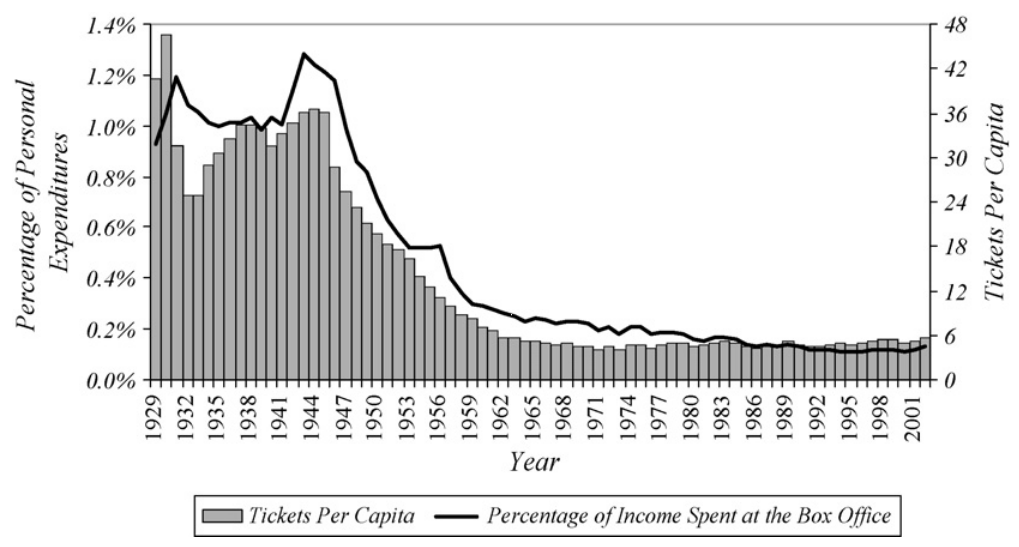
She follows up. Derek Thompson counters with the above chart:

The collapse of movie audiences, which far pre-dates Jaws and summer blockbusters, requires studios to heavily market their films since Americans’ default position on movies these days is not to see them. Studios have cannily created a summer of tent-pole features to focus audience attention on a handful of months when we’re taught to expect to go to the movies. Iron Man III would probably make a billion dollars if it were released on a Tuesday morning in March. But lesser films might benefit from debuting in a season when audiences are predisposed to going to the movies.

More Dish on this summer’s flops and the blockbuster business here, here and here.