An important update.
New Mexico’s Path To Marriage Equality
Mark Joseph Stern puts the recent developments in perspective:
[R]eally, same-sex marriage in New Mexico was probably inevitable—and no one knows that better than gay-marriage opponents. For years, groups like the National Organization for
Marriage have been pushing for state constitutional bans on same-sex marriage, even in states that were extremely unlikely to legalize such unions. This strategy was based on foresight and pragmatism: NOM et al. knew that absent a state ban, judges or legislators tend to favor equality for all and encode their beliefs in law. Gay marriage opponents didn’t want another Iowa or Massachusetts, so they rushed to create roadblocks to marriage equality while public opinion remained on their side.
New Mexico held the line, however, never explicitly legalizing same-sex marriage but never outright banning it, either. It’s the only state in the union caught in this peculiar limbo—and now it seems poised to prove NOM right. A few Republican legislators plan on contesting the marriages in court, but the state’s Republican governor has for the most part remained mum on the matter. Meanwhile, Democrats have scrambled to grab the issue as their own, vocally supporting the renegade clerks. And the state’s Democratic attorney general has lined up behind marriage supporters, throwing the state’s legal apparatus at least partially behind marriage equality.

The above map from Timothy Kincaid shows the eight counties is New Mexico that currently allow marriage equality. Update from a reader:
I like how the southwestern county of Grant is the finger, upside down. Fitting.
“Not All Like That”
Burroway describes the NALT project:
Dan Savage introduces the new project, recalling he often encounters Christians who tell him, “we’re not all like that,” that not all Christians condemn LGBT people. Savage’s response had been: Don’t tell me, tell the anti-gay Christian leaders who claim to speak for all Christians. Now there’s a platform for those Christians to do just that. Not All Like That was launched [yesterday], providing a platform for “NALT Christians” to post their videos and demonstration that Christians support LGBT people.
Gabriel Arana elaborates on the project’s goals:
The project is a call to arms for Christians who want to take back their faith from the religious right, which has sucked up much of the air in public debates on faith and policy.
When conservatives like Newt Gingrich and Rick Santorum become synecdoches for Christians writ large, it doesn’t leave much room for people like John and Catherine Shore—those who mirror public opinion far more closely than the anti-gay Christians on Fox News.
Indeed, while polling shows support for gay rights varies by denomination, the majority of Catholics and mainline Protestants—the country’s two largest Christian sects—favor same-sex marriage. But the anti-gay crowd seems to have won the public-relations war: In a well-known 2007 study of to 16- to 29-year-olds, 91 percent of non-Christians and 80 percent of active churchgoers described Christianity as “anti-homosexual.” Savage and Shore attribute the disconnect on the religious right’s well-funded media machine; when gay rights are in the news, media bookers turn reflexively to virulently anti-gay personalities like the Family Research Council’s Tony Perkins or Pat Robertson. “Tony Perkins is very loud and the NALT Christians are very quiet,” Savage says.
(Video: Evangelical blogger Fred Clark’s NALT video, a transcript of which is here)
Can Iran Bring Syria To The Table?
Omid Memarian reports on the question:
“Iran can be helpful in resolving the Syrian crisis and bringing the civil war to an end,” Hooman Majd, an Iranian-American journalist and the author of Ayatollahs’ Democracy, told The Daily Beast in an email. “As long as the US goal is not regime change, almost as a precondition, I think the Iranians and the Russians probably see it in their interests to bring the civil war to an end, and help manage the transition to a representative government, as long as that government has no elements openly hostile to Iran, to Shias, or to Russia (such as Al-Qaeda affiliated or sympathetic groups).”
“Iran has shown a willingness, (particularly the new administration in Iran) to be involved in a diplomatic solution—it would make sense for the US to take Iran up on that,” Majd added.
But Karim Sadjadpour argues that “successful diplomatic engagement with Iran is hampered by the fact that outside powers — be it the U.S., Russia, or the Arab world — cannot offer Tehran assurances that a post-Assad government in Syria will remain friendly to Iranian interests”:
Ironically, the collapse of the Assad regime would produce a common interest for Washington and Tehran in making sure that radical Sunni Islamists, who hate Shiite Iran even more than America, do not rule Damascus. Until then, as long as Iran sees itself embroiled in a zero-sum game in Syria, a half-way meeting point, however desirable, will likely remain elusive.
Regardless, Juan Cole believes that American intervention will kill any chance of negotiations between the Syrian government and rebels:
By striking Syria, Obama has all but guaranteed that a negotiated solution becomes impossible for years to come. In the absence of serious negotiations, the civil war will continue and likely get worse. The US should give serious thought to what the likely actual (as opposed to ideal) reaction in Syria will be to the landing of a few cruise missiles. The anti-regime elements will celebrate, convinced that it will all be over quickly if the US gets involved. The last thing they will want will be to negotiate with the regime.
The View From Your Window

Ile de la Réunion, France, 3.30 pm
The Closing Of The American Jewish Mind?
Peter Beinart contends that the “American Jewish community is hamstrung in its ability to respond by its own lack of experience with Palestinian life under Israeli control,” and calls for Jewish organizations to bring on real engagement:
When mainline Protestant delegations visit Israel, for instance, they are far more likely than their Jewish counterparts to visit Palestinians in the West Bank. Indeed, many Christian organizations maintain offices across the Green Line, something most American Jewish groups do not. That gives them an appreciation of Palestinian suffering that American Jews generally lack. …
I recently spoke to a group of Jewish high school students who are being trained to become advocates for Israel when they go to college. They were smart, earnest, passionate. When I asked if any had read a book by a Palestinian, barely any raised their hands. Even from the perspective of narrow Jewish and Zionist self-interest, that’s folly. How effectively can you defend Israel’s legitimacy if you don’t even understand the arguments against it?
Peter is surely right about the lack of any actual acquaintance with actual Palestinians. For years at The New Republic, the question of Israel was always discussed without any serious input from or dialogue with Palestinians at all. I was as guilty as anyone. They became in my own mind an abstraction associated with mass violence. The machinations of Arafat tended to end the conversation when it came to a possible two-state solution – as they probably should have. But the end of the Arafat era did not seem to me to prompt a new dialogue or a different approach. And again, I am as guilty as anyone. Obama’s candidacy talked me out of that indifference, if only because it became clear to me that any US coexistence and interaction with the Arab and Muslim world required some kind of two-state solution to the source of much of their anger – and after 9/11 and Iraq I believed that reconciliation was very much in this country’s interests. I still do.
Israel and its formidable lobby ended that particular opportunity for good – and by that time, it may have been too late anyway. The continuation of West Bank settlements renders any interaction with Israel’s government fruitless. They serve as a reminder that the Jewish state’s core objective at this point is expansion and oppression, not reconciliation or freedom. Which of course makes real interaction and dialogue even more fraught.
I remember a friend of mine – a good Jewish doctor with an excellent education who went to practice medicine on the West Bank for a few months. When he came back, he was a changed man. Seeing the brutal open-air virtual prisons that Israelis have imposed on the Palestinians, the daily humiliations imposed on innocents, the huge disparities in wealth and access to services, the deliberate crippling of the Palestinian economy, the often tolerated vigilante justice, the destruction of long-time homes: it all horrified him. Why had he never been told? Why had he been so blind for so long? He wanted to talk, to confess, to unburden himself of this revelation.
It was his – and my – responsibility, but it was also clearly a by-product of the American Jewish Establishment’s well-intentioed but blinkered creation of a cocoon of tired and exhausted cliches about Israel’s blamelessness, reinforcing them endlessly with Potemkin visits for congressmen and students and young Jewish Americans. The result may well be, as Yair Rosenberg has noted “more and more Jews are reaching out to Palestinians, only to find that they no longer have anyone to talk to”:
The anti-normalization movement–which advocates total boycott of all institutions and organizations that do not openly disavow Zionism, and works to exact a social, political, and economic price from those who breach it–grows every day.
A representative manifesto, signed by Palestinian student unions in the occupied territories and around the world, explicitly condemns the work of “organizations like Seeds of Peace, One Voice, NIR School, IPCRI, Panorama, and others specifically target Palestinian youth to engage them in dialog with Israelis.”
Beinart is aware of anti-normalization’s perils, but he devotes only two of his essay’s 46 paragraphs to it. Given his target audience–American Jews–this focus on one side’s sins is understandable. But it has the effect of indicting Jews in the pages of the NYRB for a lamentable situation that is not entirely their fault, while casting Palestinian isolationism as a mere footnote to American Jewry’s malaise. Moreover, such a narrow frame does not merely elide Palestinians; it also brackets out the many younger members of the Jewish community who have gone to great lengths to interact with their Palestinian counterparts–only to be rebuffed by the acolytes of anti-normalization.
Marc Tracy identifies Beinart’s stronger argument:
What makes Beinart’s piece valuable is the subtle turn he takes midway through. He notes that U.S. congressmen and senators and their staffs—most of them not Jewish—have visited Israel nearly twice as frequently as the second-most-visited country since 2000; and these trips are characterized by a parallel emphasis on Israeli totems like the Holocaust memorial (to say nothing of Lake Kinneret, site of Congressional skinny-dipping) at the expense of the West Bank. He notes, perceptively, “Establishment Jewish discourse about Israel is, in large measure, American public discourse about Israel,” adding, “Watch a discussion of Israel on American TV and what you’ll hear, much of the time, is a liberal American Jew (Thomas Friedman, David Remnick) talking to a centrist American Jew (Dennis Ross, Alan Dershowitz) talking to a hawkish American Jew (William Kristol, Charles Krauthammer), each articulating different Zionist positions.”
What I never heard discussed ever was the core argument: whether Zionism should remain the one nineteenth century “ism” still defended in the 21st Century, even as, after 60 years, the Jewish state failed to gain real legitimacy from its neighbors. What Americans never hear discussed is why the Arab world remains so furious about the establishment of the Jewish state, why an indigenous people might actually be opposed to another people and another country coming into their world, terrorizing them, and then running their new state by force of arms, even as they then expand further and further on what Palestinians regard as their land. When has Charlie Rose ever hosted such a discussion, for example?
Americans never learn and are rarely taught why Israel remains so controversial a country across the globe – and are, indeed, instructed that all objections to the Zionist project must necessarily be a function of anti-Semitism. You can see the inklings of a reassessment going on – but it is so far at the margins it may as well never exist. I’ve learned the hard way how the Greater Israel Lobby enforces this – by raising the Hitler card any time anyone wants to open the discussion. The consequences of this have been well explained by Peter. And they are not propitious for the future of a democratic or civilized Israel.
But perhaps we should all start over with an Encounter trip to the actual country run by Israelis, including the vast numbers of inhabitants denied a vote, or civil rights, or a decent future.
The Massacre Of Christians We Might Unleash
Philip Jenkins fears that Assad’s downfall could doom Syria’s Christians:
To describe the Ba’athist state’s tolerance is not, of course, to justify its brutality, or its involvement in state-sanctioned crime and international terrorism. But for all that, it has sustained a genuine refuge for religious minorities, of a kind that has been snuffed out elsewhere in the region. Although many Syrian Christians favor democratic reforms, they know all too well that a successful revolution would almost certainly put in place a rigidly Islamist or Salafist regime that would abruptly end the era of tolerant diversity. Already, Christians have suffered terrible persecution in rebel-controlled areas, with countless reports of murder, rape, and extortion.
Under its new Sunni rulers, minorities would likely face a fate like that in neighboring Iraq, where the Christian share of population fell from 8 percent in the 1980s to perhaps 1 percent today. In Iraq, though, persecuted believers had a place to which they could escape, namely Syria. Where would Syrian refugees go?
Dreher applauds Rand Paul for consistantly speaking out about Syria’s Christian minority (an example from December of last year is seen above). Julia Ioffe, on the other hand, thinks Paul’s remarks reflect a view that “some lives, Christian lives, are simply more important than other, Muslim ones”:
Yes, this is a legitimate concern—Christians make up some 10 percent of the Syrian population, and have largely backed Assad—and the Egyptian example is a widely reported one; and, given the reports of jihadis brutally establishing Sharia law in the areas they’ve secured, Paul raises a fair question. The only problem is that it seems it’s all he’s talking about. Aside from his standard non-interventionist caution, and the how-do-we-really-know-anything-about-anything epistemological exercises of the kind we saw in his confrontation with Kerry, the paramount concern for Rand Paul, a member of the Senate Foreign Relations Committee, is not the question of chemical weapon use, or the 100,000 dead, but the Christians.
Tweet Of The Day
As the sun is about to set here in #Tehran I wish all Jews, especially Iranian Jews, a blessed Rosh Hashanah. pic.twitter.com/tmaf84x7UR
— Hassan Rouhani (@HassanRouhani) September 4, 2013
Update: The account appears to be fake:
Not only were the blessings not a diplomatic signal, they weren’t even really blessings from Rouhani himself, according to Iran’s official Fars News Agency. Mohammad Reza Sadeq, an adviser to Rouhani, said the Iranian president doesn’t even have a Twitter account (although he kept referring to it as “tweeter”), let alone that he was behind the eyebrow-raising tweet purportedly from the leader of a country that wishes for Israel’s destruction. “President Hassan Rouhani has no tweeter account,” Sadeq said.
But a very well-sourced Iranian reader we reached out to is discrediting the Fars News Agency report and says the tweet is legit. We will get to the bottom of the story and update as necessary. The latest: Javad Zarif, the Iranian foreign minister, apparently just opened a Twitter account yesterday and sent this out:
Happy Rosh Hashanah
— Javad Zarif (@JZarif) September 5, 2013
And he is already engaging in some fascinating exchanges, namely with Nancy Pelosi’s daughter:
@sfpelosi Iran never denied it. The man who was perceived to be denying it is now gone. Happy New Year.
— Javad Zarif (@JZarif) September 5, 2013
Some credible confirmation of the foreign minister’s account:
Just spoke with Iranian FM @JZarif – who confirms he IS tweeting and wishes Jews in Iran & around the world a happy new year! — Ditto!
— Christiane Amanpour (@camanpour) September 5, 2013
Final update: Rouhani’s PR team has put out a press release confirming the original tweet. Translated money quote:
The Press Sec./Office of President Rouhani congratulates Jewish compatriots on the occasion of the new year
The American People Tell Washington A Few Things
An undeclared senator’s office tells me calls have run roughly 1200-7 against intervention in Syria.
— Ramesh Ponnuru (@RameshPonnuru) September 4, 2013
I have yet to talk to anyone – even in this super-liberal little ash-tray of a town – who supports the president’s proposed new war. The polls tell the same story. The NYT has this revealing nugget from the left:
Representative Elijah E. Cummings, who represents a district that includes parts of Baltimore and has not decided how he stands on attacking Syria, said the pressure from his constituents to oppose the president’s plan is unmistakable. When he visited a grocery store on Wednesday, he said, almost a dozen people told him they thought intervening in Syria was a bad idea. None of them expressed support.
“If you’ve got 95 percent of them saying one thing, it becomes far more difficult to go against them,” he said, adding that the president needed to make a more forceful and convincing case to the public if he wanted Congressional consent for an attack. “As a good friend of his and someone who supports him, I think he’s got to help the Congress help him.”
Ezra’s impression?
“The active public is against this,” Rep. Brad Sherman, who supports intervention, told me. “I don’t know a member of Congress whose e-mails and phone calls are in favor of this.” … Jonathan Allen and Jake Sherman report that House Republicans are not inclined to back President Obama on Syria. “Several lawmakers and aides who have been canvassing support say that nearly 80 percent of the House Republican Conference is, to some degree, opposed to launching strikes in Syria. Informal counts by Obama allies show that support in Congress for Obama’s plans is in the low dozens.”
House Republican leadership, meanwhile, isn’t inclined to change their members’ minds. “Speaker John Boehner’s spokesman said that he ‘expects the White House to provide answers to members’ questions and take the lead on any whipping effort.’”
This ship is sinking fast. And a new constitutional order may be emerging. Call your Senator and representative and let them know you’re against it, if you are. Now is the time for the people to save their president and their country from another Bush-Cheney-style folly.
Saving Obama From Himself
The next couple of weeks will be full of surprises, twists and turns, as this country debates in its Congress and media and living rooms whether to launch another war in the Middle East. But I think it’s fair to offer a preliminary assessment of where the wind is blowing. Obama’s case for war is disintegrating fast. And his insistence on a new war – against much of the world and 60 percent of Americans – is easily his biggest misjudgment since taking office. His options now are not whether to go to war or not, but simply whether he has the strength and sense to stand down and save his second term before it is too late.
Here’s what we know now for sure already: even if the president were somehow to get a majority in House and Senate for entering into 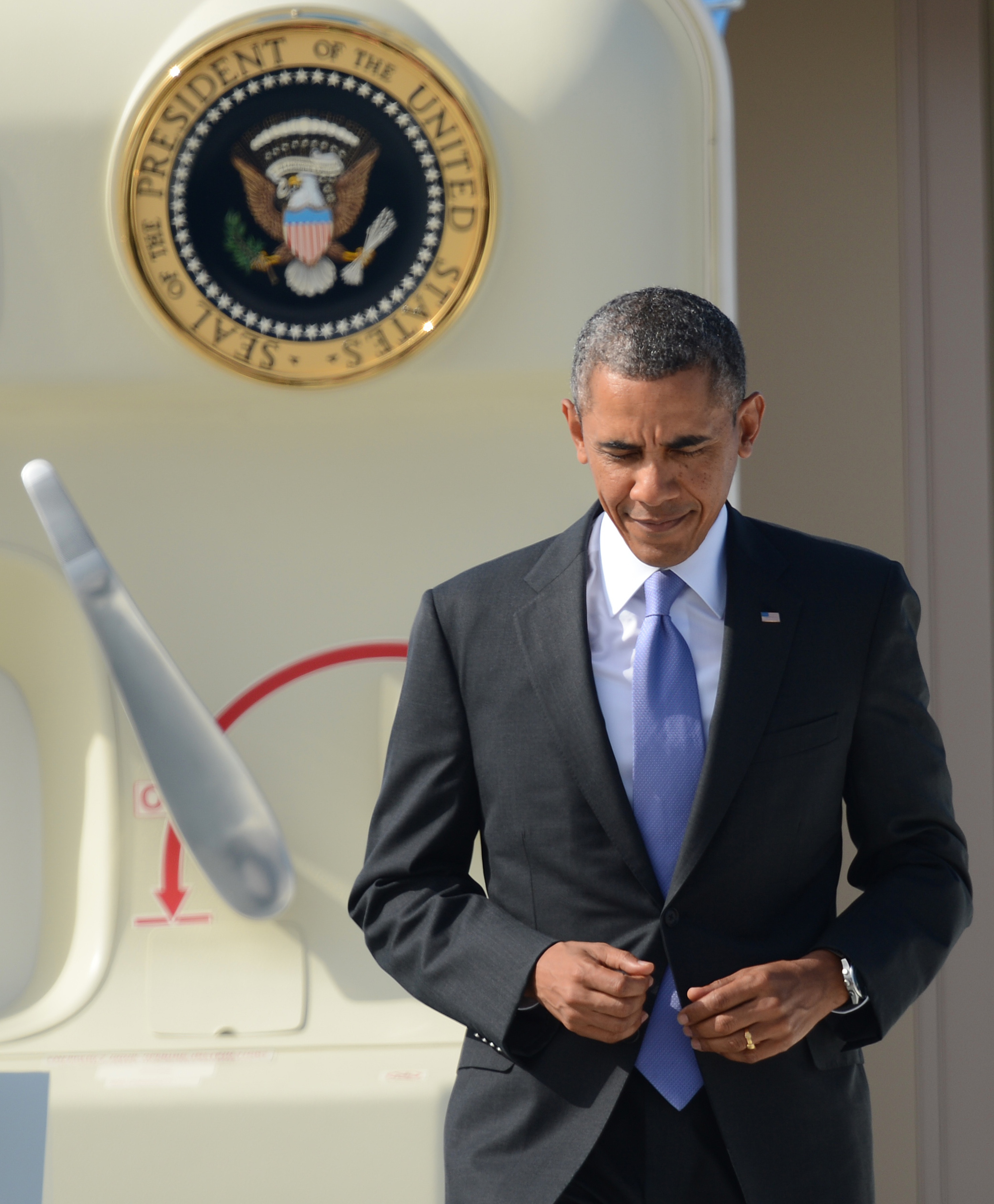 Syria’s vortex of sectarian violence, it will be a profoundly divided one. The 10-7 vote in the most elite body – the Senate Foreign Relations committee – is an awful omen. To make matters worse, there is currently a clear national majority against war in the polls and the signs from the Congress suggest a nail-biter at best for the president. Under these circumstances, no president of any party has any right or standing to take this country to war. He is not a dictator. He is a president. Wars are extremely hazardous exercises with unknown consequences that require fortitude and constancy from the public paying for them. Even with huge initial public support for war, as we discovered in the nightmare years of Bush-Cheney, that can quickly turn to ashes, as reality emerges. To go to war like this would be an act of extreme presidential irresponsibility.
And on one thing, McCain is right. To launch strikes to make a point is not a military or political strategy. It will likely strengthen Assad as he brazenly withstands an attack from the “super-power” and it would not stop him using chemical weapons again to prove his triumph. We either lose face by not striking now or we will lose face by not striking later again and again – after the initial campaign has subsided and Assad uses chemical weapons again. McCain’s response, as always, is to jump into the fight with guns blazing and undertake a grueling mission for regime change. Let him make that case if he wants – it is as coherent as it is quite mad. It’s as mad as picking a former half-term delusional governor as his vice-president. There is a reason he lost the election to Obama. So why is Obama now ceding foreign policy to this hot-headed buffoon?
The only conceivable way to truly punish Assad and assert international norms would be to get a UN Resolution authorizing it. That is, by definition, the venue for the enforcement of international norms. The US Congress cannot speak for China or Russia, Germany or Britain. And in Britain’s case, the people – through their representatives – have spoken for themselves. That means that, if we go through the proper route, nothing will be done. But that is the world’s responsibility, not ours’. And we are not the world.
The US has no vital interests at stake in the outcome of a brutal struggle between Sunni Jihadists and Alawite thugs. None. Increasingly, as we gain energy independence, we will be able to leave that region to its own insane devices. Our only true interest is Saudi oil. And they will keep selling it whatever happens. Israel is a burden and certainly not an asset in our foreign policy. The obsession with the Middle East is increasingly a deranged one. Taking it upon ourselves to ensure that international norms of decency are enforced in that hell-hole is an act of both hubris and delusion. We can wish democrats and secularists well. But we can control nothing of their struggle, as the last few years have definitively shown. And when we try, we create as many problems as we may solve. Look at Libya.
My own fervent hope is that this is the moment when the people of America stand up and tell their president no.
I support and admire this president and understand that this impulsive, foolish, reckless decision was motivated by deep and justified moral concern. But the proposal is so riddled with danger, so ineffective in any tangible way (even if it succeeds!), and so divorced from the broader reality of an America beset by a deep fiscal crisis, a huge new experiment in universal healthcare, and a potential landmark change in immigration reform, that it simply must not be allowed to happen.
We can stop it. And if Obama is as smart as we all think he is, he should respond to Congress’s refusal to support him by acquiescing to their request. That would damage him some more – but that damage has been done already. It pales compared with the damage caused by prosecuting an unwinnable war while forfeiting much of your domestic agenda.
This is not about Obama. It’s about America, and America’s pressing needs at home. It’s also about re-balancing the presidency away from imperialism. If a president proposes a war and gets a vote in Congress and loses, then we have truly made a first, proud step in reining in the too-powerful executive branch and its intelligence, surveillance and military complex.
In other words, much good can still come from this.
If Congress turns Obama down – as it should – Obama can still go to the UN and present evidence again and again of what Assad is doing. Putin is then put on the defensive, as he should be. You haven’t abandoned the core position against the use of chemical arms, and you have repeatedly urged the UN to do something. Isn’t that kind of thing what Samantha Power longs for? Make her use her post to cajole, embarrass, and shame Russia and China in their easy enabling of these vile weapons. Regain the initiative. And set a UN path to control Iran’s WMD program as well.
Obama once said his model in foreign policy was George H W Bush. And that president, in the first Gulf War, offers a sterling example of how the US should act: not as a bully or a leader, but a cajoler, a facilitator and, with strong domestic and international support, enabler of resistance to these tin-pot Arab lunatics. Obama, in a very rare moment, panicked. What he needs to do now is take a deep breath, and let the people of this country have their say.
Democracy is coming to the U.S.A.


