Giving Your All

Julian Savulescu argues that “few people if any have ever been anything like a perfect utilitarian”:

It would require donating one of your kidneys to a perfect stranger. It would require sacrificing your life, family and sleep to the level that enabled you to maximize the well-being of others. Because you could improve the lives of so many, so much, utilitarianism requires enormous sacrifices. People have donated large parts of their wealth and even a kidney, but this still does not approach the sacrifice required by utilitarianism. …

People think I am a utilitarian, but I am not. I, like nearly everyone else, find Utilitarianism to be too demanding. I try to live my life according to “easy rescue consequentialism” – you should perform those acts which are at small cost to you and which benefit others greatly. Peter Singer, the greatest modern utilitarian, in fact appeals to this principle to capture people’s emotions – his most famous example is that of a small child drowning in a pond. You could save the child’s life by just getting your shoes wet. He argues morality requires that you rescue the child. But this is merely an easy rescue. Utilitarianism requires that you sacrifice your life to provide organs to save seven or eight lives. Easy rescue consequentialism is, by contrast, a relaxed but useful moral doctrine.

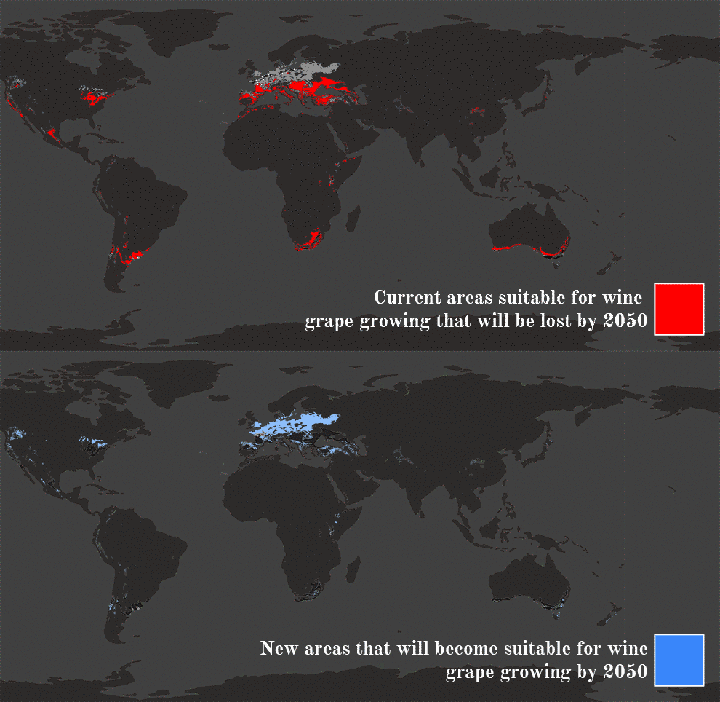
“You Can’t Just Move Napa Or Bordeaux A Few Hundred Miles North”

anigif_mobile_15f184b445b9e9803e853ce865f5bd04-5

Sandra Allen examines how winemakers are adapting to climate change:

A splashy, controversial study published last year by the Proceedings of the National Academy of Sciences found that in major wine-producing regions, the area suitable for viticulture — wine-grape growing – is threatened. By 2050, such terrain will decrease by between 19 percent and 62 percent, under a business-as-usual carbon emissions scenario, and between 25% and 73% if carbon emissions increase, which some argue is more likely. The U.S. government’s 2014 National Climate Assessment, which lays out in spectacular detail and no uncertain terms what our country should anticipate in terms of climate change, summarizes American wine’s situation thusly: “The area capable of consistently producing grapes required for the highest quality wines is projected to decline by more than 50% by late this century.” …

Even a small change in overall temperature, or increased instances of extreme weather, will throw wrenches into the hard-won understanding producers have of their grapes, land, and climate – and of how to coax from that combination the best possible beverage.

A Massacre Of Jews At Prayer, Ctd

A reader rounds out our coverage:

In your most recent post, you cite Freddie deBoer in noting a double standard in the American media, wherein Palestinians are blamed collectively for such acts of violence while Israelis face no such censure for atrocities carried out by their government.  You cited Jonathan Tobin’s pushback, who cited Palestinian “political culture in which religious symbols such as the imagined peril to the mosques on the Mount have been employed by generations of Palestinian leaders to whip up hatred for Jews.”

I think a comparison to the religious reactions to mutual atrocities is very instructive.  Calls for revenge, vicious anti-Semitic and/or anti-Israel political cartoons are all part and parcel of the Palestinian reaction.  But the purpose of the email is that I dearly want to point out to you the Jewish Orthodox reaction to the four murders. You won’t see calls for revenge.

(Yes, you might see it in right-wing politicians, but not among the Jewish Orthodox whom you routinely label as fundamentalist).  The bottom line of these reactions are the same: we have our own choices on how to act, and that the best way to fight against darkness is to increase the light; the best way to fight against hate is to increase love.  The Jewish “fundamentalist” response to tragedy, throughout history, codified almost 900 years ago by Maimonides, is always the same: start with introspection.

You can start with a letter written by Rebbetzin Tzippora Heller, who’s 12-year-old grandson fled for his life from the massacre, but whose son-in-law was seriously injured and needs multiple surgeries.  In her first letter (published here), the harshest thing she can say about the attackers is:

Please continue praying for my son-in-law … and the other victims. Pray that God gives strength to the five new widows and 24 new orphans. Thank God that we are not like our enemies.

In her second letter, she reminded all that our reaction to the events are our choice.  She closed with:

You can choose light. You can choose learning. You can choose acts of kindness. You can choose closeness to the wounded by continuing to pray …. You can transcend your limitations and your attachment to materialism by giving charity.

Even more impressive was the reaction of the four new widows.  They released a letter just two days after burying their husbands.  In it, the grieving widows urged: “accept upon ourselves to increase the love and affection for each other, whether between a person and his fellow, whether between distinct communities within the Jewish people.”

In the article, “In Har Nof, introspection, but no religious war“, the writer summarized her findings: “In shadow of Tuesday’s terrorist attack, congregants dismiss the notion that Temple Mount tensions drove rampage, say they need to ‘be stronger, pray harder’”  She noted: A poster with a photo of a bloodied prayer shawl screams out “End the hatred!”

At site of Jerusalem terror attack, no calls for revenge, just grief, the Ha’aretz writer quoted an 18-year-old girl at the funeral:

We live our lives according to God’s commandments.  That is why most of us have returned to our regular duties – because our regular day is a way of praising God. In other places when this happens, there are calls for revenge, but not here, not in our neighborhood.

Quite the fundamenalists, eh?  The differences are stark and obvious.

Another adds regarding the first post in the thread:

Israel should never have released those types of photographs for publication.  I do not have a problem whatsoever with you publishing them, as they were provided by the government of Israel, but Israel can more than make its case without distributing those types of photographs.  Let Hamas engage in that type of gamesmanship.  The rabbis should be remembered for their scholarship and how they lived, not by how they died.  Those photographs rob the rabbis of their dignity.

The Best Of The Dish This Weekend

You can’t beat Cleese and Maher on PC bullshit:

Money quote from Cleese:

Any kind of fundamentalism is terribly funny.

Of course it is. I particularly liked Cleese’s comment about the condescension involved in ruling certain groups as impermissible targets of humor. There’s this deeply patronizing idea that minorities are fragile, terribly vulnerable, unable to laugh at themselves, and incapable of the to-and-fro of democratic debate and conversation. One reason I find the latest upsurge in identity politics on the left so dispiriting (and boring) is the assumption that minorities of a few kinds are so vulnerable, so oppressed, so burdened by majoritarian prejudice that they have to go through life demanding safe zones from “micro-aggressions” and other terrible assaults on their delicate sensibilities. Members of a minority are reduced to quivering recipients of “hate”, rather than actual living, breathing, thinking people who can surely give as good as they get in public discourse. But it appears an entire generation has now been educated into this mindless, maudlin mush.

I had a fantastically lazy long weekend, napping with the pups, watching movies, and playing Angry Birds. I did manage to finish Paul Gottfried’s book on Leo Strauss and American conservatism, and recommend it. I’ve always wanted to read a critique of Strauss – and more particularly, of Straussianism – which didn’t devolve into leftist hyperbole or paranoia. This is the first I’ve read. Gottfried’s critique is really from the right – against Strauss’s postmodern reading of texts (presented as the very opposite), against the abolition of history as well as historicism, against the reclusiveness and defensiveness of the Straussian enclave, and against their fixation with Western weakness in which the world is forever 1938. He persuaded me that the core of Straussianism is political, not philosophical – and a true competitor to what I would call conservatism, properly understood.  None of this takes away from the truly remarkable scholarship that Strauss and Straussians have given us, or their useful antidote to the idea that all our core debates about the world have been resolved. But it helps reveal the deeply un-conservative and profoundly radical nature of neoconservatism, and its mania for imperialism and Israel.

Some posts worth revisiting from the weekend: how marijuana can help end addiction; the first film of a Black Seadevil from the deep; a devastating poem about love and kids by Jane Kenyon; how brands become cults; some thoughts of mine on affirmative action; André Dubus on the Eucharist; and a must-read Sharon Olds poem on welcoming a daughter on Thanksgiving.

Many of our recent posts were updated with your emails – read them all here.  You can always leave your unfiltered comments at our Facebook page and @sullydish. 16 more readers became subscribers this weekend. You can join them here – and get access to all the readons and Deep Dish – for a little as $1.99 month. Holiday shopping is kicking into full gear, so Dish gift subscriptions could be a great fit for a friend or family member. Dish t-shirts are available here and our new coffee mugs here. A reader writes:

This is a thank you letter.  Thank you, or whoever on the Dish staff selects short stories, for running Tillie Olsen’s “I Stand Here Ironing,” which lead to “Tell Me A Riddle,” which lead to the other stories in that collection, which will lead to much more reading as the winter goes on. These stories are precise and inexorable and a little jagged-edged, and you deeply and quickly care about the people in them.  So thank you, again, for introducing me to them.

Thanks goes to Matt Sitman, the Dish’s literary editor, who selects all of our weekly short stories.

See you in the morning.

Living Into The Big Unknown

5171748787_07ba8d6236_o

Jack Miles contemplates how “science keeps revealing how much we don’t, perhaps can’t, know” – and considers how that connects to religious pluralism. He argues that our ignorance can inform the way we understand faith:

However we cope with our ignorance, we cannot, by definition, call the coping knowledge. What do we call it? Let’s not give it a name, not even the name religion; the dilemma precedes religion and irreligion alike. But if we can concede that religion is among the ways that humankind has coped with the permanence and imponderability of human ignorance, then we may discover at least a new freedom to conduct comparisons. If we grant that we must all somehow go beyond our knowledge in order to come to enough closure to get on with the living of our lives, then how do religious modes of doing just that compare with irreligious modes? Since the challenge is practical rather than theoretical, the comparison should be of practices and outcomes rather than of theories and premises—yet the hope must be for a reasonable way of coping with the impossibility of our ever living a perfectly rational life.

Religion seems to to assume one aspect when considered as a special claim to knowledge and quite another aspect when considered as a ritualized confession of ignorance. One may certainly be struck by the peculiar way in which ostensibly authoritative pronouncements made in the course of religious revelation always seem to arrive coupled to the disconcerting proviso that ordinary human knowing could not have reached what is about to be conveyed: “For my thoughts are not your thoughts, neither are your ways my ways, saith the Lord, for as the heavens are higher than the earth, so are my ways higher than your ways, and my thoughts than your thoughts” (Isaiah 55:8–9). So much, it would seem, for empirical confirmation. But rather than construe such language as vicarious boasting, one may take it, counterintuitively, as Isaiah’s way of reckoning with the limitations of his own mind. To this day, most expressions of religious commitment can be understood as utterances in either of those registers. The boastful construction is smug, loud, insufferable, and can sometimes seem omnipresent. The confessional construction is reticent and thus easily overlooked, yet its appeal shouldn’t be underestimated. The world harbors many a muffled believer and many a shy practitioner, reluctant to undergo cross-examination about a confession of inadequacy that defies ready articulation.

(Photo of “a huge supernova remnant crossing over the constellations of Taurus and Auriga” by Adam Evans)

One Way To Defuse The Gender Wars

An Australian video game journalist – subjected to the usual foul abuse online – decided to do something quite simple about it: she told the mothers of the foul-mouthed boys who were abusing her. This is one tweet of her exchange with one of the mothers:

The reason I love this approach is that it immediately calls the bluff of the anonymous jerks; it targets the actual haters, rather than maligning an entire gender; it doesn’t try to shut down other people’s private pleasures; and it carries with it a sense of proportion and common sense. Somehow, in our culture wars all those sensible approaches are routinely ignored in favor of endless flaming.

“Welcome To The 21st Century”

Why Giles Fraser loathes the phrase, and other, similar expressions of “self-satisfied cultural superiority”:

Back in 1983, the German anthropologist Johannes Fabian published a brilliant account of how western anthropologists often used the language of time to distance themselves from the object of their study and to secure the dominance of a western Enlightenment worldview.

In Time and the Other he noted there was something fishy about the way early anthropologists went out and studied other cultures, talking and interacting with people in the same temporal space, yet when such encounters came to be written up, the people being studied/talked with tended to be situated back in time. The anthropologist always lives in the present. The people being studied live in the past. It’s what Fabian calls “a denial of coevalness” – a denial that we share the same temporal space with those who have different values or different political aspirations. This denial of coevalness, argues Fabian (very much in the style of Edward Said), is often a political power-play, a discourse of “otherness” that was commonly used to buttress the colonial exploitation of others.

But it’s not just colonialism-justifying anthropologists who play this linguistic/moral trick with the clock. The same thing happens in contemporary journalism all the time. Isis, for example, are often described as “medieval”. Travel to Damascus or Baghdad, and you travel not just to the Middle East but also to the middle ages. In part, this familiar trope is based on the idea that the extreme violence of contemporary jihadis has more in common with the extreme violence of the middle ages. As a comparison, this is most unfair on the middle ages, which is transformed from a rich and complex period of human history into modernity’s “other” – little more than that against which modernity comes to define itself. Forget about the founding of the great cathedrals and universities, forget about the Islamic development of mathematics, forget about Leonardo da Vinci and all of that: in secular salvation myth we are sold the simple story that we have been saved from the dark ages of barbarism and stupidity by the clear moral vision of science, rationality and Apple computers. This is just as much a salvation myth as any proposed by religion – though in this version of salvation it is religion itself that we need to be saved from.

Engaging The God Of Experience

Thomas Kidd praises David Skeel’s True Paradox: How Christianity Makes Sense of Our Complex World, a book he describes as a “remarkable” effort of apologetics:

Skeel’s work is both philosophically weighty and engagingly brief (at 160 pages, I read it in one afternoon). The essence of his case for Christianity (or at least monotheism) is that humans seem inexorably drawn to normative ideas about truth, beauty, and justice, all of which are better explained by a created order than by random materialistic chaos. As a lawyer, he especially notes how people – reformers, activists, and politicians – seem unable to get away from normative ideas of justice, and seek to implement just systems. Paradoxically (one of a number of paradoxes he notes), we have a strong sense of justice and yet seem unable to manifest and or even approximate justice in most societies. This speaks to our innate notions of morality and fairness, yet highlights our inability to overcome the debilitating effects of sin and the Fall.

Barton Swaim emphasizes that Skeel shies away from metaphysical speculation about the universe’s origins, focusing instead on “the world as we actually experience it” – which includes pain and suffering:

The “problem,” of course, is that the presence of evil in human affairs seems to suggest that God, if he is there, is either malicious for causing it or powerless to stop it: In either case, he isn’t “God” in any traditional understanding. Mr. Skeel points out, however, that in order to make the argument, terms like “evil and “malicious” must be imported from a worldview that assumes God’s existence. To make the point vivid, Mr. Skeel charts the final illnesses of two very different men: the contrarian journalist Christopher Hitchens and the less famous but equally accomplished Harvard law professor William Stuntz.

Hitchens was an atheist, Stuntz a committed Christian. The difference between the ways these men wrote about their sufferings is instructive. Hitchens hotly denied that his suffering had any moral significance but found it hard not to describe it in moral terms—writing of the cancer’s “malice” before catching himself: “There I go again.” At another point: “To the dumb question ‘Why me?’ the cosmos barely bothers to return the reply: Why not?”

Stuntz, by contrast, who lived for a decade with debilitating back pain but died of brain cancer in 2011, readily admitted that there was something wrong with the pain he lived with for a decade. The sense that “my back was not made—that I was not made—to feel like this,” he wrote, “is so real and hard that I sometimes think I can touch it, grasp it.”

Why did the famously eloquent atheist Hitchens find it hard to express the wrongness of the disease that was killing him, while Stuntz, whom we might have expected to question God’s intentions—or even his existence—had no such trouble? Mr. Skeel thinks he knows the answer. The Christian God does not simply allow or disallow suffering—he himself suffered, in the person of Jesus Christ, and uses suffering to renew his children’s character.

Samuel G. Freedman details the fascinating friendship that informs the book. For the last few years, Skeel, a law professor at the University of Pennsylvania, has ranged over the arguments in True Paradox during many conversations with an atheist colleague, Patrick Arsenault:

Their ensuing discourse roved over free will, determinism, the emergence of human language, the reasons for circumcision, the human capacity for love. They traded links to magazine articles and citations from books, with Dr. Arsenault particularly steering Professor Skeel to the work of the experimental psychologist Steven Pinker. After Professor Skeel finished his first draft in November 2013, Dr. Arsenault line-edited the manuscript.

Amid all the respect and comity, though, the atheist and the apologist ducked no fights, especially concerning Professor Skeel’s belief that God endowed humans with humanity. Dr. Arsenault asserted in one email that men and women “are not so different from those unconscious computers.” In another, he suggested that human beings, far from being the most advanced form of life, would pale next to bacteria in terms of survival under duress. As for love, Dr. Arsenault attributed his ardor for his wife to “a neuronal change induced by mutual oxytocin release.” He referred to Professor Skeel’s God only with a lowercase g.

The effect of the emails, the coffee chats and edits was to sharpen Professor Skeel’s arguments and to encourage him to reckon with the findings of scientists like Dr. Pinker. “True Paradox” became a book of engagement rather than avoidance.