Signed, Sealed, Delivered After Death

Neuroscientist David Eagleman launched a start-up, Deathswitch, that allows clients to communicate posthumously:

Subscribers are prompted periodically via email to make sure they’re still alive. When they fail to respond, Deathswitch starts firing off their predrafted notes to loved ones. The company now has thousands of users and effectively runs itself. Among the perks of a premium Deathswitch account is the ability to schedule emails for delivery far in the future: to wish your wife a happy 50th wedding anniversary, for example, 30 years after you left her a widow.

Death is the original other dimension—a parallel universe that, for millennia, we have anxiously tried to understand. As software, Deathswitch is relatively simple, but as a tool in that millennia-long project it can feel spine-chillingly disruptive. Eagleman has jury-rigged a way for people to speak from beyond that inviolable border and—for those of us still sticking it out on this side—to feel we’re being spoken to. It’s another example of technology enabling things that previously would have seemed magic.

Face Of The Day

dish_goat

For his series “Chattel”, photographer Kevin Horan took studio-style portraits portraits of farm animals such as Sydney, above. David Rosenberg explains:

Because of obvious logistics involving livestock and studio photography, Horan brings his equipment to the animals. Not only because it’s easier to transport equipment than goats and sheep, but also because he relies on the animals’ owners to help with the handling of them. “It takes more time than they ever dreamed of,” Horan said about the process.

The aesthetic of “Chattel” is a nod to studio portraiture from back in the day, so Horan shoots them in black and white and gives them a tone reminiscent of an earlier time period.

Horan once drove two hours to take some shots of Sydney – “He’s a star,” Horan laughed – but most of the roughly 32 goats and sheep that have made the final cut have been photographed around Whidbey Island, [Wash.,] although he is starting to get requests from much more distant locations.

See more of Horan’s work here.

A Very Clean Hand To God

Benjamin Dueholm notes that “Christians in the US, like US citizens in general, are more obsessed with health and hygiene than most” – a tendency in tension with the faith’s central sacrament, the Eucharist, based on a meal Jesus shared with his disciples:

Pasteurised grape juice was invented here, quickly and tragically displacing wine in many Protestant celebrations of communion. And I can’t say for sure, but I would bet a significant sum that we invented those tiny individual cups, too – pre-filled for sanitary personal consumption, now disposable by the thousand where washing and reusing prove too burdensome. It is even possible to buy in bulk little packages of juice and a tiny wafer, sealed up and ready to pass through the pews so that no human hand need ever approach the elements. It’s a strange fate for things that were meant to be shared and that were intended to signify or even become a human body.

These developments have periodically been hastened by pandemic illnesses. The Spanish influenza of 1918 caused local health departments to suspend communion services in some places. The swine flu outbreak of 2009 saw churches in many countries cease using a common cup for the wine. The Ebola outbreak is doing the same in the affected countries (though even this modern development has led to a familiar reaction: the insistence that the fully transformed Body and Blood are incapable of transmitting disease).

Fear of biological contagion becomes hard to distinguish from fear of social contagion. When AIDS, which is not communicated by saliva, reached epidemic levels, many churches responded with panic and anger. The act of eating and drinking together doesn’t look especially intimate until the prospect of sharing a disease is raised. Taking on the risk, however modest, of sharing pathogens is a form of social solidarity, an acceptance of the other that can touch very deep insecurities. As the historical theologian Thomas O’Loughlin put it in The Didache (2010), his account of the earliest Christians: ‘The breaching of the boundaries of Graeco-Roman society at this Christian meal is one of the miracles of the early Church.’ I’m not sure that’s less true in the age of microbiology.

A Tale Of Two Gitas

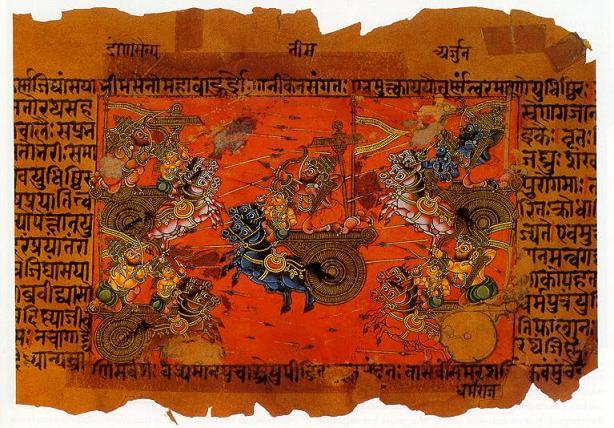
Kurukshetra

Reviewing Richard H. Davis’ The “Bhagavad Gita”: A Biography, Wendy Doniger reminds us that the holy text “incorporates into its seven hundred verses many different sorts of insights, which people use to argue many different, often contradictory, ideas.” She notes that they can roughly be divided into two categories, “the warrior’s Gita, about engaging in the world, and the philosopher’s Gita, about disengaging.” It’s the latter that featured most prominently in the Western imagination:

When Friedrich Schlegel translated a third of the Gita into German in 1808, he left out the battlefield, Krishna’s instructions to Arjuna about work and duty, his teachings about bhakti, and his terrifying manifestation in his Doomsday form. When Hegel, writing in 1827, criticized the Gita for advocating what he saw as a withdrawal and isolation from the world, a passive immersion into the brahman, he did not mention that the martial, interventionist Krishna became personally embodied on what Davis calls “a real Indian battlefield, in order to persuade a warrior to engage in worldly combat.” And so the Gita in Europe fell into disrepute and, for a while, obscurity.

The American Transcendentalists, too, tended to ignore the martial Gita, but they loved the philosophical Gita. In the 1850s, “Thoreau took a borrowed copy of the WilkinsGita with him to Walden Pond, where he imagined himself communing with a Brahmin priest” on the banks of the Ganges as he sat reading on the banks of the pond. When the first edition of Walt Whitman’s Leaves of Grass was published in 1855, Ralph Waldo Emerson commented that it read like “a mixture of the Bhagavat Ghita [sic] and the New York Herald,” and a translation of the Gita was said to have been found under Whitman’s pillow when he died.

(Image: A manuscript illustration of the battle of Kurukshetra, fought between the Kauravas and the Pandavas, recorded in the Mahabharata, via Wikimedia Commons)

A Poem For Sunday

6831075027_b95d0f337a_b

“Schoolboys in Winter” by John Clare (1793-1864):

The schoolboys still their morning rambles take
To neighbouring village school with playing speed,
Loitering with pastime’s leisure till they quake,
Oft looking up the wild-geese droves to heed,
Watching the letters which their journeys make;
Or plucking haws on which the fieldfares feed,
And hips, and sloes! and on each shallow lake
Making glib slides, where they like shadows go
Till some fresh pastimes in their minds awake.
Then off they start anew and hasty blow
Their numbed and clumpsing fingers till they glow;
Then races with their shadows wildly run
That stride huge giants o’er the shining snow
In the pale splendour of the winter sun.

(Photo by Lisa Widerberg)

Quote For The Day

“Since we are all terminally ill, each breath and each step and day one closer to the last, I must consider those sacraments which soothe our passage. I write on a Wednesday morning in December when snow covers the earth, the sky is grey, and only the evergreens seem alive. This morning I received the sacrament I still believe in: at seven-fifteen the priest elevated the host, then the chalice, and spoke the words of the ritual, and the bread became flesh, the wine became blood, and minutes later I placed on my tongue the taste of forgiveness and love that affirmed, perhaps celebrated, my being alive, my being mortal. This has nothing to do with immortality, with eternity; I love the earth too much to contemplate a life apart from it, although I believe in that life. No, this has to do with mortality and the touch of flesh, and my belief in the sacrament of the Eucharist is simple: without touch, God is a monologue, an idea, a philosophy; he must touch and be touched, the tongue on flesh, and that touch is the result of monologues, the idea, the philosophies which led to faith; but in the instant of the touch there is no place for thinking, for talking; the silent touch affirms all that, and goes deeper: it affirms the mysteries of love and mortality,” – Andre Dubus, “On Charon’s Wharf,” from Broken Vessels.

Jesus Said To Them “My Wife … ” Ctd

The_Holy_Women_at_the_Sepulchre_by_Peter_Paul_Rubens

For two years now, we’ve covered the debate over the papyrus fragment, dubbed “The Gospel of Jesus’s Wife,” that was unveiled by historian Karen L. King of Harvard Divinity School. Joel Baden and Candida Moss update us on the emerging scholarly consensus – that it’s probably a forgery, even if the materials used to construct it are ancient – and try to explain why it’s garnered such attention:

A great deal rides on this question of Jesus’s marital status. Over the centuries, and up to the present, how people have answered this question has served as a cipher in discussions about clerical celibacy. If Jesus spurned marriage, the argument goes, so too should all priests. And if Jesus chose only men as his apostles, so too should the Church. Iconoclastically minded commentators, however, insist that the idea of a celibate Jesus is a later Catholic conspiracy—the product of a male-led Church and a succession of dry, turgid councils—that’s long been used to keep the laity, and women in particular, in check. Dan Brown made a fortune peddling this very idea in The Da Vinci Code, published in 2003.

What has become clear today, thanks to the scholarship of Karen King and others, is that in the messy early Church—ripe with pretensions of order, brimming with disordered diversity—people actively debated the role of women as leaders.

People have been speculating about Jesus’s romantic life since at least the second century A.D., too. In a noncanonical text from that period known as the Gospel of Mary, for example, Peter says to Mary Magdalene, “Sister, we know that the Savior loved you more than all other women.” The second- or third-century Gospel of Philip gets somewhat more explicit, calling Mary his “companion,” and describing Jesus as having “loved her more than all the disciples” and having “kissed her often on the mouth.”

The New Testament pays notable attention to women. The story of Jesus’s life begins with the Virgin Mary holding the newborn child, ends with both Marys stationed at the cross, and along the way suggests that women followed Jesus and helped finance his mission. A woman named Junia is described in Paul’s Letter to the Romans as “prominent among the apostles,” and another, named Phoebe, is called a “deacon.”

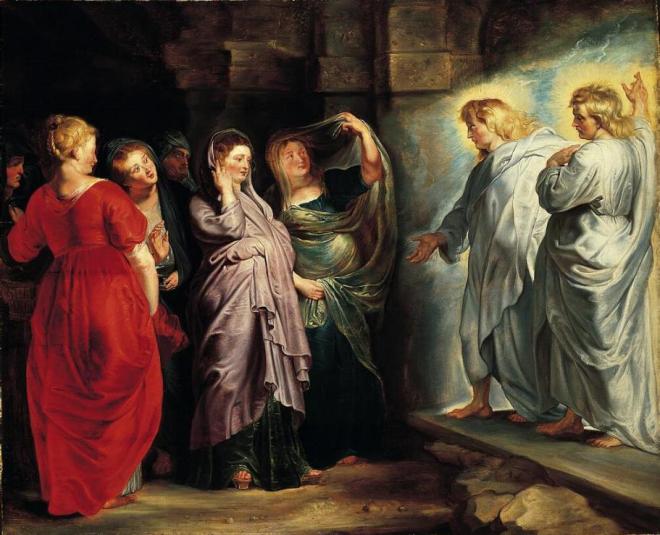
(Image: The Three Marys at the Tomb by Peter Paul Rubens, via Wikimedia Commons. Mary Magdalene is, notably, in red.)

Unbuckling The Bible Belt

PZ Myers wants to retire the ubiquitous term:

It vexes me. The official definition says the Bible Belt is the deep South, but that makes no sense. Dwight Moody, of the influential Moody Bible College, was from Massachusetts. William Riley, the pastor who invented fundamentalism, was from … Minneapolis. Saddleback Church is in Orange County. New Saint Andrews College and Doug Wilson are in Idaho; Mars Hill, before its founder’s meltdown, was based in Seattle. The burned over district? New York.

I travel a lot, all over the country, and everywhere I go, North and South, East and West, people tell me they’re living in the Bible Belt. Worse, they’re prone to tell me that their local religious fanatics form the “buckle of the Bible Belt”. Everywhere. The whole damn country. I’ve heard it in Oregon and Ohio, as well as Florida and Texas.

It’s not a belt. It’s a great fat corset, wrapped all around the USA, and it’s covered with elaborate chains and straps and buckles and fasteners. Some people use the term “Bible Belt” to disparage the South, others use it to refer to any entrenched collection of rabid believers, and it’s no longer useful at all. Stop using it!

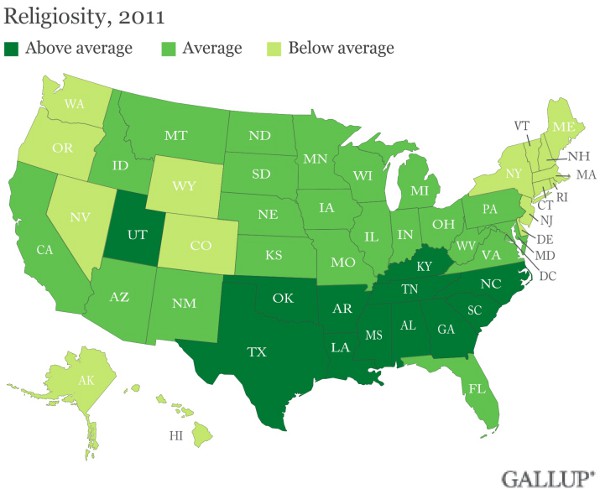
Less anecdotally, back in 2012, Gallup released a map of the country’s “religiosity belt,” below:

dish_religious-states-us-map-gallup-600

In a post about Gallup’s findings, Richard Florida remarked on how religiosity related to political affiliation:

The map charts state-by-state differences in Gallup’s Religiosity Index, which is based on respondents’ answers to questions about the importance of religion to their everyday lives, and how often they attend religious services. …

Gallup notes the relationship between religious intensity and American voting patterns, with the most religious states generally skewing Republican and the least religious trending Democrat. Our own analysis bears this out. We found a substantial positive correlation between religiosity and the percent of state residents that voted for McCain (.67) and consider themselves conservative (.78), and a substantial negative one between religiosity and the percent of residents who voted for Obama (-.64) and consider themselves liberal (-.75).