Finally, a “Thanksgiving Carol” made especially for short attention spans:
The Upside Of Being A Downer
Though ’tis the season to give thanks, Mariana Alessandri maintains that voicing dissatisfaction isn’t all bad:
The 20th-century Spanish philosopher Miguel de Unamuno didn’t recommend banishing the negative emotions or “keeping on the sunny side of life.” In “The Tragic Sense of Life” he described his anxiety over the prospect that there might be no afterlife, adding that he failed to understand people who had not once been similarly tormented by this or by the certainty of their own death.
Unamuno believed that a life worth living consists in communing with others, and that this happens most genuinely through negativity. In “My Religion,” Unamuno wrote: “Whenever I have felt a pain I have shouted and I have done it publicly” in order to “start the grieving chords of others’ hearts playing.” For Unamuno, authentic love is found in suffering with others, and negativity is necessary for compassion and understanding. If we try to deny, hide or eradicate the negative from our lives, we will be ill-equipped to deal with people who are suffering.
Captioning The Canon
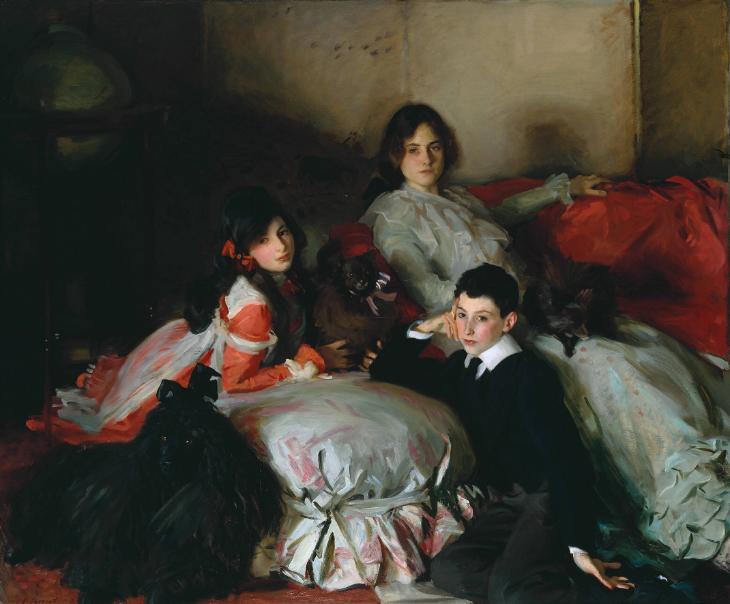
Just in time for the holidays, Mallory Ortberg presents “Families Who Hate Each Other In Western Art History”. Sample dialogue:
shouldn’t we all be smiling, Mother?
for the portrait?
thats a good idea
why dont you tell me what i have to fucking smile about
and i’ll try to work up the muscles to do it
(Painting: John Singer Sargent’s Essie, Ruby and Ferdinand, Children of Asher Wertheimer, 1902, via Wiki Art)
“Born With Empathy”
Mark Joseph Stern shares why he’s grateful to be gay:
As part of my job, I regularly read the writings of people in whom something has broken or withered—people who have lost the ability to see the humanity in others. I put myself in the mindset of people who dehumanize and vilify and hate. I become intimately acquainted with the twisted beliefs of those who, encountering a person they don’t quite understand, lash out with cruel loathing and immoral rage.
Because I am gay, it is basically impossible for me to become one of these people. The identity—a professional minority-basher—just doesn’t fit, and besides, they wouldn’t exactly welcome me into their club. Gay people are born with empathy for the underdog, whether we like it or not. We’ve all played the role of the outcast, the weirdo; we’ve all faced prejudice and discrimination and sorrow and self-loathing. Those of us who emerge from the darkness gain newfound will and determination. But we can’t shake that fundamental desire of justice, that yearning for fairness for those despised by society.
I am grateful for this yearning, which, though sometimes frustrating and heartbreaking, gives my life direction and meaning beyond the daily drudgery.
The Waning Glory Of Gobble?
The Guardian editors offer a taste of the very first Thanksgiving:
Robert Krulwich looks back at how the turkey became the holiday’s leading entrée:
[Writer Andrew] Beahrs gives his biggest props to a 19th century magazine editor named Sarah Josepha Hale. She and her magazine, Godey’s Lady’s Book, campaigned for a national day [of thanksgiving], wrote letters to governors, to every member of Congress, even to the president, and when she wasn’t lobbying, she was writing novels that romanticized turkeys in that over-the-top drooling-with-her-pen way that may make you laugh … but it worked. Here’s a passage from her 1827 novel, Northwood:
The roasted turkey took precedence on this occasion, being placed at the head of the table; and well did it become its lordly station, sending forth the rich odor of its savory stuffing, and finely covered with the froth of its basting. At the foot of the board, a sirloin of beef, flanked on either side by a leg of pork and loin of mutton, seemed placed as a bastion to defend the innumerable bowls of gravy and plates of vegetables disposed in that quarter. A goose and pair of ducklings occupied side stations on the table; the middle being graced, as it always is on such occasions, by the rich burgomaster of the provisions, called a chicken pie.
That’s turkey, then sirloin, then pork, then lamb, then goose, then duck, then chicken pie, all in one sitting! … It took 300 years or so, but eventually the turkey knocked off every other contender and is now center stage, by itself, gloriously supreme, stuffed, adorned, triumphant. Viva la turkey!
Jessica Grose regrets that her family won’t be eating turkey this year, but Betsy Woodruff would rather see the bird sidelined once again. She writes that “turkey’s problem isn’t so much that it tastes bad as that literally any other meat tastes better”:
Ham is better. Duck is better. Chicken, cooked properly, is just as good and takes much less effort, so it is better. Any sort of cow meat is better. Hot dogs, which are in their own meat category, are arguably inferior to Thanksgiving turkey, but they take one-thousandth of the time, cost way less, and are great vehicles for brown mustard. Thus, hot dogs (and of course sausages) are better, too. The president should do America a favor and pardon all the turkeys.
Ezra Klein also has a different meat in mind:
[T]he problem with roasting a whole turkey is that the leg meat needs to get to 165° but the breast dries out over 150° (and note that USDA tells you to cook the breast to 165° which is, as Serious Eats says, “a guarantee you’ll have dry, tough meat”). That’s why we cover turkey in jellied, sugared cranberries and thick gravy at the same time in order to enjoy it. We’re making up for its lack of fat and the fact that it is almost always badly overcooked.
You don’t see people doing that with, say, pork shoulder. …
Unlike turkey, pork shoulder is delicious. Unlike turkey, it’s easy to make insanely well. Unlike turkey, it’s reasonably easy to find in humane, organic forms. And unlike your turkey, your Thanksgiving guests will remember your pork shoulder. It will make your Thanksgiving different, memorable, better. They will fondly think back to how unusually delicious Thanksgiving at your house was, because you served Momofuku pork shoulder and not turkey. You will be a hero. Can’t you hear their cheers now?
Sadie Stein, meanwhile, snarks at manic media takes on unconventional menus:
[E]very November, all the food magazines and blogs start trying to bully us into to reinventing the wheel. Don’t be a fogey! they scream. What, you’re still eating turkey? HAHAHA. Well, if you insist on being a “traditionalist,” stuff that turkey with linguica and kale! Baste it with ramen! Douse it in pomegranate molasses! (All this is said in a vaguely threatening, SportsCenter-style cadence.) This isn’t your mom’s green bean casserole! You’re not even seeing those losers, are you, with their stupid political views and opinions about your love life? Surely you’re having some awesome no-strings Friendsgiving celebrating the new family you’ve chosen! Right? RIGHT?! SRIRACHA. SRIRACHA. SRIRACHA.
She continues:
My own practices are less ambitious. I like order, I like guaranteed results, and I like perfection.
Is this lonely? Yes. Tyranny is lonely. But I cannot risk a guest … succumbing to the lures of something “fun” and playing merry havoc with the priggish constraints of my menu. I was not always thus; life has made me harsh. Life and a particular batch of mashed potatoes made with Benecol butter substitute (because that’s what someone’s grandma had in the fridge), Bac-Os, and a garnish of coffee grounds.
McCardle, for her part, prefers a laissez-faire approach to Thanksgiving dinner:
It’s time for a counterintuitive “smart take”: Eat what you like on Thanksgiving, with a due emphasis on the foods that are traditional to your family and your region. And eat as much as you want of them, without overloading your stomach to the point of illness.
Personally, I find green bean casserole completely disgusting, so much so that I have never eaten it. That’s OK! It’s also OK if you love green bean casserole and wait all year to dig into its creamy depths. Pecan pie makes my teeth ache with its sweetness, but if you love it, tee up the Karo corn syrup and go to town. … I view garlic, sour cream and other Johnny-come-lately additions to mashed potatoes as fundamentally missing the point of Thanksgiving potatoes, which is to serve as a vehicle for more gravy. But if you want your potatoes swimming in wasabi and chantarelles, or whatever crazy combination you’ve come up with, bon appetit. And if you want to skip the turkey in favor of barbecued pork or planked salmon, well, all I can say is: Happy Thanksgiving.
“Death To Turkeys!”
So exclaims John Oliver, shaking his head over the annual tradition of presidential turkey pardoning:
“I issue this challenge to President Obama and all future presidents,” the Last Week Tonight host says in a new YouTube video [above] with his show on holiday hiatus. “If you want the world’s respect, just once, show up at a White House turkey pardoning with a cleaver and administer the justice these birds so clearly deserve.”
Obama has opted to ignore Oliver’s challenge; yesterday, he defended the pardon as an “action fully within my legal authority”. Dahlia Lithwick, tongue firmly in cheek, ponders the implications of the president’s policy, wondering if it will “start a wave of unauthorized poultry immigration”:
Obama’s Republican critics were quick to denounce presidential claims that the turkey pardon authority rests squarely within the enumerated powers of the executive branch. Sen. Ted Cruz published an op-ed in Politico titled “Obama Is Not a Monarch” in which he excoriated Obama’s plan to pardon the turkey as “lawless.” In it, Cruz posited that despite widespread popular resistance to turkey amnesty, “President Obama appears to be going forward. It is lawless. It is unconstitutional. He is defiant and angry at the American people. If he acts by executive diktat, President Obama will not be acting as a president, he will be acting as a monarch.”
Other Republicans pondered what might ensue if millions of turkeys were spontaneously granted amnesty. Some warned that a wave of unauthorized turkeys will soon flood the country, trailing illegal giblets and stuffing, and taking up space on supermarket shelves that should have been held by Americans. House Speaker John Boehner tweeted, “The president has said before that ‘he’s not a king’ & he’s ‘not an emperor,’ but he sure is acting like one.” Former Pennsylvania Sen. Rick Santorum called the turkey pardon “just another in a long line of power grabs by this administration.”
Brad Plumer, taking a more serious approach to the issue, maintains the pardon is a lame tradition:
For starters, the pardoned turkeys don’t get long to enjoy their newfound freedom, because the life of the modern-day turkey is mostly pretty gruesome. The turkeys most widely consumed in America, broad-breasted whites, aren’t built for a carefree life at the farm. They’ve been bred over many years to have oversized breasts and to convert feed into tasty turkey meat as efficiently as possible. Those innovations have been great for humans — they help keep the cost of Thanksgiving dinner down — but they’re not as much fun for the turkey.
Turkeys bred for eating now grow to an average of 30 pounds, much bigger than their wild ancestors did. (The two turkeys that were pardoned in 2013, Caramel and Popcorn, weighed over 37 pounds apiece.) These domesticated turkeys are often so big that their skeletons can’t support all that weight. They frequently develop bone deformities and degenerative joint diseases and suffer heart failure or bleeding around the kidneys. Many are incapable of breeding on their own.
Popcorn, last year’s officially pardoned turkey, has already died of “natural causes” – though his understudy, Caramel, “has trimmed down quite a bit … and seems to be more active as the months go by”. Previous Dish on the sad fate of pardoned turkeys here.
It’s All Relative
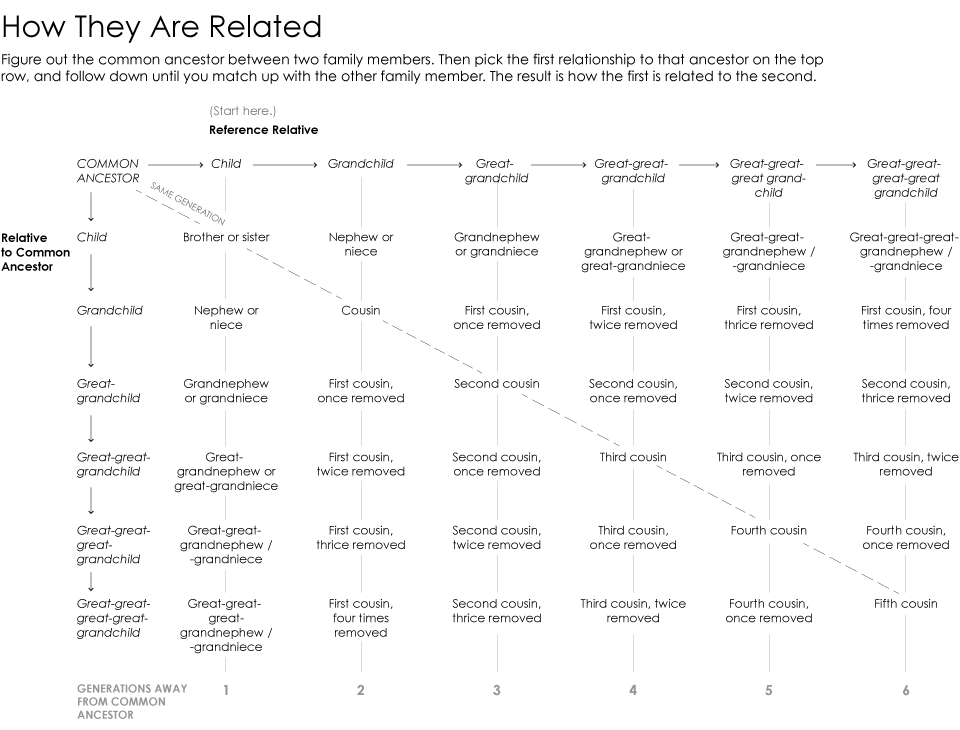
How are you related to all those supposed cousins of yours, anyway? Nathan Yau created the above chart to have you covered at family gatherings:
Here’s how it works. Figure out the common ancestor between two relatives. Then select the relationship of the first relative to the common ancestor in the top row. Move down to the row that corresponds to the relationship of the second person to the common ancestor. The result is the relationship of the second person to the first.
For example, say the first person is the grandchild of the common ancestor, and the second person is a great-grandchild. Therefore, the second person is the first cousin once removed from the first.
Meanwhile, Jessica Goldstein recently investigated how closer familial connections play out during the holidays. She talked to Frank Sulloway, author of Born to Rebel, about how birth order affects family dynamics into adulthood:
“The biological fact that you’re first, second, or third, it doesn’t have any causal influence. What’s causal is, if you are first, you’re bigger, older, stronger, and you have certain privileges you don’t have when you’re younger,” he said.
Time for more fun with stereotypes:
“If firstborns act more, within the family context, as the surrogate parent, not only are they viewed stereotypically as more responsible and harder working — what we’d call conscientious — but they actually are behaving that way with reference to their siblings and the family environment. And also within the family, typically, younger siblings are rated as being more agreeable, which basically means, more cooperative, kindly, less aggressive, less bossy.” If you’re an older sibling, with size and power on your side, “if you want something, in theory you can just take it, and sometimes older siblings just do. And if you’re younger, you have to be more careful about how you behave with a bigger person. You tend to be cooperative, like, ‘I’ll give you this if you give me that.’”
But here’s the funny thing about those differences — and, I think, why family gatherings seem to exacerbate these variances in personality: these differences are much larger within the family context than they are outside of it. … Sulloway has a very Hunger Games-y explanation for this phenomenon. “I like to think of it as, in childhood we develop a little Darwinian toolkit of strategies for dealing with our siblings and basically getting out of childhood alive. … But we don’t go around in adulthood taking stuff out of that toolkit all the time. If you did all the stuff to your friends that you do to siblings, you’d have no friends. So it makes sense that there’s a muting of effects but a continuity of effects.”
When Ragamuffins Roamed The Streets
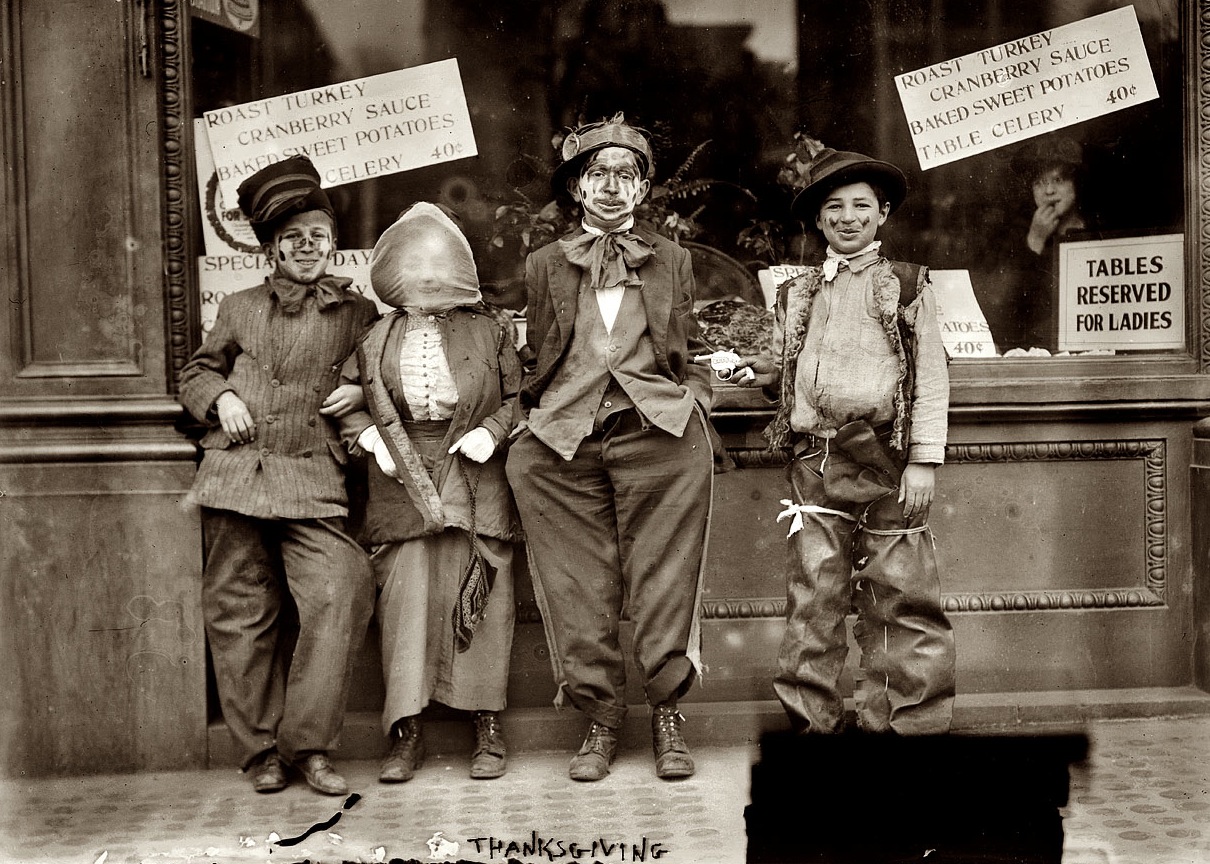
Linton Weeks reflects on the scrappy history of Thanksgiving, which “in turn-of-the-20th century America used to look a heckuva lot like Halloween”:
People — young and old — got all dressed up and staged costumed crawls through the streets. In Los Angeles, Chicago and other places around the country, newspapers ran stories of folks wearing elaborate masks and cloth veils. Thanksgiving mask balls were held in Cape Girardeau, Mo., Montesano, Wash., and points in between. …
In fact, so many people participated in masking and making merry back then that, according to a widely distributed item that appeared in the Los Angeles Times of Nov. 21, 1897, Thanksgiving was “the busiest time of the year for the manufacturers of and dealers in masks and false faces. The fantastical costume parades and the old custom of making and dressing up for amusement on Thanksgiving day keep up from year to year in many parts of the country, so that the quantity of false faces sold at this season is enormous.”
In 2012, Greg Young noted that the “custom was mostly frowned upon by polite society as a distraction from the historic and somber traditions of Thanksgiving”:
Thanksgiving ‘masking’, as it was often called, stemmed from a satirical perversion of destitution and the ancient tradition of mumming, where men in costumes floated from door to door, asking for food and money, often in exchange for music. In the 19th century, makeshift Thanksgiving parades — fantasticals — featured New Yorkers marching through the street in garish costume, most likely inspired by Guy Fawkes Day. By the late 19th century, these had morphed into a day for children to take to the street in ragamuffin garb, going from door to door, begging for fruit, candy and even pennies. …
By 1924, New York could focus its holiday cheer onto more controllable pursuits with the debut of the Macy’s Thanksgiving Day Parade. Within a couple decades, it appears that the merry tradition of Thanksgiving masking slowly relocated over to the less dignified Halloween ….
In an earlier post, Samira Kawash, author of Candy: A Century of Panic and Pleasure, elaborated on the ragamuffin fade-out:
Children weren’t just roaming the streets begging pennies. What was especially annoying was their “practice of ringing all the doorbells and demanding backsheesh.” By 1930, New York’s Superintendent of Schools was publicly condemning the Thanksgiving begging, calling it a “serious annoyance to householders” and encouraging school principles and teachers to instruct students in the origins, meaning, and proper observance of Thanksgiving. Between official disapproval and the low mood and tight purse brought on by the Depression, Thanksgiving mummery virtually disappeared in the late 1930s.
But dressing up and going about ringing doorbells and “demanding backsheesh” didn’t disappear; it just moved to Halloween. We call it “trick or treating.”
Below, watch a home movie of some of the last maskers to traipse around New York in the 1940s:
(Photo via the Library of Congress)
A Spatchcocking Good Time
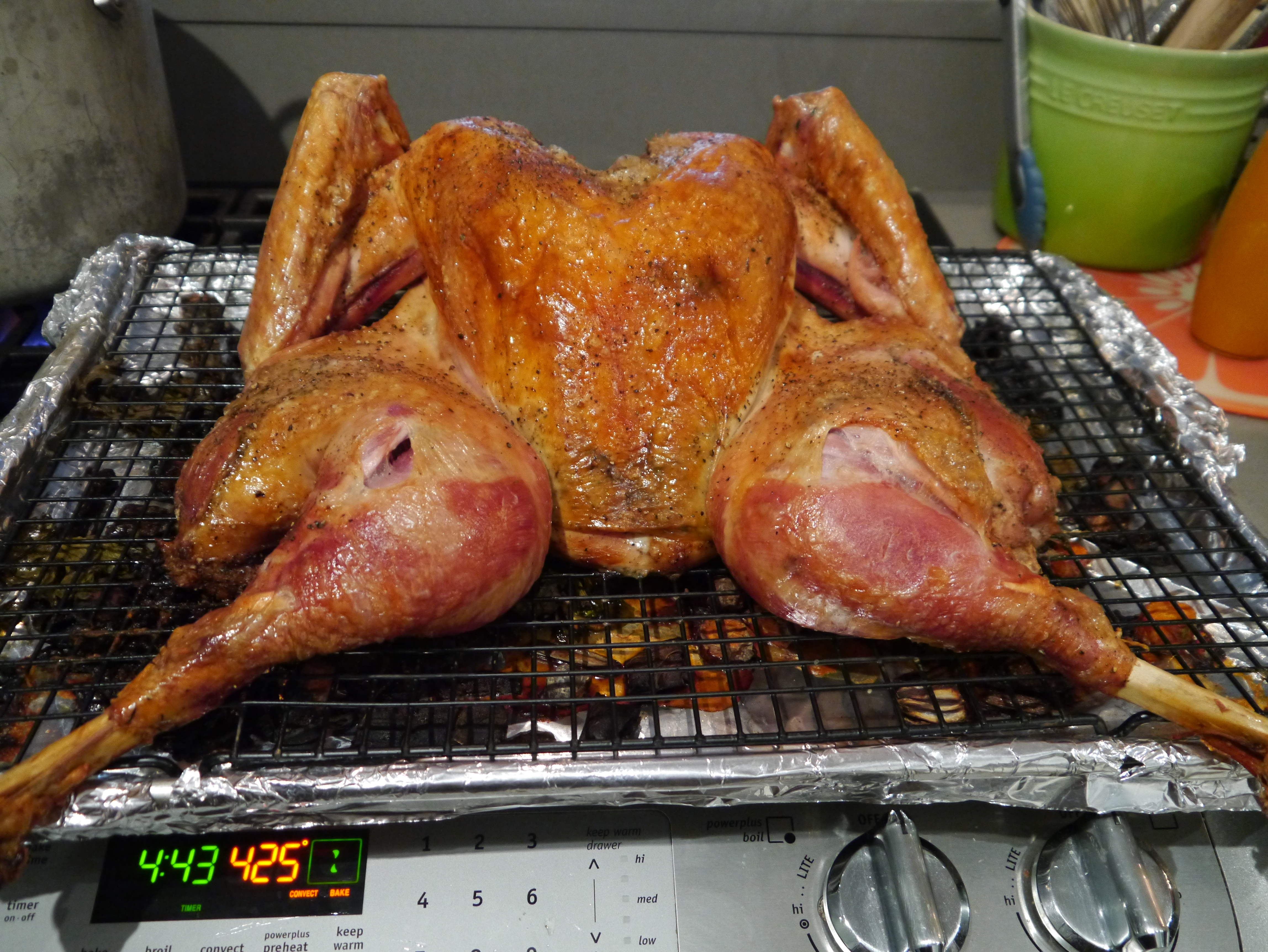
Dan Frommer explains “spatchcocking,” which involves “removing the backbone and flattening the turkey”:
This process—also known as butterflying, and common for preparing chickens—reduces the roasting time for a turkey from roughly three hours to around 45 minutes. Freeing up both oven and host, it’s a complete Thanksgiving game-changer. …
[Mark] Bittman wasn’t alone to spatchcocking in 2012, and in fact, he tends to shy away from what he calls the “quaint” s-word, which dates to the late 18th century. The bigger performer seems to be this Serious Eats article, “How to Cook a Spatchcocked Turkey: The Fastest, Easiest Thanksgiving Turkey,” which spread widely on Twitter after it was published on November 6. A week later, on November 13, Alton Brown, the witty host of Food Network’s Good Eats andIron Chef America went on NPR’s All Things Considered show to talk about spatchcocking. “It’s a fantastic word.” Bittman’s articles are dated November 15.
“It seemed like ‘spatchcock’ was the word of the day this year,” web developer Jim Ray said in a 2012 Thanksgiving-recap episode of his cooking podcast, Salt & Fat. “There seemed to be some consensus that this was the way to roast your turkey. And—I didn’t do that this year—I think it’s probably the last year that I won’t spatchcock my turkey.” Today, Ray tells me, “I’m all spatchcock all the way.” Along with, it seems, many people.
(Photo by Brett Spangler)
Any Idea How Many Calories In That?
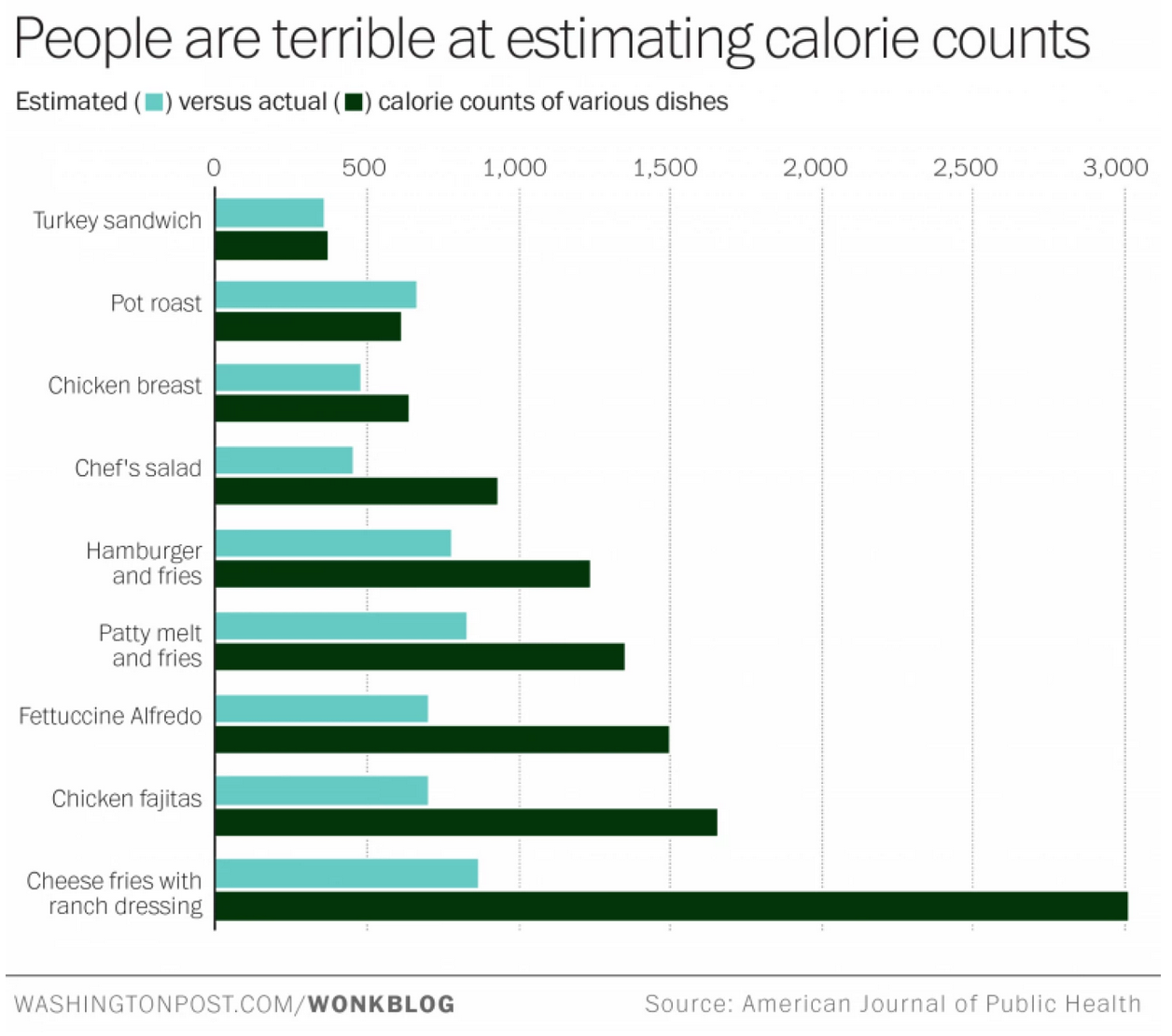
This week, the FDA released new rules on calorie labeling:
The changes are sweeping: Any restaurant with 20 or more locations, movie-theater chains, amusement parks, meals sold in grocery stores, and vending machines will all be required to label calorie amounts on food options. There is no exception for alcohol ordered from a menu (mixed drinks ordered at the bar, however, will continue to not have calorie information). The rules take effect a year from now, although vending machine operators will have two years to comply.
In response, Jason Millman highlights research on caloric ignorance, including the above chart:
Do people eat healthier when they can see calorie counts? The evidence so far seems mixed. The impact seems to be greater when the calorie count is much higher than what consumers expect. What does seem clear from past studies is that people really are terrible judges of how many calories they consume when they dine out.
Harvard Medical School researchers who polled more than 3,400 customers at fast food chains found that people significantly underestimated the calories in their meals. This varied by age group — adolescents on average underestimated calorie content by 259 calories, while adults and parents of school-age children underestimated by 175 calories. More than a quarter of people, though, underestimated calorie content by at least 500 calories, according to the research published in the British Medical Journal last year.
Danny Vinik explains why calorie counts might not alter food choices:
In 2013, researchers at the Robert Wood Johnson Foundation put together a literature review of studies on menu labeling, in order to understand public opinion on menu labeling and the effectiveness on calorie counts. The idea itself turns out to be pretty popular. In the United States, for instance, nearly three-quarters of Americans support menu labeling. After New York required labels in 2008, 84 percent of residents said they found the labels helpful. A majority of Americans also said they would choose lower-calorie food items if they had more information at their disposal—a possible sign that calorie counts could improve health.
But research also suggests that Americans are unlikely to change their behavior, even with the extra information about calories. “Four out of five controlled studies that compare restaurant patron choices in jurisdictions with and without menu labeling regulations before and shortly after menu labeling implementation have not found a relative reduction in calories purchased,” the researchers write.
Sarah Kliff flags more studies:
One study in Seattle, conducted between 2008 and 2010, didn’t find any change in the number of calories ordered at burger and sandwich restaurants — but did see a decline at taco and coffee stores.
Another study, conducted by two University of Minnesota researchers, found that when consumers were presented with calorie information in a survey setting, they would reduce their intended food order’s calories by about 3 percent. But when the same researchers tested out the calorie labels in a real-world fast food environment, nothing changed. Intentions, in other words, didn’t translate into behavior change.”Overall, our results show a considerable gap between actual choices and stated preferences with respect to fast food choices,” they write.
Matt Schiavenza examines related research:
Obviously, not everyone who eats at large chain restaurants is making a conscious effort to eat well. And even those who wish to make healthy choices sometimes lack an understanding of what, say, “1,000 calories” means. A study at the Johns Hopkins School of Public Health found that restaurant customers in Baltimore made little attempt to eat healthily when shown calorie listings. But when food calories were matched with an equivalent amount of exercise, they made more of an attempt to eat less.
 The Dish
