The Democrats’ Infighting Over Obamacare

https://twitter.com/jonfavs/status/537372051195977728

Chuck Schumer is second-guessing the Dems’ decision to prioritize the ACA:

In his harshest assessment of the Obama presidency to date, Schumer argued that the White House and congressional Democrats erred by focusing on the Affordable Care Act throughout most of 2009 and early 2010 rather than following the passage of the economic stimulus with other targeted economic legislation that would directly help more people. He said voters had given the party a mandate in 2008 to stop the financial crisis and reverse the economic damage done to the middle class, and while he supported the substance of Obamacare, it was a political loser because it offered its most tangible benefit—access to coverage for the uninsured—to just 5 percent of the voting public.

Beutler disputes Schumer’s version of history:

The health care reform process didn’t begin in earnest until after the Recovery Act had already passed, at which point Congress’ willingness and ability to pass another big deficit-financed stimulus bill had been maxed out. Maybe Schumer has other ideas in mindlabor rights? Housing policy? A different entitlement?but he’s never laid out what the achievable alternative was, and how the middle-class and Democratic Party would’ve been better off as a result.

That’s because there never really was an alternative. Not that Democrats couldn’t have done a better job helping the economy recoverI believe they could havebut that the One Big Thing they cashed their capital in on wasn’t really up to them. Health care reform was basically pre-packaged, and ready to go because that’s where the consensus was. If after such a decisive victory and once-in-a-generation majorities, Obama announced he would go small on health care reform, or put it off for another time (like he did with immigration reform) the backlash would’ve been severe. It would’ve been his first major elective move as president, and it would’ve splintered his coalition very badly.

Weigel argues along the same lines:

There’s an alternative history of the Obama years in which the administration, like some time traveller sent back to fight Skynet, prevented the Tea Party from ever being born. It governed from the populist left; it owned the fight against “Wall Street” and denied the right the ability to side with the proles by opposing TARP. It’s a widely held belief on the left that this really could have been done, with smarter hires and less concern for the financial world that was going to turn against Obama anyway. Obama could have, like FDR, “welcomed their hatred.”

The small problem with this argument is that it’s bonkers. The Republican opposition to the new Obama presidency did not begin with the ACA. It began with the economic stimulus bill, which Democrats had hoped to get as many as 80 Senate votes for, and ended up scraping through with only three Republican votes in the Senate and none in the House.

Steve M. disagrees:

But Obama, even after the stimulus fight and the rise of the tea party, had enough juice to get the health care bill passed, because that’s what he’d saved the rest of his political capital for. That was the make-or-break agenda item for him.  And of course he was going to prioritize that rather than a larger stimulus — he was an ambitious president with an eye to the history books. A bigger stimulus wasn’t going to be the accomplishment that made his name as a president — for that he needed a big piece of legislation.

Except that what Obama is going to be known for is failing to help the middle class enough in the wake of the crash. I favor the health care law, but it’s porous — it doesn’t help enough people, and there are many people it doesn’t help at all.  What if stimulus and debt relief had gotten the make-or-break treatment from the White House?

Waldman is unimpressed by such arguments:

[T]o say that Democrats shouldn’t have bothered on the off chance that they could have passed some more stimulus and maybe minimized their losses in 2010 makes one wonder what the point of electing Democrats is.

Schumer would reply, “To help the middle class!” But when he got to the point in his speech where he was ready to offer all his terrific ideas for doing so, he punted, saying, “I’d like to outline not WHAT policies Democrats will propose but rather HOW we should build our party’s platform to appeal directly to the middle-class and convince them that government is on their side.” What followed was some mundane PR advice.

That’s something there’s no shortage of, and, to put it in Schumer’s terms, the voters didn’t hire him to dispense messaging tips. If he really wants to help his party, he ought to get moving on those middle-class proposals he keeps talking about. When do we get to see them?
Being A Cop Has Never Been Safer

Shackford reflects on the revelation that last year was an all-time low for killings of police and a 20-year high for killings by police:

It’s an important reminder when Cleveland police kill a 12-year-old boy carrying a toy gun. It’s an important reminder when we see stories that police have killed more people in Utah over the past five years than any other form of violence outside of domestic conflict. Police have killed more people in Utah since 2010 than gangs or drug dealers. Obviously, it’s a positive that fewer officers are being killed in the line of duty, just as it’s a positive that crime trends are heading down. We should be worried, though, if police internalize the idea that this increase in their own shootings is what is keeping them safe in the field and not the general drop in crime.

Nick Wing adds that “Bureau of Labor Statistics list of the 10 most-dangerous professions doesn’t include law enforcement officer”:

The BLS said law enforcement accounted for 2 percent of total U.S. fatal on-the-job injuries in 2013, with 31 percent of those injuries caused by homicide. Other studies on the deaths of officers in the line of duty also showed police were far less likely to be killed in 2013 than they had been in decades. According to a count by the Officer Down Memorial Page, which collects data on line-of-duty incidents, there were far fewer deaths last year than in more than 40 years.

A 2013 tally by the National Law Enforcement Memorial Fund showed 100 officers died in the line of duty last year, the fewest since 1944. Traffic-related fatalities were the leading cause of officer deaths in 2013. The report found that “firearms-related fatalities reached a 126-year low … with 31 officers shot and killed, the lowest since 1887 when 27 officers were shot and killed.”

Ingraham points out that the true number of individuals killed by police is unknown:

It’s particularly worth noting that the FBI data on justifiable homicides is widely understood to be substantially undercounted — some states don’t participate in the FBI’s data-gathering programs at all, and others don’t tally justifiable homicides separately. So while the figures above are useful for generating a trend, the actual national numbers are considerably higher.

Ellen Nakashima provides more details on the subject:

Federal officials allow the nation’s more than 17,000 law enforcement agencies to self-report officer shootings. That figure, [Wes] Lowery reported, hovers around 400 “justifiable homicides” by law enforcement each year. Several independent trackers, primarily journalists and academics who study criminal justice, insist the accurate number of people shot and killed by police officers each year is consistently upwards of 1,000 each year, Lowery reported.

Update from a reader:

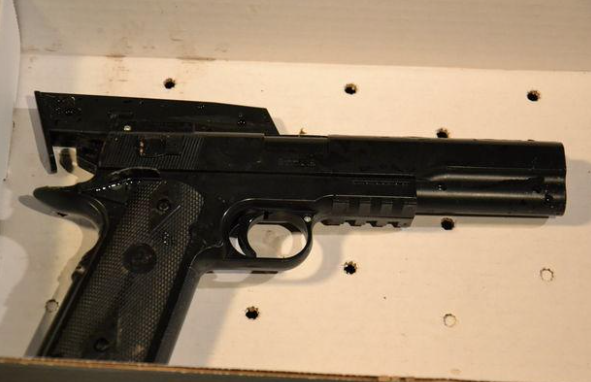
Please stop writing, or allowing people to write, that the gun the boy in Cleveland was carrying was a “toy” gun or a “fake” gun. It was a BB gun that looked very much like a semiautomatic pistol.  Maybe you can post this picture and let readers decide:

cleveland-gun

The Best Of The Dish Today

Seal Pup Season Continues At Donna Nook Reserve

So it looks as if we’re going to have a showdown between the citizens of the District of Columbia who have just voted by an overwhelming margin to legalize possession of weed and a congressman from Maryland, Andy Harris:

Rep. Andy Harris said he “absolutely” intends to launch a push to dismantle the new law when Congress returns with an empowered GOP majority in the 114th Congress. The Maryland Republican, who led the GOP’s charge this year against a separate D.C. law decriminalizing the drug, said the newer legalization statute poses an even greater health risk for young people in the nation’s capital. “It’s obviously even worse for D.C.’s teenagers and young adults than the decriminalization,” Harris said Thursday.

Really? and what evidence does he have for that? What’s staggering to me is that he doesn’t feel the need even to advance the evidence. We can vote 65 – 27 percent and for some reason, we need to be “educated” by this person from another state entirely. If he tries this, he should explain why he opposes the principle of democratic self-government. It’s really that simple.

Today, we were all over Ferguson. My take is here; yours is here and here. John McWhorter’s sanity is here. Some other topics: the racial discrimination against Asian-Americans at Harvard; the teetering talks with Iran; and the ism police now targeting art critics for the usual sins. Liberalism is under siege from the left again. Plus: a mental health break for pyromaniacs. My favorite post of the day? This window view from Alcatraz.

The most popular post of the day was Yes, Obama Is A Phony On Torture; followed by What To Make Of Ferguson?

Many of today’s posts were updated with your emails – read them all here.  You can always leave your unfiltered comments at our Facebook page and @sullydish. 22 more readers became subscribers today. You can join them here – and get access to all the readons and Deep Dish – for a little as $1.99 month. Gift subscriptions are available here. Dish t-shirts are for sale here and our new mugs here.

On a personal “Who’s Honoring Me Now?” note, I was given the Editorial Intelligence Award in London today for my Sunday Times column on America. It was an impressive list of winners to be counted among. I’m sorry I was unable to make the ceremony.

See you in the morning.

(Photo: A Grey Seal pup lies in the grass at the Lincolnshire Wildlife Trust’s Donna Nook nature reserve on November 24, 2014 in Grimsby, England. Seal pup numbers have increased on last year with over 800 pups born at the reserve so far. The Donna Nook reserve is the UK’s premier destination to see Grey Seals and thousands of visitors from across the country come to see the wildlife spectacle every year. By Dan Kitwood/Getty Images.)

The Racial Divide Over Ferguson

YouGov measured it recently:

Racial Divide Ferguson

Russell Moore observes that “the Ferguson situation is one of several in just the past couple of years where white and black Americans have viewed a situation in starkly different terms”:

White Americans tend, in public polling, to view the presenting situations as though they exist in isolation, dealing only with the known facts of the case at hand, of whether there is evidence of murder. Black Americans, polls show, tend to view these crises through a wider lens, the question of whether African-American youth are too often profiled and killed in America. Whatever the particulars of this case, this divergence ought to show us that we have a ways to go toward racial reconciliation.

Jelani Cobb remarks that, in Ferguson, “the great difficulty has been discerning whether the authorities are driven by malevolence or incompetence”: 

Last night, McCulloch made the inscrutable choice to announce the grand jury’s decision after darkness had fallen and the crowds had amassed in the streets, factors that many felt could only increase the risk of violence. Despite the sizable police presence, few officers were positioned on the stretch of West Florissant Avenue where Brown was killed. The result was that damage to the area around the police station was sporadic and short-lived, but Brown’s neighborhood burned. This was either bad strategy or further confirmation of the unimportance of that community in the eyes of Ferguson’s authorities.

McArdle is more sympathetic to the prosecutor:

To judge by last night’s events, this attempt to split the baby between declining prosecution and putting on a full trial failed. On the other hand, to judge by the Los Angeles riots after the Rodney King verdict, putting on a full trial sometimes fails, too. If a conviction was extremely unlikely — and that seems to be the consensus of most of the experts I’ve seen — then I’m not sure there were any good options here. I’m not even sure the prosecutor chose the worst one.

Dreher asks, “What would you have done had you been the cop in that situation?”:

If you don’t want to be shot by police, don’t stick your hand into the window of an officer’s car and try to grab his weapon. Can we at least concede that this was an extraordinarily stupid thing for Michael Brown to have done? That does not mean that what followed on the street was justified (nor does it follow that it was not justified). But it does mean that both the physical evidence and eyewitness statements support the contention that the initial shot that hit Michael Brown was justified.

However, Ezra has a hard time believing Wilson’s story:

Why did Michael Brown, an 18-year-old kid headed to college, refuse to move from the middle of the street to the sidewalk? Why would he curse out a police officer? Why would he attack a police officer? Why would he dare a police officer to shoot him? Why would he charge a police officer holding a gun? Why would he put his hand in his waistband while charging, even though he was unarmed?

None of this fits with what we know of Michael Brown. … Which doesn’t mean Wilson is a liar. Unbelievable things happen every day. The fact that his story raises more questions than it answers doesn’t mean it isn’t true.

But the point of a trial would have been to try to answer these questions. We would have either found out if everything we thought we knew about Brown was wrong, or if Wilson’s story was flawed in important ways. But now we’re not going to get that chance. We’re just left with Wilson’s unbelievable story.

Chilled By Climate Denial

Chris Mooney flags a study suggesting “the climate issue may have become so politicized that our very perceptions of the weather itself are subtly slanted by political identities and cues”:

Comparing Gallup polling results from early March 2012 (just after the winter ended) with actual temperature data from the lower 48 U.S. states, the researchers analyzed people’s perceptions of the warmth of the winter they’d just lived through in light of the temperature anomalies that actually occurred. … It was no surprise that temperatures predicted people’s perceptions of temperatures (duh), but what was surprising is the other factors that also shaped their assessment of how warm it was. The researchers found that political party affiliation had an effect — “Democrats [were] more likely than Republicans to perceive local winter temperatures as warmer than usual,” the paper reports.

Cass Sunstein highlights a related research showing that cold weather makes people “less likely to be concerned about global warming. And when the day seems unusually hot, concern jumps”:

To study this phenomenon, Eric Johnson, Ye Li and Lisa Zaval of Columbia University’s Center for Decision Sciences, asked almost 600 Americans two questions. The first was whether they considered the local temperature, on the day of the survey, to be colder or warmer than usual (on a five-point scale from -2, meaning “much colder,” to +2, “much warmer”). The second question was whether they believed that global warming is happening and whether they were concerned about it (on a 4-point scale from 0, “not at all convinced/worried” to 3, “completely convinced/a great deal worried”).

The researchers found that when people felt the day was warmer than usual, they were significantly more likely to believe in and worry about global warming than when they considered the day to be unusually cold. The effect was substantial, with a “much colder” day producing a full one-point decrease in both belief and worry. (The researchers found the same basic results in Australia.)

Face Of The Day

Riots After Grand Jury Decision Rip Apart Ferguson, Missouri

Missouri national guardsmen in riot gear line up in front of the police station on November 25, 2014 in Ferguson, Missouri. Over 2,000 Missouri national guardsmen are being deployed a day after demonstrators caused extensive damage in Ferguson and surrounding areas following a St. Louis County grand jury decision to not indict Ferguson police Officer Darren Wilson in the shooting of Michael Brown. By Justin Sullivan/Getty Images.

Yglesias Award Nominee

“As I was blearily trying to indicate last night, I am open to the argument that McCulloch was in fact not right. I said his critics have a point. And as I read up on the proceeding this morning, I think that point gets stronger. For those who believe Michael Brown was murdered, what they see is a prosecutor who bent over backwards for a police officer in a way he never would have for nearly any other criminal suspect in the dock. McCulloch let Wilson testify at great length … If McCulloch was determined to get an indictment, this process wouldn’t have taken nearly as long … For those who want me to be all on one side or another of this (Twitter has been an ugly place for the last twelve hours), all I can say is that I am honestly conflicted. Even in this obscenely polarizing chapter of American life, not everything is black and white,” – Jonah Goldberg, NRO.

Hating On Click-Bait

Room for Debate covers the insidious practice. Jazmine Hughes feels condescended to:

[T]he majority of backlash against click bait headlines is a response to the forced push of emotion that click bait content foists onto a consumer. The promise that “you won’t believe what comes next” or “you’ll never feel the same” deprives readers of their analytic agency and imposes an uncontextualized reaction on them. It’s aggressive, empty and intellectually reductive — or, simply, super annoying. There’s nothing wrong with an enticing headline, but pique my interest, don’t belittle my intelligence.

And Baratunde Thurston comments on its cry-wolf quality:

The occasional employment of a listicle or withheld information or you’ll-never-believe-this is fine. However, it’s not being used occasionally. It’s infecting all online information with a one-trick pony that is used over and over again until all we have are tricks. It’s the overuse that bugs me because — to overuse the metaphor — it misses the point of ponies! Ponies are supposed to help you get from point A to point B (often with your heavy burdens) — not just stand on their hind legs or chase their tails all day! The tricks are cute for a while, but ultimately we want to go somewhere.

On the positive side, this absurdity has inspired a new arena for humor. Over a year ago, my company hosted a “Comedy Hack Day” built around humor, and one team created a satirical site called Clickstrbait to lampoon this silly practice.

The Prosecution’s Weak Case Against The Media

I suspect part of what’s behind the frustration of people like McCulloch is that social media makes everyone a critic. Thousands and thousands of people are watching over your shoulder to see if you slip up, checking what you missed, judging whether you were thorough enough, questioning your agenda. Good. Having everyone watch you do your job, or not do it, may be a pain, it may be stressful, but in an imperfect justice system, it’s not exactly a bad thing.

Tim Mak Arthur Chu agrees:

“Blaming the media” for always distorting the story, for making a big deal out of minor misunderstandings, for drawing attention to things that “aren’t any of their business”—it’s the favorite rhetorical trick of powerful people who want to be left to continue doing what they were doing. Sure, the media frequently make terrible mistakes. But a kneejerk rejection of “the media” and a demand for those of us in the audience to “mind our own business” is an implicit statement that the people the media make miserable—business owners, politicians, police chiefs, celebrities—don’t make mistakes. It’s an implicit call to trust them to do the right thing without fear of external scrutiny.

Obama Bites His Tongue On Ferguson

https://twitter.com/jdisis/status/537332458543665153

Last night, Beutler called on the president to give a big speech on Ferguson:

This is Obama’s first opportunity (for lack of a better word) to use the bully pulpit to steer the national agenda in a positive direction since the slaughter at Newtown, Connecticut, and it’s the first time since he became a national figure that he’ll be able to address a racially charged issue without an election in his future to deter him.

But the statement Obama delivered last night, as Cillizza remarks, “was almost doomed from the start”:

The combination of Obama’s status as the nation’s first black president and the powerful visuals coming out of Ferguson, which are catnip for cable TV, made it a) absolutely necessary that he speak about Ferguson on Monday night and b) absolutely inevitable that whatever he said would be criticized by almost everyone emotionally invested in the story — and outrun by events on the ground that were being broadcast simultaneously with his remarks.

That sort of lose-lose proposition is increasingly becoming a hallmark of the modern presidency.

How Ezra understands Obama’s dilemma:

Obama’s language didn’t soar tonight, just as it didn’t soar in his first set of remarks on Ferguson. And that’s because Obama can manage polarization on immigration in a way he can’t manage polarization on race.

President Obama might still decide to give a major speech about events in Ferguson. But it probably won’t be the speech many of his supporters want.When Obama gave the first Race Speech he was a unifying figure trying to win the Democratic nomination. Today he’s a divisive figure who needs to govern the whole country. For Obama, the cost of becoming president was sacrificing the unique gift that made him president.

Jesse Walker questions whether such speeches matter:

I watched an Obama speech tonight. The cable channels aired it in a split screen with footage from Ferguson, so as the president urged calm I could see a live feed of the country ignoring him. His comments were predictable and bland, but even if he’d given us the most stirring rhetoric of his career I can’t imagine that it would have made much difference. This is the news, not The West Wing. Words are cheap.

Julia Azari considers the purpose of presidential speeches:

There are a number of perspectives on crisis rhetoric and on the purposes of presidential speech, but one idea that drives at many of the key points is communication scholar David Zarefsky’s argument that presidential rhetoric has the power to “define political reality.” To quickly synthesize Zarefsky’s point with other work on presidential communication (including my own), this kind of communication has a few main purposes. These include putting a political situation in the context of the past, particularly our Constitutional heritage, and applying a useful and resonant metaphor to the situation that allows us to understand what caused the problem and what kinds of solutions are available. In other words, presidential speech can provide a common text for all citizens to understand a situation, and provide a sense of what the policy alternatives are, even if agreement among them remains elusive.

This is a tremendously difficult task. When non-white human beings have been historically denied full citizenship, how does anyone begin to forge a common understanding of an event that rings true across racial and ethnic lines? How can anyone transcend the polarized state of American politics?