A Rule Of Thumb Drives

Don’t plug in ones you find:

The thumb drive has long been a weak spot in the overall security landscape. As usual, the problem has a very human face: There is a raft of good policies in place to protect companies from losing data – or gaining viruses and assorted pieces of malware – from USB flash drives. Unfortunately, people are not paying attention. Even IT professionals are not eating their own cooking when it comes to USB security, according to CIO Insight:

In a recent study of 300 IT professionals—many of whom are security experts—conducted at the RSA Conference 2013, 78% admitted to having plugged in a USB flash drive that they’d found lying around. To make matters worse, much of the data discovered on those drives included viruses, rootkits and bot executables.

The story offers a bit of comic relief: The U.S. Department of Homeland Security ran a test in which staffers dropped flash drives in the parking lot of government and contractor buildings. Sixty percent of folks who picked them up simply plugged them into networked computers. That percentage jumped to 90 percent if the drive had an official logo.

(Hat tip: Geoffrey Ingersoll)

A Pit Stop On The Road To Democracy?

While addressing this week’s Iraqi prison break, Jon Lee Anderson zooms out:

Five hundred Al Qaeda terrorists back on the streets can do a lot of damage wherever they choose to go—to Iraq, Syria, Lebanon, or the fragile Jordan, where hundreds of thousands of Syrian refugees now live in camps along the border. Martin Kobler, the U.N. envoy to Iraq, warned this week that the likelihood of a regional conflagration was growing: “The problems in Iraq cannot be separated from the problems of the region. The battlefields are merging.”

Kobler is right. The Middle East is more of a powder keg, with more fuses, than it has been in years. Political violence is surging, with regional actors like Saudi Arabia and Iran lining up on opposing sides, and the United States and Russia arrayed behind them.

Sheri Berman considers all the recent tumult in the Middle East “not a bug in political development, but a feature”:

[T]he false starts and problems, the turmoil and the chaos and yes, sometimes even the violence, were an inherent and often necessary part of the process that ultimately abolished authoritarianism and paved the way for liberal democracy. …

What has happened time and again [throughout history] is that a country begins with a nondemocratic regime, proceeds through a phase (or several phases) of minimal or illiberal democratic experience, and eventually emerges with a consolidated liberal democracy. Almost all early democratic experiments around the world were illiberal or deeply problematic, and many ended badly. Only after many generations and attempts were most countries able to consolidate truly liberal democracies–that is, to eradicate deeply ingrained nondemocratic behaviors and attitudes and develop new ways of thinking and acting that would enable liberal democracy to survive and flourish.

Jay Ulfelder pushes back on that argument:

As a grossly simplified description of the democratization trajectories followed by the United States and much of Western Europe, I think this works. As a road map that the rest of the world will eventually follow, however, I’m not so sure. In historical terms, the period during which the US and Europe could confidently be described as “consolidated liberal” democracies has been relatively brief, and some thoughtful observers argue that that era has already passed. What’s more, the geopolitical, economic, demographic, and environmental context in which political development is now occurring differs sharply from the context in which those earlier arcs unfurled, and the pace of change in that context seems to be accelerating still.

Don’t get me wrong, I’m still optimistic that global politics in the twenty-first century will continue to evolve in a more democratic direction. The tumult occurring in Egypt, Tunisia, Libya, Syria, Bahrain, Kuwait, and other corners of the Arab world is just the latest evidence that it’s getting harder and harder to sustain the kind of full-blown, paternalistic authoritarian rule that was the prevailing form of national politics around the globe throughout the twentieth century. I’m just not as certain as Berman seems to be about exactly what institutional forms that tumult will eventually produce.

Voter ID Laws Are A Bad Way To Steal An Election, Ctd

Douthat suggests the GOP rethink its voter ID push:

[P]recisely because the liberal outrage over voter ID laws is disproportionate — for understandable historical reasons and cynical political reasons alike — to their actual impact, it is quite possibly self-defeating for Republicans to keep pushing them.

In exchange for a marginal benefit to their candidates on election day, the G.O.P. is handing Democrats a powerful symbolic issue for mobilizing minority voters, and sending a message to African-Americans that their suspicions about conservatism are basically correct, and that rather than actually doing outreach to blacks the right would rather not have them vote at all. At best, the political benefit to the G.O.P. might outweigh the cost in non-presidential election cycles, for the House and for state offices, when minority turnout already tends to be depressed. But in that case, these kind of laws are just a way of consolidating the G.O.P.’s position as the new 1970s/1980s Democrats: A party that wields enough power in the states and Congress to postpone the kind of outreach it needs to be competitive at the presidential level. And as such, they’re another case of the G.O.P. playing a factional role in our politics, rather than trying to represent the nation as a whole.

Will The GOP Shut Down The Government?

Ramesh Ponnuru warns Republicans against their plan “to oppose any bill to fund the government or increase the debt limit that also provides money for putting the health-care law in place”:

The chance that Democrats would go along — would give up on their signature legislative initiative of the last decade soon after having won the presidential election and gained Senate and House seats — approaches zero percent. So if Republicans stay firm in this demand, the result will be either a government shutdown or a partial shutdown combined with a debt default. Either would be highly unpopular, and each party would blame the other. The public, however, would almost certainly blame Republicans, for five reasons.

First, Republicans are less popular than the Democrats and thus all else equal will lose partisan finger-pointing contests. Second, the executive has natural advantages over a group of legislators in a crisis atmosphere. Third, people will be naturally inclined to assume that the more anti-government party must be responsible. Fourth, some Republicans will say that government shutdowns or defaults are just what the country needs, and those quotes will affect the image of all Republicans. And fifth, the news media will surely side with the Democrats.

Jesus Christ, Super-Zealot?

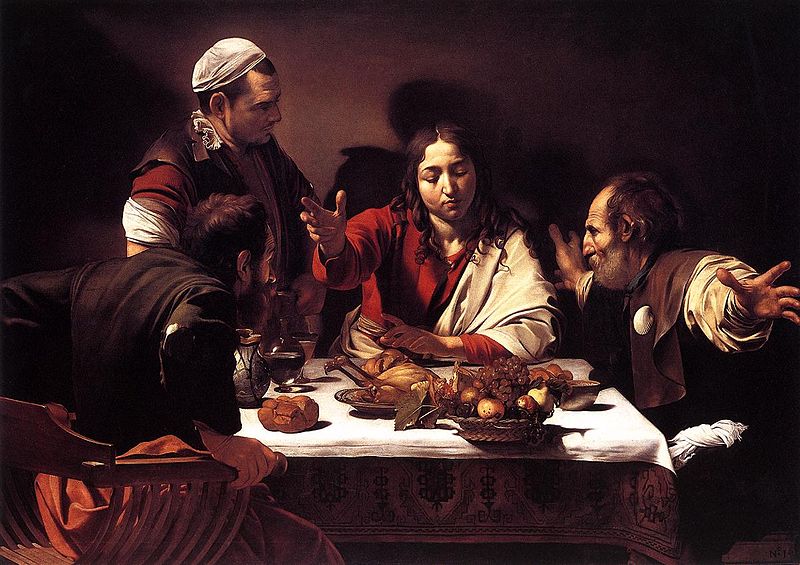
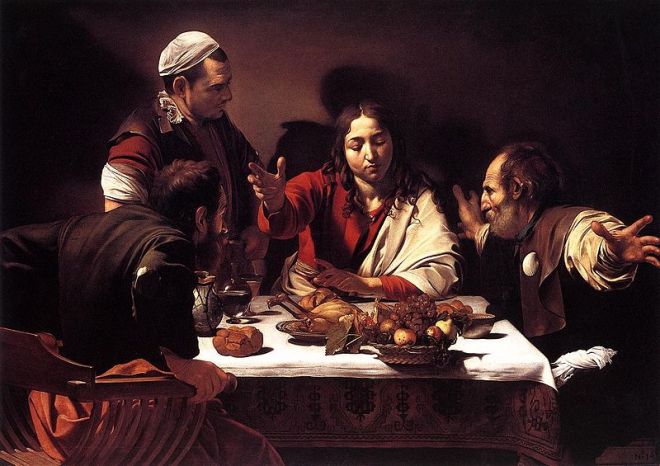
Caravaggio.emmaus.750pix

Adam Kirsch reviews Reza Aslan’s new biography of Jesus, Zealot, which revisits key moments in the Gospels to cast the Nazarene as a staunch Jewish nationalist:

Take, for instance, the moment when Jesus is asked, “Is it lawful to pay the tribute to Caesar or not?” In response, he takes a coin and asks whose picture is on it. “It is Caesar’s,” comes the reply; to which Jesus says, “Render therefore unto Caesar the things that are Caesar’s, and unto God the things that are God’s.” At least, that is how the King James Bible translates his words; and in this form, their message seems to be a kind of political quietism. Keep paying taxes, Jesus seems to advise, and obey the government, since money and worldly affairs are the government’s concern. But entrust your soul, which is what really counts, to God.

Aslan, however, shows that the same passage can be translated quite differently: “Well, then, give back to Caesar the property that belongs to Caesar, and give back to God the property that belongs to God.” Read this way, Jesus sounds much more like a zealot, demanding that the land and people of Israel—which are God’s property—be returned to God and freed from Roman control. It is sayings like this, Aslan writes, that led Jesus to be labeled a “bandit”—a term that was used for all sorts of popular revolutionaries in Judea. When Jesus was crucified next to two “bandits,” then, we should not understand this to mean thieves, as though the Romans were devising an insult to Jesus. Rather, he was crucified next to fellow rebels, whose crime, like his, was agitating for Jewish independence.

I haven’t read the book, but it sounds fascinating, and I hope to soon. But, as so often in his criticism, Kirsch penetrates to the weakness of the thesis. If Jesus were merely a political zealot, why did his message and example endure while those of hundreds of other such figures didn’t? Could it be, as the Gospels tell us, that he actually was life-changingly different, other-worldly, strictly non-violent, up-ending expectations of a political messiah by, say, riding on a donkey into Jerusalem, or consorting with the marginalized and stigmatized, and telling stories that invert the entire paradigm of power that lies behind actual politics?

Jesus, one might say, radicalized the language of Jewish messianism in such a way that it could be turned against Judaism itself. This act of religious creativity, more than his zeal, is what turned a minor Jewish preacher and miracle-worker into the Christian son of God.

And to miss that is to miss almost everything.

(Painting: A beardless Jesus, after his Resurrection, at supper at Emmaus, by Caravaggio)

Dick Morris Award Nominee

“Yes, I realize that the nursery photo in The New York Times Magazine’s recent cover story about Anthony Weiner’s rehabilitation was staged. Yes, I know that the disgraced former congressman was always “weighing” a run for mayor, and was never just a stay-at-home dad facilitating the political ascendance of his wife, Huma Abedin (he earned a hefty sum last year as a corporate consultant). But I can’t help it; I believe that Anthony Weiner, who once thought chicks would dig it if he tweeted them a picture of his namesake, is a changed man,” – Hanna Rosin, June 19, 2013.

A glossary of Dish awards can be found here.