The Best Of The Dish Today

The Republican attempt to nullify the last election and engage in unprecedented sabotage of a law for universal healthcare intensified today. It seems we effectively have no politics in this country right now – just political warfare, in which one party refuses to accept the legitimacy of election results. I once thought it would get worse before it got better, but it seems there is no bottom to the Republican spiral. It just gets worse and worse. There’s partisanship and then … there’s this derangement.

The moderate pundit, Norm Ornstein put it best; Obama’s attempt to lay out what he’d like to accomplish if we had a working political system was an attempt to frame the looming battle. I should realize this by now, but the current GOP clearly believes it is the only legitimate governing party in the US and its response to a loss is to intensify its rage. They never forgave Clinton for being re-elected; and the idea they’d let a black president leave a legacy behind is obviously inconceivable to them. And yes, that’s calling them irrational and not a little racist. But how else do you explain people who are actively attempting to persuade young adults not to get health insurance?

I’m trying to understand where the motivation comes from to actively keep people vulnerable to catastrophic debt and untreated illness. I couldn’t do that morally for my own interns. And yet here is a party seeking to ensure that young people are denied basic healthcare. I keep re-reading that sentence and trying to qualify it or make it less repellent to anyone with a conscience; but I cannot. I try to see how this fits with conservative principles of personal responsibility, but it doesn’t. It’s a campaign to persuade people to have less personal responsibility, to free-load on others, and at massive expense to everyone else.  It’s a rejection of a decade of conservative thought on the issue. Which is why nihilism and vandalism are the only words I can come up with to describe these fanatics and haters.

Meanwhile, dolphins have names; the MidWest remains a mystery; a Window View Contest champ answered your questions; and Anthony Weiner‘s no Bill Boner.

The most popular post of the day – by far – was this elusive Window View (linked to by our VFYW champ); second was my take on the Weiner “scandal”.

See you in the morning.

Peak Beard?

Emine Saner says beards may be a victim of their own success:

“In years to come, when they make movies or write books about this time, the beard will be used as a definitive visual shorthand for the early 21st century, as the mustache is for the seventies and a pair of muttonchops for Regency England,” wrote the cultural commentator Ekow Eshunin an essay on beards last year. Eshun tracks this modern sprouting back to the pre-beard nineties dotcom boom, the speed and slickness of it at odds with slacker style, grunge, facial bushiness, and New Labour, for whom “beards were everything they abhorred. Beards were Clause IV and Militant. Donkey jackets and picket lines. Marx and Engels.” After the dot-com bust, 9/11 and the war on terror, writes Eshun, “came a more reflective public mood” and a yearning for a simpler time. The craze for a kind of pastoral idyll took hold, even if the men lived in Hackney, Portland or Brooklyn–artisanal food, crafts, folk music. And beards.

Erin Gloria Ryan thinks the “peak beard” argument is credible, if depressing:

The piece’s author, Emine Saner, describes herself as a “staunch pogonophile,” (Greek for “beardfucker”) so we know she’s not just another snooty Times writer in khaki cargo shorts mincing over to Brooklyn so they can write about hipsters with a detached air of wounded nerd superiority; she’s on the side of beards. She’s a beard advocate. According to Saner, beards are everywhere–they’re at the Oscars. They’re at the Grammys, and not just on Mumford and his Sons. They’re on your barber, the tattoo artist, the guy at the bike shop, the guy in the cubicle over, the bartender, the guy on the train, the guy you are having sex with, the guy you want to have sex with. The butcher, the baker, the candlestick maker. Etc. All the cool kids are growing furry sweaters on their faces. “Beards, beards, beards,” she writes. I agree. Beards.

But Saner warns that we may be reaching a “saturation point,” that there is nowhere else for beards to grow, and that, simply due to the nature of trend life cycles, the next phase in male facial hair fashion won’t hearken back to a simpler, more barn raising-intensive time. Since everyone has a beard now, soon the only way for a guy to distinguish himself will be to shave it all off and present his face to the world like a naked baby.

The one thing beards have going for them is that they’re less hassle than shaving every day. And men are lazy. Let’s also not forget one obvious fact: having a beard is the default option for the male of our species. If you do nothing, you have a beard. The default is not a fashion statement; it is the basis for all fashion statements for the male face.

Vandals And Saboteurs, Ctd

Reuters reports that, in response to the Obama administration’s “public education campaign on healthcare reform, Republicans and their allies are mobilizing a counter-offensive including town hall meetings, protests and media promotions to dissuade uninsured Americans from obtaining health coverage.” Beutler fumes:

It’s bad enough to just not care all that much if the U.S. has a large uninsured population. But if there’s an excuse for encouraging people who have the means to remain uninsured, I can’t fathom it.

It almost goes without saying that this effort is being undertaken to keep younger, healthier people out of the exchanges, and send the individual insurance market into an adverse-selection “death spiral.” That would ruin the system for people who want the help Obamacare offers them. And so the campaign effectively amounts to asking people to continue putting their well-being and livelihoods at risk for the good of the cause of keeping health care for sick people unaffordable.

Drum can hardly believe that “they’re literally going to be encouraging people not to buy health insurance”:

What’s next? A campaign to get people to skip wearing seat belts? To skip using baby seats in cars? To skip vaccinations for their kids? It’s times like this that words fail those of us with a few remaining vestiges of human decency.

Cohn notes how unusual this kind of obstruction is:

If you’re among those people who agrees about the inherent malevolence of Obamacare, then this might all seem very reasonable. (Hey, they burned draft cards to protest the Vietnam War—and Obamacare is just as awful!) But if you don’t see things that way, you might be wondering if this is the way opposition parties and movements typically act when a law they don’t like is about to take effect. The answer is no.

And Sarah Kliff thinks that Republicans may unintentionally be helping Obamacare succeed:

Republicans have set Obamacare expectations so incredibly low that, if Godzilla doesn’t march in on Oct. 1 and gobble up our health insurance coverage and legions of IRS agents fail to microchip the masses, that could plausibly look like a success.

Earlier Dish on Republicans’ attempts to sabotage Obamacare here.


Where Is The Midwest? Ctd

image001

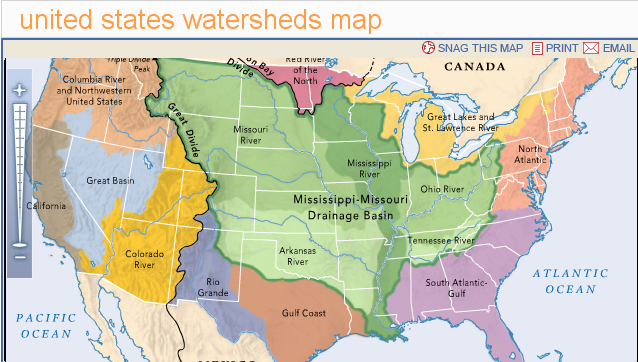
Another map from a reader:

It explains how Pittsburgh and Topeka are both sometimes “Midwest”.  I think another factor, in addition to geology, climate, rainfall, and highways, is rivers and watersheds.  Areas that share a watershed are connected physically by a river and have similar geology seem to form contiguous units.

Another writes:

Such a cool thread.  And, being the reader who (I think) got the whole “South vs Social Mobility” thread rolling, I feel a compulsion to weigh in on the Midwest one. I’m not Midwestern, but I find the cultural boundaries of the US to be endlessly fascinating, since they don’t really hew to state lines, even though everyone expects them to do so.  In particular, your reader who pointed out the 100th Meridian dividing line is pretty dead on (though I might move the Midwest/West boundary myself over to the west by about 150 miles). Think of all the things in “Midwestern” states that are so reminiscent of the West: Mount Rushmore; Teddy Roosevelt’s Badlands and its roaming bison; Dodge City, Kansas.  Those are all, in fact, on the other side of the 100th meridian.

Also, perhaps the reason that Texas has such a self-centered identity complex is because it has no other singular region in which to identify.  El Paso is solidly in the West.  Houston is solidly in the South.  Dallas, though it considers itself nominally “Southwestern” (how?), is really both Southern and Great Plains at once.  And who knows what the hell San Antonio is – not Southern, not Western, not Midwestern.  Hence, my theory is that Texas pride is so overbearing because Texans need to find they have something in common.

Another:

As is often the case in such matters, too many of your commenters have fallen into the trap of trying to logically, geometrically locate the “mid” of the West, rather than follow the historical evolution of the vernacular.

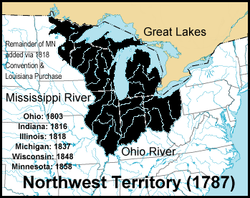
The tipoff is that nobody in the South thinks of themselves as Midwesterners, no matter where they lie, East to West. That’s because the historical precursor to the idea of the Midwest is the old Northwest Territory, which led to the settlement of the northwestern corner of the United States. At least, what used to be the northwestern corner of the United States, that is, the Great Lakes region (more or less).

The Louisiana Purchase blew up that claim to fame pretty much right as the Northwestern 250px-Northwest-territory-usa-1787Territory was formalized, but rather than die, the idea simply evolved. The people of the old northwest knew that, politically speaking and population-wise, they were still “West” even if the (largely fictional) western boundary of the nation had vaulted far beyond them. They lived in the more-or-less-west, the kind-of-west, the really-not-as-East-as-it-looks-on-your-map, or as it finally came to be known (with a shrug inserted in place of a hyphen) the Midwest.

Later, with the further addition of the Oregon Territory, the “westerners” of the Louisiana Purchase, similarly bereft of their edge status, likewise laid claim to living in the Midwest. They, as any Ohioan (living in the first Midwestern state) knows, are mere pretenders to the throne.

Another:

I have to dispute your reader who was “born and raised in the Midwest”, who continued: “I have one very simple rule: if it’s in the Eastern Standard Time Zone, it’s not Midwest.”  Try telling that to the residents of Dayton, Ohio (where I was born), where everybody identifies their region as the Midwest.  This is nothing new – when I was young (circa 1960), our local TV station produced a weekly music show called Midwestern Hayride.

In fact, as the border zone, Ohio turns out to be much more complex and interesting than it usually gets credit for.  Here’s how you should understand the three largest cities in Ohio, geographically, culturally, and politically: Cleveland is an Eastern city (old, industrial, ethnic);  Columbus is a Midwestern city (mostly flat, sprawling, surrounded by cornfields, service-oriented, much more homogeneous demographically); Cincinnati is a Southern city (geographically and politically more like Kentucky than most of the rest of Ohio).

Another passes along the Onion’s take on the subject:
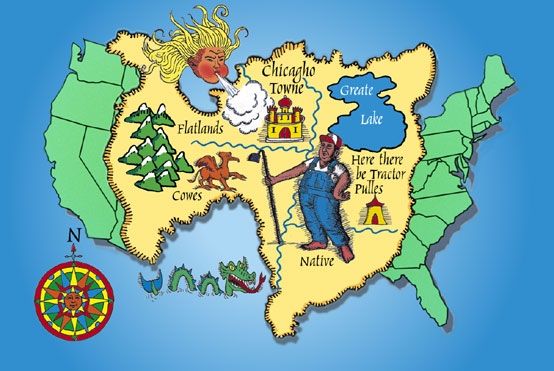
Midwest Map

“The Midwestern Aborigines are ruddy, generally heavy-set folk, clad in plain, non-designer costumery,” Eldred said. “They tend to live in simple, one-story dwellings whose interiors are decorated with Hummels and ‘Bless This House’ needlepoint wall-hangings. And though coarse and unattractive, these simple people were rather friendly, offering us quaint native fare such as ‘hotdish’ and ‘casserole.’ … [T]heir mode of dress is largely restricted to sweatpants and sweatshirts, the women’s being adorned with hearts and teddy bears and the men’s with college-football insignias.
Face Of The Day

Train Crash Kills At Least 77 In Spain

A relative of passengers involved in a train crash talks on her mobile phone as she waits for news at the Cersia Building on July 25, 2013 in Santiago de Compostela, Spain. The crash occurred as the train approached the north-western Spanish city of Santiago de Compostela at 8.40pm on July 24. At least 77 people have died and a further 131 reported injured. The crash occured on the eve of the Santiago de Compostela Festivities. By David Ramos/Getty Images.

Could Grantland Survive Without Corporate Help?

A reader writes:

I enjoyed your recent post about Nate Silver and am glad he’s moving to ESPN – one of my daily reads (in addition to the Times). I also like the idea of a Silver-led version of Grantland. But I thought I’d pass along the Big Lead’s recent piece on Grantland, which is very successful in some ways but is apparently dependent on its connections to ESPN not just for editing and support but also basic financial viability.

The article’s a bit critical of Simmons, probably in part due to professional jealousy, but I don’t think it’s entirely misplaced in its judgment (though I like Simmons for the most part). ESPN is an extraordinarily profitable media corporation that still struggles for journalistic respectability, largely because of the obvious potential conflicts of interest involved in reporting on athletes and athletics and broadcasting sports. Grantland seems possibly like a kind of write-off for them, and it’s basically safe. In some ways, 538 is a riskier and bolder move, but I think that the lessons regarding old vs. new media are more complex than a clear victory by bloggers over the old media.

A sizable excerpt from the Big Lead piece:

Grantland sought to “prove long-form has a place online.” Has it done so? Sort of.

It is hard to fashion a general principle from Grantland. The site was not a startup. ESPN affiliation offered it immediate credibility and promotion. ESPN coffers offered it cash to launch and to operate at a loss if need be. ESPN’s existing Internet infrastructure offered it multiple traffic fire hoses, including plum placement on ESPN.com and Bill Simmons’ twitter feed (now over 2 million followers). This project was more than a domain name and a dream. The floor was much higher.

The site’s birth conditions shaped its development. Grantland is utopian and expensive. The masthead has 10 people listed as some form of editor. Another 18 are listed as staff writers. There are additional, high-profile contributors. We presume there are more uncredited grunts doing technical support. Even presuming they are paid at standard rates, that is substantial overhead. Most Internet outfits are skeletal. Grantland is not just fleshed. It is bloated.

Grantland is not optimized to pay for itself with traffic. Writers are afforded time to produce thoughtful content, only thoughtful content. The site publishes a relatively small amount, only Monday through Friday. Grantland is an Internet place where weekends still exist.

How is the site’s traffic? According to Comscore, Grantland has hovered around or a bit above two million unique visitors for the past 12 months. Their number for May, after a recent uptick, was 2,474,000 unique visitors, up 26 percent from May 2012. For some perspective, that is 76 percent of the traffic generated by Deadspin over the same month. Is that traffic enough to make the site self-sufficient financially? The answer in January was “it depends on how you do the accounting” and ESPN “doesn’t discuss financials.” We suspect ESPN would argue important ad metrics are shifting from raw traffic to audience engagement. The company declined a request to provide data that would have buttressed that point.

Grantland, denied the WWL teat, probably would not survive, at least as constituted. But that does not prove long form content does not work on the Internet. Long-form, writerly content was seldom, if ever self-sustaining before the Internet. The New Yorker still prints because it is “The New Yorker.” The magazine was notably unprofitable when magazines were booming. Even before print, scholars relied on independent wealth or, more likely, someone else’s independent wealth to furnish expensive libraries and disseminate their work. The Internet has not changed the climate, so much as it has intensified and quantified it. …

Long-form content will work on the Internet, as it has throughout history, with someone or something else subsidizing it.

Read the rest of the piece here.

How Safe Are Trains?

Travel Safety

In response to the tragic train crash in Spain, Caitlin Dewey reviews data on train safety and concludes that trains “remain one of the safest ways to travel in Europe.” Waldman adds that “train travel and air travel are both substantially safer than road travel”:

The real killer, though, is motorcycles. A doctor once told me that medical professionals sometimes call them “donorcycles,” since they produce so many organ donors. I tried without success to find one source that gave comparable data on miles traveled per fatality for all different kinds of U.S. travel, but I did come across this report from the European Union from 2001/2002, which gives some pretty striking numbers. …

Even though these aren’t the latest numbers, you get the idea. What jumps out is that the individual means of transportation are the least safe, and the communal ones are the safest. Emotionally, though, we feel more safe when we feel that we, and not somebody else or an automated system, is in control.

The Shrinking Of Big Law, Ctd

Mark Obbie takes issue with Scheiber’s thesis:

From the cover lines and title (“Big Law in Free Fall,” “The Last Days of Big Law”) to an outlandishly flimsy nut graf (claiming just one in 10 top firms will survive the imminent apocalypse, or so says “one common hypothesis” that then never gets explained or examined), the story looks at one sore throat and proclaims it a cancer pandemic. Its prognosis on the death of the mid-sized full-service firm echoes a forecast made so many times it has lost all credibility. Then the piece takes yet another giant step into journalism hell by shooting readers through a time warp that conveniently skips the past 30 or so years of Big Law business history. Big Law has been declared dying for decades. Pieces touting the death of Big Law have been written for decades. Unfortunately, “Big Law Still Really, Really Dying,” while arguable (except where it’s still really, really profitable), doesn’t sell copy.

Meanwhile, Leah Plunkett focuses on the Americans who can’t afford legal help:

When people can’t get lawyers to help them with complex problems, they stand to lose (pdf) the things that are most precious to them, like custody of their children, the roof over their heads, or that quintessentially American opportunity to make a fresh start after crashing and burning.

Even if all Americans could afford to pay for lawyers, there may well not be any lawyers around. Outside of cities, lawyers can be scarce. As The New York Timesrecently reported, South Dakota has gone so far as to pass a law that will pay lawyers to work in that state’s rural communities. A worthy endeavor, but it’s difficult to imagine that the program will do much to get the over-supply of lawyers on Wall Street to migrate to Main Street: The annual stipend for South Dakota’s program is less than a month’s salary for a first-year Big Law associate in New York.1 And of course, as others have discussed, today’s young lawyers—who might otherwise be intrigued by doing Little Law on the Prairie—frequently face financial debt that is insurmountable on all but a Big Law salary.

Which Way Does The Senate Lean?

The Crystal Ball’s 2014 Senate ratings:

2014 Senate

Kyle Kondik previews the 2014, 2016, and 2018 Senate races:

The Democrats are overextended on the 2014 map, which probably means the Republicans should, at the very least, make a dent in the Democratic Senate majority next year. Two years later, the Republicans will be defending a map on which they are overextended, which could help the Democrats make up for some of their possible 2014 losses. And then the Democrats are overextended again in 2018.

All of which suggests that 60-vote Senate majorities are going to be elusive for either party, and future Senate majority leaders, be they Democrats or Republicans, are going to be continually tempted by some form of the “nuclear option” in limiting the filibuster. Given its rapidly increasing use, future Senate majorities — maybe even as soon as this one — might decide they have little choice but to reach for the button.

Enten thinks that, over the long run, the Senate favors Republicans:

Only about 26% of the country as a whole live in the top 10 metropolitan areas. For minorities, those percentages climb significantly: 37% of blacks, who voted for Obama by a 10:1 ratio, live in the top ten metropolitan areas. This includes Washington, DC, which doesn’t have any representation in Congress. Further, 45% of Latinos, who voted for Obama by greater than a 2.5:1 ratio, live in the top ten metropolitan areas.

That’s why it should be no surprise that 36 of the 50 states in the union have a higher percentage of non-Hispanic whites than the nation as a whole. That puts the Democratic party behind the eight ball in winning more states than Republicans. If racial polarization in terms of voting patterns continue to exist or get worse, then it will only go downhill for Democrats in winning more states.

This isn’t that big of a deal in winning presidential contests. The electoral college may be a lot of things, but it does take into account population in assigning electoral votes. Indeed, at this point, the Democrats seem to be enjoying an advantage in the electoral college. That is, they are in a better position to win the electoral college and lose the national vote than are Republicans.

On the Senate level, it is, however, a very big deal.

It’s Not Racist … Ctd

A reader shifts gears on the subject:

Here’s my example of race influencing being spectacularly stupid: the phenomenon of date/acquaintance rape. I’m a middle-aged white woman who grew up in a city torn by the racial tension of the late ’60s and affected by white flight (I joke that my parents were the only white people who moved INTO town, six months after the riots).  By the time I got to junior high, my 8th grade graduating class was 425 kids, of whom about 20 were Hispanic and 5 of us were Anglo.  The rest were black.

From the age of 7 to 10, I was bullied in a horrible, passive/aggressive and rejecting way by a white female classmate who was the definition of a frenemy. Around that age I also got jumped by a group of black girls from round the way, which frankly was a lot less emotionally damaging.  Two of my best friends were African-American boys who at the age of 12 were already what Fox News likes to call “hulking.”  As you can judge from the variety of “urban violence” and “urban friendship”, it came in all genders and colors.  So I was never taught either by my own experience or certainly by my parents to fear any one group, but instead to keep aware of my surroundings and have a healthy skepticism about the purported “safety” of any place or any persons.

I ended up at a small rural college that was 98% white.

While I did drink, it was always with close friends of both genders whom I knew extremely well. I never got drunk at a frat party because it was filled with young men at the height of influence of hormones and peer pressure and general dickishness whom I did not know.  The only thing I did know about them was that they were “nice boys from good families”, which is a lot of words to say white.  This one attribute made many of my fellow co-eds feel totally safe to get completely bombed out of their minds in their presence, because those boys were not the males they had been taught to be careful of.  They had been taught that a rapist is a big black guy in an alley.  And sometimes, bad things happened because of this belief that corn-fed guys out of the Lands End catalog were not capable of sexual assault.

Before you think that the above is meant to indicate I am some paragon of post-racial centeredness, I am definitely not.  The biases inherent in living in our society are difficult to escape, and I am no exception. Long after I graduated, I was the victim of an attempted date-rape by a man I had been seeing for a couple of weeks.  He was white, and a doctor, and Jewish.  Imagine all the racial/class level/educational/religious stereotypes of “this dude is totally safe and ultimately harmless” swimming around in that description.  And I fell for every one of them.

Previous posts in the thread here, here, and here.