John Knefel reminds us that the US is still holding 60 men without charge in a prison near Bagram Airfield. Because they are neither Afghan nor American, they face an uncertain future:
Pentagon spokesperson Todd Breasseale says in an email that the third-country nationals held by the US “at the small part of Parwan [Detention Facility] that we still use are all [Law of War] detainees”–the same authority that applies to nearly every detainee at Guantánamo. (There are currently 166 detainees held at Guantánamo, 86 of whom have been deemed transferrable because they are not threats to US national security.) That legal rationale allows the US to hold prisoners until the end of hostilities in the war against al Qaeda, which Pentagon officials have suggested could last as much as another 20 years.
It remains unclear what the future holds for the prison at Bagram, though Belhadi, the attorney in Pakistan, is not optimistic. “Our impression is that Bagram will remain open even after US combat operations cease in December 2014,” he says. The way forward for his individual clients and the rest of the detainees is also unclear.
(Photo: Aerial view of Parwan Detention Facility in 2009 via Wikimedia)
Sarah Posner spotlights a lawsuit challenging Obamacare’s contraception mandate:
At issue in Hobby Lobby’s lawsuit is far more than whether its employees will have coverage for all 20 methods of birth control Department of Health and Human Services regulations require employers to cover free of co-pays and deductibles. The suit, and others like it, is asking the courts to recognize for-profit corporations as entities with religious consciences that can be, in the legal parlance of [Religious Freedom Restoration Act (RFRA)], “substantially burdened” by government regulations.
The burden, Hobby Lobby argued, and the Tenth Circuit agreed, is that the government will impose fines of $100 per employee per day for failing to comply with the coverage requirement, potentially totaling $475 million in fines per year. That, the court found, amounted to a “Hobson’s choice,” forcing Hobby Lobby to choose between “catastrophic fines or violating its religious beliefs.”
[Hobby Lobby lawyer Kyle] Duncan maintained that the notion of a corporation having religious-freedom rights was “not a novel proposition,” but admitted there were no cases “squarely on point.” The vociferous dissents in Tenth Circuit’s 168-page opinion point to the conflicting legal theories that in all likelihood will be sorted out by the Supreme Court. The Tenth Circuit’s chief judge, Mary Beck Briscoe, excoriated the majority for finding that the operation of a successful for-profit corporation could be seen as a “form of evangelism,” effectively deeming them “faith-based businesses” entitled to free-exercise rights. That, Briscoe contended, “is nothing short of a radical revision of First Amendment law, as well as the law of corporations.”
After traveling from the Rocky Mountains to Manhattan, Ira Chernus questions whether America really needs a national identity:
Why do thoughtful people like Richard Hughes, and so many others, lie awake at night worrying about “what holds us together”? What would be wrong with imagining “the United States” as merely a loose administrative structure for a group of quite autonomous regions? Or perhaps an agency for safeguarding human rights and redistributing wealth in the interests of greater equity, or an entity serving only the purpose of protecting its various regions from threats coming from outside U.S. borders, or a vast debating society where we congenially discuss competing myths and values, or any number of other functions one might think of that “the United States” could play, while leaving regions as the principal source of political-cultural identity?
(Photo of Jasper Johns’ Map by Flickr user Krishna81)
Judith Schulevitz wants to change how we think about the severely overweight:
What would help the most, according to obesity doctors, would be for patients, general practitioners, insurers, and even regulatory agencies to grasp that weight loss, on its own, does not cure obesity. “This is a chronic disease much like hypertension or diabetes,” says Arthur Frank, the senior physician at the National Center for Weight and Wellness. “The idea that the task is the task of losing weight is naïve and a waste of time.” As is true of those disorders, you can’t manage obesity without a lifelong regimen that includes behavior modification and probably drugs, maybe even drug cocktails. But weight maintenance is costly, and very few insurers cover limited weight-loss programs, let alone open-ended ones.
Moreover, obesity drugs are unpopular. They don’t work all that well. Then again, not much does, and it’s not uncommon for treatments for chronic disorders to achieve partial success at best.
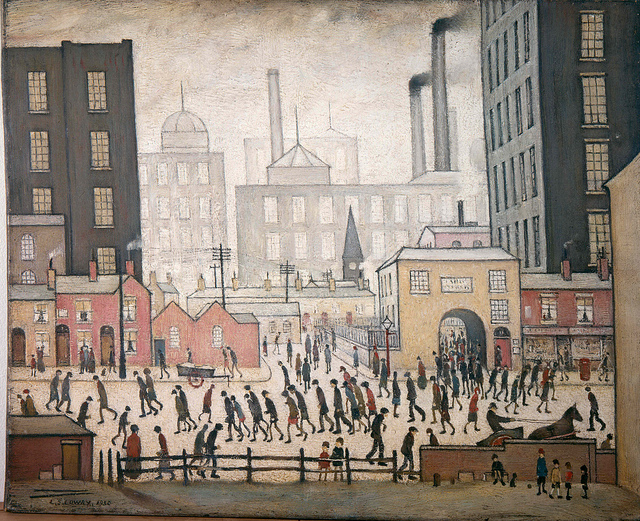
James Polchin contemplates the work of British painter L.S. Lowry:
Lowry’s paintings are rarely intimate and instead take a more sociological vision. We encounter his scenes from a distance, perhaps reflecting his own place in these neighborhoods as the weekly rent collector. He composed these landscapes like a stage set, conjuring the reality that working class lives, by the very overcrowded conditions of their domestic worlds, were so often lived in public. This distance compels a sense of mysteriousness about these lives, at the same time as it presents them on the canvas for us to consider. There is no pretense that Lowry or the spectator can really know anything about these scenes beyond our spectator view. …
Amidst this distance is a silence that permeates these canvases. … [E]ven in the street scenes such as “People Going to Work” (1934) or “Returning from Work” (1929) or “Coming from the Mill” (1930), there is an isolating stillness that surrounds so many of those fragile figures bent forward, moving along alone. You begin to wonder about their lives. The more you look at these paintings the more you realize how much they rest on mysteries.
(Image: Coming from the Mill, L.S. Lowry, 1934, courtesy of Flickr user mrrobertwade (wadey))
Michael Malice is the author of the forthcoming book, Dear Reader: The Unauthorized Autobiography of Kim Jong Il, which is “based on what is presented as fact in the DPRK.” In an article about his visit to North Korea, Malice explains why North Koreans tell outlandish tales:
The laws in North Korea are oppressive, but they aren’t completely ambiguous or arbitrary. They generally boiled down to three principles: 1) Don’t denigrate the Leaders, 2) Don’t denigrate the government, and 3) Don’t acknowledge anything is wrong. It’s this last one that explains so much of the apparent insanity behind so much of what North Koreans say.
On the limits of the propaganda:
It may be easy to convince an isolated population that they have “nothing to envy in the world,” as one of their popular songs goes. But it’s practically impossible to convince them that they have more food this year than they did last. Even if that’s the fault of Yankee imperialist bastards, Kim Jong Il either authorized the actions or was powerless to stop them. The famous Kim Jong Il stories (“He has perfect pitch!” “He can shrink time!” “He can change the weather!”) serve a very real function: they’re political ads designed to convince a skeptical, not credulous, populace that the son is the equal to the father.
It was one of those summer days in this charming little ashtray of a town when a break from blogging means a trek through marshlands and dunes to dip and bathe in the outgoing tide of the lagoons at the very end of America. This space never ages – even after twenty consecutive full summers of being here. Then the sweaty bike-ride back home and a stop at the East End coffee shop, Wired Puppy, and a small freddo. If I catch the timing right, the setting sun catches a particular tree up a side-street, and sometimes, it just shimmers. And then, at low tide, freshly caffeinated, I take the dogs out without leashes onto the flats of the bay.
Dusty comes alive again, like a puppy, scampering away from me toward the next smell or fishbone. Eddy lingers behind, sniffing behind boats tilting on their side, like beached toys. The light dims and then, if you’re lucky, the bay suddenly blazes with reflected light from the other side of this little curved peninsula. The boats turn golden.
The most popular post of the day was “Breaking: Man Gets Off Online” about sexting, politics and the future. The second was my post on the nuanced racism of Victor Davis Hanson, given an extra kick by Conor here.
If you’re one of the 33,000 readers who read this blog daily, have used up all your “read-ons”, but have yet to subscribe, [tinypass_offer text=”please do”]. We need you – and it’s only $2 a month or $20 a year. The more of you who subscribe, the more we can give back. If you have subscribed, thanks so much for joining this experiment.
I’ve been reading the suicide thread and I just don’t understand how suicide is selfish. When torture victims break, we don’t call them selfish. People can be tortured by their brain’s messed-up chemistry as brutally as they can be tortured with stress positions and sensory deprivation. People break. That’s not a character flaw. Too much pain and a person will do whatever he or she has to to make it stop.
Another:
What could be more selfish than other people presuming that we should stay alive just to meet their needs? How is that not as, if not more, selfish than the selfishness they associate with individuals who take their own life? It’s my life, not theirs.
More readers share their stories:
I’ve known five people who have committed suicide. I agreed with two of them. The other three were needless tragedies, from what I knew of their lives. The common thing between them all: they were suffering, in one form or the other.
The first ones were early in my life, and they were young as well. Most took their life with a firearm and left their family and friends emotions and well-being as mangled as they had left their corpses. They became unmitigated tragedies akin to murder.
In my 20s, a woman that I had grown up with killed herself. However, in her case, I knew why she had ended her life and I could understand her reasons. She had been fighting serious medical problems her whole life and in final years, the complications were severe. She had a horrible quality of life and she talked about suicide for several months before committing the act. My regret is that she used such a brutal method to end her suffering because she didn’t know any better.
Over the years, I have acted as a hospice caretaker for my late friends and I have witnessed the agony of their last days. Hospice does help, but we as a society are geared to having someone live to the end of their days, regardless of their desires or how bitter and traumatising the outcome and stigmatizing their death if they should choose to end their struggle early.
The one exception to this pattern was a friend who, suffering with late stage colon cancer, chose to stop fighting, live his life as best he could for as long as he could, and when it got bad enough, he committed suicide. The outcome was different. No horror or trauma. His friends and family were deeply sad, but we were glad his suffering had ended. He planned it, he had a farewell party, and he went peacefully. Death was going to have him, but he choose and controlled his terms to meet death. I cannot disagree with him on choosing that path.
The subject of suicide (and euthanasia) is troublesome and complex. We have no cultural framework to deal with them in a constructive manner. We need to talk about end of life issues more and quit shoving the subject to the fringes of society. I suggest that in the course of discussing suicide, we must recognize that it can offer an end to suffering when death truly is the only way out.
Another:
A dear friend of mine from college, an Iraq war veteran, took his life in 2011. His funeral service was the most difficult experience I had ever endured. He was 24 years old and had so many who loved him. We played rugby together and the men’s and women’s teams from our college both attended. We were all so devastated.
The reception was better. We shared funny stories and loving memories. Some of his artwork was on display. There were so many pictures of him laughing and smiling. I don’t know if it was to punish myself or blame myself for not seeing it, but when I got home I looked through every one of the pictures of him on Facebook to see if there was some glimpse of what drove him to suicide. Two years later we all try to remember him and smile, but I find the fact that he would only be 26 now so painful. Suicide leaves wounds.
Then last year my cousin took his own life. I experienced a new level of “difficult.” Sometimes I feel so selfish because he took his life just hours after midnight, hours after my birthday had finished, and I don’t know if I’ll be able to really celebrate again. My birthday is tomorrow. I was in Mexico at the time, got back three days later, and called my mother to say we had landed back in the states. That’s when I heard the news. I was in the middle of the Atlanta airport, sitting across from my fiance, and I have never felt more lost in my life. He was a hero firefighter. He was a devout Christian. He was always donating money and his time to charity. A little over 24 hours before he took his life, he had organized an ran a charity event that raised thousands. Over 900 people came to pay their respects at his wake. 900!
At the funeral our family was there for six hours, as mourners came through non-stop. Didn’t he know that he had this effect on everyone? Is it worse if he didn’t or if he did know and didn’t feel like it had enough meaning to stop him? Nearly one year later the wounds on our family, especially his parents and siblings, are as fresh as ever. I love him so dearly, but sometimes I feel so mad and selfish that he would make us feel this way. If he is at peace, does it make our pain less important? I’m still lost.
Benjamin Wallace-Wells profiles growth skeptic Robert Gordon, who believes the US economy will never regain its 20th century preeminence:
There are many ways in which you can interpret this economic model, but the most lasting—the reason, perhaps, for the public notoriety it has brought its author—has little to do with economics at all. It is the suggestion that we have not understood how lucky we have been. The whole of American cultural memory, the period since World War II, has taken place within the greatest expansion of opportunity in the history of human civilization. Perhaps it isn’t that our success is a product of the way we structured our society. The shape of our society may be far more conditional, a consequence of our success. Embedded in Gordon’s data is an inquiry into entitlement: How much do we owe, culturally and politically, to this singular experience of economic growth, and what will happen if it goes away?
[N]eighborhood watch programs might be good at reducing crime—but only in neighborhoods where there isn’t much crime to begin with. Minor crime reduction in low-crime areas is worth celebrating (really, it is—no one should have to live in fear that their house or car will be broken into, or that they will be mugged during a late-night stroll), but for the neighborhoods where we need additional security and measures of protection the most your local neighborhood watch isn’t going to be able to do much good.
Update from a reader:
The article you linked to was poorly-reasoned. The latter does not follow from the former:
“The primary problem … is that the areas with highest crime rates are the most reluctant to organize…. Many people refuse to host or attend community meetings, in part because they distrust their neighbors,” – National Institute of Justice study.
“So neighborhood watch programs might be good at reducing crime—but only in neighborhoods where there isn’t much crime to begin with… For the neighborhoods where we need additional security and measures of protection the most your local neighborhood watch isn’t going to be able to do much good,” – Daniel Luzer.
The quote says no such thing; the fact that there are less neighborhood watches in areas with high crime rates is discussed, but their effectiveness where they exist is not.
Seems like a minor point, but it matters to me. I live in a high-crime city with horribly low police levels and high levels of citizen distrust of the police that deign to work here. Just Monday my friend called 911 when someone tried to get into her house (behind a closed gate) – after nine rings, she gave up. However, our neighborhood responded immediately. Our ‘hood email is very active, very talkative, and very social. In fact, it’s why I’ve stayed for 12 years. We know 50 of our neighbors very well, 50 more to talk to in the street. We socialize regularly. We garden together, make wine, trade backyard livestock and know-how, and of course, party. We’re not a formal “neighborhood watch,” but we definitely send a “we’re not easy marks” message to criminals – having interrupted a number of crimes in progress.
We’re a mix of medium, low and very low income, and a mix of education levels from no high school graduation to doctorate. We’re a mix of ethnicities and sexualities. When there’s someone we don’t know walking around, an email goes out to the neighborhood list and other eyes give the person a second glance. Is it a scary sort of tribal, us/not-us vibe? It can be, and we actively guard against it. Is there racial hostility? We are very aware of that; an African-American man who has lived in the neighborhood for 30 years was “flagged” on email by a newbie who didn’t recognize him. It’s a great, ah, growing opportunity for us to recognize our own racism, and pull that infection out.
Our frequent face-to-face interaction is the key. It allows us to be idiots and change our ways; it allows us to have fun together; it allows us to be generous and to accept generosity. It’s a pretty great place to live. Our next party is a Blazing Saddles-themed potluck and movie night, a week from Saturday; the Tuesday after that, we’re having a BBQ for National Night Out.
I strongly encourage everyone to meet their neighbors. It takes a critical mass of involvement and good will to have what we have, so it won’t necessarily be easy or immediate – but you never know until you try. The biggest benefit is the love and sense of community we get here, and it is truly awesome.