Vandals And Saboteurs, Ctd

In the NYT, there’s another account of the bizarre doings of a Congress that, despite an 83 percent disapproval rating, is far more concerned about nullifying the results of the last election through sabotage and gridlock than bringing about any change other than the kind of crude austerity that has clearly failed in Europe. The legislative nihilism is matched by total disrespect for the president. I’m not talking about robust criticism; I’m talking about the contemptuous dismissal in a statement like this:

“These are tough bills,” acknowledged Representative Harold Rogers, the Kentucky Republican who leads the House Appropriations Committee. “His priorities are going nowhere.”

I’m not surprised that dude is a white guy from Kentucky talking about a black president, I’m sorry to say. Chait, who specializes in Republican pathologies, profiles the House:

The Republican Party has spent 30 years careering ever more deeply into ideological extremism, but one of the novel 173293592-SD-600x400developments of the Obama years is its embrace of procedural extremism. The Republican fringe has evolved from being politically shrewd proponents of radical policy changes to a gang of saboteurs who would rather stop government from functioning at all. In this sense, their historical precedents are not so much the Gingrich revolutionaries, or even their tea-party selves of a few years ago; the movement is more like the radical left of the sixties, had it occupied a position of power in Congress. And so the terms we traditionally use to scold bad Congresses—partisanship, obstruction, gridlock—don’t come close to describing this situation. The hard right’s extremism has bent back upon itself, leaving an inscrutable void of paranoia and formless rage and twisting the Republican Party into a band of anarchists.

And the worst is not behind us.

He believes that Boehner’s days are numbered:

The fall will bring a quick succession of events — a possible government shutdown and a debt ceiling fight — merely to avoid calamity. If Boehner gets through those events, plus stiffing conservatives on the Benghazi investigation, he’ll be facing a potential open rebellion even before he tries to cut some kind of deal on immigration. If Boehner holds on to his job through the next election I’ll be surprised and impressed. The walls are closing in on him.

Solitary For Life

Solitary confinement has a way of outliving its justifications. First it was supposed to inspire spiritual reflection and penance, then it became a last-resort punishment. Now, Rob Fischer reports, isolation units serve as long-term housing for gang members:

Ninety-eight per cent of inmates in Pelican Bay [State Prison]’s [security housing units (SHUs)] are there because they have been “validated” as prison-gang members, based on any number of criteria—some were identified by other inmates, others by tattoos or artwork. The gangs aren’t so well represented in solitary just because their members commit more serious infractions, though that’s almost certainly true; rather, it’s because SHUs are the [California Department of Corrections and Rehabilitation (C.D.C.R.)’s] gang-fighting strategy. The only way out is to disavow membership, and the only way to do that is to “debrief,” or inform on other gang members.

Most of the major prison gangs have “blood in, blood out” policies, under which an assault is part of the initiation and death is the only way out—and that can extend to members’ families. The debriefing requirement leaves some inmates with no good option but to languish in the SHUs indefinitely. It can be a particularly dispiriting state of affairs for those eligible for release. Parole boards require certain benchmarks of good behavior, like work participation and education attainment, that aren’t offered to inmates in SHUs. As a result, anyone in a SHU who has been sentenced under California’s three-strikes laws, which impose minimum-to-life sentences on third-time offenders, faces the serious possibility of a de facto life sentence in solitary confinement.

Fischer notes that Pelican Bay once capped SHU stays at 180 days; today, nearly half of its 1,100 inmates in solitary confinement have lived that way for more than 10 years. More Dish on solitary confinement here, here, and here.

Baby Talk

How we talk about royal spawn has changed over time:

[B]aby-body talk—especially when it comes to the Hanoverians and the Windsors and the Private Eyelike—hasn’t always been so forthright. Conversations surrounding royal pregnancies have mostly been a matter of indirection. Of course, this isn’t surprising, given that the word “pregnant” remained taboo until the 1950s, according to the Online Etymological Dictionary. Dainty euphemisms included “in a family way” or “with child.” (There were some cruder alternatives: Eighteenth-century slang used the non-euphemistic “poisoned” to connote the condition. According to A Dictionary of Slang and Unconventional English, “in the spud line” was at one point an alternative.) In 1857, when Queen Victoria gave birth to her youngest child, the official announcement was careful to avoid any unseemly agency with tactical deployment of the passive voice. “This afternoon, at a quarter before two o’clock, the Queen was safely delivered of a Princess …” read the official announcement.

(Image: Private Eye’s cover announcing the birth of the new prince)

Vlad The Popular

Christopher Read explains why, despite Vladimir Putin’s brutal tactics and corrupt regime, the Russian president maintains favorable numbers:

Putin gained immense popularity in 2009 by publicly taking to task one of the richest Russian-based oligarchs, Oleg Deripaska, for shortcomings in his aluminium-smelting factory in Leningrad province. Putin’s style has certainly been authoritarian, but to see oligarchs as human rights victims is to stretch the definition.

Other elements of his popularity have been a more assertive international stance in which Russia shows independence in the face of American and western opposition — currently manifesting in the crisis in Syria, one of Russia’s oldest allies — and a relatively successful economic policy which saw a period of growth, falling unemployment and rise in real wages, sometimes achieved by increasing state intervention in the economy, including the re-nationalization of factories and industries.

Obviously, none of this was popular in the West, since they curtailed Western influence over the country, limited business opportunities and, supposedly, revived Soviet-era ghosts. The response of the Russian population, apart from its oligarchs and intellectuals, has been much more favorable and, even though they are slipping, Putin’s poll ratings remain very high.

The South vs Social Mobility, Ctd

Al-Ga-Ms-SC-1

The popular thread continues: A reader points to this analysis of how ancient “black soil” helped make the South (Cretaceous rock units -139-65 million years old – are shown in shades of green. Older rock units are in gray, younger ones in yellow):

During the Cretaceous era, 139-65 million years ago, shallow seas covered much of the southern United States. These tropical waters were productive–giving rise to tiny marine plankton with carbonate skeletons which overtime accumulated into massive chalk formations. The chalk, both alkaline and porous, led to fertile and well-drained soils in a band, mirroring that ancient coastline and stretching across the now much drier South. This arc of rich and dark soils in Alabama has long been known as the Black Belt.

But many, including Booker T. Washington, co-opted the term to refer to the entire Southern band. Washington wrote in his 1901 autobiography, Up from Slavery, “The term was first used to designate a part of the country which was distinguished by the color of the soil. The part of the country possessing this thick, dark, and naturally rich soil …” Over time this rich soil produced an amazingly productive agricultural region, especially for cotton. In 1859 alone a harvest of over 4,000 cotton bales was not uncommon within the belt. And yet, just tens of miles north or south this harvest was rare. Of course this level of cotton production required extensive labor …

Another:

Your reader’s email providing “answers” on the South and social mobility leaves me with questions. “Where can someone right out of high school rise to a six figure income right away without working on an oil rig?” I’m not sure, but I am highly skeptical that the answer is “natural gas”. First off, a lot of these jobs being created in energy and natural gas in particular are not the sort of jobs you get right out of high school. Second, here are some salaries for available natural gas jobs in the Keystone state from a quick Google search (from Indeed.com):

338 available jobs making $30,000+
218 making $50,000+
105 making $70,000+
39 making $90,000+
and only 13 making $110,000+

Finally, even if there are a ton of great jobs waiting for any high-school grad, this article from Philly.com puts the total employment picture into perspective:

Even if shale-gas development has created 245,000 direct and indirect jobs – the number used by the Pennsylvania Department of Labor and Industry, and touted by industry trade groups – that still amounts to only 4 percent of total employment in a state with 5.7 million jobs.

(As an aside, it’s also worth noting that most energy analysts, and the President of the United States, recognize that in reality natural gas will almost certainly benefit MORE from efforts to address global warming – with or without fracking – than any other energy source.)

Maybe I’m wrong, and digging something out of the ground is a better route to economic mobility than cultivating a creative skill-set that provides unique, real-world value. I remain, however, unconvinced.

Another:

I had the opportunity to reflect on your thread this morning, as I left the interstate in a torrential downpour, and instead commuted to downtown Memphis via US-51, in a route that took me through the Whitehaven suburb of Memphis, directly past Graceland. I’ve lived in the Memphis area my entire life, and I can remember the same area in the early 1980s, when it was a much whiter and more affluent area. I also have been witness to the slow decline over the past decades, and this morning spent the ride dodging flash flooding and reflecting on the white flight that has occurred in Memphis, juxtaposed against the maps showing relative social mobility.

The problem isn’t the lack of social mobility, in my mind. The problem is that the post-civil rights area resulted in the mass migration of the affluent away from those who were already destitute. In so doing, the entire economic base that supported the region shifted, and further entrenched the already stagnant economics of the minorities left behind while geographically consolidating the economic fortunes of the better off. There are abandoned factories and businesses, and crumbling schools all over this area, along with the scavenger pawn shops and dollar stores that moved in to fill some of the voids.

This, to me, is what I think of when I read about the lack of social mobility. Everything that might have contributed to mobility was simply relocated, and the skeletons left to rot.

Nice Work If You Can Get It

Packer examines the practice of “public figures commanding and getting spectacular fees for minimal work”:

If it isn’t fair to ask stars to refuse the money, it is fair to ask exactly what they do to earn it. One problem with the star system (aside from its appearance of corruption and conflict of interest, and its demoralizing effect on adjunct professors, journeymen power forwards, mid-level executives, freelance journalists, and career bureaucrats) is the pervasive mediocrity and corner-cutting that it encourages: the utter banality of corporate speeches written by staff, the abuse of researchers and ghostwriters by big-name authors, the ease with which a star athlete transitions into a business franchise or a commentary gig, the lack of face time with the prof that awaits CUNY students who register for “Are We on the Threshold of the North American Decade?,” a course whose instructor needed three Harvard grad students just to help him put together the syllabus. Nothing spells the end of real achievement like becoming a brand.

Urban Canyon

23_4

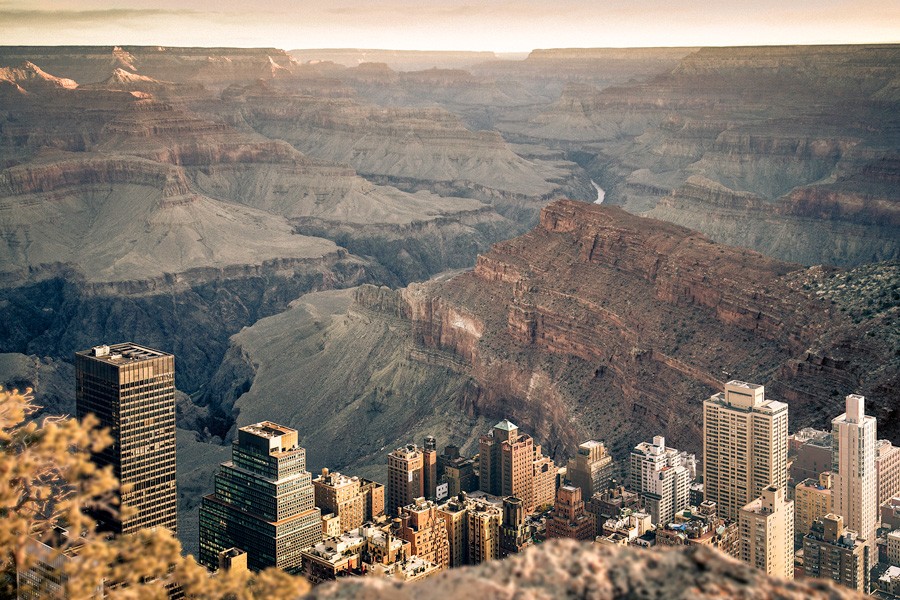
On his website, Swiss photographer Gus Petro explains the concept underlying Merge:

In this project two opposite places are merged into one: New York City, where, it seems like, everyone wants to live there, and Grand Canyon / Death Valley, which are unlivable.

Mark Byrnes spoke to the artist about his process:

To make it, Petro took the photographs he had of the two sites, matched their perspective points and lens angles, then put them through a process he calls “Photoshop magic.” And he’s been surprised by the reaction. “After showing the images, most of the people who haven’t been in either place thought it was real,” he says. “They began questioning me where it is. I didn’t expect that for sure.”

Smoking Bans And Hazy Science

Arthur Caplan points to a recent study suggesting that the health reasons for outdoor smoking bans aren’t backed up by strong data:

In getting these bans enacted three justifications were used: Smoking on beaches and in parks posed a health hazard to nonsmokers, especially children; cigarette butts were toxic to humans and animals and constituted an unacceptable form of litter; and public smoking by adults provided a dangerous model that threatened the future well-being of children and adolescents.

The problem is that the scientific evidence supporting each of these arguments is exceedingly weak. Consider the comments of some of the toughest anti-smoking groups in the nation about the best rationale for bans–the hazards of smoking in public to others. An official of the American Lung Association, concerned that efforts to ban smoking on beaches and in parks might deflect attention from more effective public health interventions, told [study authors Ronald Bayer and Kathleen E. Bachynski] in an interview, “I don’t think we should be making claims that are not supported by the data. If you try to tie it [banning smoking on beaches and in parks] to a health outcome, that’s where you get in trouble.”  A representative of the Campaign for Tobacco-Free Kids was even more direct in another interview: “There is not a lot of science around outdoor smoking bans…. There is some science, but you have to be very close to the smoke in an outdoor setting…. The last thing we want to do is put our credibility on the line with regard to the science.”

Where Is The Midwest? Ctd

A reader writes:

Your reader says that Pittsburgh cannot count as an East Coast city because it is 7+ hours from the coast. Then please explain to me why it belongs in the same region as Chicago (8 hours from Pittsburgh); Des Moines, IA (12); Lincoln, NE (14); and Rapid City, SD (19). Granted, the distance from Wilmington, NC to Shreveport, LA is a solid 14 hours, and no one thinks that North Carolina and Louisiana are in wildly different regions. I just get riled because frequently people from the East Coast actually have no idea how huge this country is, and make flippant statements like “Pittsburgh is too far from the coast so lump it in with the flyovers.” America is vast, and contains multitudes. Explore!

Another reader:

I was born and raised in the Midwest and lived in various states for 40 years, and it never ceases to amaze me how people conflate anything that’s not East Coast as Midwest. While I love my East Coast brethren, they are profoundly ignorant of the geography of this country. Pittsburgh is about as Midwestern as San Francisco. Wyoming in the Midwest? Huh?

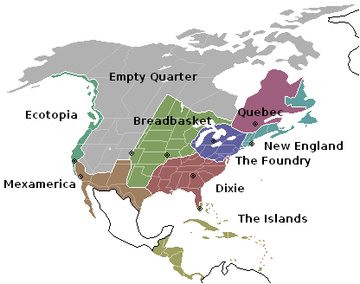
I have one very simple rule: if it’s in the 360px-NinenationsEastern Standard Time Zone, it’s not Midwest. To extend it, there are only a few tiny portions in Mountain Time that are Midwestern. Broadly speaking, there are two basic parts of the Midwest: the Great Lakes region and the Great Plains region. They may look similar to someone sitting in DC or New York, but they are different culturally, topographically and politically. But the best map and definition that’s ever been written to date is still Joel Garreau’s Nine Nations of North America. Garreau really nailed the specific differences and demarcation points (though I would lobby for an additional “nation” that picks up the Scandinavian quality of the people in the Upper Midwest into Canada).
Another:

Here’s a definition from a born-and-raised Midwesterner who often drives to its outer reaches: Midwest = Germans + Grids + Gardens

Germans: On this map of ethnic ancestry from the 2000 census, there’s a broad swath of German-plurality counties starting from central New York, through Pennsylvania stretching westward to the Rockies and beyond. Germans help define the southern border of the Midwest (though stray Finnish, Dutch and African-American counties are certainly Midwestern as well). Germans heavily influenced Midwestern architecture, food, religion, and its devotion to public education.  The “American” cultures of Kentucky and southern Missouri are southern – the accents change, Baptists predominate, and so does the food (it gets better down South, but that’s not Paula Deen’s doing). But not all German areas are Midwestern, so a limit to this is:

Grids. A central man-made feature of the Midwest is its grid pattern, which, thanks to the Land Ordinance of 1785 and Glaciation, stretches from south of Cleveland toward Cincinnati, and then west to the Rockies, defining the eastern and southern borders of the region. There are a few pockets where “queer” roads must follow the hills, such as around Bloomington, Indiana, or Athens, Ohio, or in the Ozarks. Those areas are on the fringes of the Midwest. Driving a Detroit-made sedan or pick-up truck down a straight state highway is a Midwestern rite of passage. So straight roads and flatlands (not Appalachian or Ozark zomias) help define the Midwest. This grid was made possible in part by Glaciation, which covered the land with very fertile soil. So the last characteristic is:

Gardens. (I couldn’t find a better synonym for farms that maintained the alliteration.) Anywhere that farming occurs on a wide scale and without irrigation is Midwestern, which defines the western border from about Joplin, Missouri, northward to Topeka, Lincoln continuing to just west of Fargo. Northern Michigan and Wisconsin are also peripherally Midwestern, and I suspect residents of those regions agree, though I can’t speak to northern Minnesota.

Putting this all together, Germans, Grids and Gardens means the Midwest begins in Downtown Cleveland, south to about Athens, Ohio, then west about Cape Girardeau, Missouri, with a bump up I-55 to St. Louis, and back down I-44 to Joplin, then north to Topeka, Lincoln, west of Fargo, to Canada.

Update from a reader:

Was that “born-and-raised Midwesterner” really suggesting that the defining characteristic of the Midwest is that it’s GGG?

Heh. One more reader:

There’s a historic line of demarcation that cuts right through some of the most contentious 100thmeridianstates. The 100th meridian quite accurately separates the lower-lying, well-watered eastern half of the Great Plains from the high-country, arid western half. Rainfall drops from two feet to a foot at the meridian; altitude crosses from under to above 2000 feet. In the past, east of the 100th was lush tallgrass prairie; west, sunburned shortgrass. Today, in the east, Mother Nature does a lot of the irrigating; in the west, farmers pump the aquifers and cosset every drop of rain. East is dairy cows; west is steers raised for beef.
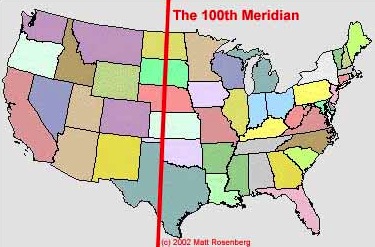
See where the U.S. highway system goes from a dense mesh to a loose net on this map? That’s the 100th meridian, and those roads speak volumes about the human population density on either side of it. Much has been written about the meridian – Wallace Stegner’s biography of John Wesley Powell is named for it, for example – and it remains meaningful to the regional culture today, as this 2011 article from the Pierre, South Dakota Capital Journal notes. I’d suggest that it’s what really divides the Midwest – a green and pleasant, neighbors-and-towns land – from the brown and solitary West.