The Salt Pinch

The travel bans are being lifted by some Northeast states this morning, but as Brad Plumer voxplains, our salt problems persevere:

“We’ve become salt-addicted over the last 50 years, and we’re now discovering that there are all these hidden costs,” says Xianming Shi, an associate professor in civil and environmental engineering at the University of Washington. He estimates the US now spends $2.3 billion each year to remove snow and ice from highways. It then costs another $5 billion to pay for the resulting damage. And that’s not even counting the cost of salting cities or rural roads.

So, in recent years, some officials have been looking for ways to reduce their reliance on road salt. There are tricks like pre-salting roads before storms hit — which prevents ice from sticking in the first place. There are exotic remedies like adding beet juice to salt, which can lessen the ecological harm. Engineers like Shi have been working on more futuristic technologies — like “smart” snowplows that are thriftier with salt, or ice-free pavement.

“The Most Feminist Show On Television”

That’s what Amy Sullivan calls The Fall:

The show, which stars Gillian Anderson in her first major television role since The X-Files went off the air in 2002, came under heavy criticism when the first season aired in 2013 for complaints that it glamorized violence against women. Serial killer Paul Spector (Fifty Shades of Grey’s Jamie Dornan) revels in the “aestheticism” of posing the nude bodies of his victims, washing their skin and painting their nails after he’s killed them. Some critics thought the show went beyond simply telling a story to the point of sharing Spector’s obsession with the women’s bodies.

I can certainly sympathize with fatigue over the seemingly endless tally of dead women on television. … But the debate over The Fall’s first season obscured the show’s revolutionary treatment of women and the topic of sexual power. In fact, I haven’t seen another program that so directly challenges and rewrites the traditional conventions of crime dramas, starting with Anderson as DSI Stella Gibson, a highly-regarded London cop who gets called to Belfast because investigators there need her expertise on a murder case.

Refreshingly, none of the tropes we’ve been trained to expect in a story about a powerful woman play out. Nobody resents Gibson’s appearance on the scene or questions her authority. Her gender is a non-issue; subordinates hop to when she enters a room and they follow her commands without question. Gibson doesn’t try to submerge her femininity and stomp around barking out orders. In Anderson’s restrained yet compelling performance, Gibson is cool, calm, and always chic, with the most fabulous coat in detectivedom.

I discovered it a couple weeks ago and now just have the final episode to watch. I can’t express how smart the series is, and how superb and commanding Gillian Anderson is as Stella Gibson. This is the feminism I believe in: a woman totally in charge of her life and of her career, whose authority is unquestioned, whose complexity and brilliance are celebrated, who utterly owns her sexuality and deploys it as coolly and as aggressively as any man would. At no point did I fear for a vulnerable Stella Gibson, even as I was deeply moved by her own female take on the victims of rape and murder, and even though she was obviously at times in great danger. I saw instead a master investigator whose nail-biting duel with a disturbed (and way hot) serial murderer became gladiatorial. Somehow gender slipped away from relevance, even as Anderson’s gender was absolutely integrated into her entire character. That’s new and powerful. It makes Girls seem as adolescent as it actually is.

Charlotte Alter is also a fan of the BBC series, now available on Netflix streaming:

[T]here’s little doubt that The Fall is great for women. …

[Stella is] brilliant, unflappable, and sexually liberated — she makes a habit of selecting male co-workers for one-night-stands, then quickly discarding them. When a male colleague questions her about her sexual habits, she coolly points out his double standard by comparing his alarm to the ease with which he handles men doing the same thing. “Woman f—s man. Woman, subject: man, object,” she says. “That’s not so comfortable for you, is it?”

Madeleine Davies joins the chorus of praise:

Gibson is the type of detective who will continue to remember the women murdered as people rather than cases and, when alone, will weep for them. She’s also the type of detective who can break a man’s nose with a quick upper cut or, with calculating detachment, sit across from a dangerous criminal in an interrogation room as he hurls abuse at her. She’s smart, brave, capable and unapologetically sexual—a matinee idol for a modern-day feminist.

Some have said that The Fall—a series that’s second season arrived on Netflix this past weekend—is misogynistic, but it’s a shallow critique. While it’s true that women are frequently treated as objects or lesser in the show, they’re never treated as objects or lesser by the show. In fact, rarely has a series hit back at misogyny so relentlessly, sometimes to the point where it almost feels cruel in its portrayal of male characters, all of whom—even the most innocent—find ways to demean the women in their lives.

Alyssa Rosenberg also examines how the show portrays men:

[The Fall] raises an issue that is a live current in U.S. debates over gender and sexual violence, suggesting that all men are capable of terrible things. That’s the sort of sentiment that anti-feminists accuse feminists of using to smear innocent men, and that most U.S. feminists would aggressively deny believing. But by leaning into it, “The Fall” has made fascinating, discomfiting television.  “I think one of the reasons why ‘The Fall’ has some of the impact that it seems to have is because it posits the notion that Spector is on a continuum of male behavior,” [writer/director Allan] Cubitt told me at the Television Critics Association press tour earlier this month. …

But there’s a subtlety to “The Fall” that prevents it from becoming some sort of railing stereotype. The second season looks hard at what [serial killer] Paul means to his family, particularly his daughter, and the ways in which the skills that make him a killer also make him a good, encouraging father to her. Humans succumb to their worst desires and impulses sometimes. But we also sometimes succeed in overcoming them.

It’s grown-up TV. You should watch it if you can. And that above scene is way hotter when it’s not edited by YouTube.

The View From Your Window Contest: Winner #240

VFYWC-2-4-0

Turns out this week’s contest was one of our most challenging ever, with only around twenty entries submitted, such as:

Oakland. Looking at the Claremont Hotel. A wild-ass guess, of course.

Another reader is seeing things:

Finally, an easy one. Clearly, this is not an actual window view. It’s an early landscape by the British Artist, Stephen Darbishire, in the years prior to his Impressionist period. I couldn’t find the print on his website, but it’s undoubtedly his. Thrilled! I got one!

Another was wondering about Virginia, West Virginia, or England:

There is no snow so I don’t think it’s New England. The gold trim around the window could indicate it’s an elegant old manor house or hotel. The determining factor will be the pine tree and where that particular fir grows. Someone will know as they always do!

Sadly no amateur arborists this week, but this reader gets us to the right continent at least:

I’ve come to admire the people who just send in a gut response almost as much as the ones who spend hours puzzling out a more likely answer. So, in the midst of a bout of insomnia waiting for the sleep aid to kick in, I have spent about five minutes on this.

This picture is obviously Europe. Or, alternately, constructed by Europeans. Though the lack of leaves and presence of evergreens suggest Europe if the picture is a recent one. I suspect that the distinctive forward facing arch of the building in the foreground has a architectural term associated with it and is an excellent clue, though I know few architectural terms myself. My first thought was Germany. I randomly picked Nuremberg but saw no roof lines anything like that. My next thought was Scandinavia, though I quickly abandoned that as much too flat. In pursuit of less-flat terrain I thought perhaps Zurich, then Geneva. In the one random photo of Geneva I looked at there was a building with a similar arch. So, in five minutes flat, I have a guess.

Or farther East?

I’m pretty sure it’s not Vienna.  So I’ll go with Bratislava instead.  However, I’ll leave it to the real keeners to pinpoint the window.

You won’t get that from this reader:

I am definitely wrong; and way way too baked this morning to look further, but that picture sure did remind me of my visit to Wurzburg.

Germany was by far the most popular incorrect guess:

I’m one of your serious readers and not-at-all-serious contest contenders.  I know when I’m out of my league – no guesses at the specific location, and I may be off by a continent or two.  But the style of the buildings, the feeble light, and the swoop of the hills remind me of Baden-Baden. I recall a winter evening in a cheap, charming hotel, on a small ridge overlooking the street leading to the Kurhaus, with a view very much like this one.  Even if this is really Montevideo, the picture brought back a nice memory of a pre-kids sabbatical in Baden-Wurtenberg 20-some years ago.

A former winner is stumped:

Tough contest this week. A generic Germanic city, though it might be Swiss or Czech or … No real good clues like flags, signs or license plates that I can see except those two dome-roofed tennis (?) structures across the way. Searching for them or generic “German clock towers” has gotten me nothing. So I’m just going to say Heidelberg, Germany, because it could be, and Heidelberg does have two clock towers in relative proximity. Not that I can find those tennis (?) courts anywhere across the Neckar River…

Almost had it. This reader half-gets the right country:

Somewhere in Czechoslovakia or possibly Hungary. We’ve been everywhere on this one, from Hungary to Montreal. But we’re convinced this is a public structure like a museum – one of our team spotted seated lion structures on a wrought iron fence – but beyond that we’re stumped.

Only four readers guessed the right city:

I better start attempting guesses even though these are inscrutable to all but well-traveled readers. The shapes in the architecture, as well as the Soviet-era dilapidated buildings, strongly suggest Prague to me. I was there in the ‘90s on a choir tour, just while Prague was on the verge of being assimilated into the McDonald’s form of Western civilization.

A former winner picked Prague as well:

I’m stuck. I keep ending up back in Prague so I’ll guess that, but … WTF are those domes and why can’t I find them?! sldjfoiwejfsalkdfjaskhdgaghd

A winless 17-contest veteran takes the well-earned prize this week:

I didn’t get as much time to work on the puzzle this weekend as I’d have liked. It’s obviously Europe, but that’s about as far as I’ve gotten. I’m going to guess Prague knowing that I could be half a continent off and just be ok with that feeling.

So where was it in Prague exactly? Our Dishness-channeling photographer weighs in:

Very very cool. I’ve been reading The Dish since The Atlantic days and used to send you guys a lot of material when I worked at Radio Free Europe/Radio Liberty, especially during the Iranian revolution-that-wasn’t a few years back – so selecting my view for the contest is really something for me.

Specifics: Taken from the south-facing window of a villa at Dykova 12, Prague, Czech Republic, at the headquarters of Socialbakers, where I work as Chief Editor.

Some more: This is taken from Prague’s Vinohrady neighborhood in a little part adorned with turn-of-the-century villas – some of them are very striking, others, depressingly in disrepair. This view is to the south, overlooking the Vrsovice area. It’s a bit industrial and a bit residential (I live just out view of this photo). The one thing it doesn’t have is a baroque or gothic tower of some sort, which is sort of what people expect from pics of Prague, I think.

I’ve lived in Prague for more than six years, and I still find it strikingly beautiful and exceptionally photogenic. The distinct orange tile roofs, rolling landscapes, and sort of dark, industrial, working-class fabric of the place is great. Charles Bridge is fine, Old Town Square is striking, and Prague Castle is huge. But a lot of the Czech Republic’s beauty lies far from Prague’s main attractions.

As you can sort of make out in the shot, just a few kilometers from the middle of what would be considered “the middle of the city” there is … not much of anything. Villages, fields, forests, and castles – lots of castles. The perfect stomping grounds for a couple of parents with an active little family.

Lastly, as you probably noticed, we didn’t receive an entry from Chini this week. Whether he was stumped or somehow otherwise prevented from playing (stuck in a snowbank?), it breaks the chain of the most consecutive correct guesses that this contest will ever see. We tip our cap.

See everyone Saturday!

The Immorality Of Repealing Obamacare

Michael R. Strain dismisses it:

In a world of scarce resources, a slightly higher mortality rate is an acceptable price to pay for certain goals — including more cash for other programs, such as those that help the poor; less government coercion and more individual liberty; more health-care choice for consumers, allowing them to find plans that better fit their needs; more money for taxpayers to spend themselves; and less federal health-care spending. This opinion is not immoral. Such choices are inevitable. They are made all the time.

Chait pushes back:

Rather than wade into the trade-offs created by repealing Obamacare, [Strain] simply asserts the conclusion is obvious:

“Repealing Obamacare could — although wouldn’t necessarily — result in more people dying. But it clearly would not be immoral.” I don’t understand how this sort of language (“it clearly would not be immoral”) could be used to defend any moral choice. Moral choices are subjective by definition. Some people believe the level of medical deprivation caused by repealing Obamacare would be moral. Some people think it would be moral to force the staff of the American Enterprise Institute to engage in gladiatorial bouts to the death for our amusement. The problem here isn’t that Strain offers the wrong answer but that he offers the wrong kind of answer.

I personally consider the kinds of trade-offs caused by repealing Obamacare wildly immoral. Repealing Obamacare does not raise questions about luxuriously expensive treatments. It raises questions about access to basic forms of care that, in my opinion, should be available to all Americans.

Beutler piles on:

Conservatives want to enact sweeping changes to Medicare, but they don’t propose repealing that program and then replacing it at some later date. This is partly because any party platform that included outright Medicare repeal would lose, but it’s also because conservatives recognize that it would be an immoral way to treat elderly people who budgeted their retirement savings with the expectation that their medical bills would be mostly covered. The moral and political implications parallel each other.

But that’s exactly what conservatives want to do with Obamacare.

The Party Of No And Dunno

A reader writes:

I hope a lot of voters were watching CBS on Sunday night when 60 Minutes interviewed Boehner and McConnell to talk about their plans now that the GOP controls the House and Senate. Both men acknowledged that the economy has been recovering and that the recovery has been picking up steam. They also acknowledged that the recovery has mostly only benefited the top income-earners while leaving the majority of Americans stuck in neutral. Boehner and McConnell want to “do something” to address income inequality and make sure those on the bottom of the economy have the opportunity to move up. They basically accused Obama of only helping the top 1% (which seems a complete reversal of the stories we’ve been hearing from them the last six years, but I digress).

This all sounds good enough to me, since for so long, it seemed the GOP was unwilling to even acknowledge there was an issue with inequality. If they want to blame Obama, I don’t really care so long as they are willing to present solutions.

So, the interviewer then asked if they would support raising taxes on top income earners. Answer:

No. The interviewer asked if they would support raising the minimum wage. Answer: No. The interviewer asked if they would support Obama’s plan to provide free community college. Answer: No. The interviewer asked if they would support Obama’s plan to expand the Child Income Tax Credit for working families. Answer: Maybe (Boehner mumbles about wanting to help working families but says he needs to further study this idea).

Boehner then said that he thinks the solution to raising wages and a more full recovery is the removal of “regulations” coming from Obama’s administration. The only example of such onerous regulations he gave is Obamacare (which I don’t know I would call a regulation, but semantics). He ignores that the economy grew more in 2014 (the first year of Obamacare) than any year since 1999 – which I acknowledge doesn’t mean that Obamacare was the catalyst for growth, but it does seem to indicate that it’s not a “job killer”.

The interviewer then asked about roads and bridges: would the GOP Congress find a way to put forward a comprehensive infrastructure bill? Boehner and McConnell both acknowledged that the Highway Trust Fund is underfunded and that our crumbling roads and bridges need to be addressed. However, they stated that they will not adjust the gas tax and instead try to find the funds “in other ways”.

I know you love to bang the drum of the GOP having no real policies or proposals, so I thought this interview was one of the most stark examples of that – and would be understood by a large number of underinformed voters. Boehner and McConnell acknowledge that there are real problems that need to be addressed. They are excited because they finally have the power to put some bills on Obama’s desk. Yet all they can do – still! – is say No to any suggestion while presenting no ideas or policies of their own for how to address those acknowledged problems.

It’s astounding to me and, frankly, a complete dereliction of duty. I’m no partisan, but I can’t see how we won’t look back at this no-nothing party and shake our heads at how they we allowed them to gain any power at all.

Update from a reader:

I am sure you’re going to get a lot of email about the eggcorn from your reader:

I’m no partisan, but I can’t see how we won’t look back at this no-nothing party and shake our heads at how they we allowed them to gain any power at all.

“no-nothing”!

hyuk hyuk.

Is iTunes On The Way Out?

Purchased Music

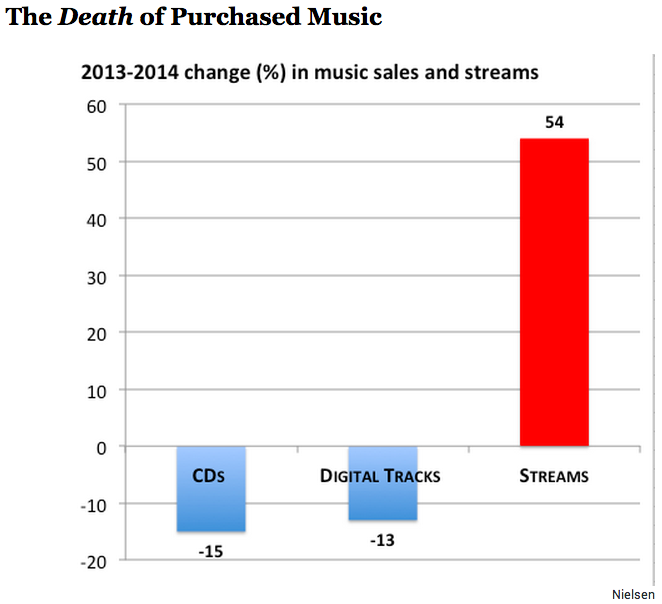
Derek Thompson finds that both CDs and digital music downloads “are down double-digits in the last year, with iTunes sales diving at least 13 percent“:

Digital track sales are falling at nearly the same rate as CD sales, as music fans are turning to streaming—on iTunes, SoundCloud, Spotify, Pandora, iHeartRadio, and music blogs. Now that music is superabundant, the business (beyond selling subscriptions to music sites) thrives only where scarcity can be manufactured—in concert halls, where there are only so many seats, or in advertising, where one song or band can anchor a branding campaign. …

The top 1 percent of bands and solo artists now earn about 80 percent of all revenue from recorded music, as I wrote in “The Shazam Effect.” But the market for streamed music is not so concentrated. The ten most-popular songs accounted for just shy of 2 percent of all streams in 2013 and 2014. That sounds crazy low. But there are 35 million songs on Spotify and many more remixes and covers on SoundCloud and YouTube, and one in every 50 or 60 online plays is going to a top-ten song. With the entire universe of music available on virtual jukeboxes, the typical 3.5-hour listening session still includes at least one song selected from a top-ten playlist that accounts for .00003 percent of that universe. The long tail of digital music is the longest of tails. Still, there is a fat head at the front.

Medicare Wants To Pay For Outcomes

Sarah Kliff puts a favorable spin on the news:

The Obama administration announced Monday a sweeping new plan that will directly affect thousands of hospitals and doctors across the country. The federal government now plans to pay Medicare doctors more if they help patients get healthier — and less if their patients just stay sick. This would be done by tying 85 percent of all Medicare payments to outcomes by the end of 2016 — rising to 90 percent by 2018.

The idea is to move away from the broken and expensive “fee-for-service” system, which pays doctors a flat amount for every surgery and physical they perform — even if they do nothing to actually help a patient.

Orszag is excited:

To be sure, more needs to be done: The targets have to be hit. And that will require action. Today’s announcement provided no details about the specific steps ahead. Will Medicare move more toward bundled payments for specific episodes of care, or toward accountable-care organizations, through which hospitals and other providers receive one payment for all the care a patient needs during a year? Such details are crucial.

The first step in any worthy project, though, is to set clear goals. We desperately needed them for payment reform. With today’s announcement, the administration has raised the odds that the era of slower growth in health costs will continue.

Suderman is skeptical:

This isn’t a plan. It’s a plan to develop a plan (or plans) in hopes of meeting a not-very-well-defined target.

Fine. The administration will eventually try to do something. And whatever that something is, it will likely be a bigger version of a program that has already been tried before. Medicare has tried out lots of experiments in alternative payment systems, attempting to influence provider behavior and health outcomes through bonuses, bundled payments, penalties, and various pay-for-performance measures.

And what we know from these experiments is that even in optimal conditions, it’s very, very hard to make them work.

Jason Millman admits that “it’s still uncertain how well these payment approaches work”:

“We still know very little about how best to design and implement [value-based payment] programs to achieve stated goals and what constitutes a successful program,” concluded a 2014 Rand Corporation study funded by HHS. The report, which reviewed pay-for-performance models implemented over the past decade, said improvements were “typically modest” and often hard to evaluate.

Sam Baker provides more background:

Some of the models HHS wants to expand were part of the Affordable Care Act, including Accountable Care Organizations. Networks of hospitals and doctors pull together into a single ACO, with the goal of tightly coordinating care for each patient. ACOs are billed based on their outcomes, rather than allowing each member to bill Medicare separately. Medicare even penalizes some ACOs if they don’t meet certain quality standards or savings targets.

ACOs have had mixed results: Although they’ve shown an improvement in quality, several providers have dropped out of the program, and Medicare hasn’t saved as much money as many advocates had hoped.

And John O’Shea recommends that, “before blindly pushing Medicare doctors and other medical professionals out of fee for service and over the cliff, the Obama administration should be sure they have a safe place to land”:

[M]edical professionals have found that ACOs are exceedingly difficult to implement. Research by the Medical Group Management Association found implementing and/or optimizing an accountable care organization was one of the top five challenges for members, with 60.2 percent of respondents to one survey saying implementing ACOs was one of the biggest challenges, making it the fifth most challenging issue overall. In fact, of 44 issues facing medical practices, the top challenge for Medical Group Management Association members was preparing for new reimbursement models that include greater financial risk for practices.


It’s High Time For More Marijuana Research

A major doctors’ group supports reclassifying cannabis:

There’s some very early, and largely anecdotal, evidence that marijuana might be an effective treatment for some forms of epilepsy in children who haven’t responded to traditional medications. It’s partly to help bolster these types of clinical studies that the American Academy of Pediatrics today recommended that the government re-classify marijuana as a Schedule II drug, a category that includes other addictive, yet still therapeutic, substances like oxycodone, morphine, and codeine. Currently, marijuana is considered a Schedule I drug, along with things like heroin and acid, which are thought to have no medicinal value.

German Lopez spells out why reclassification has proven so difficult:

When marijuana’s classification comes under review, its schedule 1 status is consistently maintained due to insufficient scientific evidence of its medical value.

Specifically, the scientific evidence available for marijuana doesn’t pass the threshold required by federal agencies to acknowledge a drug’s potential as medicine. HHS’s 2006 review of marijuana’s schedule found several problems: no studies proved the drug’s medical efficacy in controlled, large-scale clinical environments, no studies established adequate safety protocols for marijuana, and marijuana’s full chemical structure has never been characterized and analyzed.

But one reason there isn’t enough scientific evidence to change marijuana’s schedule 1 status might be, in fact, the drug’s schedule 1 status. The DEA restricts how much marijuana can go to research. To obtain legal marijuana supplies for studies, researchers must get their studies approved by HHS, the FDA, and DEA. (This process didn’t even exist until the late 1990s. Before then, it was nearly impossible to obtain marijuana for medical research.

Changing marijuana’s schedule, in other words, is a bit of a Catch-22.

Sullum sounds off:

Reclassifying marijuana would not automatically make it available as a medicine, but it would have several salutary effects, especially if marijuana is placed in Schedule III or lower. Facilitating research is one possible benefit, although if that is the aim rescheduling should be accompanied by the abolition of the federal government’s monopoly on the legal supply of cannabis for research. The AAP does not mention that change, but it makes sense in light of the organization’s position that marijuana derivatives should be treated like any other drug considered by the FDA.