The Ferguson Decision: Tweet Reax

https://twitter.com/michaelhayes/status/537070409720795137

https://twitter.com/juliebosman/status/537069535413563393

https://twitter.com/tanehisicoates/status/537073199985729536

https://twitter.com/sepinwall/status/537069780122238976

https://twitter.com/msjwilly/status/537073781807022080

https://twitter.com/DannyVinik/status/537076177614434305

https://twitter.com/jetpack/status/537082474187485185

https://twitter.com/PaulLewis/status/537088874418540544

https://twitter.com/JonathanBlakely/status/537091695746482177

The Best Of The Dish Today

Much more Dish coverage soon. Meanwhile, Elizabeth Nolan Brown offers a truce in the gender debate:

Perhaps rape is something best looked at as a phenomenon driven by a small number of serial predators that are enabled by the culture. Callous attitudes toward rape don’t “cause” rape, but they could—in aggregate—create conditions where it’s easier for rapists to do so. Do Valenti and company overstate the extent to which socialization influences rapists? Sometimes. But there’s also a tendency among conservatives and many libertarians to dismiss feminist talk of “rape culture” as patently absurd. And I like to think (or hope, at least) that this is partly a function of parties talking past one another.

It’s a piece, like many of Elizabeth’s, that’s well worth your time. My core principle in all this is about protecting free expression, even at the expense of social justice. Because without free expression, we cannot know what social justice can actually mean. There is an epistemological certainty on the cultural left that troubles me as much as the doctrinal certainty on the Christianist right. It is because we need always to doubt such certainties that free expression comes first. At root, I guess, I just don’t believe that some things must never be said and some debates must never be held. One side may go a long way toward winning … but we should never believe that a debate has ended. It can always be revived. I’ve battled both the conservative cultural police as well as the liberal version on this question. And while I’m more than happy to air as many dissents as there are, I’m not giving up on that basic principle. It’s called liberalism.

Today, I marveled at Merkel, took stock of Obama’s energy and climate legacy, and backed Rand Paul’s call for a formal declaration of war before the US ever goes into combat again. We aired the contours of the latest extension of the talks to restrain Iran’s nuclear weapon potential; and debated whether the executive branch was more of a Republican office than a Democratic one. Plus: the latest round in the fight to insist upon the facts over the myth of Matthew Shepard.

The most popular post of the day was This Is The Way Benghazi Ends …, followed by An Evangelical Changes His Mind On Gays.

Many of today’s posts were updated with your emails – read them all here.  You can always leave your unfiltered comments at our Facebook page and @sullydish. 22 more readers became subscribers today. You can join them here – and get access to all the readons and Deep Dish – for a little as $1.99 month. One long-time holdout writes:

I’ve been enjoying the blog since 2008.  I am sorry I haven’t subscribed until now.  What won me over was the View From Your Window contest.  I am completely hooked on it and was so excited to send in my (correct, I think) guess that I realized I really need to subscribe, if for the contest alone. How about more contests, like one from Tuesday to Saturday, to keep us occupied when we are impatiently itching for the next VFYW?

The contest already takes Chris but primarily Chas these days a ton of time to compile and edit each week, so having another one would be a bit too much to handle. But keep the feedback coming. A final email for the day:

What would happen if Sen. Rockefeller just released the torture report? If it is so important that the American people see it – and I agree that it is – maybe it is time for this child of privilege to take a stand for the sake of the republic. Would he be arrested? Tried? It just seems ridiculous to say “we will read it into the Congressional Record but they will probably stop us. Hmm, if only there was some way to get this report into the hands of the American people.” The Internet. Wikileaks. It’s not that hard.

The Dish is also available. Just sayin’.

See you in the morning.

Face Of The Day

Activists Hold Vigil In Support Of Immigrant Children At White House

Anti-immigration protesters shout “Go home!” to demonstrators during a vigil in support of children fleeing violence in Central American outside the White House on November 24, 2014. Organized by the Central American Resource Center, a Latino resource and justice center in the District of Columbia, students, activists and their supporters held the vigil to demand the Obama Administration continue to reform the immigration system. By Chip Somodevilla/Getty Images.

Teaching From The Head, Not The Heart

In a review of three recent books on education, Jonathan Zimmerman argues that “the biggest insult to the intelligence of American teachers is the idea that their intelligence doesn’t matter”:

“The teaching of A, B, C, and the multiplication table has no quality of sacredness in it,” Horace Mann said in 1839. Instead of focusing on students’ mental skills, Mann urged, teachers should promote “good-will towards men” and “reverence to God.” Teachers need to be good, more than they need to be smart; their job is to nurture souls, not minds. So [Getting Schooled author] Garret Keizer’s first supervisor worried that he might have too many grades of A on his college transcript to succeed as a high school teacher, and Elizabeth Green concludes her otherwise skeptical book [Building A Better Teacher] with the much-heard platitude that teachers need to “love” their students. Keizer is offended by comments like that, and he has every good reason to be. Do lawyers have to love their clients? Must doctors adore their patients? What American teachers need now is not love, but a capacity for deep and disciplined thinking that will reflect – and respect – the intellectual complexities of their job.

Sherman The Statesman?

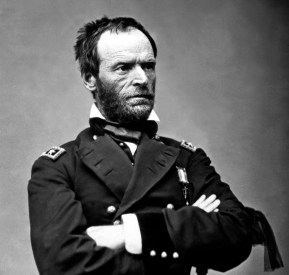
D.H. Dilbeck parses Robert L. O’Connell’s Fierce Patriot: The Tangled Lives of William Tecumseh Sherman, an “effusive new biography” that “frequently offers an outright apologia” for the Civil War general sometimes accused of war crimes and even genocide. Part of O’Connell’s revisionist take is to emphasize Sherman’s achievements over his often overblown rhetoric, especially when it comes to his role in the making of modern America:

O’Connell devotes the majority of this first portrait [of Sherman as a strategist] to Sherman’s Civil War career. In the summer of 1863, midway through the war, Sherman’s strategic genius blossomed. From then until the war’s WAR AND CONFLICT BOOK ERA:  CIVIL WAR/LEADERSend, he perfected a hard-edged strategy for defeating the Confederacy. Sherman realized defeat was “ultimately a state of mind,” which meant he had “to utterly demoralize the Confederacy by making it look helpless.” Only then would the resilient Confederate people abandon their bloody rebellion. This strategy culminated in Sherman’s march across Georgia and South Carolina in late 1864 and early 1865. Before embarking, Sherman assured a skeptical Ulysses S. Grant, “I can make this march, and make Georgia howl!” The second half of that cable, though less well known, is far more revealing: “This may not be war, but rather statesmanship.” That is, Sherman’s military strategy always had a political goal in mind: to woo Confederates back into the Union like a shrewd statesman. O’Connell also rightly notes that the deeds of Sherman’s army during the March did not match the most ominous words of their commander.

Susan Schulten details one fascinating aspect of Sherman’s war-time manuevering – his use of cutting-edge maps:

Whether we characterize Sherman’s campaign as excessive and brutal or necessary and swift, there is no question that it was among the most ambitious campaigns of the war, because to fulfill Grant’s directive, Sherman had to take his armies beyond the reach of Union supply lines. This was unthinkable to most contemporary generals, and required a superior body of cartographic intelligence. In short, Sherman needed maps.

Thanks to Capt. William Merrill, chief topographer of the Army of the Cumberland, Sherman got what he needed, and then some. By the summer of 1864 Merrill had assembled a crack team who continuously improved Union intelligence through fieldwork, traversing the land and collecting local knowledge. As a result they simply knew the terrain better than their counterparts, and mapped it with more detail, giving Sherman a decisive advantage as he closed in on Atlanta. These maps have been ably collected in the Sherman collection at the Library of Congress, and testify to the extraordinary work done by Merrill and his men, as well as by the Coast Survey, the primary federal mapping agency.

Sherman made extensive use of their work; he studied not just the physical topography of the region, but its material and human conditions. He pored over the 1860 census, asking where his troops might best forage and survive as they lived off the land. In fact, years earlier Sherman had asked the superintendent of the census, Joseph Kennedy, whether it was possible to design maps that represented not just the land, but its people and resources.

(Image: Matthew Brady’s 1864 photographic portrait of Sherman, via Wikimedia Commons)

Misshapen Cities

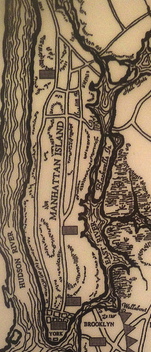
Another strike against Manhattan: Henry Grabar flags new research suggesting that circular cities are superior to their elongated counterparts. He notes a paper by MIT scholar Mariaflavia Harari, who “analyzed more than 450 Indian cities to elucidate what influence, if any, a city’s shape would have on indicators like rent, wages and commute time”:

What she found is that “compactness” — in her paper, the nearer, basically, that a city’s shape is to a circle — is a kind of urban amenity, like a subway line or a Manhattan movie theater, that people will pay for. All else being equal, India’s compact cities have lower wages, higher rents and shorter commutes. “One standard deviation deterioration in city shape, corresponding to a 720 meter increase in the average within-city round-trip,” Harari writes, “entails a welfare loss equivalent to a 5 percent decrease in income.”

An instructive comparison is between Kolkota (Calcutta) and Bengaluru (Bangalore). Among the country’s largest cities, these are on opposite ends of Harari’s measurement system: giraffe-like Kolkota has the “worst” geometry, squat Bengaluru the “best.” According to Harari, “if Kolkota had the same compact shape that Bengaluru has, the average trip to the center would be shorter by 4.5 kilometers and the average trip within the city would be shorter by 6.2 km.” Just a couple of miles difference, right? But the average commute speed in India is 12 km per hour, and is forecast to fall to 9 km per hour within the decade. For the average person, on an average potential trip, compactness could save an hour a day

(Map of Manhattan via Flickr user Nick Normal)

The Culture Wars And … Manners, Ctd

Alyssa Rosenberg revisits the debate over manners:

Civil disobedience often tests the desire of powerful organizations to be seen as legitimate and bound by clear rules and standards — it is, essentially, a test of manners and norms. There is something radical about making such a request for civility and good manners upward, and to turn powerful people’s sense of their own sophistication and goodness against them.

Asking someone who would not use racial slurs against Jews or African Americans why he or she is uncomfortable extending that same courtesy and consideration to Native Americans will force a genuinely good-hearted, thoughtful person to confront his or her contradictions. Asking someone like physicist Matt Taylor whether he considered the feelings of his female colleagues and science fans everywhere before putting on that stupid bowling shirt would probably make him think twice.

At the same time, she concedes that these “conversations and requests for polite considerations will not work with all people, and they are certainly not a solution to the significant structural problems of race, class, gender, sexual orientation and gender identity that confront us today”:

But fighting the big fights takes tremendous energy. If we can save each other some of the constant little stings that sap our resources, I’m all for adding etiquette to the list of demands.

Drum, meanwhile, recommends that we “recalibrate our cultural baselines for the social media era”:

People can respond so quickly and easily to minor events that the resulting feeding frenzies can seem far more important than anyone ever intended them to be. A snarky/nasty tweet, after all, is the work of a few seconds. A few thousand of them represent a grand total of a few hours of work. The end result may seem like an unbelievable avalanche of contempt and derision to the target of the attack, but in real terms, it represents virtually nothing.

The culture wars are not nastier because people on the internet don’t have to face their adversaries. They’re nastier because even minor blowups seem huge. But that’s just Econ 101. When the cost of expressing outrage goes down, the amount of outrage expressed goes up. That doesn’t mean there’s more outrage. It just means outrage is a lot more visible than it used to be.

Angela Merkel: The Real Conservative

GERMANY-VOTE-MEDIA

I’ve long been fascinated by Angela Merkel, and not entirely sure why. She’s been German Chancellor for nine years now, is the most powerful politician on the continent, and has approval ratings of over 70 percent. And yet she somehow eludes easy characterization and her studied affect of dullness deflects any serious scrutiny. And so she has hovered around the edges of my brain – a Thatcher who is also an un-Thatcher, a woman in power for a decade who somehow doesn’t prompt the polarization and drama of the Iron Lady.

George Packer’s long but rich profile manages to crack this puzzle a little. Merkel’s strain of tedium is mostly of the good kind. She’s so thoroughly a pragmatist that she has largely overcome the left-right ideological battle in Germany. And, partly because she was in East Germany at the time, she missed the culture war battles of the late 1960s and 1970s. And so she has risen above the fray – while never veering very much from the dead center of German politics. And yet, she is also a brilliant, revenge-seeking pole-climber of the first order (and I mean that very much as a compliment). This story is eye-opening:

Angela was physically clumsy—she later called herself “a little movement idiot.” At the age of five, she could barely walk downhill without falling. “What a normal person knows automatically I had to first figure out mentally, followed by exhausting exercise,” she has said. According to Benn, as a teen-ager Merkel was never “bitchy” or flirtatious; she was uninterested in clothes, “always colorless,” and “her haircut was impossible—it looked like a pot over her head.”

A former schoolmate once labelled her a member of the Club of the Unkissed. (The schoolmate, who became Templin’s police chief, nearly lost his job when the comment was published.) But Merkel was a brilliant, ferociously motivated student. A longtime political associate of Merkel’s traces her drive to those early years in Templin. “She decided, ‘O.K., you don’t fuck me? I will fuck you with my weapons,’ ” the political associate told me. “And those weapons were intelligence and will and power.”

She bided her time but delivered a ballsy coup de grace to her party leader Helmut Kohl. And I loved this story of how she actually won the Chancellorship after a close election which her main rival, Gerhard Shröder, assumed guaranteed his victory over the schlubby, gray woman seated next to him:

On Election Night, Merkel, Schröder, Fischer, and other party leaders gathered in a TV studio to discuss the results. Merkel, looking shell-shocked and haggard, was almost mute. Schröder, his hair colored chestnut and combed neatly back, grinned mischievously and effectively declared himself the winner. “I will continue to be Chancellor,” he said. “Do you really believe that my party would take up an offer from Merkel to talk when she says she would like to become Chancellor? I think we should leave the church in the village”—that is, quit dreaming. Many viewers thought he was drunk. As Schröder continued to boast, Merkel slowly came to life, as if amused by the Chancellor’s performance.

She seemed to realize that Schröder’s bluster had just saved her the Chancellorship. With a slight smile, she put Schröder in his place. “Plain and simple — you did not win today,” she said. Indeed, the C.D.U. had a very slim lead. “With a little time to think about it, even the Social Democrats will come to accept this as a reality. And I promise we will not turn the democratic rules upside down.”

Two months later, Merkel was sworn in as Germany’s first female Chancellor.


In this deft political style and in her post-ideological politics, she reminds me of Obama but with far less rhetorical skill and far more political success. Packer is too kind, I’d say, about the consequences of her austerity program for the entire euro zone, but he captures something deeper about Merkel’s significance. The country’s strength perhaps needs this undemonstrative figure wielding it; it defuses opposition and calms neighbors’ fears. But her stolidity, complacency and risk-aversion at the helm of a satisfied and prosperous country also taps a deeper German longing and an old German past:

“West Germany was a good country,” Georg Diez, a columnist and author, told me. “It was young, sexy, daring, Western—American. But maybe it was only a skin. Germany is becoming more German, less Western. Germany has discovered its national roots.”

Diez didn’t mean that this was a good thing. He meant that Germany is becoming less democratic, because what Germans fundamentally want is stability, security, economic growth—above all, to be left in peace while someone else watches their money and keeps their country out of wars. They have exactly the Chancellor they want.

She is the very model of a modern German politician, a woman whose empiricism and skepticism makes her arguably the leading conservative figure of our age. And by “conservative”, I don’t in any way mean “Republican.”

(Photo: Photos of German Chancellor and Christian Democratic Union (CDU) candidate Angela Merkel are seen on the front pages of German newspapers on September 23, 2013, a day after general elections. By Barbara Sax/AFP/Getty Images.)

“Straight Inmates Fake Being Gay To Live There”

Ani Ucar reports on the gay wing at LA’s Men’s Central Jail “an exceptionally rare, if not unique, subculture, the only environment of its kind in a major U.S. city”:

Nothing like it exists in America’s 21 largest urban jails, all contacted by the Weekly, where officials described in far more modest terms their own steps to deal with and house gay inmates. San Francisco has a transgender housing area, but gay inmates live among the general population. In New York’s Rikers Island, whose similar gay wing was shuttered in 2005, a jail spokesman laughed out loud, saying that whoever decides which men get placed in L.A. County’s gay jail wing “must have really good gay-dar.”…

MCJ’s gay wing was set up in response to a 1985 ACLU lawsuit, which aimed to protect homosexual inmates from a higher threat of physical violence than heterosexuals faced. But something unexpected has happened. The inmates are safer now, yes. But they’ve surprised everyone, perhaps even themselves, by setting up a small and flourishing society behind bars. Once released, some re-offend in order to be with an inmate they love. There are hatreds and occasionally even severe violence, but there is also friendship, community, love — and, especially, harmless rule-bending to dress up like models or decorate their bunks, often via devious means.

Mark Joseph Stern comments:

The gay wing, of course, is still a jail, and most inmates yearn for their eventual release. Many were disowned by their families after coming out and turned to drugs to cope. About 150 of the 400 inmates take self-improvement classes to help them stay clean when their sentences end, but a number of repeat offenders wind up back behind bars. Life in the gay wing isn’t a happy ending, nor is it necessarily a new beginning. But in America’s cruel, overcrowded prison system—where brutality and sexual violence toward LGBTQ inmates is horrifically common—the gay wing serves as a tiny bright spot of hope.

Obamacare’s Auto-Renewal Mess

It could create a backlash:

Unless people provide updated information and have their eligibility re-determined, most who received subsidies for marketplace coverage in 2014 will automatically receive the same dollar level of subsidies in 2015.  (These subsidies consist of advance payments of premium tax credits, which are paid to insurers on enrollees’ behalf to help cover the enrollees’ premiums.) But since many factors that affect the level of people’s subsidies change from year to year, a high percentage of people who auto-renew will receive advance premium credits that turn out to be too low or too high.  To avert such problems, consumers need to return to the [Federally Facilitated Marketplace] (rather than auto-renewing) to receive an updated eligibility determination.  That is the only way to ensure they receive the correct level of benefits.

Adrianna McIntyre is concerned:

According to Gallup, only seven percent of newly-insured exchange enrollees plan to shop around. An overwhelming 68% plan to keep their current plan; the remaining 25 percent expect to find coverage elsewhere, drop coverage, or aren’t sure. Call me a skeptic, but I’m hard-pressed to believe two-thirds of exchange enrollees fully understand the volatile nature of subsidies and want to keep their current plans anyway.

Hence, the administration considering changing enrollees’ plans for them:

Under current rules, consumers who do not take action during the open enrollment window are re-enrolled in the same plan they were in the previous year, even if that plan experienced significant premium increases. We are considering alternative options for re-enrollment, under which consumers who take no action might be defaulted into a lower cost plan rather than their current plan.

Suderman opposes this move:

It’s not just auto-reenrollment. It’s auto-reassignment, at least for those who pick that option. Basically, if you like your plan, but don’t go out of your way to intentionally re-enroll, the kind and wise folks at HHS or state health exchanges might just pick a new plan—perhaps with different doctors, clinics, cost structures, and benefit options—for you. And if you want to switch back? Good luck once open enrollment is closed. There’s always next year.