It’s definitely not going to fly if people think of her as an outsider who’s just trying to establish a dynasty. She has to avoid any hint of that. But I do think she has at hand a critique of Enzi that might work with Wyoming Republicans. When he was running for the Senate, Ted Cruz said that he would consider himself a disappointment if all he did with his time in office was to compile a conservative voting record. He presented himself as someone who would be more of an activist than that. Enzi has a conservative voting record, but some Republicans in Wyoming might want someone who has done more to move the debate than he has. Cheney, if she wants to run that way, could find that Republicans agree.
But there’s one more wrinkle: She (presumably) favors same-sex marriage, while Enzi doesn’t — which would make this an interesting test of how important that issue is to Republicans.
Chait sees her visibility as a drawback for the GOP as a whole:
No. 1 problem here is that Cheney, if she wins, will become a high-profile spokesperson, and will join the Limbaughs, Palins, and Glenn Becks as defining the GOP as the party of crazy.
No. 2 problem is that she will make it hard for other Republicans to nudge their party to the center, or even to prevent it from moving even farther right. One of the problems faced by the pragmatic wing of the party is that its elected officials can’t say even mildly heterodox things without incurring the wrath of the true-believing faithful, and Cheney could become one more loud true believer flaying any colleagues who gesture in the direction of sanity.
Liz Cheney won’t cost the Republicans a seat in Wyoming. The real fear is that she’ll cost it seats elsewhere.
If she wins, which she well may, her victory may prove to be another dose of self-administered poison for Republicans. One lesson will be clear: No one is conservative enough to be safe from internal attack.
“The nation’s capital is in full spasm over Mark Leibovich’s cutting takedown of the city’s cozy culture in his new book, “This Town.” The fear: That it will send a chill through the elite after-hours social circuit — where the real business of this town often gets done between reporters and sources,” – Lois Romano.
You think any of these reporters want to do anything like cite their cocktail buddies for war crimes, or hack the government to get NSA files?
All I can say in my defense is that I never hurled a stone at him, or shouted abuse. But I stood by, many a time, as others did those things, and I neither walked away nor averted my eyes. I never held anyone’s cloak, but then I was never asked to. I watched it all, gripping a rock in my hand as though I were preparing to use it — so that no one would turn on me with anger or contempt — and I always stood a little behind them so they couldn’t see that I wasn’t throwing anything. I was smaller and younger than the rest of them, and they were smaller and younger than him. In my memory he seems almost a full-grown man; I suppose he was eleven or twelve.
We called him Nigger Jeff. I have never doubted that Jeff was indeed his name, though as I write this account I find myself asking, for the first time, how we could have known: I never heard any of the boys speak to him except in cries of hatred, and I never knew anyone else who knew him. It occurs to me now that, if his name was Jeff, there had to have been at least a brief moment of human contact and exchange — perhaps not even involving Jeff, perhaps one of the boys’ mothers talked to Jeff’s mother. But we grasp what’s available for support or stability. It’s bad to call a boy Nigger Jeff, but worse still to call him just Nigger. A name counts for something.
I read the story about “Nigger Jeff” and it brought back a memory from almost 62 years ago.
I was raised in a small coal mining town in Southern Illinois. My dad owned a grocery store that served everyone in town, the black population included. We all, of course, knew each other anyway (how can you not know everyone when there are only 350 people in town?) and as a young child, I remember our black neighbors as well as our white ones. One in particular was a woman of generous size who made the best barbeque in the world. Every year, twice a year, like clockwork, the smell of barbecue roasting on her outdoor huge grill would permeate the town and everyone would run to her house to buy ribs, pork for sandwiches, etc. I can still taste it and have found nothing to compare.
She shopped at my dad’s store and one January she came into the store when I was there. I had gotten a black doll from Santa that year and I ran to her and said so proudly…”look at my nigger baby”. She sat down in the one chair in my dad’s store, said “come here baby” and sat me on her ample lap. I’m not sure what the words she used but she made it clear to my five-year-old brain that that word was just not acceptable. I still have trouble saying it (writing it is hard enough).
I suppose if more of us had those kinds of connections with people who are not like us and who were willing to educate a five-year-old little white girl about the harm that a word can cause, the world would be a better place …
“The toad will not remove itself from the oil pipeline,” – the last voice of genuine political opposition in Russia, Aleksei A. Navalny, describing Putin’s petro-state.
This was a great line as well:
The current power — is not a healthy big fish, but a puffer fish or a Latin American toad, which puffs itself up when it senses danger, using TV to spread lies from prostitute TV hosts.
The snark in the face of a jackboot is the sign of a man without fear – as he faces five years in jail. Stay tuned for more coverage
The Colorado State Auditor checks in (pdf) on Colorado’s medical marijuana industry:
As of October 2012, a total of 903 physicians had recommended medical marijuana for the 108,000 patients holding valid red cards. Twelve physicians recommended medical marijuana for 50 percent of those patients, including one physician with more than 8,400 patients on the Registry.
Mark Kleiman is uncomfortable with how medical marijuana laws have been exploited by such doctors:
The strategy of using quasi-medical legalization as a means of normalizing consumption and moving the political acceptability of full commercial legalization has been a great success; apparently most voters either have short memories (of when they were being assured that “medical marijuana” was all about the patients and had nothing to do with full-on legalization) or don’t mind being bullshat in a good cause. And I’m not unhappy with the outcome. Nor am I naive about political tactics: Bismarck was right about laws and sausages.
Still, the whole deal – and especially the role of the “kush docs” – makes me a little sick to my stomach.
So smoke some weed, dude. It’s great for nausea. If that is the worst that can happen – fee-for-service medicine capturing yet another simple medication – I’m not so downcast. Peter Guither responds:
Yes, many legalizers came to the issue without much knowledge about the medical benefits of marijuana. And yes, they discovered that medical marijuana was also good for the legalization movement. They realized that the mass public would be less likely to be scared by a product that was used by grandmothers with cancer, which could defang the decades of government propaganda. And so they learned more about medical marijuana. And, lo and behold, they discovered it was really true. And they met inspirational people whose illness was transformed by using medical marijuana. And so they became legalizers who also cared about medical marijuana. It was not incompatible at all. Sure, they were “using” medical marijuana as a foot in the door for legalization, but only because that was the best way to also insure that sick people would be able to get their medicine.
(Photo: Dave Warden, a bud tender at Private Organic Therapy (P.O.T.), a non-profit co-operative medical marijuana dispensary, displays various types of marijuana available to patients on October 19, 2009 in Los Angeles, California. By David McNew/Getty.)
“Perhaps the Republican Party needs to hit rock bottom and Liz Cheney is the last shot of rail tequila before the conservative movement blacks out, wakes up and heads to a meeting,” – Jon Lovett.
I have read The Godfather. Once. While I agree with some of Mr. Ferraro’s points on the substance of the story, it is the writing that should instantly disqualify it from being anyone’s candidate for “greatest American novel.” Sloppy, juvenile, repetitive, rambling, indulgent, oblivious to the ghosts of Shakespeare and Proust face-palming their way through every page. I boggled at the number of times Mario Puzo went out of his way to describe the unclenching anal sphincter of a mobster in the throes of death, like it was his favorite bit of trivia (I feel for his party guests). And not even the film adaptation – a classic, indeed – could make any damn sense of what Michael was up to during his year in Sicily. This trash makes Stephanie Meyer’s oeuvre seem downright tolerable. If we’re going to nominate it for anything, how about the next eight or nine Poseur Awards?
Another piles on:
I found Prof. Ferraro’s pick LUDICROUS. Aesthetically speaking, The Godfather is a disaster. Terrible prose, rioting metaphors, ham-fisted plotting. It’s my go-to example of a terrible book that made a wonderful movie. Here’s a typical passage:
Luca Brasi was indeed a man to frighten the devil in hell himself. Short, squat, massive-skulled, his presence sent out alarm bells of danger. His face was stamped into a mask of fury. The eyes were brown but with none of the warmth of that color, more a deadly tan. The mouth was not so much cruel as lifeless; thin, rubbery and the color of veal.
There’s more where that came from – so much more. I feel that either Prof. Ferraro was deliberately provocative, or has somehow confused the book and the movie. He offered this as something to sit next to Lolita, for God’s sake!
And another:
By happy coincidence, I picked up the novel and read it a couple of months ago. I love the movies (I and II). I can’t pass one up when I’m flipping channels. But the book is really awful. Coppola took the good parts, transcribed them literally, and made them much better with that fabulous cast and magnificent ambience. But the stuff that didn’t make his script (subplots about Johnny Fontaine’s drunken Dino-like sidekick and the size of Sonny’s girlfriend’s vagina) are preposterous and wretchedly written.
I’m glad Mario Puzo developed the myth, but even more glad that Francis Coppola turned it into something magic.
Readers are also listing their picks for the greatest American novel on our Facebook page.
[The Department of Homeland Security] has helped create institutional inertia: Its very existence suggests the domestic response to the threat of terror is of equal weight with defense, transport, health, labor, or foreign affairs. It heaps largesse on a range of contractors, all of whom have an interest in hyping the threat of terror to ensure the money keeps flowing.
That’s unfortunate. Beyond the waste of money and the overregulation, the expansion of the homeland security state has created unnecessary fear among a population that should be able to trust its government to send accurate signals about risk. So let’s start sending the right signals. Shut down the DHS, and redistribute the agencies under its umbrella back to other departments, including the justice, transportation, and energy departments. Then start bringing their budgets into some sort of alignment with the benefit they provide.
[T]hough Kenny’s case against security theater is well-taken, it’s not clear to me that we would yield significant dividends from a deconsolidation of DHS. Though there is a compelling case that we should never have created the agency in the first place, striking a symbolic blow against a culture of fear is not quite enough to merit the expense of yet another reorg.
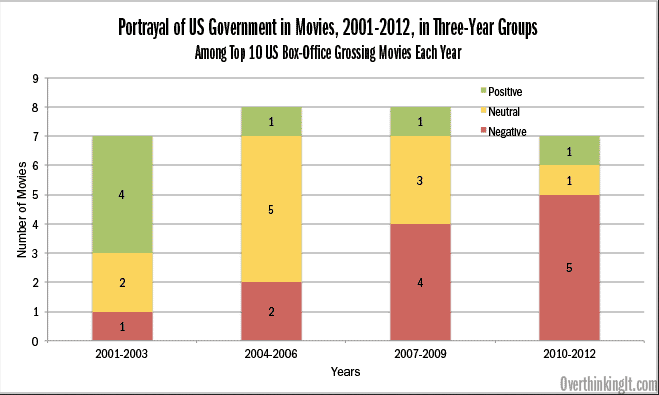
Mark Lee illustrates the increase of Hollywood movies portraying government in a negative light, linking it with Americans’ rising distrust of Washington in the real world:
The theory is that, in the years since 9/11, America has grown increasing disillusioned with its government due to its repeated shortcomings–Afghanistan, Iraq, Hurricane Katrina, the Great Recession, Congressional gridlock–and that Hollywood movies have reflected this disillusionment with more and more stories that involve rogue heroes operating outside of, or in some cases, directly against, the authority of the US government.
Both of these trends feel right on a gut level. Who among us isn’t more cynical and distrusting of the United States government now, compared to 12 years ago? And doesn’t Independence Day, in which the US government unequivocally saves the day, feel dated and corny compared to movies like The Dark Knight Rises and The Avengers, in whichnon-state actors rise above the pettiness of governments to get the job done?
Recent Dish on the appeal of anti-government cinema here.
Another reason why inactivity is an integral part of watching baseball was summed up by Robert Benchley: “One of the chief duties of the fan is to engage in arguments with the man behind him.” Watching baseball by yourself is entertaining only in proportion to your understanding of the subtleties of the game; but watching in a group or crowd inevitably turns into conversation, and it becomes the most convivial of spectator sports.
On that note, another sends the above video to defend the sport’s stasis:
At 300 feet away from the batter and the pitcher, you can have this interaction with the right fielder.
Another reader:
Here’s something that drives me crazy when people complain that there’s too much inactivity in baseball, and that it is thus boring. There are far fewer “time outs” than people realize, especially when there are runners on base. When the catcher tosses the ball back to the pitcher? Time’s in. If the catcher overthrows the pitcher, or throws it back too slowly, or the pitcher drops the ball, the runners will advance. When the pitcher is looking in at the catcher to get the sign? The runners can take off. If there’s a runner on second and the third baseman is playing too far from the bag to cover a throw from the catcher? Again, there goes the runner.
And all the while, infielders are shifting from one spot to another, to induce the runner to take too big a lead so that he can be picked off, or to hold him closer to the bag. Plus, the batter and runners take signs from the third base coach that are flashed too quickly for spectators to take notice, and the pitcher and catcher are changing sign sequences to keep their communications secret, often with instructions from the dugout.
Nothing going on? Bullshit.
Another:
Lowen Liu asks, “What other sport teases your attention in this way, dares you to look away, to yawn … ?” The answer is professional football.
There is almost 60% more action in a three-hour baseball game than a three-hour football game. According to a Wall Street Journal study of four games from week 16, the average NFL game features just 10 minutes 43 seconds of action. Commercials account for nearly 60 minutes of the three-hour affair. And when the networks are showing the game, the bulk of the time is spent either on replays or shots of players huddling, in pre-snap formations or “milling about.”
Another adds:
Sometimes the NFL game clock continues counting down while bunches of players or referees get together to have a chat. And then in a close game, just when the drama should be at its peak, the offensive team with a lead (and sometimes even a narrowly trailing team with the ball) is given an incentive to stand around doing nothing for half a minute every time it starts a play to run down the clock. Stand around, stand around, wait, count 35 seconds, then snap! And then 22 men spend 10 seconds sprinting maybe 40 feet each. Usually less. Then walk around a bit, get back in line, and wait for it, wait for it, have we counted to 35 yet? And repeat.
Ugh.
As a born-and-bred Midwesterner, I never questioned the constant action of the game my family watched every Sunday … until I caught games from the 1998 World Cup on TV. When the NFL season began a few weeks later, I couldn’t stop noticing, and being hopelessly bored by, the long stretches of nothingness that actually characterize the American game. Not that I became some huge soccer fan, but American football, with its endless committee meetings and appellate court proceedings and “athletes” who often play only a few dozen seconds per week, quickly became too boring for me to watch. When I kept a stopwatch of actual game-playing action a decade or so ago, I kept coming up with a figure of about 1/8, or about 88% downtime.
Don’t get me wrong – a football game is great background noise for a party. But to sit down and spend three hours paying attention? Give me a baseball game any time, or hockey, or even, yes, the one-and-a-half soccer games that can be played in the same span.
Another looks to another sport:
Lowen Liu claims that part of the beauty of baseball is the down time. So I guess Test Match Cricket, played over five days; with meal, drinks and sleep breaks in between; where attending any one day of play does not guarantee you will see all the players on the field (or even see the match reach a conclusion); and a two-hour nap wouldn’t matter a jot; then Test Match cricket must be THE beautiful game!
Of course the five-day limit is a modern adjustment – they used to play on until there was a winner. In Durban 1939, England played South Africa for ten days, until they were forced to call it a draw because the ship was leaving to take the England team back home! Now there’s a game with down time …