Our Secret Bias

Research suggests we that we trust the contents of secret documents more than the unclassified stuff:

Specifically, “(a) people weigh secret information more heavily than public information when making decisions, (b) people perceive the same information as being of higher quality when it is portrayed as secret rather than public, and (c) people evaluate others’ decisions more favorable when those decisions are based on secret information rather than on public information.”

The authors [of the study] suggest this effect was very much in evidence following the original Wikileaks disclosures, when people who are normally skeptical about the judgments of U.S. officials were suddenly taking as gospel documents written privately by those very same officials. As Dan Drezner wrote at the time, there was a “natural inclination to think that any Wikileaks document will endow it with the totemic value of Absolute Truth. “If it was secret, then it must be true,” goes this logic.” In fact, it’s quite possible for diplomats or military commanders to be as wrong in private as they are in public.

It’s also not hard to imagine the kind of incentive structure that this bias creates. If classified information and secret recommendations are judged to be more credible, there’s going to be a natural tendency for the officials crafting and passing along this information to keep as much of it secret as possible.

Assimiliating Isn’t Simple

Claude S. Fischer reflects on the Americanization of recent immigrants:

Take the case of Mexican-Americans, an intriguing instance of Americanization, given their especially large numbers and their easy travel back-and-forth to the “old country.” These immigrants are, as the title of historian George Sanchez’s 1995 book states, Becoming Mexican American. That is, they are defining and building a distinctly new identity. Through organizations, political mobilization, and ideological construction (for example, building up the legend of Atzlán), activists are constructing what it means to be both Mexican and American. And they are doing it in American ways, with voluntary associations and mobilized by modern American ideology extolling ethnic consciousness. The latest wave of immigrants have entered a culture that values, at least ceremonially, ethnic pride, probably as a result of the 1960s Black Pride movement. (“Black is Beautiful” was soon followed by “Kiss Me I’m Polish.”)

One advantage of studying contemporary over historical immigration that we have more tools for the study. Some survey research casts light on how Hispanic or Latino consciousness has developed. For example, a recent study compared the answers of Hispanics who took a survey in English to those who took it in Spanish. The English speakers expressed more “Hispanic Consciousness” than did the Spanish-speakers. They were more likely to say that it was very important for Hispanics to “maintain their distinct cultures,” less likely to say that it was very important for Hispanics to “blend into the larger American society,” and more likely to be critical of how the U.S. media portrayed Hispanics.

That is, the more integrated into American society, the more they emphasized their ethnicity. Another study not only found that, as might be expected, more educated and later-generation Latinos were likelier to vote in elections, but also that they were likelier to engage in specifically Latino-oriented activism.

How We Process Medical Problems

Lisa Rosenbaum considers how doctors and patients approach medical decisions, examining the influence of the “affect heuristic,” which is defined as “the role that emotions play in our perceptions of benefit and risk”:

When affect guides our decisions, we are far more sensitive to possibility than to probability. In one experiment, some subjects were asked how much they were willing to pay to avoid a potential loss of twenty dollars; others were asked how much they would pay to avoid a potential electric shock. The people asked about the shock paid about the same amount of money, regardless of whether the probability of receiving it was one per cent or ninety-nine per cent. The responses of people asked about the monetary loss, however, tracked more closely to the associated probabilities. The mere possibility of risk, no matter how small, drives our behavior.

How might this tendency play out in medicine? Take, for instance, the increasing rate of women with breast cancer pursuing prophylactic double mastectomy—most famously, Angelina Jolie. For most women with breast cancer, the risk of later developing breast cancer in the other breast is low, meaning the risks of mastectomy outweigh the benefits. Indeed, a recent survey of women who had undergone prophylactic mastectomy found that some seventy per cent would derive little survival benefit. Nevertheless, ninety per cent of those women reported that they were “very worried” about breast-cancer recurrence. In other words, in the setting of fear, the possibility of recurrence, rather than its actual probability, fuels decisions that, over all, likely cause more harm than good.

Voting Inequalities

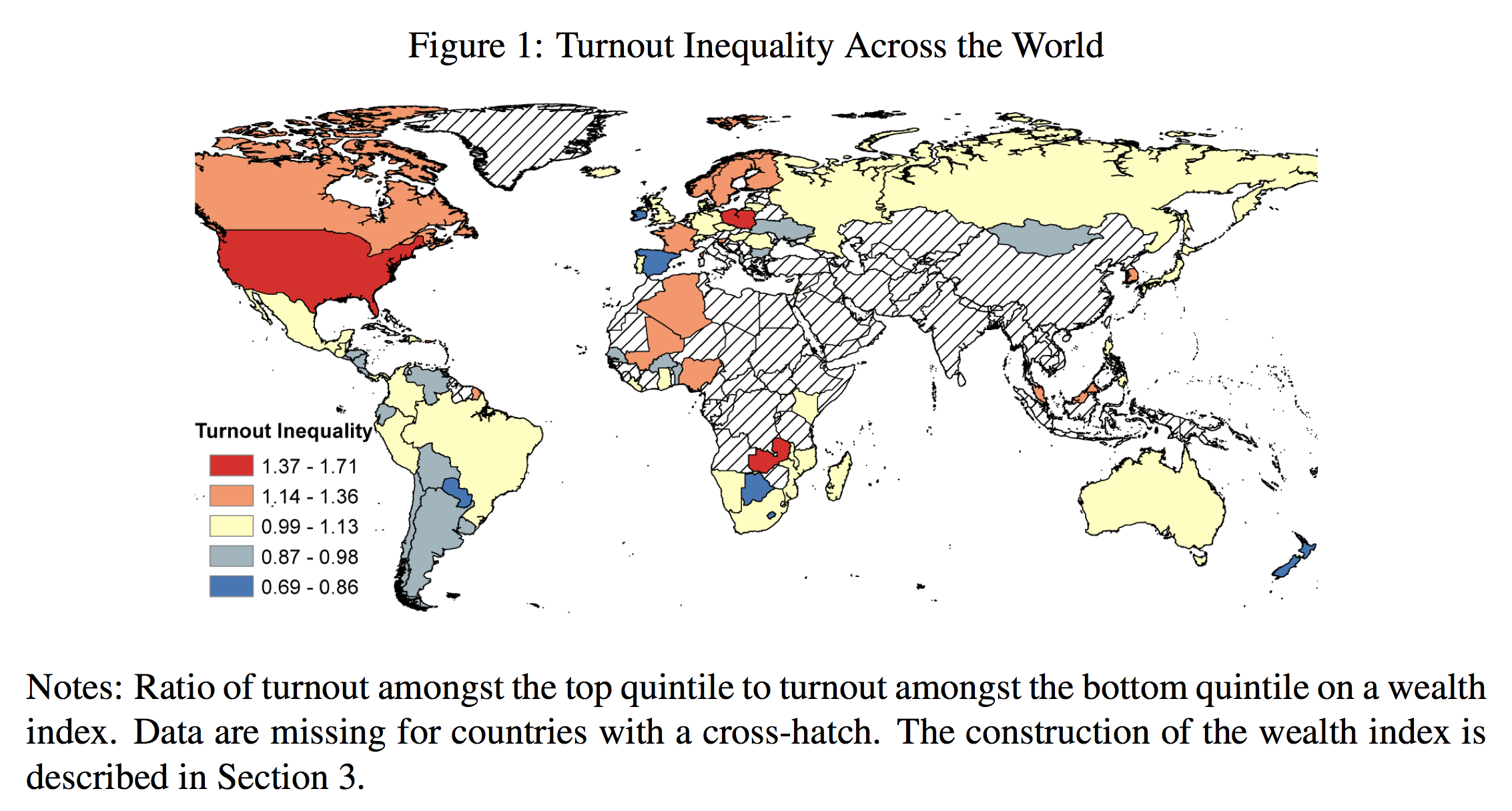
Voting Inequality

The above map is from a paper by Kimuli Kasara and Pavithra Suryanarayan (pdf), “When do the Rich Vote Less than the Poor and Why? Explaining Turnout Inequality across the World.” The abstract:

The conventional wisdom that the poor are less likely than the rich to vote is based upon research on voting behavior in advanced industrialized countries. However, in many places the relationship between turnout and socioeconomic status is reversed. We argue that the potential tax exposure of the rich explains the positive relationship between income and voting in some places and not others. Where the potential tax exposure of the rich is high, they have more of an incentive to participate in politics. Therefore, where states have the capacity to tax the rich, politicians use fiscal policy to gain support. Using survey data from a wide range of developed and developing countries, we demonstrate that the rich turn out to vote at higher rates than the poor where the state has the bureaucratic capacity to tax the rich and where the political preferences of the rich and poor diverge.

Joshua Tucker points out “the role of the US – and, interestingly, Poland and Zambia – as outliers in terms of having over-representation of the well-off citizens among voters.”

Amazon’s Unfulfillment Centers

A Financial Times article spotlights Amazon’s shipping warehouse in the former coal-mining town of Rugeley, England. John Brownlee follows up:

The issue at Rugeley is not that workers are ungrateful for the jobs Amazon has given them, or even that they find these jobs unpleasant. Most of Rugeley’s workers come from mining families, a stock not exactly known for its weak-livered dandyism. It doesn’t matter that these jobs are hard. It’s that they have no future. … The jobs in the Rugeley fulfillment center are almost always temporary positions handed out by agencies on zero-hour contracts. Nothing is guaranteed, and a fulfillment associate’s job can completely disappear between one day and the next. As such, the local economy is not recovering as locals hoped. Amazon is not investing in the town’s people; instead, it’s mechanizing them.

Brownlee talks to Ben Roberts, whose photo series Amazon Unpacked documents Rugeley’s “vast” and “shockingly quiet” shipping center:

“The workers at Rugeley are effectively human robots,” Roberts says. “And the only reason Amazon doesn’t actually replace them with robots is they’ve yet to find a machine that can handle so many different sized packages.” … “When you buy something from an independent retailer, you might pay more than Amazon, but that extra bit is an investment,” Roberts explains. “When you pay it, you’re investing in the quality of not only your own life but the life of the community around you.”

Dustin Kurtz reacts:

The same panicked grasping by local governments at jobs, no matter how temporary or poorly paid, that led to the placement of the warehouse in Rugeley is how Amazon managed to place packing plants in other locations as well. Amazon (a company that receives more money from the UK government than it pays in taxes, remember) currently has other UK “fulfillment centers” in Hemel Hempsted, Hertfordshire; Swansea, Wales; Doncaster, South Yorkshire and Peterborough, Cambridgeshire, former mining towns all. At what point will those communities be forced to ask what, in fact, Amazon is giving back to them, if anything?

The Senses, Rod, And God

If you thought Rod Dreher was a bit of a Puritan, you’re not entirely right:

“The hunger for strangeness” — that’s a great phrase, isn’t it? It is interesting to observe how often the impulse to suppress it arises in human culture, always at the hands of a moralistic idea in power, an idea that distrusts sensuality as nothing more than a temptation away from the Truth. Let me clarify that I believe sensuality can be a temptation away from Truth … but it also can be an avenue towards Truth. In Orthodox Christian worship, the incense, the icons, the vestments, the singing — it’s all meant to reveal God to us, and to prepare our hearts to receive Him. The reason for feasting and fasting in traditional Christianity is to learn to rejoice in the gifts of God — of bread, of wine, of meat and fruit — while also learning not to be overcome by our pleasure in these created things.

Drunk History, Ctd

Jenna Martin looks back at the brilliant web series as it premieres as a TV show tonight:

When a teen-aged Michael Cera, playing Alexander Hamilton against type, opens his mouth in the first episode, his high-pitched stammer is replaced by a deep, slurring voice. Both Cera and Jack Black, who brings his manic energy to the character of Benjamin Franklin in two episodes, are returning for the television incarnation of “Drunk History,” which premières on July 9th on Comedy Central. The show will feature other famous comic actors including Kristen Wiig, Owen Wilson, Will Forte, Bill Hader, Jack McBrayer, and Rob Riggle.

Much of the humor of the Web series comes from seeing the conventions of the historical documentary corrupted. Every episode includes stirring music, reënactments filmed in soft focus, and portraits fading into other portraits. In one episode, Benjamin Franklin’s mistress, played by Jayma Mays of “Glee,” is strumming a harp and looking off into the distance, until Franklin pops up from behind a nearby window. I giggled, remembering a documentary about Napoleon which showed a woman’s hand strumming a harp every time that Josephine was mentioned. For people who found Steven Spielberg’s “Lincoln” a bit too sanctimonious, then the episode, featuring Will Ferrell as Lincoln and Don Cheadle as Frederick Douglass, might be the perfect antidote.

Previous Dish on the series here and here.

If Immigration Reform Dies

In a post urging Republicans to kill immigration reform, Bill Kristol and Rich Lowry claim that, if “Republicans take the Senate and hold the House in 2014, they will be in a much better position to pass a sensible immigration bill.” Wonkblog pushes back:

The odds that Republicans would go anywhere near immigration reform in 2015 after they painfully, anxiously killed it in 2013 are vanishingly low. But let’s say, hypothetically, they did. It’s easy enough to imagine the Democratic — and Hispanic — response: If Democrats win the White House again in 2016 and increase their numbers in the House and Senate, they will be in a much better position to pass a sensible immigration bill.

That’s the thing about “later” The other side has a vision of it, too.

Waldman contrasts GOP opposition to Clinton’s and Obama’s healthcare bills with GOP opposition to immigration reform:

Those two efforts at health care reform were always understood as a conflict between a Democratic administration seeking a longtime Democratic goal, and Republicans in Congress trying to stop them. It was reported like a sporting event: Clinton loses, Republicans win; Obama wins, Republicans lose. Immigration, on the other hand, has been reported largely as a battle within the Republican party. President Obama, knowing full well that anything he advocates immediately becomes toxic for most Republicans, has been using a lighter touch when it comes to public advocacy for comprehensive reform. I’m not saying he hasn’t been pushing for it, but he hasn’t done the all-out, campaign-style barnstorming tour that would help turn it into a purely Democrats-versus-Republicans issue. The story has always been, “What will the Republicans do?” and if reform goes down, the headlines won’t read, “Obama Defeated on Immigration Reform,” they’ll read, “Republicans Kill Immigration Reform,” with subheadings like “Danger ahead for GOP as Latino voters react.”

Those headlines got more likely today. Brian Beutler reports that “John Boehner stated a specific policy preference Tuesday that will alienate the entire Democratic Party if he adheres to it, and thus doom the reform effort”:

“It’s clear from everything that I’ve seen and read over the last couple of weeks that the American people expect that we’ll have strong border security in place before we begin the process of legalizing and fixing our legal immigration system,” Boehner said outside the Capitol Monday afternoon. … [Boehner’s statement] amounts to a de facto endorsement of the conservative view that any steps to legalize existing immigrants should be contingent upon implementation of draconian border policies. As is Boehner’s custom, it also eschews the word “citizenship,” suggesting that even if Democrats agree to a trigger, he won’t guarantee that it would be aimed at a full amnesty program, and, thus, eventual voting rights for immigrants already in the U.S.

Yglesias dismisses complaints about immigration reform’s border security measures:

The more nonsensical argument I’ve been hearing takes the Congressional Budget Office’s conclusion that the Gang of 8 bill would cut unauthorized migration in half and appends the word “only” to it. Get it? Immigration reformers say their reform bill will secure the border, but in fact it will only cut unauthorized migration in half relative to the current policy baseline. But of course not passing the immigration bill just leaves us with the current policy, which (by definition!) doesn’t cut unauthorized migration at all relative to the current policy baseline. So disappointment about the border security potency of the bill can’t actually be the reason for not passing it. The reason for not passing it would have to be what it plainly is—hostility to creating a path to citizenship for current unauthorized residents of the country that’s so intense that it outweighs other possible benefits of the bill.
The Badass Flight Attendants Of Asiana 214

Lisa Wade hails them:

[I’m] surprised to see almost no discussion of the flight attendants’ role in this “miracle.” Consider the top five news stories on Google at the time I’m writing: CNN, Fox, CBS, the Chicago Tribune, and USA Today.  These articles use passive language to describe the evacuation: “slides had deployed”; all passengers “managed to get off.” When the cabin crew are mentioned, they appear alongside and equivalent to the passengers: the crash forced “dozens of frightened passengers and crew to scamper from the heavily damaged aircraft”; ”passengers and crew were being treated” at local hospitals.

Only one of these five stories, at Fox, acknowledges that the 16 cabin crew members worked through the crash and its aftermath.  The story mentions that, while passengers who could were fleeing the plane, crew remained behind to help people who were trapped, slashing seat belts with knives supplied by police officers on the ground.  The plane was going up in flames; they risked their lives to save others.

At least one of the 12 flight attendants at the scene carried out an injured child on her back, while others freed trapped colleagues with axes:

[Cabin manager Lee Yoon-hye] herself worked to put out fires and usher passengers to safety despite a broken tailbone that kept her standing throughout a news briefing with mostly South Korean reporters at a San Francisco hotel. She said she didn’t know how badly she was hurt until a doctor at a San Francisco hospital later treated her. … Lee said that after the captain ordered an evacuation, she knew what to do. “I wasn’t really thinking, but my body started carrying out the steps needed for an evacuation,” Lee said. “I was only thinking about rescuing the next passenger.”

Passenger Eugene Anthony Rah took the above photo:

One tiny woman, who he said is flight attendant Kim Ji-yeon, stood out to him, because she was helping the injured, “carrying people piggyback” who couldn’t walk. Tears were streaming down her face, he said, as she helped clear the plane only minutes before flames engulfed the passenger cabin. He copied her name off her uniform name tag, he said, because “she was a hero.”

Update from a reader:

I used to work in the building that housed Virgin Airlines’ main office. One day their future flight attendants were training outside. They were training with their “emergency” voices.  Andrew, they had more power and authority in their voices than any movie depiction of a military drill sergeant I have ever seen. They actually scared me! I have never looked at a sweet, polite, gentle airline flight attendant the same after that day, knowing the firm fury that they can unleash should the need arise!