“A primary challenge under these circumstances seems doomed to failure, so it makes sense that Liz Cheney would think it is a good idea,” – Daniel Larison.
Quit For America?
Chicago educator Katie Osgood implores Teach For America (TFA) recruits to leave before the school year starts:
TFA claims to fight to end educational inequality and yet ends up exacerbating one of the greatest inequalities in education today: that low-income children of color are much more likely to be given inexperienced, uncertified teachers. TFA’s five weeks of Institute are simply not enough time to prepare anyone, no matter how dedicated or intelligent, to have the skills necessary to help our neediest children. This fall, on that first day of school, you will be alone with kids who need so much more. You will represent one more inequality in our education system denying kids from low-income backgrounds equitable educational opportunities.
She notes that Chicago, where Teach For America places a corps of 500, recently shuttered 50 schools:
As a result, we have thousands of displaced teachers looking for jobs, we have dozens of quality schools of education producing certified teacher candidates-many from the neighborhoods they hope to teach in-all looking for work in Chicago and other urban centers around the country. Just yesterday, I spoke with a fully-qualified new teacher who reported that she will likely have to take substitute positions or do after-school tutoring as there are no full-time jobs being offered in the Chicago Public Schools. Like so many other cities (New York City, Detroit, and Philadelphia to name a few) we have no teacher shortages. We have teacher surpluses. And yet, TFA is still placing first year novice corps members in places like Chicago. To put it bluntly, the last thing our students undergoing mass school closings, budget cuts, and chaotic school policy need is short-term, poorly-trained novices. Teach for America is not needed in Chicago. Teach for America is not needed in most places.
Michael Noll pushes back:
[T]he average classroom experience for U.S. teachers is one year–as per Diane Ravitch, who is no TFA fan. The larger point is that teachers all over the country, regardless of region, are leaving the profession almost immediately after entering it. Partly, they’re leaving because of the lack of union support. But they’re also leaving because schools are, by and large, not supportive environments, either intellectually or professionally or financially. Low-income schools are, of course, hit hardest by this trend. TFA may have imperfect means, but the intentions, I believe, are pure. If teachers leave after two years, that means they spend one more year in the schools than the average U.S. teacher.
The Plastered Economy

Derek Thompson calculates the economic cost of hangovers:
Excessive drinking costs the economy more than $220 billion — or about $1.90 per drink, according to the Center for Disease Control and Prevention, which studies the negative externalities of alcohol consumption each decade. Seventy-two percent of the costs came from lost workplace productivity, according to the 2006 survey, which suggests that the economic drag from hangovers is about $160 billion (… also the total cost of natural catastrophes in 2012.)
Brad Plumer is suspicious, noting that “when you add up all the different studies on lost workplace productivity over the years, it starts to seem like a miracle the United States even has a functioning economy”:
[M]any of these estimates are outright silly. The idea that coffee breaks or or a little Internet browsing cost billions in lost productivity is highly questionable. As Jack Shafer pointed out back in 2010, many people are likely to waste time during the workday no matter what. The fact that they might do so by playing fantasy football rather than, say, taking a leisurely trip to the water cooler doesn’t seem terribly important. …
[N]o one’s ever done a rigorous analysis of all these supposed productivity-killers. The findings are usually just large numbers tossed around to draw attention to pet issues. A new study finding that spam or yawning or picking your nose costs billions of dollars in lost productivity might make for good headlines. But it rarely tells us anything useful about the economy.
Who Will Pay Egypt’s Bills?
Evelyn Gordon focuses on the country’s economic problems:
If you think last week’s revolution was primarily a revolt against the Muslim Brotherhood’s undemocratic behavior, then you’ll think the West’s main goal should be “supporting the Egyptian people in their aspirations to democracy and inclusive governance,” as EU foreign policy chief Catherine Ashton put it last week–for instance, by helping them draft a new and improved constitution. But if you realize that the revolution was primarily about economic distress, then you’ll understand the West’s main goals should be arranging short-term aid and pushing long-term economic reforms needed to stabilize the economy–because without economic improvement, even the best constitution won’t prevent another coup next year. Desperate people can’t afford to wait for the next election to bring about policy changes.
Drezner suspects that Egypt will have to ask the IMF for more money:
Please bear all of this in mind as you read about the alleged decline of U.S. influence in the region. There’s a difference between declining salience and declining influence. Because if I’m reading this correctly, Egypt will have no choice but to go back to the IMF — and the United States still has a wee bit of influence within that international organization.
Recent Dish on the subject here.
Macho Men
Nicole Pasulka delves into the history of the Village People and the YMCA:
At the Y, a spiritual man was a well-built, muscular man. The organization’s leadership positioned the regional branches as destinations that could protect newcomers from “negative” influences. It was here that many young guys had their first homosexual experiences. So [Village People members] Jacques Morali and Randy Jones were part of a history that included both diligent Christian bodybuilders and men cruising for “trade”—straight-identified, masculine men. According to John Donald Gustav-Wrathall’s meticulous history of male-male relationships within the organization, homosexual cruising and weight lifting went hand in hand. Though the organization condemned homosexual sex as “immorality” or “perversion,” by emphasizing fitness, the Y didn’t just make sex between men possible, it “shaped same-sex sexual desire.”
The astonishing scene above is from one of my favorite bad movies of all time: Can’t Stop The Music. Steve Guttenberg’s neck veins and Bruce Jenner’s exposed midriff – combined with absurd disco choreography and manically coked up acting – it’s a classic. Back to Pasulka, on the 1978 hit single “Macho Man”:
[Producer Henri] Belolo says the title track was meant to appeal to “the ego of all the people… going to the health club building muscles.” Somewhere along the way, that came to include millions of straight people.
In 1979, [musician Jacques] Morali told Rolling Stone, “When Macho Man came out, I did it believing that the gay audiences were going to like it very much. But the straight audiences liked the song much more, because straight guys in America want to get the macho look.” As the producers were learning, they didn’t have to specify their target. “Macho Man” made it to number twenty-five on 1978’s Billboard Hot 100 chart and hit platinum. Either the Village People had found an audience beyond the gay discos or a lot of people were pumping up their disco tits.
In fact, both were kind of true. While gay men in the Village had been bulking up, slowly trading angora for ripped T-shirts and pegged pants for Levi’s, straight men had registered that the “macho” look was en vogue in stylish cities like New York, Los Angeles, and San Francisco. Some straight men even started wearing bandannas in their back pockets—a method gay men used to signal their preference for different kinds of sex. Though they were oblivious to the code, straight men had figured out this was the “in” look.
Everyone In Egypt Needs A Voice
Steve Negus wants Egypt to adopt a parliamentary system:
The new electoral law should increase incentives for compromise, for example, by increasing the power of parliament and of the prime minister over that of the president. Parliamentary systems are better for encouraging negotiation and limiting the ‘winner takes all’ mentality that is so risky in democratic transitions, and if political rules are being revisited, the parliamentary model is one that should seriously be considered. A blocked political order in which temporary winners exclude their opponents is one that the last two years have shown us the importance of avoiding.
Laura Dean hopes that the Muslim Brotherhood will be given a place at the table:
As we have seen time and again in this part of the world, it is impossible to stamp out ideas by censoring them. In so doing you only push them underground and legitimize their most radical elements. Even the Brotherhood spokesman, Wael el Karim, who is more diplomatic than most said, “Now we see the only path to power in Egypt is by force.” Only by bringing them into the political fold and treating them like the political losers that they are, rather than like criminals, which they are not, can that rift be healed and can they begin to develop into the mainstream political player, among many players, that they could be.
My fear is that the army just overplayed its hand – and made all this far more difficult. This video (featured in our Tweet reax earlier) is the most dispositive I’ve seen yet: a soldier just picking off civilians from a rooftop as if he is hunting for game. Then this:
Doctors at the morgue say 54 dead, mostly from bullets or asphyxiation. Forensic reports I saw were live ammunition shot through the back
— Bel Trew – بل ترو (@Beltrew) July 8, 2013
Dish coverage of this possible turning point in Arab history here, tweet reax here, expert analysis here, and the Arab world’s response here. Stay tuned for updates.
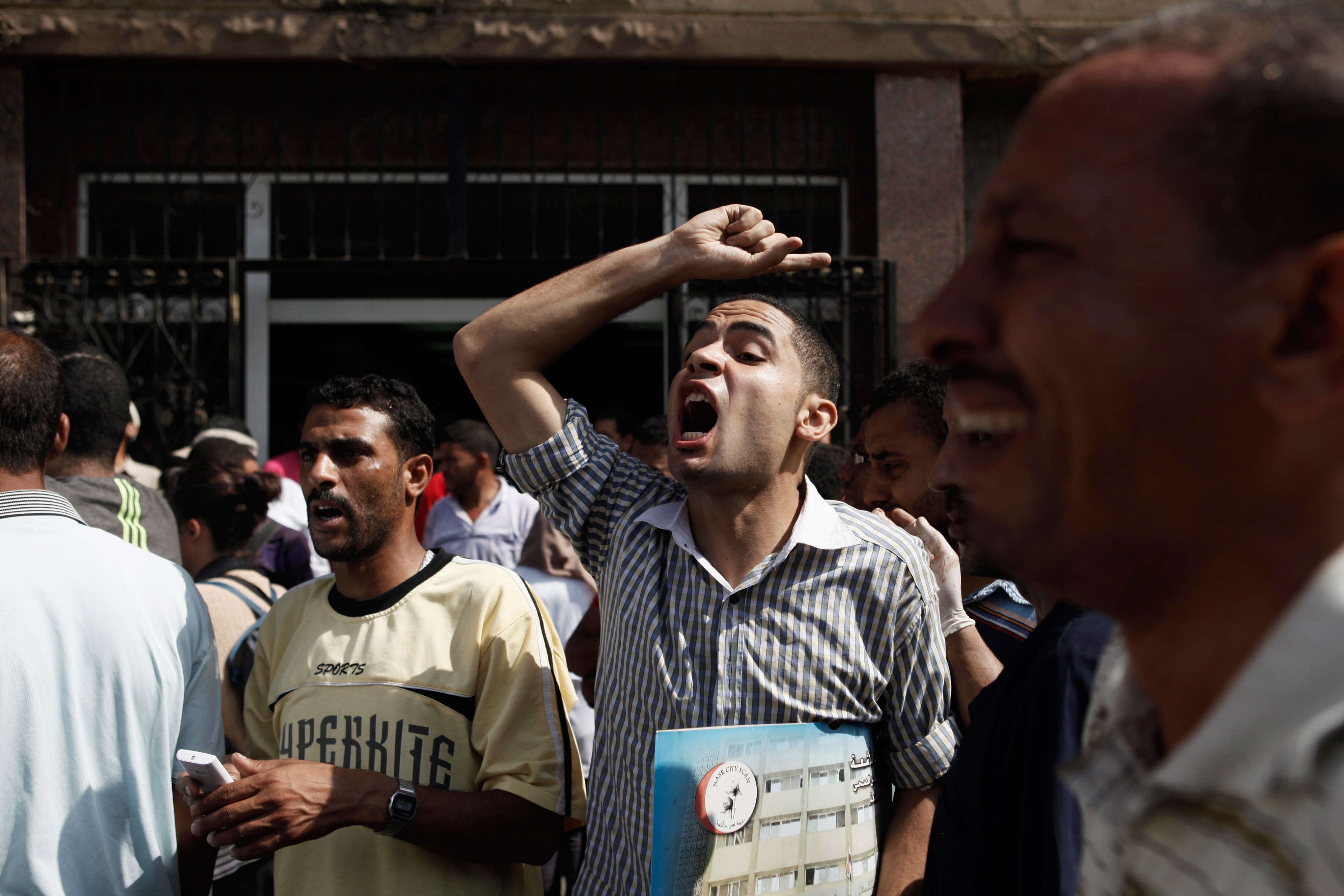
(Photo: A man reacts after seeing the body of a slain protester at the Liltaqmeen al-Sahy Hospital in Cairo’s Nasr City district, allegedly killed during a shooting at the site of a pro-Morsi sit-in in front of the headquarters of the Egyptian Republican Guard on July 8, 2013 in Cairo, Egypt. By Ed Giles/Getty.)
Quote For The Day
“It’s very important for people not to be overly critical of someone else until you’ve examined your own heart,” – former president George W Bush, when asked what he meant when he responded to a question about marriage equality thus:
I shouldn’t be taking a speck out of someone else’s eye when I have a log in my own.
The Last Lesson We Learn From Our Pets, Ctd

This post struck a chord with a lot of readers. Here are a few of many we are planning to post:
I feel your pain. We have had to put four dogs to sleep and one cat (age 18.5). This is not counting my parents’ pets. When we put our last dog, sweet golden retriever Zella, to sleep (very unexpectedly), I did as I always do and stayed with her through the whole procedure. My husband couldn’t bear to be there, and so he said good-bye and left to wait outside.
This, however, made Zella a bit agitated – “Why is Papa leaving?” She was not feeling well (she had hemangiosarcoma, which is basically a blood-fed tumor, in her case larger than a softball and pressing on her liver), but she perked up when the vet came in because he had been working with hamsters and his hands and shirt smelled so awesome. So she was wagging her tail and smiling when we invited her to sit on the floor, which she did not want to do. So I sat on a bench in the room and she hopped up next to me and sat/leaned against me. As the serum was injected, Zella just leaned on me more and more and ended up with her head in my lap. It was really a very peaceful and sweet way to die.
The vet told me afterwards that he wished every pet owner would stay with their pet at the end, because when they leave the room, the pet gets agitated and it’s harder for the staff to keep them still, making the whole process so much more stressful for the pet. He also said that the women always stay, but only about half of men do, which I thought was interesting.
I’ve attached a picture of sweet Zella on the day before we took her in. She was SUCH a great dog! I am very sorry about Dusty’s health. It is so, so hard to say goodbye to a wonderful dog. I will be thinking of you when that day comes.
Another reader:
The decisions you have to make on behalf of your companion animals just rip you apart. We recently faced that
problem with our beagle, Buddy. By age 14 he had lost almost all of his teeth (we never could get him to floss), he had been blind for two years and almost completely deaf, yet he seemed to get some enjoyment out of life. He still loved to eat, of course; he could still consume a milk bone with no teeth. And he could usually make it out the doggy door to the back yard when he needed too. Most of all, he seemed to get very happy when we would lie down next to him and pet him.
But sadly, about a month ago, things got suddenly worse. He refused to eat his kibble (he would still eat treats) and his back legs were giving out, so he could not stand up reliably. He could no longer make it through the doggy door; we had to carry him outside and back in. He barely recognized us and he slept 99% of the time. When he would stand up, he seemed to be in pain. After conferring with the vet, we decided it was time. However, he had been my best friend for so long … it took me a couple of days to agree. But we finally put him in the car for his last ride.
He always hated going to the vet. Nasty things seemed to happen there. This time he knew where he was, and tried to struggle before going in the vet’s door; then he sort of gave up. They got us into a room in short order, and we spent some quiet time with him. The doctor came in and asked us if we wanted to stay while she gave him the shots. There was never any question; we had him since he was eight weeks old, so we were going to be there at the end.
By this time he was just lying on the table anyway, seemingly passed out. When she gave him the final shots, it seemed to make very little difference; his shallow breathing just stopped entirely. I took one last look at him and just lost it, bawling all the way home.
When we got our house, our other beagle, Cloe, gave us a quizzical look seemingly asking, “Where is he?” That night, she kept getting up and wandering around the house, then letting out a short high-pitched yelp, and looking at us questioningly. She knew he was missing.
The next day, she seemed to adapt and life went on. So we gave her a lot of love, and we adapted too, but we always remember Buddy. I cannot find the actual quote, but I am sure that Arthur C. Clarke once wrote something like the following: “One of greatest tragedies of human life is the all too short lives of our animal best friends.” So Andrew, prepare yourself.
Ask Michael Hanna Anything (About Egypt)
[Re-posted with new questions suggested by readers]
Michael Wahid Hanna will join us to answer your questions related to the ousting of Morsi and the Muslim Brotherhood, the ensuing violence, and what’s next for Egyptians. Hanna’s Twitter feed continues to be a must-read for anyone following the events in Egypt. From his bio:
Michael Wahid Hanna is a senior fellow at The Century Foundation. He works on issues of international security, international law, and U.S. foreign policy in the broader Middle East and South Asia. He recently served as a co-director of The Century Foundation’s International Task Force on Afghanistan, co-chaired by Thomas Pickering and Lakhdar Brahimi. He has published widely on U.S. foreign policy in newspapers and journals, including articles in the New York Times, the Los Angeles Times, theBoston Globe, Christian Science Monitor, the New Republic, and World Policy Journal, among other publications, and is a frequent contributor to Foreign Policy. He appears regularly on NPR, BBC, and al-Jazeera.
To submit a question for Hanna, simply enter it into the Urtak survey after answering all of the existing questions (ignore the “YES or NO question” aspect and simply enter any open-ended question). To vote, click “Yes” if you have a strong interest in seeing him answer the question or “No” if you don’t particularly care.
The Coup Watched ‘Round The Arab World, Ctd
Adam Shatz runs down how news of Morsi’s ousting is going down across the Middle East:
Qatar, which invested heavily in the Brothers, has lost a major ally. (The Saudis, who supported the more extreme Salafis against the Brothers, played their hand much better: the Salafis sided with the army and are likely to have a say in the transition.) Hamas, which reshuffled its regional alliances when its parent organisation came to power in Egypt, leaving its offices in Damascus for Doha, must be weighing its options. Bashar Assad is already gloating. Morsi was a passionate champion of the Syrian insurgency; only two weeks before his overthrow, he infuriated Assad (and, more fatefully, Egypt’s secular-minded generals) by appearing at a rally where one cleric after another called for jihad against the regime in Damascus. In an interview with the official Thawra newspaper, Assad said: ‘The summary of what is happening in Egypt is the fall of what is called political Islam.’ That autopsy might have come as news to his Islamist allies in Tehran and in Hizbullah, without whom he could not have defeated the rebels in Qusayr. Still, the Sunni trend in Islamism has suffered a serious blow in Cairo, and its effects are likely to be far-reaching.
Madawi Al-Rasheed zooms in on Saudi Arabia in particular, whose rulers always saw the Brotherhood as a rival brand of Islamism:
The failure of the Muslim Brotherhood to hold on to power for a year is now celebrated in the official Saudi press. So-called liberal journalists congratulate the Egyptian people on getting rid of the so-called religious dictatorship while forgetting their own plight under a regime that was equally if not more oppressive. In contrast, Saudi Islamists spread the rumor that Saudi Arabia, together with the United Arab Emirates, was behind Morsi’s fall. While there may be some truth to this, such rumors undermine the Egyptian crowds that assembled to press for his downfall. If the outcome so far pleases the Saudi regime, it should not obscure the fact that Egypt remains diverse, volatile and may not unquestionably succumb to the rule of Islamists or other governments eager to patronize them. The Egyptian crowds got rid of their Islamists and will not become clients of the Saudi regime. They have staged two revolutions so far and will continue to do so until they reach a post-revolutionary equilibrium in which all are politically represented.
William McCants gauges the Salafi reaction:
[N]o Salafi is likely more pleased with the turn of events in Egypt than Ayman al-Zawahiri, the leader of al Qaeda. For decades, Zawahiri has argued that the Muslim Brotherhood’s engagement in party politics does nothing more than strengthen the hands of its adversaries and ratify an un-Islamic system of rule. Since the beginning of the Arab Spring, he has continued to make his argument that the West and its local proxies will never allow an Islamist government to actually rule. He doubtless views the coup last week as a final vindication of his argument.
More Dish on the regional reaction Egypt’s coup here.

