How Barbaric Is Force-Feeding? Ctd

You be the judge. Yasiin Bey (aka Mos Def) demonstrates the force-feeding procedure used on Gitmo hunger strikers:

Conor watched the video (I actually found it too painful after a while):

[W]hile I don’t know whether or not forced feeding crosses the line of torture, the exercise reminded me of the late Christopher Hitchens volunteering to be waterboarded.

The Obama Administration is force-feeding numerous Gitmo prisoners twice daily as a response to a hunger strike they launched to protest being held indefinitely without charges or trial.

The standard procedures used include “strapping detainees to a chair, forcing a tube down their throats, feeding them large quantities of liquid nutrients and water, and leaving them in the chair for as long as two hours to keep them from purging the food,” The Washington Post has reported. Detainees say the procedures are abusive, verge on torture, and have “caused them to urinate and defecate on themselves and that the insertion and removal of the feeding tube was painful.”

It’s definitely grotesquely inhumane. Seizing control of a human being’s internal body and organs, painfully forcing instruments inside his sinuses and stomach twice daily to keep him under the total control of the authorities is horrifying enough. But when you consider that, unlike Mos Def, these prisoners, many innocent or falsely charged, have no way to challenge their indefinite detention, and are stuck in an endless purgatory of nothingness, the barbarism is obvious. As is the sadism and “globalized indifference” of the American public and their craven Congress. Steve Chapman wants the force-feedings to stop:

It would be unpleasant for the administration to accept the possibility that these detainees will die by starvation. But it might also force the American public and its elected representatives to wake up to the needless, open-ended suffering that is being inflicted on innocent people. It might induce other nations to accept freed inmates.

It might do none of these things. Then maybe the hunger strikers will conclude they are better off dead. If that choice reflects badly on us, it should.

Amen. Life-long confinement without even due process of any meaningful sort, is so alien to democratic principles and Western jurisprudence, it remains a rebuke to everything America claims to stand for.

Earlier Dish on force-feeding here.
Now We Should Add FA To LGBT? Ctd

Readers push back against the notion that Fat Acceptance (FA) be treated like an oppressed group:

I take issue with Anna Mollow comparing fatness to sexual orientation: “Body size is determined primarily by genetics”. This statement is missing half of the equation.  Genetics plus caloric intake determine body size; the two halves necessarily go together.  Compare that to sexual orientation: you can be gay and celibate but you’re still gay.  If you’re genetically predisposed to fatness but your calorie intake is low (because of food availability, quality, poverty, or whatever), you won’t be fat.

Fat attraction is different.  That sounds more like another sexual interest along the great spectrum of human sexuality.

Another reader:

I’m sorry, but give me a freaking break. Do we need a separate acceptance movement for short people?

Or people with ugly noses? With bacne? What about an acceptance movement for unintelligent people with lousy personalities?  I mean, why should I have to try and not be a stupid asshole towards people; shouldn’t the onus be on them to accept me for the stupid asshole I am?  After all, it’s not like I can control my stupid genes or asshole-ish upbringing!

Look, nobody’s perfect.  Some of those imperfections can be fixed, mitigated or papered-over.  But sometimes, we just gotta do the best we can with the hand that the good lord dealt us, and hope to meet people who either don’t mind the imperfection or to whom it’s not an imperfection, but a bonus. Demanding that everyone ignore your particular imperfections or be branded some kind of bigot is both unrealistic and a bit self-centered.

And I say this as a fat person whose family is full of fat people.  No “thin privilege” here.

Another:

“Body size is determined primarily by genetics.” Anyone who wants to convince us of that needs to explain why our genetic pool has changed so drastically in the past half century to produce the dramatic rise in obesity within the US. Fat-shaming is not cool and may well be counter productive. But if one is going to make extraordinary scientific claims about genetics, one needs to produce extraordinary evidence to back them up.

Another:

If obesity was primarily a genetic disease, you’d see it all over the world, not just in large numbers in the United States. In most other countries in the world, people simply don’t get as fat as they do here. And more interestingly, immigrants from those same countries to the US become obese at the same rates as Americans. Unless people have conditions like hypothyroidism or the rare Prader-Willi syndrome (most obese people don’t), making a comparison between gay people and fat people is irresponsible and unfair to both.

The Massacre In Cairo, Ctd

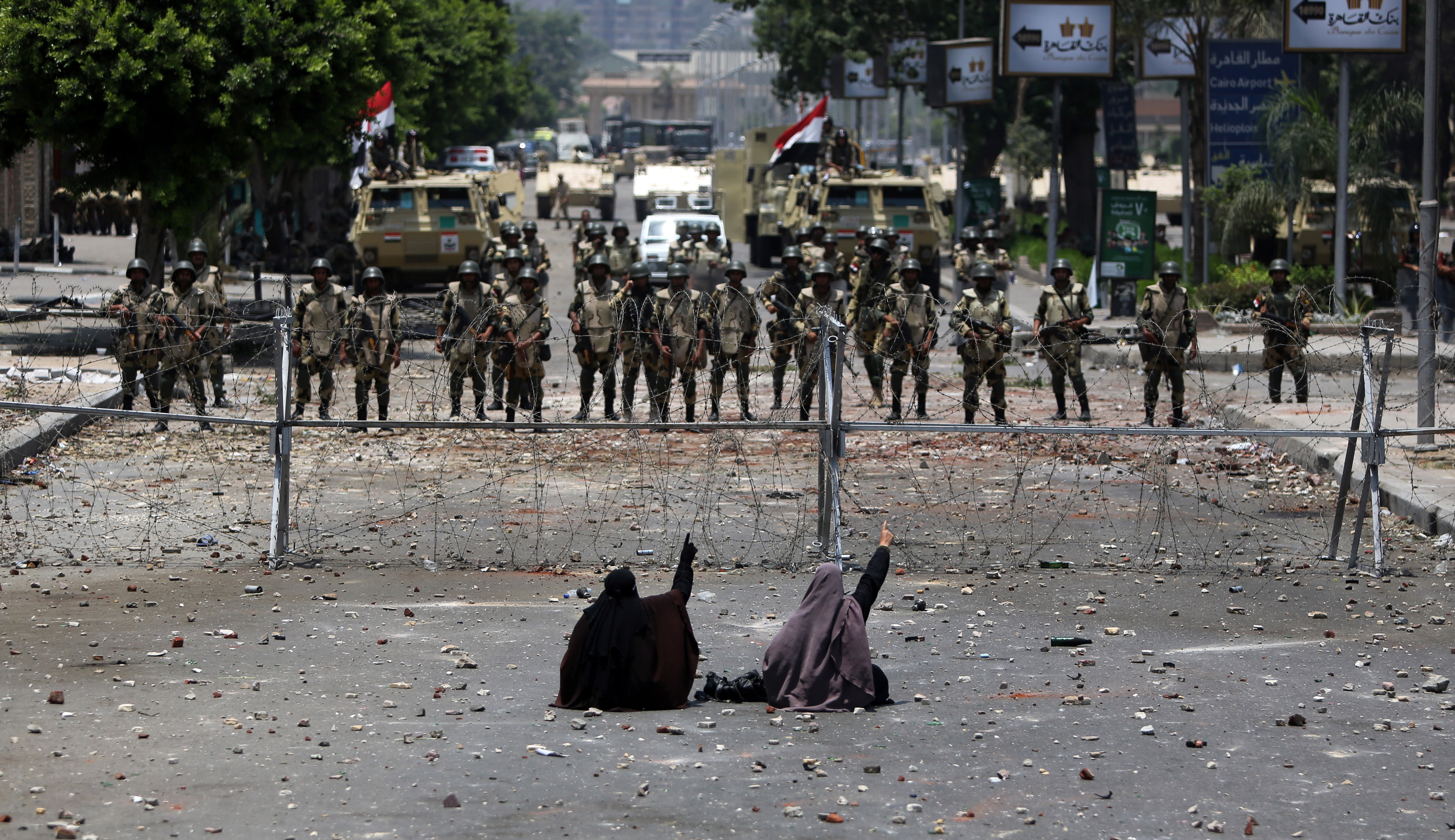
EGYPT-POLITICS-UNREST

Omar Ashour fears that the country is on the brink of civil war:

The shadow of Algeria in 1992 looms. There, the full-blown civil war did not start right after the coup in January, but in September 1992; nine months later. If al-Seesi and his junta behave like Khaled Nezzar in Algeria or Francisco Franco in Spain, we are likely to see an escalation in armed confrontations between the junta and the president’s loyalists. This can have disastrous regional and international consequences. Egypt’s population is three times that of Algeria in the 1990s and more than four times that of Syria. Unstable Libya and Sudan are on the borders and so is Palestinian Gaza and Israel. All sides in Egypt have their international and regional allies and patrons and they will be asking them for help.

Walter Russell Mead adds:

Few potential tourists and investors these days are picking up their newspapers and thinking that Egypt is looking like a safe destination once more. The uglier the military government looks, and the more blood it has on its hands, the harder it will be for Western governments to shovel billions more aid dollars into the Egyptian money pit.

The calendar is also bad; Ramadan has come. The mosques will be packed and emotions will be high. This is the time of year when religion looms largest in the life of the average Egyptian, and it is the time of year when the imams have their biggest audiences. From the Brotherhood’s point of view, the military could have done it no greater favor than creating 42 new martyrs at the start of the holiest month in the year.

And David Kenner notes that the “violence is already threatening to break apart the alliance between some political forces and the military”:

The Salafist Nour Party, which was already feuding with other opposition forces over the selection of the next prime minister, has withdrawn from any negotiations on government formation, while a spokesman said that “[i]t is as if the former regime is back fully fleshed.” Secular leader Mohamed ElBaradei, meanwhile, called for an independent investigation into the events.

(Photo: Egyptian supporters of deposed president Mohamed Morsi sit in front of barbed wire fencing that blocks the access to the headquarters of the Republican Guard in Cairo on July 8, 2013. Forty-two loyalists of Egypt’s ousted president were killed while demonstrating against last week’s military coup, triggering an Islamist uprising call and dashing the army’s hopes for an interim civilian administration. By Mahmum Hams/AFP/Getty Images)

Massacre In Egypt: Tweet Reax

“A Globalization Of Indifference”

The new Pope coins a phrase:

“Where is your brother?” Who is responsible for this blood? In Spanish literature there is a play by Lope de Vega that tells how the inhabitants of the city of Fuente Ovejuna killed the Governor because he was a tyrant, and did it in such a way that no one knew who had carried out the 447px-Rose_champagne_infinite_bubblesexecution. And when the judge of the king asked “Who killed the Governor?” they all responded, “Fuente Ovejuna, sir.” All and no one! Even today this question comes with force: Who is responsible for the blood of these brothers and sisters? No one! We all respond this way: not me, it has nothing to do with me, there are others, certainly not me. But God asks each one of us: “Where is the blood of your brother that cries out to me?”

Today no one in the world feels responsible for this.

We have lost the sense of fraternal responsibility; we have fallen into the hypocritical attitude of the priest and of the servant of the altar that Jesus speaks about in the parable of the Good Samaritan: We look upon the brother half dead by the roadside, perhaps we think “poor guy,” and we continue on our way, it’s none of our business; and we feel fine with this. We feel at peace with this, we feel fine! The culture of well-being, that makes us think of ourselves, that makes us insensitive to the cries of others, that makes us live in soap bubbles, that are beautiful but are nothing, are illusions of futility, of the transient, that brings indifference to others, that brings even the globalization of indifference. In this world of globalization we have fallen into a globalization of indifference.

(Photo by Gaetan Lee via Wikimedia Commons)

The Massacre In Cairo

Pro-Morsi Supporters Killed In Shooting Incident Outside Presidential Guard Barracks

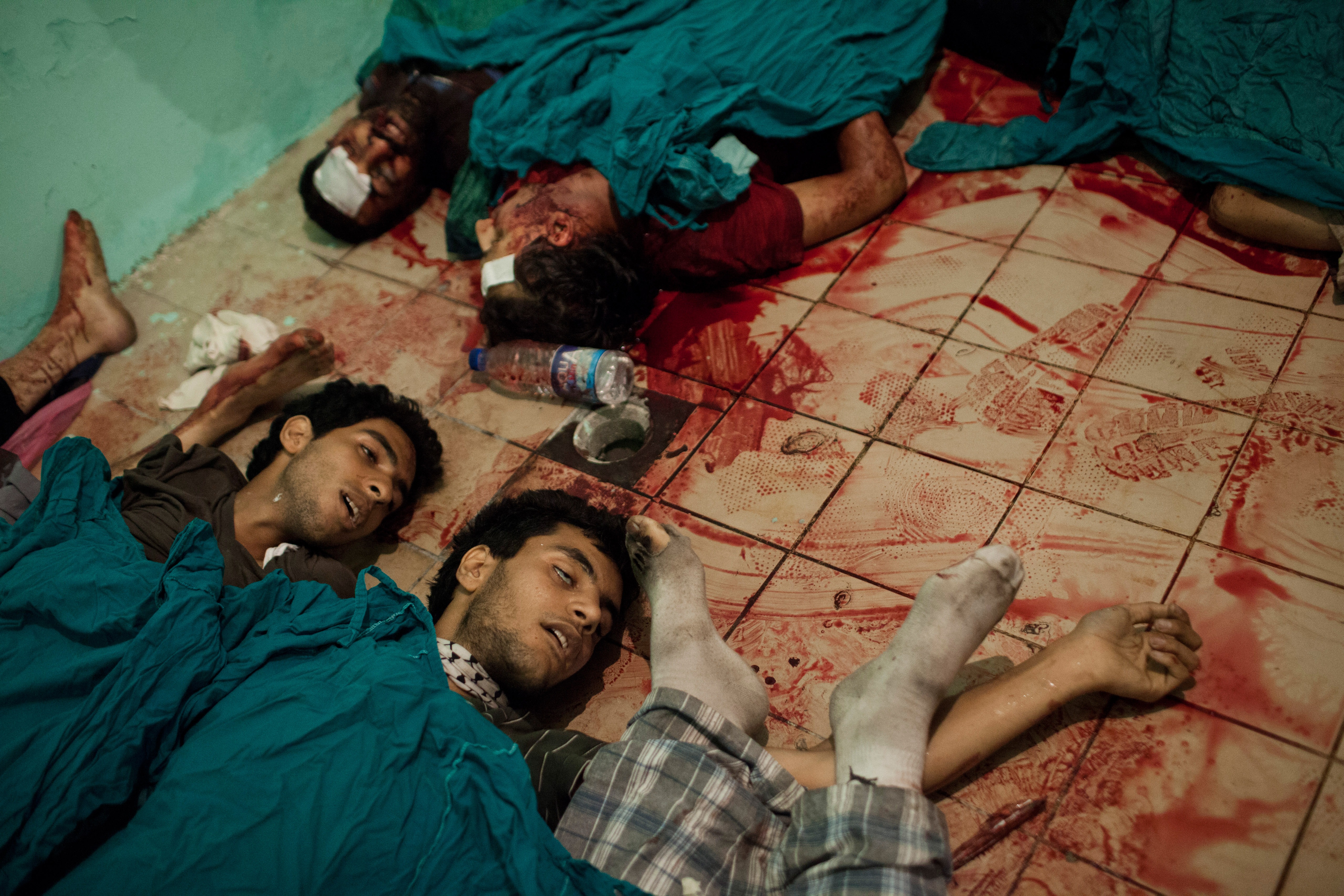
The bottom line is that we still don’t quite know what happened. Did some Muslim Brotherhood members try to storm the Republican Guards HQ after dawn … or did the military open fire on praying protestors? A helpful summary from the Guardian:

The Egyptian military says gunmen from an “armed terrorist group” and linked to the Muslim Brotherhood – the Islamist organisation with which Morsi is affiliated – tried to storm the building shortly after dawn, firing live ammunition and throwing firebombs, killing one police officer. But the Muslim Brotherhood said troops opened fire at protesters, including women and children, none of whom had attacked the troops. The Guardian’s Patrick Kingsley spoke to a number of witnesses who gave differing accounts of what happened. Accounts from five of the wounded backed the Brotherhood’s version of events.

The NYT has this detail:

Bullet holes in cars, lampposts and corrugated metal barriers indicated that gunfire was coming from the top of a nearby building where the sandbag barriers around makeshift gun emplacements were visible. Bullet casings on the ground and collected by Islamist demonstrators bore the stamp of the Egyptian Army. But Egyptian state television showed film of a pro-Morsi protester firing what appeared to be a homemade handgun at advancing soldiers from behind a corner about 250 yards away. The footage was in daylight, hours after the initial attack began. A witness who lived nearby said he saw two men with similar weapons among the protesters.

The protesters, witnesses and video footage all appeared to portray the pro-Morsi demonstrators as attempting to fight back against the soldiers by throwing rocks.

It seems insane to me that, holding power and needing some Islamist support, the military would then engage in an unprovoked slaughter of protesting Morsi supporters at prayer. And yet the slaughter seems beyond anything we have yet seen since the start of this turbulence. I tend to agree with Juan Cole, until we get further evidence:

Both narratives are problematic. The army’s description of a “terrorist attack” sounds propagandistic. The Brotherhood account doesn’t indicate a motive for the army abruptly to launch an attack on peaceful demonstrators.

But this does, from the army spokesman:

The scene spiralled out of peacefulness at about 4am, he says. An armed group attacked the perimeters around the Republican Guard HQ, and the personnel responsible for securing the premises – from the army and police – were attacked by live ammunition, Ali says.

At the same time other groups started to climb up the buildings nearby and throw stones, molotov cocktails, bombs and heavy objects, Ali says, resulting in the death of one army officer and the injury of 42. Many of them are in a very critical condition, he says.

Stay tuned.

(Photo: The bodies of men lie on the floor of a morgue at the Liltaqmeen al-Sahy Hospital in Cairo’s Nasr City district, after allegedly being killed during a shooting at the site of a pro-Morsi sit-in in front of the headquarters of the Egyptian Republican Guard on July 8, 2013 in Cairo, Egypt. By Ed Giles/Getty.)

Egypt: Fact Of The Day

As the country now seems on the brink of full-scale civil war, this tiny nugget leapt out at me:

The recent 2008 Demographic Health Survey in Egypt (EDHS) reported that the FGM/C prevalence rate among women from ages 15-49 is 91.1 percent, but 74 percent among girls age 15-17.

Declining, perhaps, but still close to ubiquitous. Mark Steyn notes how Morsi’s wife conducted herself while “First Lady”:

President Morsi’s wife, Naglaa Ali Mahmoud, is his first cousin, and covered from head to toe. If you were a visiting foreign minister, you were instructed not to shake hands, or even look at her… Eschewing the title first lady, she preferred to be known as “first servant.”

Otherworldly War Photography

Platon

For three years, Richard Mosse worked with a discontinued infrared military surveillance film to photograph war zones in eastern Democratic Republic of Congo, where at least 5.4 million people have died of war-related causes since 1998. The resulting body of work, The Enclave, was presented at the Irish Pavilion of this year’s Venice Biennale, and is featured in a new book. Rebecca Horne evaluates the artist’s choice of medium:

The false-color infrared satellite film was initially used for aerial reconnaissance, showing healthy foliage as pink and red and thereby highlighting camouflage as blue or purple. Here, it is the medium for on-the-ground images from war zones of the Congo. As with the film’s properties that switch one color for another on the spectrum, viewers may become unsure of what they are looking at, and where it fits in the cultural spectrum. Through [Mosse’s] lens, a world of sinister machismo is seen in the hues of prom dresses and flowers. Is it an art project or a serious documentary? Either way, the images upend these tidy categories and introduce messy questions about objectivity and aesthetics.

Mosse recounts the hazards of working on the project:

Working in eastern Congo with a large wooden camera on a tripod was never going to be simple. You have to walk for days through the jungle to reach certain rebel groups, walking across shifting front lines, and brushing shoulders with suspicious guerrillas along the mucky track. The rain and lightning assault the landscape around you, sweeping through your tent at night. Perhaps the most frustrating, however, was the land’s entrenched corruption, and its greedy officials. Each little village seems to have a mwami (chief), his queen, and a retinue of immigration officials, intelligence officers, and police, who will keep you in a little shed all day, shouting or pushing papers around their desk, until they receive a $20 bill. The national army are the worst, extorting the local civilian population as they process through the jungle to sell their produce on market day. You can see why rebel groups have formed to fight the government. People are so burned out, disillusioned by insidious corruption that has become institutionalized over several generations. They are humiliated, and that humiliation expresses itself in the most horrifying violence, cycles of massacre and systematic sexual violence. Recently, the massacres have been so horrific that unborn babies have been cut from their mother’s belly while entire families are slaughtered by spear.

Mosse describes more about the project here.  Gallery here.

(Photo: Platon, 2012. Farm near Bihambwe, Masisi Territory, North Kivu. This rich pastureland is fiercely fought over in an escalating territorial conflict. Image courtesy of the artist and Jack Shainman Gallery.)

Visit Mom, Or Else

China recently passed a law requiring adult children to visit their elderly parents. Xiaoqing Pi takes note of the first case:

A Chinese woman and her husband have been ordered to visit the woman’s elderly mother at least once every two months, and during at least two public holidays every year, in the first application of a new law that requires Chinese people to “regularly” visit their parents. A local court in Wuxi, a city in eastern China’s Jiangsu province, imposed the requirement on the daughter and son-in-law of a 77-year-old woman identified only by her surname, Chu, the official Xinhua news agency reported on Monday. Ms. Chu’s daughter had not visited her since the two had a falling out in September, according to other state media reports (in Chinese). The court ruled that Ms. Chu could ask authorities to fine or even detain her daughter and son-in-law if they failed to visit, Xinhua said.

Some 33 percent of young Chinese citizens report seeing their parents just once a year, while a further 12 percent haven’t visited their parents “in years.” Bruce Einhorn says the law has roots in China’s one-child policy:

With government-provided assistance very limited, seniors in China largely depend on their families to care for them in their golden years. Hence the risk from the One Child Policy: Without brothers and sisters to pick up the slack, all it takes is one unfilial child for the system to break down.

Adam Minter argues that economic and migratory shifts bear some responsibility:

In China’s traditional agrarian culture, those aging relatives would live with, and be supported by, their children. But the country’s modernizing economy means children are moving far from their parents to work. … According to data gathered by the Chinese Academy of Social Sciences, in 2011 empty nests accounted for 49.7 percent of urban households and 38.7 percent of rural households. This number will increase as China’s population ages, reaching more than 54 percent of all elderly households in 2050, says [deputy director of China’s National Committee on Aging] Zhu Yong.

Michael Pettis warns that China’s changing demographics pose a long-term threat to its economy:

While China’s overall population will stay roughly constant over the next three decades, its working population will actually drop by 1½ percent a year during this time. The explosion in the number of senior citizens, with no equivalent increase in the number of children becoming adults, means that by the middle of the century China’s working-age population will fall to 56 to 58 percent. China will then have one of the oldest populations in the world, and it will have a relatively small economically productive base on which to support a small number of children and a large number of retirees.

Recovered Books

From a collection of book covers with one letter missing:

dish_here'swaldo

After the jump is another collection of covers – classic works of literature with a contemporary pulp remake:

dish_dorian

Details on the series:

The UK publisher [Oldcastle Books’s Pulp! The Classics] has since released pulped versions of Robinson Crusoe, Wuthering Heights, The Hound of the Baskervilles, The Great Gatsby and The Picture of Dorian Gray, which features the face of actor Ryan Gosling. “I was asked to include him by my handlers for commercial viability reasons, but I’ve no idea who he is,” says Mann. According to marketing manager Alexandra Bolton, Oldcastle’s pulp imprint is designed to appeal to audiences who might perceive texts by Austen and Hardy as stuffy “whilst appealing to existing fans of classic novels and avoid debasing the actual text.”

Create your own taglines for the covers here.