
“The Light Of Faith”

VATICAN-POPE-AUDIENCE

Friday marked the release of Pope Francis’s first encyclical, Lumen Fidei – “The Light of Faith.” Rocco Palmo provides context for the how the document came into being:

While the less than four month period between Francis’ election and the rollout of his first major document is a modern record, the pontiff let slip in mid-June that he was reworking a draft text given him by Pope-emeritus Benedict XVI, and that the finished product – ostensibly prepared to mark the ongoing Year of Faith – would be “the work of four hands” …

[W]hile Benedict’s first encyclical, Deus caritas est, was likewise rooted in a late effort of Blessed John Paul II, it emerged some nine months after Joseph Ratzinger’s 2005 election. Until now, the quickest time-lapse between a Pope’s ascent and first encyclical was held by John Paul, whose Redemptor hominis was given in March 1979, four and a half months into his pontificate, while Paul VI and Blessed John XXIIII respectively waited fourteen and eight months before publishing their first top-tier messages.

Elaborating on the theme, Samuel Gregg emphasizes the basic continuity between the two popes – and Francis’s humility:

No doubt some will claim (especially after they read Lumen Fidei) that, because Ratzinger penned the first draft, this encyclical “isn’t really Francis’s text.” But, actually, it is. Francis was under no obligation to use Benedict’s initial draft. Yet he did. Moreover, encyclicals are rarely composed in their entirety by a pope. Others, for a variety of reasons (such as expertise in the subject-matter), are normally asked to contribute to the drafting process. Naturally there’s always speculation about particular persons’ influence upon individual documents. In the end, however, final authorial responsibility for these texts belongs to the pope who signs them. They are truly his documents, for without his signature denoting his assent to every word of their content, they lack magisterial authority and are destined to be mere archival curiosities.

One of the many things I admire about Pope Francis is his genuine humility. And it’s a truly self-effacing pope who freely acknowledges his predecessor’s profound contribution to the first encyclical of a new pontificate.

Reading Lumen Fidei, David Cloutier reaches back to then Joseph Cardinal Ratzinger’s early theological work and the argument that faith includes more than mere belief in certain intellectual propositions:

[I]n Joseph Ratzinger’s 1968 Introduction to Christianity…faith is named as “taking up a position” and “to take one’s stand on something.” Ratzinger is trying to identify faith with a certain type of stance toward reality, rather than with any formulae, claiming that faith is the prerequisite of all real human understanding. Without faith, he suggests, all understanding eventually is reduced to “making” – that is, not to standing somewhere, but to remaking the world in one’s own image…

The overall outline of the [encyclical] suggests its central concern, set out in the initial paragraph, to counter the idea that religious faith is in fact a form of “darkness.” Rather, faith means standing somewhere, taking a stand, one that illuminates rather than darkens. In the first chapter, the existential or dynamic (rather than propositional or doctrinal) aspect of what faith means is vividly described, in particular using Abraham.

Kyle Cupp notes that the encyclical’s description of faith leaves room for life’s uncertainties:

We read that “faith opens the way before us and accompanies our steps through time,” summoning us to an unseen future, but then the encyclical says something striking:  “the sight which faith would give to Abraham would always be linked to the need to take this step forward: faith ‘sees’ to the extent that it journeys, to the extent that it chooses to enter into the horizons opened up by God’s word.”  In other words, to see by the light of faith, you first have to take a step in the darkness.  Faith is a choice to move, to journey, and only on this journey is the path illuminated by faith.  The light shines after the taking of each step, and as faith is a choice one must make at each moment of each day, the sight of faith is neither immediate nor constant.  The light and the dark go together.  In the words of the Lumen Fidei:  “Faith by its very nature demands renouncing the immediate possession which sight would appear to offer; it is an invitation to turn to the source of the light, while respecting the mystery of a countenance which will unveil itself personally in its own good time.”

James Martin elaborates on how Francis connects faith to love, a move that he hopes will appeal to “the seeker, the doubter, the agnostic and even the atheist”:

[A]s the pope says, “Love is an experience of truth.” For those still searching for God, then, Francis encourages them to meditate on their experience of love, not simply as an ephemeral emotion, but as a way of tasting faith and experiencing truth, both of which can lead to faith.  As we reflect on the love that God has shown us in our lives, as the People of Israel did over history, we slowly come to belief. And here is a beautiful line that will speak to many seekers: “To the extent that they are sincerely open to love and set out with whatever light they can find, they are already, even without knowing it, on the path leading to faith.”

To that end, faith is a journey. Lumen Fidei speaks of the “path” and “road which faith opens up before us.” In other words, don’t be afraid to keep looking. “Religious man is a wayfarer,” says Francis (and I would add religious woman, too), “he must be ready to be led, to come out of himself, and to find the God of perpetual surprises.”

So, to the seeker Francis says: don’t be afraid of using your intellect, see what love might teach you about faith, and stay on the path. Then one day, you may be surprised to discover that you are in a relationship with God and, more important, that God is in a relationship with you.

John Allen, Jr., reads the encyclical in much the same way:

[T]he new pope’s first encyclical insists that Christian faith “must be professed in all its purity and integrity,” but also strikes a  pose of open arms to all the “seekers” of the post-modern world.

Anyone who is “open to love,” the document says, is “already, even without knowing it, on the path leading to faith.”

In a sense, the document amounts to a synthesis of the spirit of “affirmative orthodoxy” under Benedict, which is now seemingly being extended into the papacy of Francis: Tenacity in defending the content of orthodox belief, but a determination to phrase that content in the most positive and outward-reaching fashion possible.

For those not inclined to read the entire encyclical, you can read a helpful summary of it here.

(Photo: Pope Francis smiles after his weekly general audience in St Peter’s square at the Vatican on June 12, 2013. By Alberto Pizzoli/AFP/Getty Images)
When God Grew Up

Michael Tolkin spots this provocative passage from Walter Kirn’s My Mother’s Bible:

Why did God take so long to post the rules, allowing his children to blunder about in darkness between their expulsion from Eden and Moses’ time? It seems so cruel, this interlude of anarchy [creation, Babel, flood, slavery] that left human beings to their own devices and caused them to be cursed, cast out, and slaughtered when their trial-and-error search for answers went awry. Why not reveal the Ten Commandments to Adam, say, so he could teach them to his poor son, Cain? Why for so long did the Lord require his children to read his mind instead of his stone tablets? Maybe it took him a while to know his own mind. Maybe, that is, God’s will didn’t properly exist until human beings revealed it in the negative by confounding it in so many ways. By hovering over them while they lurched through history, God learned as much from his children, it seems possible, as they eventually learned from him. And the chief thing he learned was that he didn’t like it when they acted in ways that reminded him of himself.

Tolkin comments:

The God who surprises and fascinates Kirn is not the great and terrible Oz mocked by atheists; after creating the world, he can only affect it by suggestion, not by changing the rules that God himself put into motion. God’s miracles are limited in duration and scale, and nothing fundamental in creation is ever permanently reversed. God is everywhere at the beginning, and withdraws from conversation as the march across the wilderness comes to an end. Kirn isn’t surprised by the humanity of Adam and Eve or Abraham and Moses; it’s God’s humanity that fascinates him. When God speaks to Moses out of the burning bush and tells him to go back to Egypt and free the Hebrews, Kirn notes that Moses wants to tell the Hebrews who sent him, and therefore wants God to tell him his name, but God won’t do it; all he says is for Moses to tell them “I Am That I Am.” “Today it seems profound,” writes Kirn, “this answer, a great grammatical infinity loop… Considered in context, though, as a piece of dialogue, it strikes me as a joke. Before this, God either damned you or cursed you, but now he’s learned to pull your leg.” Kirn sees comedy in God’s game of inscrutability — “Maybe Jehovah’s crazy-making name is part of a longer ‘Who’s on first?’”

Let It Blow

Robert T. Gonzalez praises the above short film, Bert Haanstra’s 1959 Oscar-winning documentary Glas, as the “perfect little ten minute vacation”:

[W]hat caught my attention was how effectively it contrasts the meticulous, method-based craftsmanship of the glassblowers with the automated processes of the bottle-building machines. It’s an especially powerful comparison, considering that glass blowing remains widely practiced to this day, even after decades of global industrialization. I can think of few examples where an artisan’s virtuosity juxtaposes more compellingly with the raw generative capacity of a factory – this makes the film wonderful to think about, and practically impossible not to watch.

Notes On A Dirty Old Man

In an essay entitled “I Should Have Slept With Philip Roth” – an excerpt from her new memoir, On My Knees – Periel Aschenbrand describes an encounter with the famous author:

I was trying to make a good impression and sound mildly intelligent, so I started talking about French critical theory. This was definitely a gamble since I don’t actually know anything about French critical theory. Had I read “The Dying Animal” before I met Roth, I would have known this was a colossal waste of time. But I hadn’t read “The Dying Animal” before I met Roth because I hadn’t read anything by Roth before I met him. As it turned out, it didn’t really matter what I was talking about because Philip Roth spent the vast majority of the time I was with him alternately talking about his great love for cherries and staring at my tits.

While I was droning on about the great French feminist philosopher Monique Wittig, who is both famous and obscure enough that I thought I could get away with it, Philip Roth interrupted me, “I have a question for you.”

I was already formulating my answer. Yes, Mr. Roth, of course, I would be thrilled to have you write the foreword of my next book. I look at him expectantly, the way I imagine a dog would look at its owner right before the owner is about to fill its bowl with food. I was anticipating a very serious literary question.

Roth said, “Do you like cherries?”

Trying not to skip a beat, I licked my lips and batted my eyelashes. “Who doesn’t like cherries?” I asked as I smiled sweetly.

Roth got a devilish twinkle in his eye, “Would you like to taste one of my cherries?”

He pierced a cherry with his fork. I opened my mouth, and Philip Roth, one of the greatest writers maybe ever, popped a cherry into my mouth.

“Mmmmm,” I said, as I smiled at him, “Delicious!”

It was actually revolting. The cherries were preserved in some heavy, sugary red liquid. They tasted like cough syrup. But hey, who was I to ruin an old man’s good time?

Drinking Until You Divulge

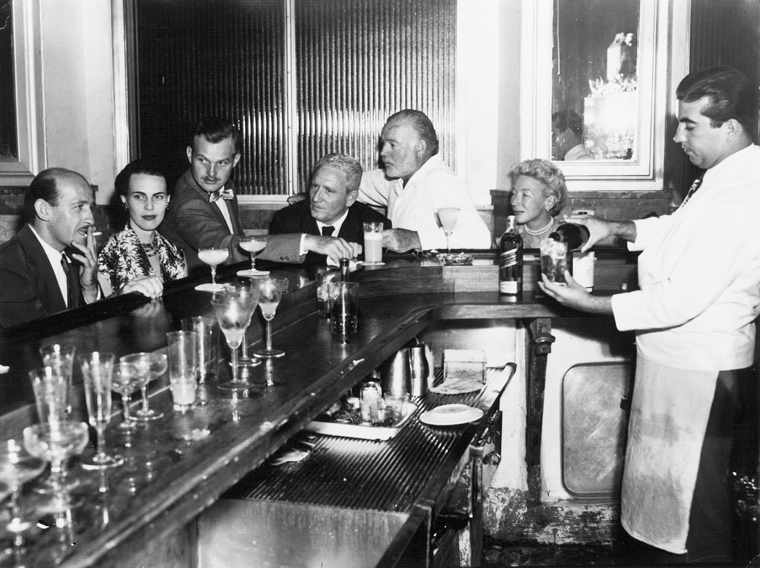
EH 5084P

While under the influence, Damian Sowers makes a connection between bad habits and good writing:

Writing is only interesting to other people if it is deeply revealing. Your brain has a self defense mechanism which prevents you from divulging too much of yourself to perfect strangers. Fortunately, this mechanism can be easily bypassed with chemicals.

If you’re not terrified to click the little green publish button, drink more and rewrite.

(Photo: Hemingway, third from the right, drinking in Havana in 1955, via Wikimedia Commons)

Love, Divided

In an interview, Christopher Bram, a novelist and author of Eminent Outlaws: The Gay Writers Who Changed America, describes the tension that animates much of his work:

One theme that appears again and again is the conflict between big love and little love. The phrase was coined by my friend Mary Gentile, who went to college with me and has been one of my best readers and toughest critics. Mary recognized early that my characters are often torn between their love for something personal and immediate and love for something larger and more difficult. In Surprising Myself, Joel finds himself divided between love of sex and self and his love of his partner, Corey. In Gossip, Ralph is torn between political loyalties and his affection for a closeted Republican. And so on. Sometimes the larger love is just plain wrong, as in Hold Tight, where Hank Fayette, a white sailor from Texas, has no trouble accepting his homosexuality but is angrily confused when he falls in love with a black man, the smart-mouthed Juke. He feels his very identity as a white man is being thrown into doubt.

I’m not sure where this pattern originated in my work. It might come from my experience as a gay person: all of us must learn to choose between what we were taught to feel and what we really feel. Or maybe I just read too much George Eliot in college.

How he writes about sex:

Sex is as important as laughter for me in storytelling. Well, it’s another part of my realism. Sex is not just a sensuous act, but an expressive act, a dramatic act. People reveal a lot about themselves in bed. Or they can anyway. When it’s just sex, I usually skip over the act and say something like, “Afterwards they smoked cigarettes.” But when something in addition to lust is being expressed or worked out, I write a scene. For example, the first real sex scene in Surprising Myself isn’t until fifty or so pages in, when Joel and Corey have been together for three years. They have all these other bonds and memories and emotions, which crowd into bed with them. And Joel finds himself fantasizing about all the guys he didn’t sleep with. He is both confused and excited.

You’re right; people rarely talk about the sex in my novels, but I suspect that’s because so much else is going on. The sex is blended with the rest of life. In novels by, say, Edmund White or Alan Hollinghurst, there’s often not much else going on except sex, so readers really notice it.

“A Democracy Of Affection”

Christopher Richards describes his passion for the poetry and personal outlook of Frank O’Hara:

What I love about O’Hara is the way that he is camp, because it’s not too camp. It is not camp at all. What his poems declare, to quote his friend [James] Schuyler, is “I just can’t help it, I feel like this.” Certainly other poets have expressed this democracy of taste, this unbridled attraction before him—particularly Whitman, in his own nineteenth-century queer way. As O’Hara once commented to his roommate and sometimes lover, Joe Lesueur, homosexuality wasn’t just about sex, it was about his love of the freedoms that went with it. O’Hara seized on this and sought out what he wanted when he wanted it. As Lesueur describes in his memoir Digressions on Some Poems by Frank O’Hara, “Frank had at various times both the desire and the determination to make out with a great majority of the people to whom he was attracted, their diversity being truly mind-boggling: big guys, little guys, macho straight men, flagrantly gay men, rough trade, gay trade, friends, friends of friends, offspring of his friends, blonds, blacks, Jews, and—women: Grace Hartigan, for example.” …

His work is filled with unexpected tastes and nearly absent of any sort of hierarchy. Kangaroos? Lovely. Long terrible b-films? Satisfying. Rachmaninoff? Sublime. Drinking coke with a cute guy? The best. O’Hara presides over a democracy of affection.

Focusing Our Revision

“[I]n most parts of literary culture, revision has become as important as inspiration,” writes Craig Fehrman, who traces the current role of revision back to two influences – Modernism and the typewriter:

Most Modernist writers, like Hemingway with The Sun Also Rises, wrote by hand and then painstakingly typed up the results. That took time, but seeing their writing in such dramatically different forms—handwritten in a notebook, typed on a page, printed as a proof—encouraged them to revise it aggressively. “Much as I loathe the typewriter,” W.H. Auden wrote, “I must admit that it is a help in self-criticism. Typescript is so impersonal and hideous to look at that, if I type out a poem, I immediately see defects which I missed when I looked through it in manuscript.”

Twenty-first century technology has made revising easier than ever – maybe even too easy:

Today, most of us compose directly on our computers. Instead of generating physical page after physical page, which we can then reread and reorder, we now create a living document that, increasingly, is not printed at all until it becomes a final, published product. While this makes self-editing easier, [scholar and The Work of Revision author Hannah] Sullivan thinks it may paradoxically make wholesale revision, the kind that leads to radically rethinking our work, more difficult.

“The ideal environment for revision is one where you can preserve several different versions of a text,” Sullivan says. With only one in-progress draft on a computer, we lose the cues that led the Modernists to step back from their work and to revise it. “It’s that moment of typing things up that led to the really surprising and inventive changes,” Sullivan says. “The authors came back to their text, but it seemed estranged.”

Mental Health Break

Rapper Mr. J. Medeiros recently took a stand for marriage equality:

I don’t know what it’s like to be gay. I do know what it’s like to love someone in a way that only a marriage can describe. I do know what it’s like to have an identity. To believe these things should be denied to roughly 9million people living in the US (or the much greater number worldwide) does not sit well with my conscience. The same conscience that brought me to seek my God in the first place. I am a Christian who supports gay rights.