On Literary Translation

In a classic New Republic essay from 1941, Vladimir Nabokov expounds on the necessary qualities of the good translator:

We can deduce now the requirements that a translator must possess in order to be able to give an ideal version of a foreign masterpiece. First of all he must have as much talent, or at least the same kind of talent, as the author he chooses. In this, though only in this, respect Baudelaire and Poe or Joukovsky and Schiller made ideal playmates. Second, he must know thoroughly the two nations and the two languages involved and be perfectly acquainted with all details relating to his author’s manner and methods; also, with the social background of words, their fashions, history and period associations. This leads to the third point: while having genius and knowledge he must possess the gift of mimicry and be able to act, as it were, the real author’s part by impersonating his tricks of demeanor and speech, his ways and his mind, with the utmost degree of verisimilitude.

What not to do:

The … sin of leaving out tricky passages is still excusable when the translator is baffled by them himself; but how contemptible is the smug person who, although quite understanding the sense, fears it might stump a dunce or debauch a dauphin! Instead of blissfully nestling in the arms of the great writer, he keeps worrying about the little reader playing in a corner with something dangerous or unclean. Perhaps the most charming example of Victorian modesty that has ever come my way was in an early English translation of “Anna Karenina.” Vronsky had asked Anna what was the matter with her. “I am beremenna” (the translator’s italics), replied Anna, making the foreign reader wonder what strange and awful Oriental disease that was; all because the translator thought that “I am pregnant” might shock some pure soul, and that a good idea would be to leave the Russian just as it stood.

(Hat tip: buzzwords)
Faces Of The Day

dish_catpic

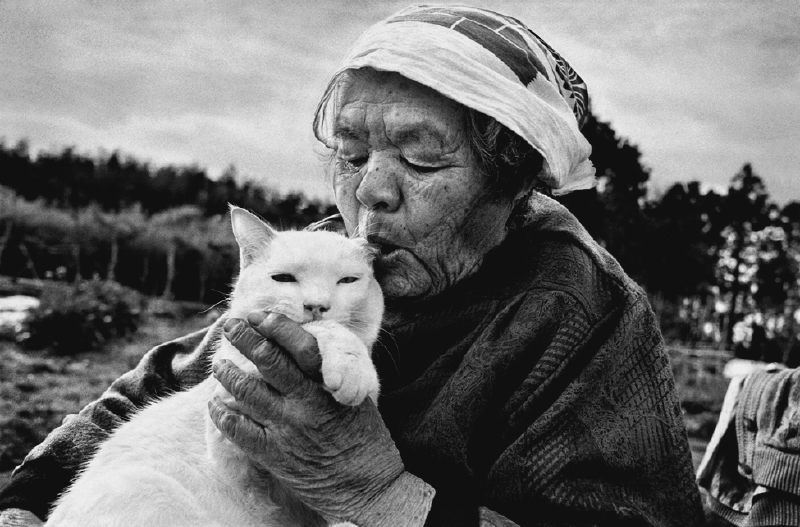
Tom at Demilked captions the above image:

For the last 13 years Japanese photographer Miyoko Ihara has been taking pictures of her grandma, Misao, to commemorate her life. 9 years ago, 88-year-old Misao found a stray odd-eyed cat in her shed: she called it Fukumaru, hoping that “the god of fuku (good fortune) would come and everything will be smoothed over like maru (circle).” Miyoko has been photographing their beautiful friendship and the way they go about their daily routine ever since. The strong bond between the two glows in every shot: “Partly because they are both hard of hearing, my grandmother and Fukumaru are always looking into each other’s eyes. They’re really close,” says Miyoko, who has recently published a hard cover photo album Misao the Big Mama and Fukumaru the Cat.

(Photo by Miyoko Ihara, from Misao the Big Mama and Fukumaru the Cat)

Why Do We Grieve For The Dead?

Julian Baggini considers the question:

There are, of course, plenty of … things about a death to get upset about, most obviously our sadness for the person who has died. However, philosophers have struggled to make sense of this and, as a result, have often concluded that there is simply nothing to be concerned about. The person has died. He cannot suffer in any way. There is no point in feeling sorry about what he might have missed out on because there is no longer anyone there to feel sorry for. The only people who can feel any pain are those who survive.

I think there’s something deeply wrong about this. The sadness that one feels for the deceased is not that he is, in a strange way, still around but unable to appreciate life, but rather that he is no longer around at all. He is not suffering but nor is he enjoying, savouring, loving, laughing, or appreciating either. That is the cause of our sadness, for him or, perhaps more accurately, for what the deceased could still have been.

Many philosophers have been baffled by this, protesting that it is no more rational to feel sad for the unexperienced joys of the deceased than it is for those of the never born. But there is a huge difference between the time two people could have spent together in the real world were it not for an accident, say, and the time two people who had never been born could have spent together in a parallel, imaginary universe. The former did not come to pass when it very nearly could have, while the latter is just one of an infinite number of counterfactual possibilities. It takes a curiously impersonal perspective to assign the same value to both the unrealised experiences of purely hypothetical beings and those of people who lived and breathed. If we can delight in someone’s company, or even just derive enjoyment from a glass of good wine, then there is nothing irrational about feeling sad, perhaps painfully so, that someone we know who would have taken equal pleasure did not have the chance to do so.

The Afterlife Of A Manic Pixie Dream Girl

8647054660_dea68a2106_o

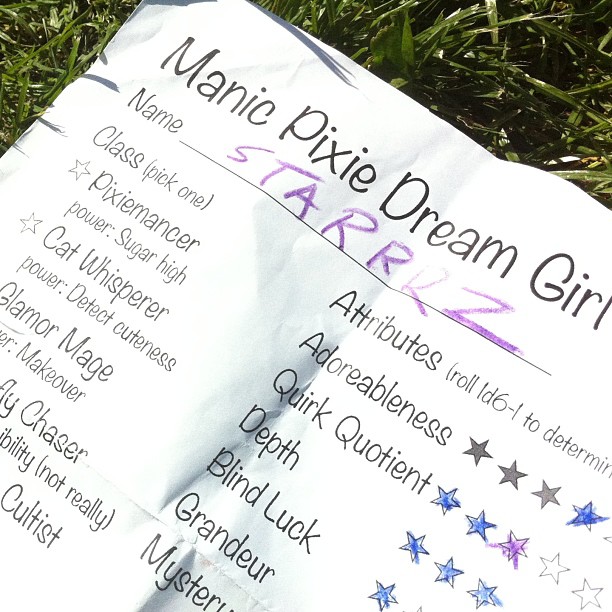
Laurie Penny describes her former life as a MPDG:

I had the raw materials: I’m five feet nothing, petite and small-featured with skin the color of something left on the bottom of a pond for too long and messy hair that’s sometimes dyed a shocking shade of red or pink. At least, it was before I washed all the dye out last year, partly to stop soulful Zach-Braff-a-likes following me to the shops, and partly to stop myself getting smeary technicolor splotches all over the bathroom, as if a muppet had been horribly murdered.

And yes, I’m a bit strange and sensitive and daydreamy, and retain a somewhat embarrassing belief in the ultimate decency of humanity and the transformative brilliance of music, although I’m ambivalent on the Shins. I love to dance, I play the guitar badly, and I also–since we’re in confession mode, dear reader, please hear and forgive – I also play the fucking ukelele. Truly.

Penny dropped the identity “about the time I got rid of the last vestiges of my eating disorder and knuckled down to a career”:

I became successful, or at least modestly so–and that changed how I was perceived, entirely and all at once. I was no longer That Girl. I didn’t have time to save boys anymore. I manifestly had other priorities, and those priorities included writing. You cannot be a writer and have writing be anything other than the central romance of your life, which is one thing they don’t tell you about being a woman writer: it’s its own flavor of lonely. Men can get away with loving writing a little bit more than anything else. Women can’t: our partners and, eventually, our children are expected to take priority. Even worse, I wasn’t writing poems or children’s stories; I was writing reports, political columns. …

[I]n the real world, the very worst thing about being a real-life MPDG is the look of disappointment on the face of someone you really care about when they find out you’re not their fantasy at all–you’re a real human who breaks wind and has a job.

(Photo: Manic Pixie Dream Girl LARP character sheet by Colin Fahrion)

A Poem For Saturday

section_header

From “Song of Myself” (1867) by Walt Whitman:

I think I could turn and live with animals, they are so placid and
self-contain’d;
I stand and look at them long and long.

They do not sweat and whine about their condition,
They do not lie awake in the dark and weep for their sins,
They do not make me sick discussing their duty to God:
Not one is dissatisfied, not one is demented with the mania of owning
things,
Not one kneels to another, nor to his kind that lived thousands of years ago,
Not one is respectable or unhappy over the whole earth.

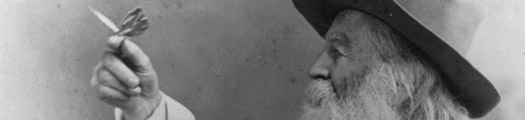
(Photo of Whitman holding a butterfly from the 1889 edition of Leaves of Grass)

The View From Your Window Contest

vfyw_7-6

You have until noon on Tuesday to guess it. City and/or state first, then country. Please put the location in the subject heading, along with any description within the email. If no one guesses the exact location, proximity counts.  Be sure to email entries to contest@andrewsullivan.com. Winner gets a free The View From Your Window book or two free gift subscriptions to the Dish. Have at it.

The Inner Lives Of Animals

Brandon Keim investigates the field of animal consciousness:

The whale biologist Shane Gero is part of a research team that has conducted long-term sperm-whale studies off the island of Domenica in the Caribbean. These studies describe the dynamics of whale families in which children are, in a very real sense, the centre of their lives. Yet Gero told me of being chastised by colleagues for referring to animals by name rather than number. Pressure still exists to think not of individuals, but of general species traits that happen to be manifested in a particular animal. Gero has helped to decode the vocalisations that sperm whales might use as names, something that’s also been observed in dolphins, but this remains controversial.

That’s why a visitor to the ‘Whales: Giants of the Deep’ exhibition at the American Museum of Natural History in New York can learn a lot about their skeletons, heart capacity and navigational abilities, but barely anything about their intelligence and social lives — arguably the most dynamic area of contemporary cetacean research. …

[I]n some respects the general public outpaces much of the scientific community, at least when it comes to the familiar animals we live with and know well. All those cute cat videos, reliably mocked as a symptom of our unintellectual internet habits, bespeak our era’s willingness to acknowledge the inner lives of companion animals. Not that they’re tiny humans in kitten suits, of course — indeed, part of the fun in knowing a cat (not to mention watching those videos) is the obvious disparity between their view of the world and our own. But neither are they entirely incomprehensible, per Ludwig Wittgenstein’s enigmatic statement: ‘If a lion could speak, we would not understand him.’ Wittgenstein probably never saw a pair of lion cubs at play.

The Ethics Of Editing Reality TV

Reality television producer Troy DeVolld talked to the AV Club:

TDV: Like with journalism, it’s choosing your moments, choosing what to discard, being able to rearrange that order. Timelines are a big thing in reality TV. Over the course of four months, you’re trying to find six or eight scenes that relate to each other that you can make an episode out of.

AVC: Is a “Frankenbite” another way reality shows condense timelines?

TDV: A Frankenbite, by definition, is just when you take original spoken material and you cut it into a smaller, or different, version of itself. There’s a big difference between the Frankenbiting that you’re probably thinking about most often and the Frankenbite that actually has to happen for a show. If I say, “Yesterday I went to the mall, I bought a lemonade, I rode the kids’ train, and then I bought a pair of pants,” but all I needed to know is there’s a pair of pants, I will Frankenbite it down into, “I went to the mall and I bought a pair of pants.” Because after all, a reality show’s only half an hour to an hour long, and you can’t have somebody, every time they open their mouth, take 20 or 25 seconds to relay the thought. So Frankenbiting should be for the compression of time.

When you are Frankenbiting for the purpose of making someone say something they didn’t say, then there’s a whole ethical thing that comes into play, which is you don’t want someone to say something that isn’t authentic to their character.

But I could take that same sentence that says, “Today, I went to the mall and bought pants” [and say], “Well, there was a scene where she went to a boutique, and it wasn’t at the mall, and I want to set up the top of the scene. And somewhere else she says, ‘My friend at the boutique.’” I could say, “Today I went to the [cut] boutique [cut] and bought pants.” So I’m changing the location. I’m not doing anything sinister. It’s sort of mixing the spackle to hold the show together without having to redo the interviews.

AVC: Do you think you’re held to a different standard of authenticity because it’s a visual medium?

TDV: Exactly. You can’t see the ellipses in reality TV when we’re putting portions of a thought together. So many people are sloppy as bejesus about it. You just hear the shift in pitch when people are speaking. …

AVC: But you’re not actually putting words in their mouths?

TDV: No. In a scene, I might have to say, “Can you guys please have a conversation about what happened last Thursday, because I can’t make sense of these two scenes without you talking about how you got from this point to this point; something happened off-camera.” There are certain things you’re going to have to ask for. Interview content is a little bit different, because there are some people that come in and they’re like, “What do you want me to say?” It’s like, “Well, I want you to answer these questions.” So whenever I write questions for people, I always start with the phrase, “If this is true…” because you’re going to drive the person bananas if you’re like, “So, tell me about how much you hate so and so.” Then they shut off, and they don’t want to work with you anymore.

Previous Dish on reality TV here, here, and here.

When Does A Vigilante Become A Villain?

Heather Havrilesky assesses the questions tackled by Chuck Klosterman in his new book, I Wear the Black Hat: Grappling With Villains (Real and Imagined):

If Batman were real, and you knew that a vigilante was killing criminals without due process, would you root for him or want him arrested? What about Bernard Goetz, who became a hero to many New Yorkers in 1985 for stopping four black teenagers from mugging him on the subway (by, uh, shooting them) but who fell out of favor as soon as people figured out he was “weird,” as Klosterman puts it? Why is Batman seen as a hero, when Goetz is seen a villain? Could it all boil down to a strong jaw, black tights and an excellent sports car?

Obviously, it’s more complicated than that. But one thing you can say about Klosterman is that he’s unafraid of complications. In exploring why “the qualities that we value in the unreal (Batman) are somehow verboten in reality (Goetz),” Klosterman analyzes 1) the state of crime in New York City in 1985; 2) the pressures on Goetz after becoming an “overnight” celebrity; 3) the plot of “Death Wish“; 4) that Goetz said, after the shooting, “I wanted to kill those guys”; 5) the subsequent crimes committed by the teenagers in question; 6) Goetz’s alleged history of racist statements; 7) the ways public perceptions of Goetz split down bipartisan lines, 8) Goetz’s habit of sharing his New York City apartment with squirrels; 9) that Batman is cool and can’t be interrogated by reporters.

Once Klosterman has sifted through all these factors and also considered Ted Bundy, French political scientist Alexis de Tocqueville, sci-fi novelist Norman Spinrad and Bret Easton Ellis’ “American Psycho,” he finally concludes that, “[t]he reason things unacceptable in life are acceptable in fiction is because fiction is the only way we can comfortably examine the morally obscene.”

Pinning Down “Punk”

“1991 may be known as the year punk broke,” writes Anne K. Yoder, “but 2013 may soon become the year of its canonization”:

[It’s] no surprise that the current fêteing has lost touch with punk’s confrontational roots, its urgency and exigency—the capstone being the punk show at the Met, currently exhibiting facsimiles of CBGB’s bathroom walls.

The antidote? One comes in the form of the latest chapbook, Punk, from Sarah McCarry’s Guillotine press. Punk skewers this kind of nostalgic teleology, among other things, in the dialogue between lifelong lady punks, Mimi Thi Nguyen and Golnar Nikpour. Nguyen has been making zines like Slander and Race Riot since 1991 and has written a great deal about punk along the way; Nikpour grew up in New York by way of Tehran and was a co-coordinator of seminal punk fanzine Maximum Rocknroll, which she still contributes to intermittently. Their final note is a good starting point for the conversation, as Nguyen defines punk as “a plural, rather than a coherent, series of forms or formations, that can and should resist institutionalization,” and that “attempts to describe punk are always partial because punk is—”

And so the chapbook ends, leaping into whitespace that refuses to propose a stable definition of punk. … [The authors] concur that punk by its own definition exists as a constellation of scenes united by a rather elastic set of punk ethics, and that history cannot be reduced.

And the medium is the message:

If anything, Punk, and the entire Guillotine chapbook series, adheres to this essential punk ethic that Nguyen and Nikpour identify with and promote. For one, it’s a DIY endeavor and McCarry designs, letterpresses, and sews the chapbooks herself—a practice more common within poetry circles. The series is dedicated to publishing “revolutionary nonfiction,” front-loaded with incendiary political material that’s also quite timely and often couched within a personal narrative.

Recent Dish on punk here. The above video of Debbie Harry demonstrating the pogo, the British punk dance, for Americans on Glenn O’Brien’s TV Party, is via Dangerous Minds.