The Coup Watched ‘Round The Arab World

Egyptian President Morsi Ousted In Military Coup

Rania Abouzeid considers what the events in Egypt signal to other “Arab Spring” countries:

Egyptians aren’t the only ones watching. The rise of political Islamism during the so-called Arab Spring was in many ways a reaction to the repression of Islamists under the various secular regimes they helped topple in Tunisia, Libya, and Egypt. Their rise was like a recoil after the restrictions on their political participation were lifted. An equilibrium was bound to be reached at some point, although the fear was always that, once in power, Islamists might curtail the very freedoms that helped them get there—one vote, one time, so to speak. What is the message from the pro-democracy advocates in Tahrir Square? Was it that if the results at the ballot box don’t go your way, and your interests coincide with that of the military, it’s fine to depose Egypt’s first democratically elected leader? That even if Islamists play by democracy’s rules and win an election, they can be undemocratically removed?

Many Egyptians, it appears, would say yes.

I was struck by this quote from an Egyptian woman in the NYT today:

“Why is it just ballot boxes? Are ballot boxes the only forms of democratic expression when the rulers fail the people? Why did we have to bear his bad administration at a time when the country cannot cope with such failure?”

Channeling Jefferson?

What country can preserve its liberties if their rulers are not warned from time to time that their people preserve the spirit of resistance?

Like others, I remain conflicted about what just happened in Egypt – worried about the coup precedent, yet relieved by the ouster of someone incapable of uniting the country. But the faces on the streets, the unusually massive public demonstrations, and the dismal record of Morsi tip the balance, in the end, for me, for now. The integration of the Arab Muslim world into modernity will be messy, protracted and contain any number of twists and turns. Our role should be patience and distance, not micromanagement. This is their struggle before it is ours. And we have to let them lead us, not the other way round.

(Photo: An Egyptian woman celebrates in Tahrir Square, the day after former Egyptian President Mohammed Morsi, the country’s first democratically elected president, was ousted from power on July 4, 2013 in Cairo, Egypt. By Ed Giles/Getty Images.)

Police State Watch, Ctd

A reader objects to my sympathy over the shooting of this Rottweiler:

Give me a break! The only person to blame for that dog’s death is his owner. When the police are investigating a potentially volatile situation, the correct response for any citizen is to stay the fuck back! Instead, he got out of his car and escalated the situation. He acted irresponsibly and his dog Max paid the price for it. Maybe you’re blinded by your love for beagles, but a rottweiler is no beagle. If one was charging at me and I had a gun, I’d shoot the damn thing dead too. Better the dog than me (or my face). Do a Google image search for “Rottweiler attacks”.

Another:

I can’t disagree with you more about the dog shooting.

If I’m a cop and some guy’s Rottweiler jumps out of a car window and starts menacing me, then I’m opening fire. I’ve got a guy in cuffs who seemed to be trolling for a confrontation and an angry, threatening dog of unknown training and you want me to say “here nice doggy, doggy?” No way. People first, pets second.

How about a little personal responsibility on the part of that dog owner and countless others like him. Why is someone’s out-of-control dog the problem and not fault of the dog’s owner and protector? Furthermore, what was the guy thinking? I’ll leave my dog baking in the car under the California sun while I get booked downtown. Is somebody going to approach the car with a barking Rottweiler in it so they can care for the dog?

If this rant seems over the top, then it’s because I’m sick of dog wastes on the sidewalk and in public places. Just because you think your dog is great or whatever isn’t an excuse to let it shit on our shared spaces. Same with crotch sniffing, baby scaring, licking whatever, “oh he’s just playing (or saying hello)” dog encounters. You want that in your private spaces, be my guest. You want that in our public areas, I’m bringing mace.

All righty then. You can watch the video yourself to judge if the dog was a genuine threat to the cops or just an opportunity to kill something with a gun.

The Quintessential American Word: “Hi!” Ctd

A reader writes:

Apropos of your coverage of “Hi” as distinctively American, I thought you might be amused by this anecdote. Many years ago, while touring New Orleans, I decided to go to a service at the Catholic cathedral in Jackson Square, in the heart of the French Quarter.  I’d been raised a Lutheran, though I was a lapsed one at the time, and I had never attended a Catholic service before.  At the end of it, the priest asked the congregation to something or other (I forget his exact words), at which point the immaculately dressed elderly lady in front of me turned around and said to me, “May the peace of God be with you.”  I was so discombobulated by this completely unexpected turn of liturgical events that all I found myself blurting out to her was “Hi!”

Another reader:

“Hi!” was my first, and for a long time, only, word, as a baby.  It is for many American kids.  “Hi!” “Hi!”  They hear it all around.

Another:

We have neighbors who moved in last year from Burma. They are part of the Karen ethnic group. They have two small kids, maybe 4 and 5. Their family and ours have struggled with the language barrier, but whenever the kids see me they say “HI!”. I finally got a chance to talk to an English-speaking family member, and asked what the normal Karen greeting was. Like many languages, it depends on the time of day, and the relative station each speaker occupies. But the kids have found a great new toy – greeting someone without worrying about any of that stuff. “Hi!”

Someone should start a new blog about democracy in America. Call it “Hi Times.”

The Roots Behind Pussy Riot

Novelist Mikhail Shishkin examines modern Russian history and sees literature and politics long locked in a tense embrace:

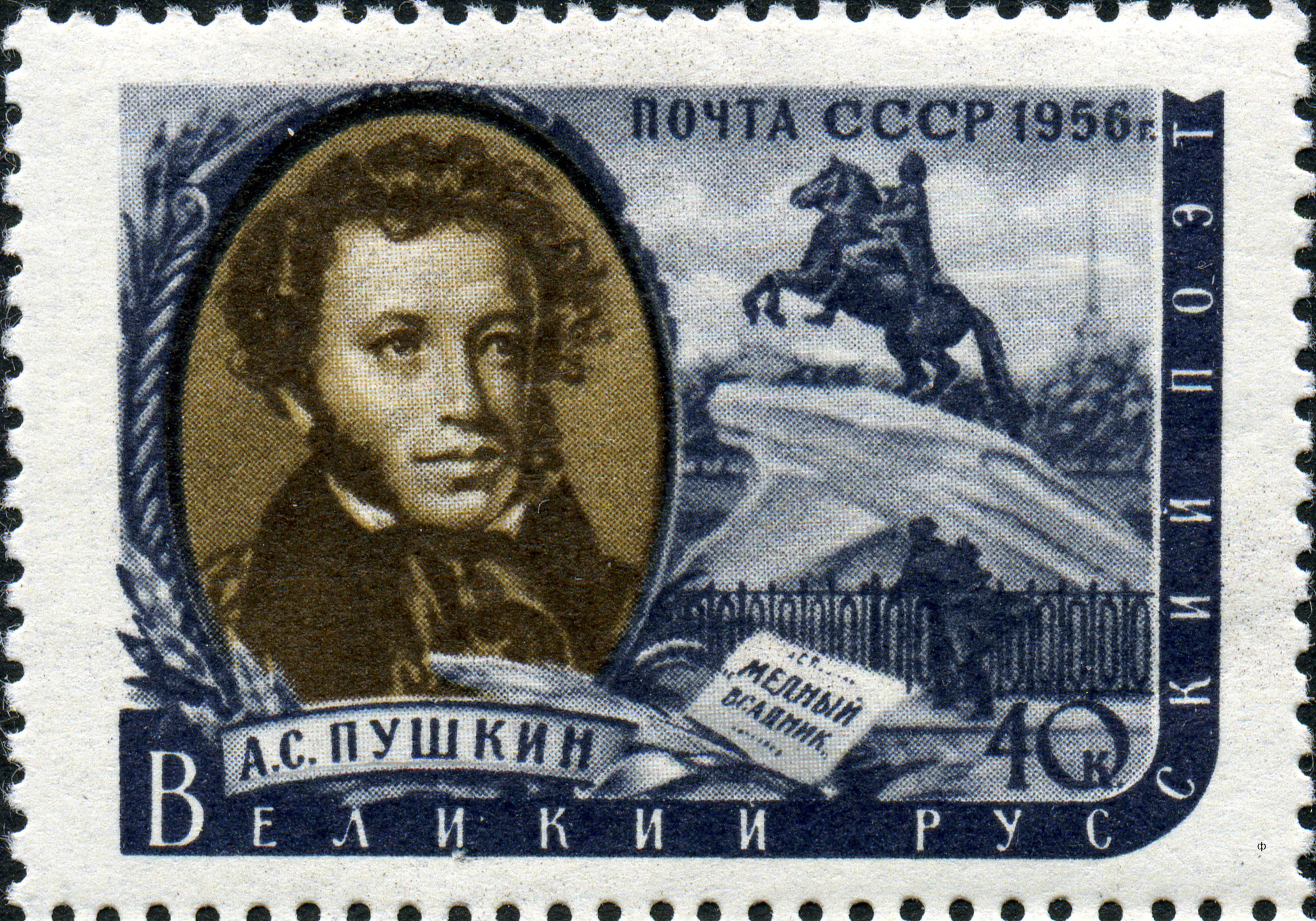
The state in Russia fears the poet because, beginning with Pushkin, he (or she) is a power USSR Stampindependent of the state and insubordinate to the state, a power just as sacred—the representative of another country, but one that falls within the borders of the same empire. The resulting duality of power led inevitably to conflict: how can two powers, both appealing to a higher divine authority, coexist in one totalitarian state? This was the ultimate question of Russian literature, to which every generation of Russian writers painfully sought an answer: should the poet be with the czar, or against him?

Previous regimes tried to co-opt poetry, but, according to Shishkin, Putin is unlikely to follow suit:

The new authoritarianism in Russia could not care less about literature; its priority is to control the electorate through television.

(Image: Soviet stamp with image of Pushkin circa 1956 via Wikimedia Commons)

“Eleven Oligarchs In Robes”

Ezra highlights Justice Roberts’ unique and immense power in presiding over the system of FISA courts:

The 11 FISA judges, chosen from throughout the federal bench for seven-year terms, are all appointed by the chief justice. In fact, every FISA judge currently serving was appointed by Chief Justice John Roberts, who will continue making such appointments until he retires or dies. FISA judges don’t need confirmation — by Congress or anyone else.

No other part of U.S. law works this way. The chief justice can’t choose the judges who rule on health law, or preside over labor cases, or decide software patents. But when it comes to surveillance, the composition of the bench is entirely in his hands and so, as a result, is the extent to which the National Security Agency and the Federal Bureau of Investigation can spy on citizens.

“It really is up to these FISA judges to decide what the law means and what the NSA and FBI gets to do,” said Julian Sanchez, a privacy scholar at the Cato Institute. “So Roberts is single handedly choosing the people who get to decide how much surveillance we’re subject to.”

Cannabis Capitalism

Mark Thornton blames the potency of pot on Prohibition:

I don’t see a problem with more potent pot. I don’t disagree that Prohibition is the main force behind it – but it means you can also inhale less for more effect. The double standards are again revealing. Who is complaining that we have bourbon in the alcohol market alongside beer? A couple of Jäger shots and I’m buzzed. Six beers and I’m bloated and useless. I’d rather do the shots. Vince Beiser examines the regulatory choices Washington state is facing as it sets up a legal marijuana industry:

One route Washington could take would be to issue lots of grower licenses and limit farm size to end up with a large number of small producers. Call it the mom-and-pop, artisanal-weed option. That would generate competition, which keeps prices low, encourages innovation, and makes it much more difficult for the industry to accumulate the kind of political power wielded by, say, Big Tobacco—the three companies that control 85 percent of the national cigarette market. On the other hand, it’s more difficult to monitor and regulate hundreds of small businesses than a few big ones. “And,” points out [Mark] Kleiman [who is advising Washington state on marijuana policy], “they’re not making as much, so each of them has a stronger incentive to push stuff out the back door”—into the black market.

If the state instead allowed only a few big growers to operate, they might get rich enough to become powerful players in state politics. But their centralized operations would be much easier to keep tabs on, and they would have a powerful incentive to abide by the law. “Otherwise they could lose their oligopoly position, which is basically a license to print money,” says Kleiman.

An Imposter’s John Hancock

“Joseph Cosey,” the favored alias of autograph forger Martin Coneely, comes to life in a 1956 New Yorker profile:

From the early thirties until shortly after the Second World War, [Cosey] papered the country with his handiwork—forgeries predominantly of Lincoln, but also of Franklin, Edgar Allan Poe, Mary Baker Eddy, and a score of other illustrious Americans—in such profusion that the autograph market was thrown into a state of demoralization from which it has not even yet fully recovered. …

Cosey successfully forged not only signatures but whole letters and other manuscripts in the handwriting of the signers. Ordinarily, when he attempted holographs, he reproduced an actual text verbatim, but he became so familiar with the literary style of some of the persons whose handwriting he forged that from time to time he improvised texts over forged signatures and thus ad-libbed some lines that became—temporarily, at any rate—footnotes to history.

(Hat tip: Longform)

Do Swedish Meatballs Come With That?

Ikea and the UN’s High Commissioner for Refugees are joining forces to build a better refugee shelter:

Ikea’s [new tent] design, a cross between a giant garden shed and a khaki canvas marquee, is Ikea Flatpackformed from lightweight laminated panels that clip on to a simple frame, providing UV protection and thermal insulation. Like an Ikea product, the polymer panels come packed in a box, along with a bag of pipes, connectors and wires — and no doubt a cartoon construction manual. “It is designed this way, like an Ikea bookshelf, to be easy to transport and easy to set up in the field,” says Johan Karlsson, project manager of Ikea’s Refugee Housing Unit. “And the panels can last up to three years.”

The kit also incorporates a fabric shading sheet with a metallic layer that reflects the sun during the day and keeps the heat in at night, as well as a solar panel to provide the shelter with power.

The UN is planning to test 50 prototype shelters in Ethiopia, Iraq, and Lebanon. Others have developed novel forms of refugee housing, but the traditional canvas tent remains dominant. Alternatives include the Superdobe Eco-Dome, the Buckminster Fuller-inspired Hexyaurt, and the Global Village Shelter, which is made from water- and flame- resistant paper.

Why Should Women Shave? Ctd

Athletes of both genders sound off:

I’ll apologize for taking this thread in a new direction, but as a guy who swam competitively for many years, I have inhabited the flip side of this coin (though of course without the kind of oppression that women endure, to which I am wholly sympathetic). When we shaved for competition, it was considered by many to be an effeminate act and we endured taunts from classmates. Folks were particularly merciless when it was revealed that we made an event out of it and shaved together as a team. It must have been the mental image of a room full of high school athletes shaving together, and shaving each other. Part of the advantage of shaving was thought to be related to the removal of the top layer of skin, so we shaved backs and other inaccessible areas – try that without a helper.

The removal of a layer of skin was thought to make you more sensitive to the flow of the water, but I remain skeptical.

The first thing I noticed about being shaven is how little you can feel, compared to being hairy. When you swim with hair, you know exactly where your leg is and how the water is acting on it, due to the tiny tug that passing water exerts on each little hair. When swimming following a shave, I felt temporarily lost in the water and swam largely on muscle memory. Folks saved their shave for the most important race of the season.

Maybe this was the reason most swimmers used “motion lotion,” a Ben Gay-sort of oil that gave your skin the icy-hot feeling. It was described to me as lubricating the body so it slips through the water better (swimmers would avoid applying the oil on parts of the arms and hands where you would want to “grip” the water”). On reflection, it seems more likely that the icy-hot feeling helps swimmers feel the water, in the absence of hairs.

This seems like an area ripe for systematic study.

Another reader:

Just to make the conversation interesting, I thought I’d throw in the topic of men who shave their legs. I suppose there are a few reasons that come to mind, either you’re a body builder, a swimmer, or in my case, a racing cyclist, then there’s also those who perform in drag and those who just feel like it. Others abound I’m sure.

As a cyclist it’s a funny thing because unlike swimmers, we do it throughout the season, and not just before competitions (as I understand it, that’s what they do). The reasons a cyclist does it are 1) for treating road rash, which if you’re racing, is inevitable, 2) to signify that you are a racing level cyclist, and not a weekend warrior, 3) pros have the additional reason of making it easier for leg massages. People talk about wind resistance, but the time saved is an insignificant difference. Some people might not mention reason 2, but I contend that that’s a force motivating people to do it – like a monk shaving their head before committing to the lifestyle.

The funny thing I’ve run into is having to mentally prep a girl for when I might be hairless again, and the understandable response of “oh, hmm.” I think it’s less a visual thing for girls – cyclist legs are ripped and sweet lookin – and more a feeling thing. When we lay in bed making sexual congress, the silk feeling of my legs against her legs will prompt a “wtf” reaction whether she’s “cool” with it or not. It’s a mixed signal since a part of her mind is expecting one feeling and getting a very different one It’s a small matter to me, if a girl would really object to having sex with me because I have shaved legs I’d stop being interested anyway, but still funny to remember there’s a minority of men who deal with the same problem, though in reverse.

A female cyclist:

I have one particular reason for keeping my nether-regions nearly clean-shaven and haven’t seen it addressed on the blog:  cycling.  Yup, I’m a long distance bicycle rider and, after many years of feeling a post-ride soreness that felt as if someone had taken a baseball bat to my genitals, I realized my pubic hair was the problem!  Being on a saddle for 8 or 9 hours at a time resulted in my pubic hair being tugged every which way for hours.  Tugged, pulled, yanked.  Ouch.  So I began trimming and realized immediate relief.  No more tugging or yanking as I shifted around on the saddle. That was years ago and I remain happily trimmed.  As long as I continue to turn a pedal, I’ll keep the trimmer close by.