Love Has No Narrative

Freddie loved the film Before Midnight, which made him “feel better about romantic love and life-long partnership”:

Perpetually, magazines and publishers release arguments that love is dead, or was always a lie, or that long-term relationships are contrary to human nature, or whatever. I have come to think that these arguments are exactly as immature and juvenile as the fairy-tale vision of love where two people meet and immediately fall in love and live happily ever after. I have had a life filled with both happiness and tragedy and there is no question in my mind that the portrayal of human life or human relationships as some hopelessly bleak and maudlin journey reveals a teenaged sensibility, a grasping and fussy pessimism that speaks of a refusal to confront life as petty indignities and great victories and terrible tragedies and little moments of grace all stacked on top of each other in nothing resembling a narrative or a plan.

Love is hard but it’s probably worth it and anyway, what else?

We have this idea that either you have a relationship with The One or you’re settling, and that the romantic ideal is to pursue the former and not the latter. But as I get older I more and more think that the real beauty comes precisely from the endless negotiation between two flawed people who aren’t perfect for each other or for anyone else but who are willing to work to find a way to live together in order to enjoy the good each has to offer. It’s not “romantic life vs. settling.” It’s getting to good enough with another person out of the conviction that there is nothing else and nothing better. And sometimes it doesn’t work. I believe in Celine and Jesse together, and I love this movie for showing two people who both can’t get along and are meant for each other.

Previous Dish on Linklater’s newest film here and here, which includes the trailer and the famous train scene referenced in the above video.

Innovate, Baby, Innovate

Reihan wants conservatives to embrace a new report, “Putting Energy Innovation First.” Yep, he’s one of the sane ones. In a follow-up, he smartly defends putting innovation before other climate change responses:

While it is true that we have the technological means to curb carbon emissions, we don’t have the means to curb carbon emissions without substantially changing how we organize our society in ways that will tend to also curb consumption and mobility. This is why energy innovation, and specifically devising cheaper-than-coal energy technologies, is so important: Energy poverty remains an enormous problem, and so we have to find a way to both increase energy consumption while also reducing reliance on carbon-intensive energy sources.

Carbon pricing can help encourage the adoption of low-emissions technologies and reduce the amount of driving, etc., yet politically realistic carbon taxes are unlikely to have a dramatic effect. Politically unrealistic carbon taxes, meanwhile, will tend to shift carbon-intensive activities to jurisdictions that don’t impose them. Cheaper-than-coal technologies, in contrast, will spread organically, and quickly. So if energy innovation reform increases the likelihood of achieving energy breakthroughs, I think it makes sense to prioritize it above carbon taxation or CTPs [cap-and-trade programs], both as a political and as a substantive matter.

Meanwhile, Gleckman examines a study finding that current energy-related tax breaks are ineffective:

Although the Code included $48 billion in energy-sector tax preferences in 2010-2011, their effects were essentially nil. “The combined effect of energy-related subsidies for renewable sources and fossil fuels is very small, probably less than 1 percent of U.S. emissions, and could be either positive or negative.” … The NAS report did conclude that one set of subsides—tax incentives for research and development in low-carbon technology—may be effective. However, the panel could not model those preferences.

The Best Of The Dish Today

Lake Georg-IN-645am

Quite simply this. And this:

all eyes are opened, or opening, to the rights of man. the general spread of the light of science has already laid open to every view. the palpable truth, that the mass of mankind has not been born with saddles on their backs, nor a favored few booted and spurred, ready to ride them legitimately, by the grace of god. these are grounds of hope for others.

for ourselves, let the annual return of this day forever refresh our recollections of these rights, and an undiminished devotion to them.

See you tomorrow.

The Quintessential American Word: “Hi!”

Fourth Of July Drummers

[Re-posted from earlier today]

Henry Fairlie published this gem about his adopted country – like me, he was a Tory and a passionate American – thirty years ago today. If you have never read it, do yourself a favor. It’s the experience of a Brit brought up in post-war England discovering America in later life. This anecdote never fails to make me smile – with recognition and wonderment:

One spring day, shortly after my arrival, I was walking down the long, broad street of a suburb, with its sweeping front lawns (all that space), its tall trees (all that sky), and its clumps of azaleas (all that color). The only other person on the street was a small boy on a tricycle. As I passed him, he said “Hi!”—just like that. No four-year-old boy had ever addressed me without an introduction before. Yet here was this one, with his cheerful “Hi!” Recovering from the culture shock, I tried to look down stonily at his flaxen head, but instead, involuntarily, I found myself saying in return: “Well—hi!” He pedaled off, apparently satisfied. He had begun my Americanization.

“Hi!” As I often say—for Americans do not realize it— the word is a democracy. (I come from a country where one can tell someone’s class by how they say “Hallo!” or “Hello!” or “Hullo,” or whether they say it at all.) But anyone can say “Hi!” Anyone does. Shortly after my encounter with the boy, I called on the then Suffragan Bishop of Washington. Did he greet me as the Archbishop of Canterbury would have done? No. He said, “Hi, Henry!” I put it down to an aberration, an excess of Episcopalian latitudinarianism. But what about my first meeting with Lyndon B. Johnson, the President of the United States, the Emperor of the Free World, before whom, like a Burgher of Calais, a halter round my neck, I would have sunk to my knees, pleading for a loan for my country? He held out the largest hand in Christendom, and said, “Hi, Henry!”

One thing that shocked me most about Washington when I moved there was the Mall. I was expecting some kind of royal park or something, I suppose. But around these massive neo-fascist monuments, Americans were playing frisbee, chowing down on picnics, scuffing up the grass, treating the place as if it were their own. And then I realized the core difference: it was their own. There had been no monarchy presiding over this Mall after the Revolution – and that democratic instinct, that leveling perspective gave us frisbees and volleyball and touch football all around secular hallowed ground. I was hooked within weeks of arrival here. Why? I’ll let Henry explain:

I had been in the country about eight years, and was living in Houston, when a Texan friend asked me one evening: “Why do you like living in America? I don’t mean why you find it interesting—why you want to write about it—but why you like living here so much.” After only a moment’s reflection, I replied, “It’s the first time I’ve felt free.”

(Photo: George Goldstein, Harold Johnson and Harold Valentine prepare to march through their neighborhood playing their drums to celebrate the 4th July, circa 1935. By FPG/Hulton Archive/Getty Images.)

Tonight’s Big Event

dish_fireworks1

Neil Irwin presents five facts about fireworks. First on his list:

You might injure yourself. You probably won’t kill yourself. The Consumer Product Safety Commission found that in 2012, there were 8,700 injuries in the United States caused by fireworks that required treatment at a hospital, well within the recent range of injury numbers (the 15-year high was 11,000 in 2000, the recent low 7,000 in 2008). But there were only six deaths reported in 2012, four in 2011, and three in 2010. (Here is more from Sarah Kliff on where on the body those injuries are likely to occur)

Marc Herman reads the The Consumer Products Safety Commission (CPSC)’s report on fireworks safety:

The key to avoiding fireworks injury appears to be, broadly, not treating gunpowder like it’s barbeque sauce. The bulk of injuries came from various homemade firecrackers and misuse of powerful rockets. Reading the directions, and not trying to re-invent something the Chinese had pretty much nailed 2,000 years ago, appear to be the trick to avoiding injury, according to the CPSC report

And Margaret Hartmann finds a political angle on Independence Day festivities:

Thanks to sequestration, the Fourth of July is going to be a good bit less festive this year, particularly if you happen to live on or near a military base or are an air-show buff. As the Washington Post reported this week, politicians’ dire predictions have mostly not come true, but over the long holiday weekend, federal cutbacks will be especially visible as, with the military subject to across-the-board cuts, bases have been forced to scale back or cancel their Independence Day celebrations.

And National Geographic presents photography advice for capturing fireworks.

(Photo by Flickr user bayasaa)

Face Of The Day

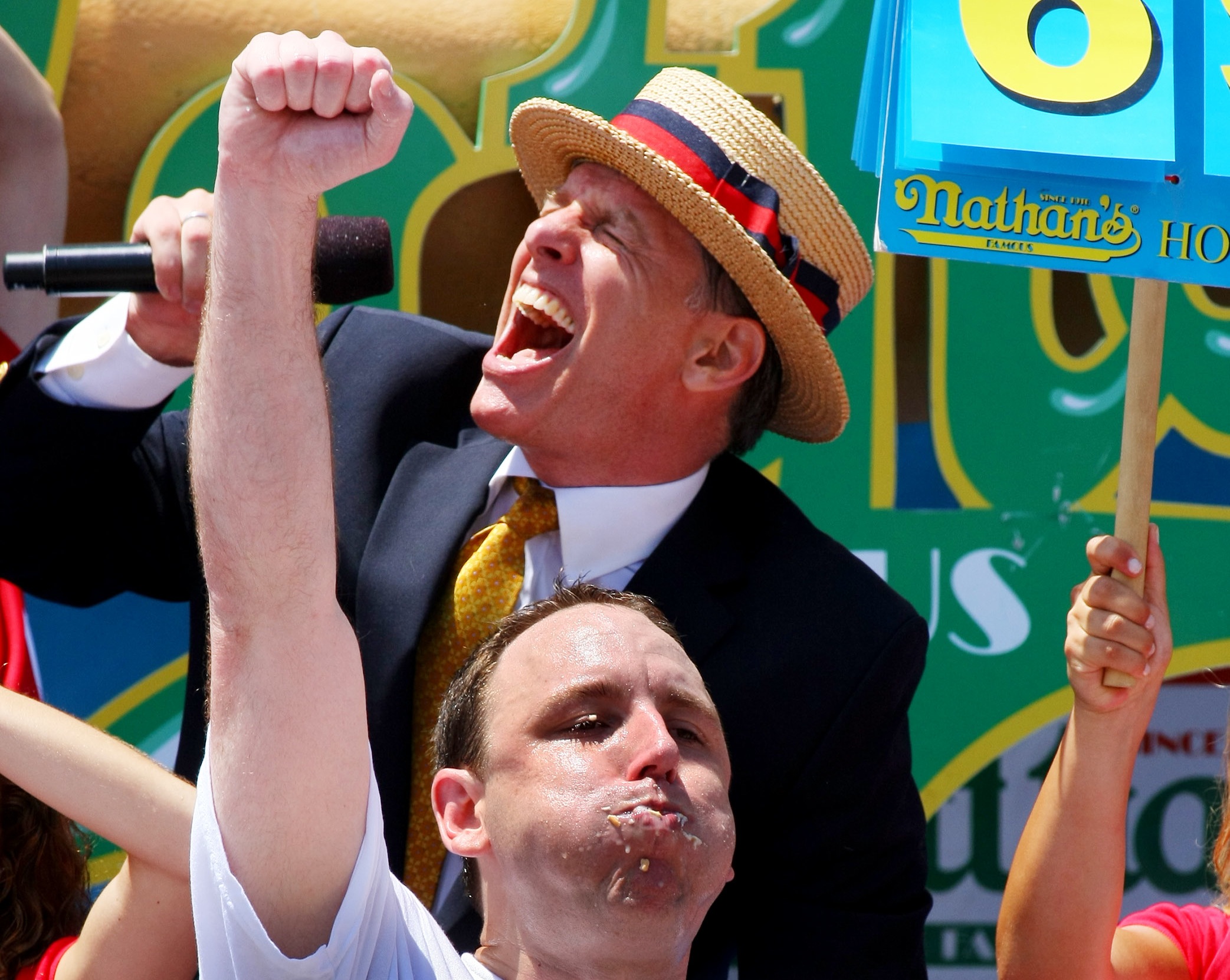
Top Speed Eaters Compete In Nathan's Hot Dog Eating Contest

Master of Ceremonies George Shea cheers as Joey ‘Jaws’ Chestnut sets a new record and wins the Nathan’s Famous Fourth of July Hot Dog Eating Contest at Nathan’s Famous in Coney Island on July 4, 2013. Chestnut, of San Jose, California, ate 69 hotdogs in ten minutes to win his seventh straight title. By Monika Graff/Getty Images.

The Self-Made American

Jim Cullen considers its myth and mythos in American culture:

Today, even those who invoke the self-made man in politics almost always credential themselves as self-made in the realm of commerce (standard operating procedure for Republican politicians in particular, whose private sector credentials are often flimsy, since they have typically spent much of their careers in government service). Rare is the figure— [author Daniel Walker] Howe among them—who recognized this had not always been so. “Few expressions in our language have shriveled as badly as the term ‘self-made man,’” he noted in his chapter pairing Frederick Douglass and Abraham Lincoln in Making the American Self. “Among intellectuals at least, it is widely regarded as the platitudinous expression of an obsolete individualism. Once upon a time, however, the self-made man represented a heroic ideal.”

Indeed, even a brief immersion in seventeenth-, eighteenth-, or nineteenth-century U.S. sources suggests that the conception of the self-made man was a good deal broader than business or politics. Yes, of course, John D. Rockefeller was considered an exemplar of the self-made man. But so was Ralph Waldo Emerson. Benjamin Franklin is widely considered the patron saint of American capitalism, but he was also celebrated by his contemporaries as a self-made scientist, diplomat, and writer. Self-made men came from other realms as well, among them the military (Andrew Jackson, Ulysses S. Grant, George Patton) and the arts (Walt Whitman to Walt Disney).

(Hat tip: 3QD)

Quote For The Day II

US-JUSTICE-GAY-MARRIAGE

“When slavery was assailed twenty-five years ago, the whole land took the alarm, and every species of argument and subterfuge was resorted to by the defenders of slavery.  The mental activity was amazing; all sorts of excuses, political, economical, social, theological and ethnological, were coined into barricades against the advancing march of anti-slavery sentiment.  The same activity now shows itself, but has added nothing new to the argument for slavery or against emancipation …

When the accursed slavery system shall once be abolished, and the Negro, long cast out from the human family, and governed like a beast of burden, shall be gathered under the divine government of justice, liberty and humanity, men will be ashamed to remember that they were ever deluded by the flimsy nonsense which they have allowed themselves to urge against the freedom of the long enslaved millions of our land. That day is not far off,” – Frederick Douglass, 1862.

(Photo: Michael Knaapen and his husband John Becker react outside the US Supreme Court in Washington DC on June 26, 2013. The US Supreme Court last Wednesday struck down a controversial federal law that defines marriage as a union between a man and a woman, in a major victory for supporters of same-sex marriage.The Defense of Marriage Act (DOMA) had denied married gay and lesbian couples in the United States the same rights and benefits that straight couples have long taken for granted. By Mladen Antonov/AFP/Getty.)

Why Do The Poor Become Parents?

Dana Goldstein reviews Doing the Best I Can, a book on inner-city fatherhood:

Poor, single dads have a lot in common with their female counterparts. Both young men and young women in these neighborhoods see forgoing contraception as a key sign of sexual trust and fidelity, and they demonstrate little anxiety about unexpected pregnancy—a surprising notion for many middle-class Americans, who viscerally fear the loss of educational, career, and romantic opportunities that premature parenthood brings. Far from disdaining marriage, low-income single parents have fully absorbed mainstream cultural messages about what that institution should entail: two good jobs, home ownership, and a “soul mate” kind of love. Because these goals appear impossible for people living hand-to-mouth at the bottom rung of the American economy, however, men told the researchers that marriage is generally off the table as a realistic lifestyle. Indeed, they mistrust women, whom they see as enforcers of middle-class earning expectations they cannot meet. The love these men feel for their children is far stronger than any romantic connection they’ve made with those children’s mothers.

Reihan chimes in:

I’m more inclined to think that there might be some value to marriage-promotion programs, not because poor people “don’t respect marriage” — as Dana points out, that is not generally true — but rather because committed relationships require a skill set that is not evenly distributed across the population.

As women have entered the workforce, “traditional” gender roles have been fading. And so individual couples and families find themselves negotiating responsibilities and boundaries in ways that weren’t strictly necessary in an age of rigidly-defined gender roles. As a good friend pointed out in conversation a few weeks back, it is thus not surprising that marriages have tended to be more durable and successful among educated Americans with strong communication skills, as they are more accustomed to navigating complex relationships in the course of their working lives. Imparting communication skills is extremely difficult, and it might be a lost cause. But the best marriage-promotion programs rest on the idea that communication skills that can reduce friction in relationships really can be taught.

TNC’s dispatch on a Chicago family getting evicted feels tangentially related:

When we left, the beautiful brown boy was standing on the sidewalk next to his parents. His mother held the baby on her hip. She said nothing. One of the officers wished them good luck. The man yelled in response, “You talk about us like we dead. We ain’t dead. We still a family. Good luck to you.” He said it in such a way that he seemed to be trying to convince himself. …

When I saw the father today, I saw a man without the power to set his own laws. I’ve seen the same pose out in the streets where men yell and threaten violence. I used to think such a display fearsome, but people who must show their power through threatening violence inhabit a low rung.