Dish readers know the story by now. This is how the Wall Street Journal headlined the latest:
 Yes, that news-editorial wall has gotten more and more porous over there, hasn’t it?
Dish readers know the story by now. This is how the Wall Street Journal headlined the latest:
Yes, that news-editorial wall has gotten more and more porous over there, hasn’t it?
The man who threatened to bash a gay man views himself as the victim of murderous violence. Baldwin says of his homophobic criminal incitements on Twitter:
It’s just another chink in your armor for people to come and kill you.
Do these massively wealthy celebrities even hear themselves?
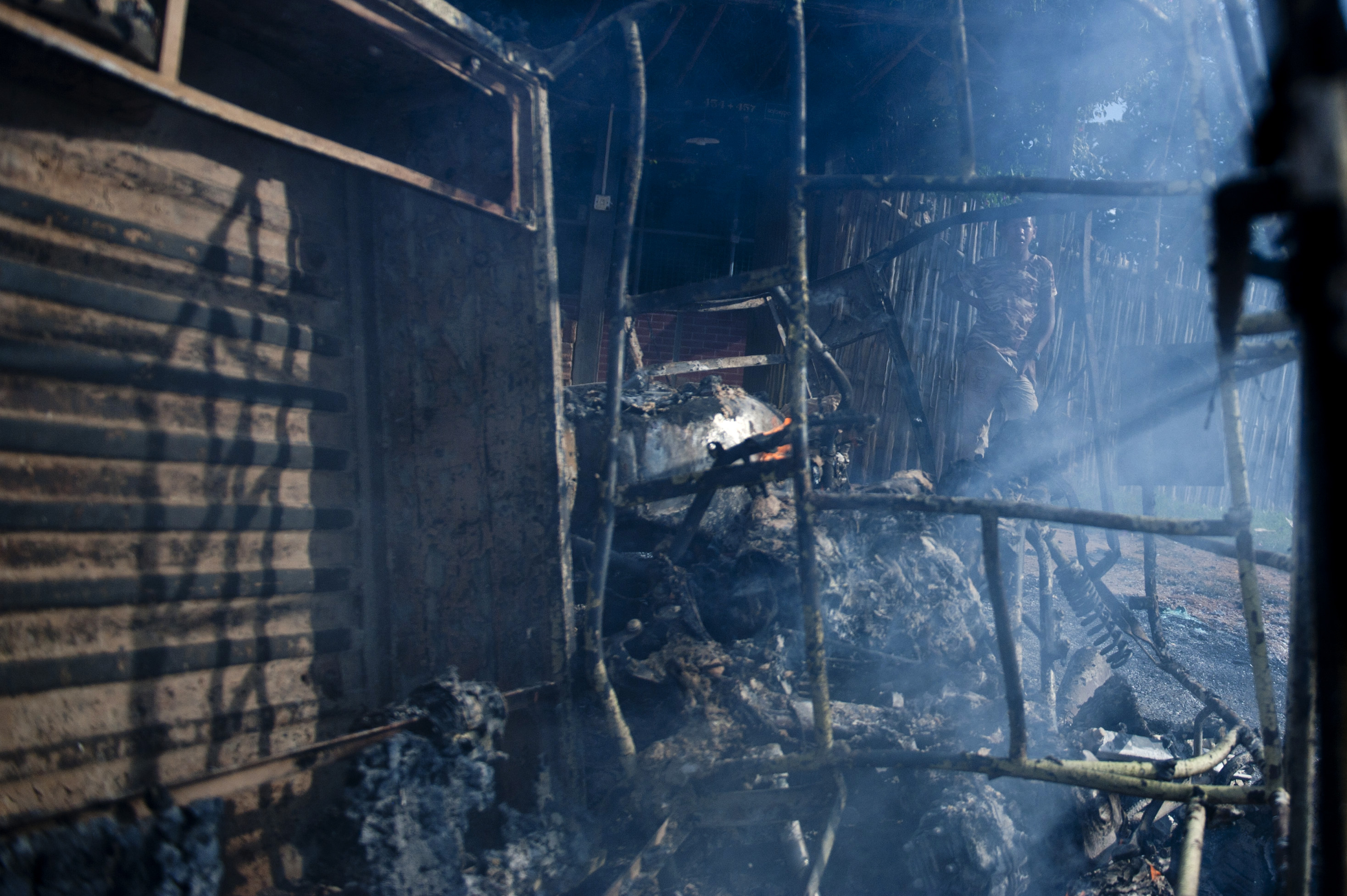
One argument that many people of faith cling to these days is that not all religion is inherently violent or intolerant; non-fundamentalist religion can coexist with modernity, because it can acknowledge the role of doubt and conscience in any religious calling. And yet, religion only fitfully takes this form, and seems inherently prone to controlling the beliefs of others. One argument I’ve used in the past is that if Christianity was successfully turned into a war- and torture-machine in early modern Europe, then it is no wonder that a non-pacifist fundamentalist faith like Islam could also veer wildly off course. But I long suspected that Buddhism was arguably the faith most immune to these temptations, more powerfully drawing people away from conflict and toward meditation and peaceful coexistence. Time for a reality check from Burma:
Days after Buddhist mobs tore through the central city of Meiktila in March, two trucks filled with men showed up in Mr. Nyi Nyi’s neighborhood and hurled stones at the night watchmen with slingshots. Some Muslims with means have fled to Malaysia or Singapore. Muslim-owned businesses are losing Buddhist customers. A growing Buddhist movement known as 969 that has the blessing of some of the country’s leaders is campaigning for a boycott of Muslim products and businesses and a ban on interfaith marriages.
The movement says it is not involved in violence, but critics say that, at the least, hate-filled sermons are helping to inspire the killings. “This is the first time we experience this in our lifetime,” said U Maung Maung Myint, who runs an import-export company and is one of the trustees of the Bengali mosque, which is only a few hundred paces from a Buddhist pagoda, a Christian church and a Hindu temple. He was referring specifically to the mistrust between communities.
And this is a consequence of more democracy. As in Egypt and Iraq, sudden freedom may take intolerant and sectarian religious forms. But when Buddhism becomes a vehicle for mob violence against minorities and sectarian cleansing, it truly is depressing.
(Photo: A youth watches as a structure burns in Lashio, Shan state of Burma on May 29, 2013. Burma’s government called for calm Wednesday after mobs burned down a Muslim orphanage, a mosque and shops during a new eruption of religious violence in the east of the country. By Ye Aung Thu/AFP/Getty Images.)

And Europeans are none too happy about it:
In Germany, a government investigation into what Chancellor Angela Merkel’s government knew about Prism will likely come into being this week. In Brussels, kickoff talks on the EU-U.S. trade deal could be hampered or stall out completely over fears that the U.S. government is using its spying system to steal European trade secrets. And on both sides of the Atlantic, Transatlanticists are struggling to figure out what still binds both sides.
Stephen Walt says the spying should come as no surprise to political realists:
What we are is a set of national states whose interests align in many areas, but not everywhere. And that’s also why various proposals for a global “League of Democracies” were always a bit silly: Sharing a democratic system is too weak a reed on which to rest a global alliance. Even democratic states experience conflicts of interest with each other, and as the NSA has now shown, they continue to see each other as competitors and spy on each other in order to seize various advantages. So nobody should be surprised that the United States was using its superior technical capacity to try to gain an edge on its European partners, and you can be sure that America’s European allies have been spying on the United States too, if not as extensively or as expensively.
(Photo by Mike Herbst)
 A heart-breaking story about what rejecting your own gay son can lead to. This is the kind of tale that is helping evangelicals turn a corner on gay dignity and equality. Because the consequences of rejection can be so devastating.
Final count by #Egypt medics: 16 killed around Cairo University in clashes last night between pro-Morsi demonstrators and protesters.
— Sheera Frenkel (@sheeraf) July 3, 2013
New chant in #Tahrir: "bus, shouf/al thawra ya kharouf!" 'come see the revolution, you sheep!"
— ashraf khalil (@ashrafkhalil) July 3, 2013
Soldiers close to pro Morsi rally appear ready to move: armoured vehicles idling at parking lot entrance. Soldiers w/riot shields in jeeps.
— Kareem Fahim (@kfahim) July 3, 2013
Dear Egyptian revolutionaries: Just remember, we in US already have dibs on July 4; so hurry up or slow down
— Juan Cole (@jricole) July 3, 2013
Josh Marshall updates us on the situation:
This morning the military will or already has convened a meeting of all political factions to discuss its ‘road map’ for post-Morsi Egypt. With the military, the Interior Ministry lined up against it, significant non-MB Islamist factions standing apart and millions remaining in the street, Morsi and the Brotherhood appear already to have lost control of the state. The ‘coup’ seems almost to have happened in advance of itself. But the prospect of deadly street battles seems very real regardless.
Juan Cole was surprised by “the brevity and completely uncompromising character of the speech” Morsi gave last night:
Morsi did not offer to revise the hated constitution. He did not offer to form a government of national unity, with cabinet members from the opposition parties. This, even though his cabinet is collapsing, with six resignations, and even his own spokesmen have resigned. He did call for a reconciliation commission, and promised parliamentary elections in a few months. But these are not new ideas and are unlikely to resolve the conflict.
Marc Champion wishes that Morsi had taken a different approach:
What Mursi should have said in his rambling speech last night was that the military’s ultimatum was unnecessary, and that when he had earlier offered to engage with the protesters, he had in mind creating just the kind of road map and transitional coalition government that the armed forces appeared themselves to be proposing. What would he have had to lose? By then, at least five members of his cabinet had resigned, abandoning what they saw as a sinking ship.
Instead, Mursi decided to call the military’s bluff, always a bad move when the other side has tanks and you don’t.
George Packer praises “Two American Families” (trailer above) and calls the documentary a rebuke to conservatives who blame our economic malaise on a culture of complacency:
If you screened “Two American Families” for Charles Murray and other social critics who believe that the decline of America’s working class comes from a collapse of moral values, social capital, personal responsibility, and traditional authority, they would probably be able to find the evidence they’d need to insulate themselves against the sorrow at the heart of the film.
None of the four parents finished college. The Neumanns’ divorce leaves Terry and the children in worse straits than ever. The Stanleys don’t move to rural Mississippi, where life is cheaper. The kids make plenty of their own mistakes. None of them thinks of inventing Napster. The Stanleys and Neumanns are punished to the fullest extent of the economic law for every mistake made, and for all the mistakes they didn’t make.
But the intellectually honest response to this film is much less comforting, for the overwhelming impression in “Two American Families” is not of mistakes but of fierce persistence: how hard the Stanleys and Neumanns work, how much they believe in playing by the rules, how remarkable the cohesion of the Stanley family is, how tough Terry Neumann has to become. Both families devoutly attend church. Government assistance is alien and hateful to them. Keith Stanley says, “I don’t know what drugs or even alcohol looks like.” In the words of Tammy Thomas, whose similar story is told in my new book, “The Unwinding: An Inner History of the New America,” these people do what they’re supposed to do. They have to navigate this heartless economy by themselves. And they keep sinking and sinking.
Graeme McMillian wonders why genre books flourish as e-books:
There are multiple theories for the genre dominance in digital publishing, including the appeal of anonymity offered by e-reader devices, which don’t display the cover of a potentially embarrassing book for all the world to see. As Antonia Senior wrote in The Guardian last year, ”I’m happier reading [historical romance fiction] on an e-reader, and keeping shelf space for books that proclaim my cleverness.”
But the digital delivery system also offers immediacy and ease of access for material that often is serialized and written to make you want to know what happens next, as soon as possible. Liate Stehlik, senior vice president and publisher at HarperCollins, subscribes to that idea, at least partially. Genre fans, she says, became “early adopters” of the digital format because e-books are the optimal format “for people who want to read a lot of books, quickly and frequently. Digital has replaced the paperback, certainly the paperback originals. I think the audience that gravitated to eBooks first really was that voracious reader, reading for entertainment, reading multiple books in a month across multiple genres.”

Jesse Prinz traces the “wide-eyed, slack-jawed feeling” through centuries of science, religion, and art:
[L]ike science, religion has a striking capacity to make us feel simultaneously insignificant and elevated. Dacher Keltner, professor of psychology at the University of California, Berkeley, has found that awe, an intense form of wonder, makes people feel physically smaller than they are. It is no accident that places of worship often exaggerate these feelings. Temples have grand, looming columns, dazzling stained glass windows, vaulting ceilings, and intricately decorated surfaces. Rituals use song, dance, smell, and elaborate costumes to engage our senses in ways that are bewildering, overwhelming, and transcendent.
Wonder, then, unites science and religion, two of the greatest human institutions. Let’s bring in a third.
Religion is the first context in which we find art. … Up through the Renaissance, art primarily appeared in churches. When in the Middle Ages Giotto broke free from the constraints of Gothic painting, he did not produce secular art but a deeply spiritual vision, rendering divine personages more accessible by showing them in fleshy verisimilitude. His Scrovegni Chapel in Padua is like a jewel-box, exploding with figures who breathe, battle, weep, writhe, and rise from the dead to meet their God beneath an ethereal cobalt canopy. It is, in short, a wonder.
When art officially parted company from religion in the 18th century, some links remained. Artists began to be described as ‘creative’ individuals, whereas the power of creation had formerly been reserved for God alone. With the rise of the signature, artists could obtain cultlike status. A signature showed that this was no longer the product of an anonymous craftsman, and drew attention to the occult powers of the maker, who converted humble oils and pigments into objects of captivating beauty, and brought imaginary worlds to life. The cult of the signature is a recent phenomenon and yet, by promoting reverence for artists, it preserves an old link between beauty and sanctity.
Go here for a virtual tour of the Scrovegni Chapel. On the image seen above:
14-year-old Zev from Natick, Massachusetts, has taken the photography world by storm with his surreal photo manipulations. Better known by the nickname of ‘fiddle oak’, Zev presents a highly imaginative portfolio of surreal self-portraits, which he created together with his sister Nellie (aged 17). His work seems to mirror the transition from the fairy-tale childhood worlds into those that are way more complicated and still unknown.
Website: fiddleoak.wordpress.com, flickr
Gina Tron was attacked by a serial rapist in 2010. She describes her enraging experience reporting the crime to the NYPD:
I was interviewed by a detective who kept asking me about what I was wearing at the time and who told me that this case would probably never make it anywhere because I was intoxicated. Instead of focusing on what was done to me, most of his questions focused on why I didn’t fight back harder and run away sooner. The answer to both was because I was afraid and operating on a kind of autopilot–I never imagined anyone would accuse me of failing to get away.
I went to see the same detective at the Special Victims Unit (the division that deals with rape) a few days later to look through pictures of convicts on their database.
I spent hours scanning photo after photo of criminals to see if I could spot my guy. The detective was extremely discouraging about it, saying that it was a waste of time. He kept commenting to his buddies about how I looked like so-and-so from some other police unit–I couldn’t tell if it was a compliment or an insult, but my intuition was telling me it was the latter. I was probably being sensitive, but I really wasn’t happy about having my looks talked about, since I was literally searching for my rapist. I could barely take care of basic hygiene needs at the time, let alone look nice for the cops, and I told him to please stop talking about my looks. He replied that he was doing me a favor by humoring my iffy rape case, and that if I continued to give him attitude he would just drop it.
The indignities don’t end there. Marcotte fumes:
Women, it turns out, are in a perpetual state of consent unless they bring weapons to bars and are able to wield those weapons against rapists who have made it clear that they are willing to beat you into submission. Because of this, there’s probably a rapist still wandering around Brooklyn, hanging around groups of people in bars, and picking off women to kidnap and rape. And now he knows that the system is built for him to keep right on going.
Amanda Hess adds:
Reading the piece, I thought of a friend who told me that when he has children, he hopes they won’t be girls. His boys, he says, would benefit from a progressive upbringing that teaches them not to victimize women. But his girls would be impossible to protect from other people’s kids. Apparently, the thought of daughters who might be violated scares him so much that he’d prefer they didn’t exist.

