Your Vacation Begins With Planning

Professor Michael Norton, coauthor of Happy Money: The Science of Smarter Spending, explains how planning ahead can optimize your vacation in unexpected ways:

There’s a funny thing about vacations: we often experience one of the biggest increases in happiness in the weeks before the vacation begins. This seems odd—after all, the purpose of a vacation is to go away and be happy—but it speaks to the power of anticipation. Yes, it can be hard to wait for things (think of children in the days leading up to Christmas) but research shows that anticipation is a huge and often untapped source of happiness. Vacations are great, but looking forward to that sunny beach while trapped in an office cubicle can be nearly as exciting and interesting as the beach itself.

Given this, how do we maximize the happiness we get from our vacations? While we’re often tempted to put the trip on a credit card and pay it off months after the trip, we suggest a new strategy: pay now, and consume later. Imagine a vacation where you had to pay for every single bite of food you took, with a man standing next to you and making you fork over a dollar each bite. Not. Much. Fun. But when we pay for things up front, by the time they come around they actually feel free—because the pain of paying is so far in the past, we can truly enjoy the moment. And of course, paying up front also increases the likelihood that we will spend the time before the vacation daydreaming about it.

Literal Cartography

This embed is invalid


Stephan Hormes and Silke Peust created the above map, which translates the names of places to their literal meanings:

Most of the meanings are bland descriptions of the terrain or climate of the places they describe. Michigan, for example, is the “Land of the Big Lakes” (duh), and Mississippi is the “Land of the Great River.” Others carry baffling specificity, like Alabama’s “Land of the Thicket Clearers” or Missouri’s “Land of the People with Dugout Canoes.” Some are poetic, like Mexico’s “Navel of the Moon” and Houston’s “Heart’s Farm.” Others are more worldly: Cuba is the “Place to Find Gold,” and “Chicago” apparently means “Stink Onions.”

More here.

Steal This Blog

Kal Raustiala and Christopher Sprigman explain how the Chinese concept of shanzhai, which refers to low-cost knockoffs, may work to the advantage of Western companies:

[L]ike so much else in China, the meaning of shanzhai is undergoing a drastic change. As The Wall Street Journal recently noted, “Once a term used to suggest something cheap or inferior, shanzhai now suggests to many a certain Chinese cleverness and ingenuity.” Indeed, Beijing seems to believe that shanzhai is something to cultivate. In 2009, an official from China’s National Copyright Administration declared that “shanzhai shows the cultural creativity of the common people.” He added, “It fits a market need and people like it.” There is a certain convenience to this realization, of course: Chinese authorities hope that the relative freedom to copy might help ease or at least mask the yawning economic divide in China.

Felix Salmon agrees that “Chinese piracy, far from being symptomatic of a deep-seated inability to innovate, is actually an economically vital form of innovation”:

Raustiala and Sprigman use the example of Xiaomi, a phone company which has sold some 7 million phones, for a total of more than $1.6 billion, since its launch less than two years ago. Xiaomi copies a lot of Apple’s innovations, but it also generates many of its own, and it iterates much faster than Apple does. Much the same can be said for Weibo, which started by copying Twitter but which at this point is arguably more advanced than the original.

Or look at the Chinese YouTube, Youku, which is displacing television in large part because it has no copyright verification. As Chinese media companies evolve to take advantage of Youku, they will be much better placed to compete in the 21st Century than US companies which rely on copyright laws to keep consumers boxed in to increasingly-unnatural modes of consumption. If you’re playing litigious defense, that might help your current cashflows — but it’s not going to help you win a generation which will increasingly neither know nor care what “live TV” means.

Recent Dish on the imitative tendencies of the Chinese here.

Datamining For Laughs

Aziz Ansari is taking an analytics-based approach to his new stand-up material, asking show attendees to provide their name, gender, age, and relationship status before entering a ticket lottery. He explains on his website that, so far, his “writing process has been very interactive”:

One thing I found very interesting is how differently these conversations are among different groups of people. Single people between the age of 18-25 view these topics in a much different light than say single people over 30. Or married people over 40.

This gave me an idea. What if I could setup small shows to talk to very specific groups about these topics? What if I could do a show with half an audience of younger people and the other half is older married people? What if half the audience was single women over 30 and the other half was single men between 18-25?

Gabe Stein appreciates the experiment, but hopes it doesn’t come at the expense of creativity:

By knowing the approximate demographic makeup of his audience, Ansari can decide to tell specific jokes each night that he thinks will work for a particular audience. He can then gauge their feedback, and adjust his jokes accordingly to make sure audiences of all ages, genders and marital statuses respond positively to his shows. … [B]y using the web to collect data on his test audiences, Ansari is, however slowly and basically at first, starting to take comedy into the realm of data science by trying to understand who his audience is and what different segments of them like. If he succeeds, it’s only a matter of time before other acts and creative professions follow suit. Let’s just hope that the data doesn’t wash away the creativity entirely. That would be ironic, but not particularly funny.

Reviewing The Reviewers

Linda Holmes labels seven approaches to TV criticism, including:

The Craft model. In a lot of ways, this is the kind of criticism with which people are most familiar. It’s focused on the quality of work that goes into a show — how strong is the directing, writing, acting, lighting, scoring, and so forth. The higher-brow the show is, the more Craft writing there is; nobody spends a lot of time writing about the direction on NCIS or The Big Bang Theory, even if they like those shows.

And:

The Maker model. These are the pieces of writing that focus on the relationship between a show and its creator, in spite of the fact that lots of people’s work go into the final product. It’s kind of like auteur theory in film, although it tends to be a little more from-the-hip with television, and it doesn’t necessarily indicate that anyone is sophisticated enough to be considered an auteur. These are things like Emily Nussbaum’s marvelous New Yorker piece on Ryan Murphy, “Queer Eyes, Full Heart.” There are makers who attract much more Maker writing than others — Shonda Rhimes, oddly enough, attracts less of it than you might expect, given her massive impact on the ABC lineup, while Lena Dunham attracts outrageous tons of it, despite her relatively small audience. (Aaron Sorkin gets more of it the more he complains about it, which is sweet justice for someone, but I’m not sure who.)

One follower of the Maker model would be Brett Martin, whose forthcoming book Difficult Men profiles showrunners such as Matthew Weiner (Mad Men), Vince Gilligan (Breaking Bad), and David Chase (The Sopranos).  In a review of the book, Ken Tucker considers the quality of today’s TV criticism:

“An opportunity for editorializing and snarkiness”—that’s what has passed for TV criticism in many outlets. … [R]ecapping is ultimately a mug’s game—there is no way to maintain that kind of writing without becoming either burned out or a hack. And beyond the difficulties of sidestepping those occupational hazards, there remains the challenge of creating diverse aesthetic principles that rise above the Internet’s limited range of extracritical responses, which typically run the gamut from this-is-awesome! blog posts to fitfully edited twelve-thousand-word essays about this or that show’s elaborate “mythology.” Among those asking the proper artistic questions are Alyssa Rosenberg, blogging for ThinkProgress.com, Tom Carson at GQ.com, and Matt Zoller Seitz at New York magazine’s Vulture.

As Martin’s book argues, great TV must be interpreted and challenged by great TV criticism. Male egos may grow lush under the adoring gaze of online fanboys and fangirls. But as Martin’s vivid and idea-packed study makes plain, the best way to make sense of our culture’s difficult men, on- and offscreen, is to subject them to rigorous, if often admiring, scrutiny—in short, the sort of criticism that must now extend to television as much as it does to any other first-rate art.
Cent From My iPhone

E-mail Credibility

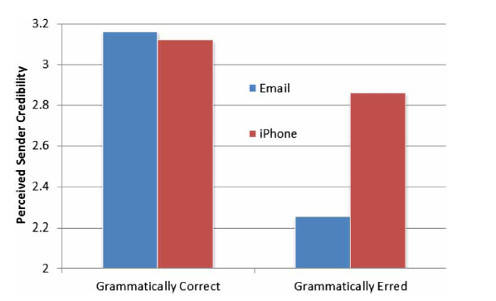
We are more forgiving of sloppy e-mails when we know they were sent from a smartphone:

When the message had correct spelling, grammar and punctuation, the sender was rated as being very credible — and there was little difference between whether the email seemed to have been composed on a computer or a phone. But when the message had errors in it, things changed: Students attributed higher credibility to the person who’d written the lousy message on a phone.

(Hat tip: J.K. Trotter)

Reserving Your Commute

Transportation researchers are exploring models that would compel drivers to reserve slots at coveted intersections:

So let’s say you want to drive through one of these points. As you approach, your car contacts the “intersection manager” and tries to make a reservation. The intersection manager crunches the data on all other cars on the road, decides whether it can fit you in, and tells you how much a place will cost. At this point, to reserve a space, you pay a small reservation fee. That’s to keep people from reserving spaces on roads all over town.

Once your road reservation is made, then you continue on course to arrive at the intersection within a certain time window — as with restaurants, there can be a bit of flexibility here, though not too much. As you cross into the intersection on the desired course, you pay the remainder of the reservation cost. Naturally, fees will be highest along the most desirable corridors, for the same reason it’s hard to get a table at Komi.

Now let’s say you can’t get your first-choice reservation.

You still have options to get into town. For starters, you can choose another route and make a reservation with that intersection manager. You can also simply show up at the intersection and hope the manager finds you a place; again, as at a restaurant, something might open up, but you could be waiting a while. You can also brush past the manager and continue on the road anyway, but you’d risk causing an accident or getting a ticket.

When the system is operating at its theoretical peak, the prices at various intersections create incentives for people to find alternate commute routes — or, of course, to take public transit. Those incentives, in turn, should decrease congestion. (On the flip side, if managers ask too much for space on the road, their route will go out of business.) Sure enough, when [researchers Matteo] Vasirani and [Sascha] Ossowski ran their idea through a model of Madrid traffic, they found that as intersections profits increased, general travel times across the city decreased.

The Best Of The Dish This Weekend

This embed is invalid

 
Gay pride waxed this weekend, despite the greatest actor in the world’s threat to gay-bash someone by anally raping him with his boot. (Don’t worry, GLAAD has forgiven him). But the Sunday joy in New York and San Francisco was overwhelmed by the massive demonstrations in Cairo against the Muslim Brotherhood government. The Christianity of “redneck” Duck Dynasty proved far more Jesus-like than the Christianism often associated with the South (but not defining of it); and we noted the difference between “friending” acquaintances and actual friends. And the inimitable Maria Popova pondered George Washington at the age of 15.

The most popular posts of the last three days were on Arec Baldwin’s violent homophobia; and Tammy Duckworth’s classic takedown of a disability scam. Seriously, a politician at her best. The most popular post of the last week remains “David Gregory Is What’s Wrong With Washington.” It seems to have struck a chord. Peeps seem to dislike him even more than Peggy Noonan.

I write this with Provincetown in the distance – and hope to arrive there tonight. It’s been almost a month without a husband or two hound dogs. I need a fix.

See you tomorrow.

The Lion Of Blues

Jack Hamilton remembers Bobby Bland, the blues legend who died last week at age 83:

Jimi Hendrix once described the blues as “easy to play, but hard to feel;” Bobby “Blue” Bland made the blues as complex as a modernist novel, and effortlessly easy to feel. Bland may not have been the greatest blues singer of them all (though he’s certainly in the conversation), but he was arguably the most complete, melding the urbane smoothness of the pop crooner to the ferocious ecstasy of the gospel tradition.

He was called “the Sinatra of the blues,” a nickname that rankles a bit in its equivocating imprecision: Bobby Bland was, first and foremost, the Bobby Bland of the blues. But as comparisons go, one could suffer worse. Like Sinatra, Bland boasted such an extraordinary combination of technique, charisma and musical intelligence that his vocal performances were themselves an act of songcraft. The sides that Bland cut for Duke Records in the 1950s and 1960s unfold like riveting dramas; Bland could cycle through entire complex economies of emotion in a three-minute recording, bending notes, phrases, and whole songs to his will. His best performances make a word like “soul” seem woefully insufficient.

Anne Powers appraises Bland’s lasting influence, especially on black artists:

For the mostly African-American audience that supported Bland for much of his career, songs like “I Pity the Fool,” “Ain’t No Love in the Heart of the City” and the spiritual shout “Farther Up the Road” captured the joy and sorrow of life with both immediacy and complexity. Bland’s multidimensional music became a blueprint for generations of R&B singers, and more recently, a grounding element for hip-hop artists like and Drake. It’s easy to imagine these young stars as kids, watching their mothers dress up for a night out while the grave, reassuring sound of Bland’s singing drifted through the house. Bland’s music is the kind that can school anyone about the incomprehensible depths of love, the importance of dignity and the promise of the kind of good life that really might be within reach.

No Rain On Your Parade

http://vimeo.com/67904132

Amber Long captions a behind-the-scenes look at Rain Room, a remarkable installation currently at MoMA:

Rain Room, an installation by London-based artist collective rAndom International, is an experiment in sensory disruption. A 300 ft² room is rigged to create a constant downpour, but motion-detecting cameras stop the rain anywhere a person is present. The effect is one of being cloaked in dryness, which follows you wherever you go. The rain is actually so loud that the voice of a person a few feet away is drowned out, thus the lacuna of rain occupied by a body actually forms its own “room.”

Kevin Holmes adds:

The unusual nature of Rain Room fosters a variety of reactions and forms of engagement from the audience that seem to move it beyond being just an installation into a performative piece, an element rAndom International often capitalizes on by introducing dance performances where dancers move through the space alongside visitors.