It’s Not Easy Seeing Green

Chris Mooney reviews research suggesting that “we tend to focus far too much on outward symbols (like Prius driving) in judging whether people are energy conscious. As a result, these powerful symbols bias us into overrating certain kinds of seemingly green behavior, and underrating other behaviors that may be quite green, but don’t seem that way to us at first glance”:

[R]esearchers showed as much with a pretty unforgettable research design. In one of the experiments reported in their paper, they asked Swiss research subjects to evaluate the energy consciousness of two drivers, one of whom drives a Prius, and one of whom drives an SUV. But the Prius driver drives his more fuel efficient car 28,700 km per year, and the SUV driver only drives his less fuel-efficient car 11,400 km per year, as follows:

If you carefully do the math, you’ll see that at least as the scenario is described here, there is only one possible conclusion: the Prius driver uses significantly more fuel per year. Yet overwhelmingly, when given this information, people rate the Prius driver as more energy conscious — a phenomenon that recurred across several different experimental designs. “It is something on the order of 80 or 90 percent of people who are going for the wrong answer” in one of the designs, says study author Michael Siegrist. “So it is a very large effect.”

The Dish Mug Is Here!

bowie-mug

[Re-posted from yesterday]

A reader recently wrote:

I haven’t bought a t-shirt because that’s not so much my thing. I eagerly await a coffee mug though. A mug with a beagle on it would make my mornings brighter.

We looked and labored over a dozen different mug options and chose what we think is the perfect one:

mugs

This navy-colored coffee mug is very high quality, holds a generous 15oz, and, during our caffeine-addled test phase, it proved very durable. So the sturdy mug should last a long time in any Dishhead’s kitchen or office (and yes, it’s microwave and dishwasher safe – we tested that too). As a serious coffee-addict, I love it.

The Dish mug can be yours for $15 plus shipping and handling. Just click here [sold out] and follow the simple prompts to order yours today. We only have a limited number of mugs for sale, so get yours before someone else does. And send us a photo when it arrives; you might see it on the blog.

Update from a reader:

Hubby has been told that it better be going in my stocking this year.  Thank you!

Another:

Love them – will give as gifts! Hope you have the web address on there so friends who don’t know you will check out the Dish.

Sharing Is Staring

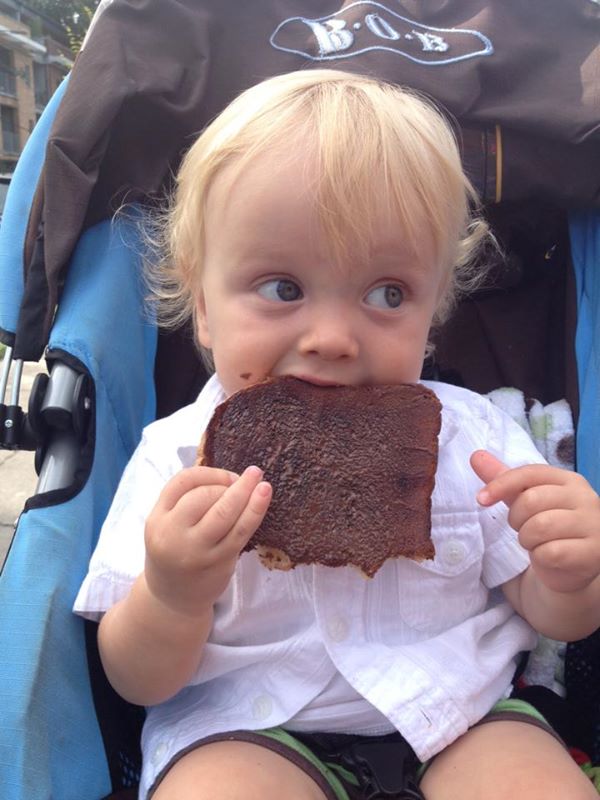
Priya Kumar explores the pros and cons of sharing baby photos on social media:

It’s tempting to suggest that parents shouldn’t post baby pictures online, but this ignores the very real benefits they experience from doing so. Sharing pictures online helped the mothers I toastinterviewed feel connected with family and friends, which is especially important for parents whose friends and family don’t live nearby. They received social support and validation, which is helpful when dealing with loss of sleep and the overwhelming responsibility of caring for a tiny human being. For those who cherished their experience of motherhood, sharing pictures online created a record of those memories. Also, family and friends constantly ask to see more baby pictures, so parents may feel some pressure to share them online.

At the same time, mothers recognized that by sharing pictures online, they were making decisions on behalf of their children that couldn’t be easily reversed. Eventually, their children would grow up and develop opinions about what they wanted their parents to share and not share online. Rather than seek to control their children’s digital footprints, parents can engage in what we call privacy stewardship. This means that parents should consider what types of information they feel are and are not appropriate to share about their children online and then communicate their preferences to family and friends.

(Photo by Betsy Bodenner)

A Woman’s Place In The House

Marcotte spotlights the gender breakdown in Congress:

As reported by both Nia-Malika Henderson of the Washington Post and Rachel Maddow this week, Republicans announced the chairmanships for next year’s House committees. Twenty out of 21 of the spots are going to men. The only woman is Rep. Candice Miller, who will be heading the Committee on House Administration.

Compare this with the list of chairmanships for the Democratic-controlled Senate in 2013, where women chaired six out of 20 committees, including really big ones like the Senate Budget Committee.

The Democrats also fail as spectacularly as the Republicans on the racial diversity front, but the fact remains that they are the more female-friendly party not just in electoral representation but also when it comes to putting women in leadership positions in Congress.

It’s true, as my colleague Jessica Grose has argued, that it’s overly simplistic to assume that women are “a uniform voting block with uniform ideas about what is best for them.” There are plenty of female Republicans, both voters and politicians, who don’t feel like this election was “bad for women.” However, it’s also true that numbers like this matter. Democrats have more women in leadership in part because they just have more women altogether, as our chart showing the growth of female representation in Congress demonstrated. But also because the party puts women in positions of power, a move, whether meant consciously or not, that likely encourages more women to run for office as Democrats.

Passing On Peril

James Poniewozik defends his decision to avoid a certain trope:

We all have our not-for-me markers with fiction: mine is kids in peril. It’s not that I can’t appreciate, even enjoy a series based on it; Broadchurch, about the aftermath of a child’s murder, was one of the best things I saw on TV last year. But when I’m off the TV-critic clock, these shows need to clear a much higher bar for me. …

It’s one of fiction’s jobs to face the worst of experience, not to leave an unexplained hole in place of terrible crimes, illnesses and accidents that–would that it were otherwise–do happen. Stories that handle the material with respect and awareness of its lasting consequence do a service; beyond the general role of art to reflect human experience, they provide a kind of emotional disaster preparedness.

But it’s also not anyone’s job as a viewer, or as a human, to face the worst in fiction, much less repeatedly. Again, I get why someone might make this argument. Like real-life violence–see the debate over watching terrorist beheading videos–the outrage that a fictional atrocity provokes makes people want to react morally one way or another. Either it must be a violation to portray this thing, and to watch it; or it must be an obligation, a mark of bravery, to bear witness. The counter-moralizing response to the one I talked about above is: you owe it to others–to real people who suffer and die–to confront this stuff. If you avoid certain kinds of dark material, you’re avoiding life, you’re in denial, you’re a wimp.

I have to side with the wimps here.

Quote For The Day II

“‘Social justice’ is an awkward term for an immensely important project, perhaps the most important project, which is to make the world a more equitable, fair, and compassionate place. But the project for social justice has been captured by an elite strata of post-collegiate, digitally-enabled children of privilege, who do not pursue that project as an end, but rather use it as a means with which to compete, socially and professionally, with each other. In that use, they value not speech or actions that actually result in a better world, but rather those that result in greater social reward, which in the digital world is obvious and explicit. That means that they prefer engagement that creates a) outrage and b) jokes, rather than engagement that leads to positive change. In this disregard for actual political success, they reveal their own privilege, as it’s only the privileged who could ever have so little regard for actual, material progress. As long as they are allowed to co-opt the movement for social justice for their own personal aggrandizement, the world will not improve, not for women, people of color, gay and transgender people, or the poor,” – Freddie DeBoer.

It’s an interesting complement to this.

A Poem For Friday

2909252617_1f456d0c81_b

“for deLawd” by Lucille Clifton:

people say they have a hard time
understanding how i
go on about my business
playing my ray charles
hollering at the kids—
seem like my afro
cut off in some old image
would show I got a long memory
and I come from a line
of black and going on women
who got used to making it through murdered sons
and who grief kept on pushing
who fried chicken
ironed
swept off the back steps
who grief kept
for their still alive sons
for their sons coming
for their sons gone
just pushing

(From The Collected Poems of Lucille Clifton 1965-2010, edited by Kevin Young and Michael S. Glasner with a foreward by Toni Morrison © 2012 by The Estate of Lucille Clifton. Used by permission of BOA Editions, Ltd. Photo by Flickr user Greg)

Quote For The Day

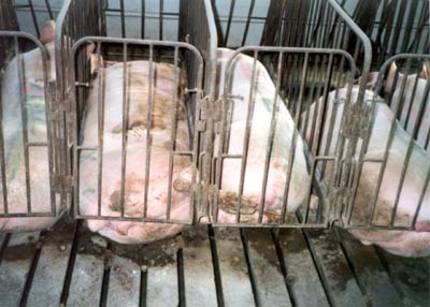
“The suggestion that any feature of this ruthless business is designed to afford “protection” to the pigs, much less to the babies, is perverse. Normal, healthy mother pigs, for example, do not after birth fall over and crush their young — as if they were all just naturally clumsy. These pigs.jpgare not exactly normal, healthy animals we’re talking about, however, after their interminable, pain-inflicting confinement in the gestation crates, among many other travails. Subject a sow to hyper-intensive breeding so that she is grossly larger than nature intended, fill her with steroids to accelerate growth still more, withhold anything resembling humane veterinary care, and through it all deny the creature her every natural need and desire, even the need to move and turn around — and, yes, she is not going to be quite herself. Just spare us this talk of how factory farmers are “protecting” the young from their mothers, when what’s needed here is protection of all these creatures from the whole wretched system.

Being immobilized for all of their existence, lying and living in their own urine and excrement, the sows are sick, sore, atrophied, usually lame, crazed or broken in spirit, and kept alive in these torments only by a massive and reckless use of steroids. The confinement of the sows, presented in terms of solicitude for the piglets, is among the causes of the welfare problem it purports to solve. And the piglets in any case are taken from their mothers in short order to begin their own lives of merciless confinement, mutilation, privation, and fear, in a process, from birth to slaughter, utterly devoid of human compassion,” – Matthew Scully, speaking truth to power, and putting governor Christie on the spot. Scully’s book, Dominion, remains a must-read on this vital moral issue.


Skilled But Excluded

Leonid Bershidsky regrets that that Obama’s executive order did little for skilled immigrants:

On the surface, there is little the president, without Congress’s help, can do for skilled migrants. The Immigration and Nationality Act allows only 65,000 people a year to receive H1B temporary skilled worker visas. (Exempt from this quota are 20,000 U.S. graduates of master’s degree programs, as well as an unlimited number of potential government and nonprofit employees.) Just 140,000 skilled workers and their family members are eligible for employment-based green cards each year. …

Perhaps the story of the lottery-losing programmer isn’t as poignant as that of Astrid Silva, who, according to Obama, came to America with just “a cross, her doll and the frilly dress she had on.” The programmer would, however, be more immediately useful to the U.S. economy than Silva, “a college student working on her third degree.” Not letting him in is at least as wrong as kicking out Silva would be.

Jim Manzi argues for more high-skilled immigrants generally:

All of the major Anglophone democracies have done a far better job of this than America and have reaped the benefits.

Australia, Canada, and New Zealand all have a higher foreign-born population than the U.S., and all three plus Britain have more new immigrants each year per capita than the U.S. They have all used some kind of points system to select for immigrants with relevant skills, such as English proficiency and educational attainment, and extra points for degrees or expertise in such fields as science, technology, and medicine. They are generally moving to a two-stage system in which foreign applicants who achieve at least some specificed target score under such a points system are put into a pool which prospective employers can browse, and are granted visas when specific employers offer them jobs. America should implement such a system.

Along the same lines, Philip Sopher thinks it should be easier for physicians to immigrate to the US:

The United States… has strict policies regarding medical licensing—a doctor is only allowed to practice in the U.S. once he has obtained a license in the state in which he intends to work. The person must acquire a visa, pass the first two steps of the United States Medical-Licensing Exam (USMLE), then become certified by the Education Commission for Foreign Medical Graduates (ECFMG), get into an accredited U.S. or Canadian residency program, and finally, go back and pass step three of the USMLE. Each of these steps could take multiple years, repelling doctors who are already able to practice in the country in which they were trained.

But is it really a good idea to deter them? By 2020, America’s doctor shortage is projected to reach 91,500 too few doctors, with nearly half of the burden falling on primary care. This means doctors will be overworked and citizens may have to wait longer and pay higher fees for an appointment. Without all of these barriers, many foreign doctors would find the prospect of migrating to the United States appealing.

Recent Dish on STEM-oriented immigration here.