You Are Worthless, Alec Baldwin, Ctd

This is now getting hilarious:

[T]he idea of me calling this guy a ‘queen’ and that being something that people thought is 175px-BaldwinTAhomophobic … a queen to me has a different meaning. It’s somebody who’s just above. It doesn’t have any necessarily sexual connotations. To me a queen… I know women that act queeny, I know men that are straight that act queeny, and I know gay men that act queeny. It doesn’t have to be a definite sexual connotation, or a homophobic connotation. To me those are people who think the rules don’t apply to them. This guy could blatantly lie, I mean blatantly lie about my wife on the internet and there are just no rules that apply to him, but that’s outrageous to me.
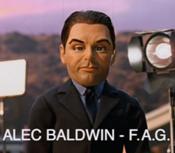
He somehow hasn’t come up with an explanation for why he desired to sodomize the dude with his boot, but decided not to because the dude would enjoy it too much. But we’ll wait. This raging bigot will surely come up with some reason for using that analogy that has nothing to do with homosexuality at all.

Again: the double standards for a liberal are simply astounding. Let us just stipulate that if Alec Baldwin is not a homophobe, then Mel Gibson must also now be cleared of any insinuation that he is an anti-Semite. And at least Gibson was drunk. What excuse does Baldwin have? Oh, I forgot, this one:

His rant, he said, was not “a call for violence against a specific person because they’re gay, it’s a call for violence against a person who lied about my wife.”

Seriously, bragging about calling for violence against someone is now exculpatory? Only in Hollywood …

M0re Dish on this douche here and here.

Cooking After The Crash

In the midst of an economic depression, Greeks have turned to a traditional staple – lentils:

Those who still have their jobs, even if they’ve seen their incomes plunge by a third or more, consider themselves lucky. But they no longer stock up on pork chops and imported Gouda cheese, as they did in better times. They eat out less too. On TV, there has been an explosion of “cook-on-the-cheap” shows, including one in which a portly, smiling chef teaches you how to make five elaborate three-course meals for just 50 euros a week. There’s also a bestselling cookbook, Starvation Recipes, based on tips from Greeks who survived the famine of World War II. (Sample: Save bread crumbs from the table in a jar to eat later.)

A recent Kapa Research poll found that 71 percent of Greeks find it difficult to get by on their current income. In supermarkets, shoppers talk about the prices — spending on groceries dropped 8 percent just in the first six months of last year, compared with the same period in 2011 — and about how little money is left over to pay property taxes and electricity bills. So everyone buys lentils.

And why shouldn’t they? A steal at a little more than $1.50 a pound today, lentils were born in Greece. Evidence of cultivation has been found in caves dating as far back as 11,000 B.C. They are ours, and they fueled an empire.

A Poem For Sunday

oldbible

“Mood” by Countee Cullen:

I think an impulse stronger than my mind
May some day grasp a knife, unloose a vial,
Or with a little leaden ball unbind
The cords that tie me to the rank and file.
My hands grow quarrelsome with bitterness,
And darkly bent upon the final fray;
Night with its stars upon a grave seems less
Indecent than the too complacent day.

God knows I would be kind, let live, speak fair,
Requite an honest debt with more than just,
And love for Christ’s dear sake these shapes that wear
A pride that had its genesis in dust,–
The meek are promised much in a book I know
But one grows weary turning cheek to blow.

(From Countee Cullen: Collected Poems, The Library of America, 2013, ed. Major Jackson. Poems © Amistad Research Center, Tulane University. Reprinted by permission. Photo by Patrick Keller)

A List To Live By

Maria Popova explores George Washington’s Rules of Civility & Decent Behavior in Company and Conversation, a list of 110 guidelines he penned when he was 15 years old:

Some, at the intersection of the dated and the timeless, expose the parallel progress of cultural conventions and technology: For instance, Washington admonishes against reading “letters, books, or papers in company” — the then-equivalent of looking at your iPhone during a dinner party. Some speak to the enduring importance of critical thinking: “Be not hasty to beleive flying Reports to the Disparag[e]ment of any.” Some advocate for the humanizing effect of compassion: “When you see a Crime punished, you may be inwardly Pleased; but always shew Pity to the Suffering Offender.” Some remind us of how our personal micro-culture shapes us: “Associate yourself with Men of good Quality if you Esteem your own Reputation; for ’tis better to be alone than in bad Company.”

The last item from the list:

Labour to keep alive in your Breast that Little Spark of Ce[les]tial fire Called Conscience.

Rejecting The Head Of State

https://twitter.com/Doranimated/status/351398167738204161

One year after Mohamed Morsi’s inauguration as president, hundreds of thousands of Egyptians are flooding Tahrir Square calling for his resignation. The protests are even more massive than the 18-day revolution that toppled Mubarak back in February 2011:

The scene on Sunday was a far cry from a year ago today, when supporters packed the square to celebrate Morsi’s inauguration. Now many are back to blame him for a stagnant economy, worsening security and an ongoing lack of basic services. Demonstrators waved red cards and chanted “irhal” – “leave”, and promised to camp in the square until Morsi resigns. Thousands more have joined marches headed for the presidential palace, and are expected to arrive around dusk. “It’s the same politics as Mubarak but we are in a worse situation,” said Sameh al-Masri, one of the organisers on the main stage. “Poverty is increasing, inflation is increasing. It’s much worse than Mubarak.”

The Tahrir protests are peaceful so far, but another wave of demonstrators marched to the presidential palace and the Muslim Brotherhood headquarters, where things got aggressive:

[S]everal dozen youths attacked the headquarters of Morsi’s Muslim Brotherhood on a plateau overlooking the capital. They threw stones and firebombs at the building, and people inside the walled villa fired at the attackers with birdshot, according to an Associated Press Television News cameraman at the scene. Earlier in the day, two offices belonging to the Brotherhood’s Freedom and Justice party, were attacked and ransacked in the city of Bani Suef, south of Cairo.

The AP reports that the protesters are made up of “secular and liberal Egyptians, moderate Muslims, Christians – and what the opposition says is a broad sector of the general public that has turned against the Islamists”:

They say the Islamists have negated their election mandate by trying to monopolize power, infusing government with their supporters, forcing through a constitution they largely wrote and giving religious extremists a free hand, all while failing to manage the country. With protesters from a range of social and economic levels in a festive atmosphere, the crowds resembled those from the 18 days of protests against Mubarak – a resemblance the protesters sought to reinforce, chanting the slogan from that time: “The people want to topple the regime.”

Cairo-based journalist Evan Hill reviews the path that led to this moment:

A journalist said it was as if Egypt’s body politic were rejecting a transplant and killing the nation in the process, a fledgling democracy’s auto-immune system gone haywire. …

If Morsi falls or steps down, millions of Egyptians will view it as a victory. Perhaps he could be succeeded by a salvation government, and some kind of stable progress will ensue, though the Brotherhood can hardly be expected to quietly allow their project to dissolve around them, and it would likely mean the return of the army to a guiding role. Revolutions come with chaos. History teaches us that many years may pass before a country comes out of such upheaval with a working government, satisfactory justice and reconciliation, and a consensus about national identity. But even in such a positive scenario, it is hard not to view the first two and a half years of Egypt’s revolution as a series of squandered promises.

The Write Way To Die

Tim Parks traces novelists’ deaths back to the themes of their work, arguing that both follow from a defining dilemma:

What I am suggesting is that a novelist’s work is often a strategy (I don’t mean the author need be aware of this) for dealing with some personal dilemma. Not just that the dilemma is “worked out” in the narrative, as critics often tell us, but that the acts of writing and publishing and positioning oneself in the world of literature are all part of an attempt to find a solution, however provisional, to some deep personal unease. In many cases, however hard the writing is pushed, the solution is indeed only temporary or partial, both author and work eventually succumbing. Obviously the easiest group of authors to look at in this regard would be the suicides, Woolf, Pavese, Wallace.

He closes with a meditation on Faulkner:

Whisky and writing intertwine throughout Faulkner’s life, feeding each other, blocking each other, never allowing him to achieve any stability, always acting out a salute to other men he feared he could not resemble. By the time he was fifty the end seemed inevitable. There are only so many times one can dry out in a clinic and fall drunk off a horse. It was actually something of a miracle that Faulkner outlived his dear mother for a year before one more courageous binge, one more salute to the truly brave, as he saw it, did him in, aged sixty-five.

Self-Help For The Second Sex

Sarah L. Courteau looks at the market for self-help books:

Men are a distinct minority of the self-help clientele—only about 30 percent, according to Marketdata. They tend to consult books about how to dominate in the boardroom or be a savvier investor. The typical consumer is a woman who is middle aged and affluent. (By and large, self-help is neither marketed to nor used by the young, who are busy out there making the mistakes they’ll be looking to fix in a few years’ time.) She’s someone who wants to maximize, and she has the luxury of a little money—and perhaps time—to worry about how to take off a few pounds, put her best foot forward at work, improve her relationship or her dating life, get her schedule or her closets more organized, or become a better mother. She is representative of a generation that has made enormous strides, yet she feels dissatisfied with where she is.

It’s easy for women to believe they need all the help they can get. We’re raised on Cosmo and Seventeen, both of which are chock-full of tips on how to pluck our eyebrows, choose a lipstick, or have better sex. We graduate to Real Simple and O: The Oprah Magazine when we have households of our own. The line between fighting for equal footing—that elusive sense of “empowerment” that we’re forever supposed to be grasping for—and the conviction that we could always be doing more is fine, if it exists at all. No surprise that self-help marketers know that their target audience consists of people who have already shelled out money for a self-improvement product within the last several months.

Learning From The Little Ones

wind

Richard Lewis, who works with children in the areas of drama and poetry, marvels at their capacity for insight. “To Be Alive,” a poem written by a 10 year old named David, sparked these thoughts from Lewis:

Certain pieces of writing, certain gestures of thought that children share with us can become emblematic—they are entryways to understanding the power of a child’s way of gathering insights. In many instances, the child is not even aware of what he has said and will simply shrug if one tries to praise or compliment him. David’s writing provided, for me, one of those emblematic moments. What he verified and illustrated was the act of imagining, particularly for children, as a bodily experience—as well as the ways that language, both spoken and written, thought and dreamt, is nurtured and embedded in the imagination. We are creators of images and caretakers of the images we perceive and communicate; it is the play of our imagining that allows us to inhabit aspects of the world seemingly distant from ourselves. Certainly David demonstrated this when he wrote without hesitation, “Sleep and the wind and I / drift to air.”

This ability of children to easily enter into the life of something other than themselves—to exchange their own mind for the mind of another—grows not only out of their innate playfulness, but out of a fluidity and plasticity of thought that is, in many ways, an inborn poetic gift. It is, perhaps, a way of seeing in which the seer does not distinguish between herself and the nature outside of her, an imaginative grasping of the whole of life before it becomes separated into subject matters and academic disciplines. One might think of it as a wilderness of thought that encompasses a multitude of growing worlds, each connected and dependent on the other—a truly ecological means of thinking and perceiving.

His takeaway:

So much of this childhood ease with both the visible and invisible, what we know and don’t know—the pure sense of expectation and delight in the mystery of what is happening and about to happen—is not only a function of our mind’s ability to balance opposites through the equipoise that is our imagination, but also a way of experiencing the world poetically. I don’t mean a poetry of verse and poems, but a poetic understanding that allows us to stand, for instance, in the middle of a stream and say nothing, and yet to feel, if only fleetingly, a sense of how we and the flowing water are of one being. Or to walk down a city street and accidently walk through the shadow of a tree that seems to move with us, to want to follow us—an expectation, an incandescent moment of which we are suddenly made aware. Each is only an instant, but an instant that carries with it a form of knowledge accessible to children and adults alike, one we rarely include in our current estimates of intelligence or achievement. This awareness should not be seen as a lack of development or a passing innocence, but as a container of thought that we carry with us over a lifetime. Within it, we, the stream, the tree, and the tree’s shadow share the same language.

(Photo by Flickr user enki22)

How Belief In The Apocalypse Is Accelerating It

David Swanson rails against the Christianist resistance to taking climate change seriously:

According to a Newsweek poll, 40 percent of people in the United States believe the world will end with a battle between Jesus Christ and the Antichrist. And overwhelmingly, those people also believe that natural disasters and violence are signs of the approach of the glorious battle—so much so that 22 percent of Americans believe the world will end in their lifetime. This would logically mean that concern for the world of their great-great-grandchildren makes no sense at all and should be dismissed from their minds. In fact, a recent study found that belief in the “second coming” reduces support for strong governmental action on climate change by 20 percent.

His broader point:

You see, the problem with theism is not that some of its spin-off beliefs succeed in an undemocratic system. The problem is that theism is anti-democratic at its core. It moves us away from relying on ourselves. It teaches us to rely on someone supposedly better than us.