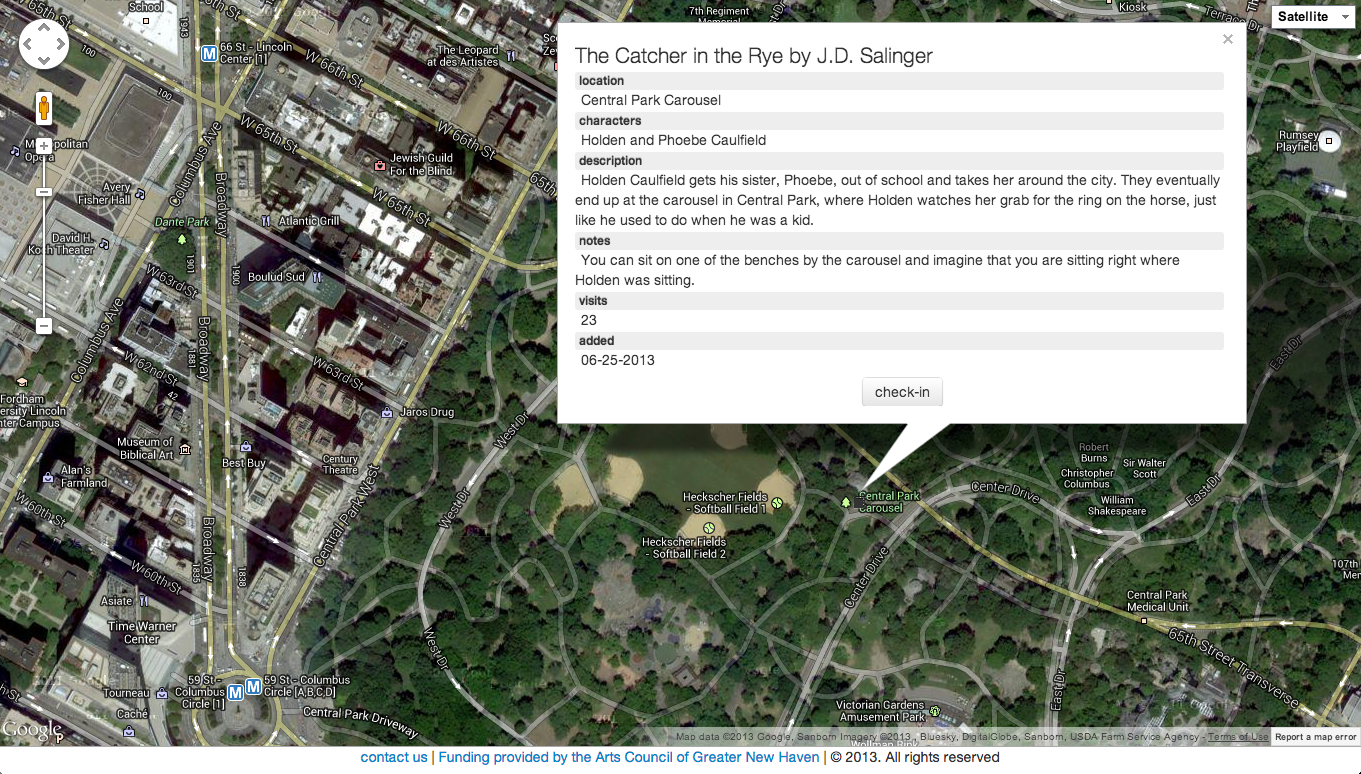
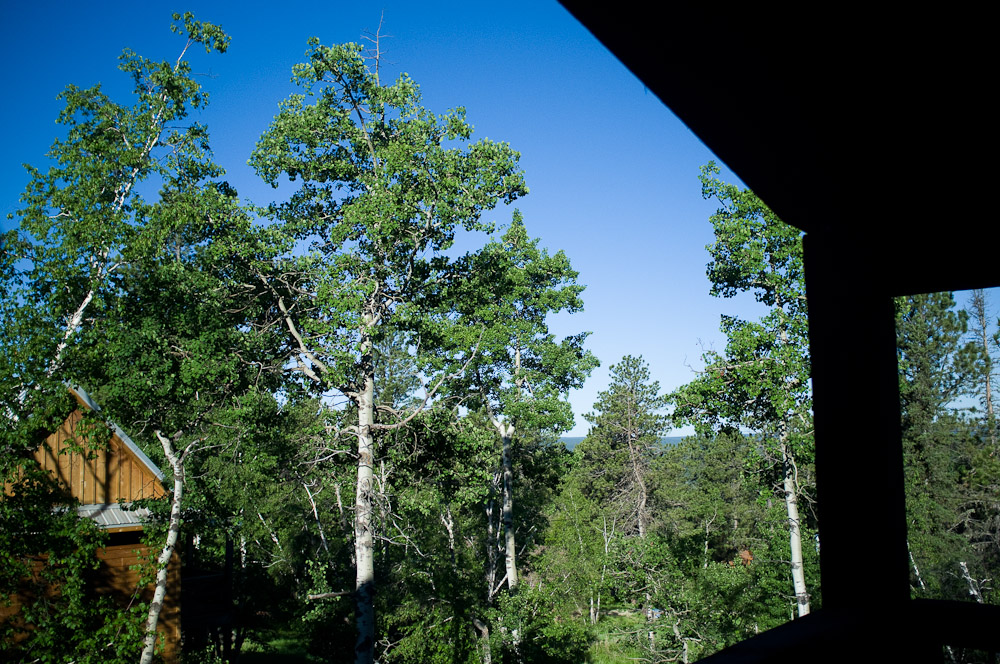
Placing Literature is a new interactive website that lets users map the whereabouts of scenes from fiction. Amanda Kooser explains the appeal:
One of the first things I did when I visited London a few years ago was to go on a Sherlock Holmes walking tour. I’m not the only avid reader compelled to seek out the real-life settings found in books. This desire is what has brought about Placing Literature, an interactive site dedicated to plotting scenes from books onto real-world maps. It’s like a heady mixture of a database, Google Maps, and the efforts of a bunch of literature geeks. Placing Literature started with a conversation between co-founders Andrew Bardin Williams (an author) and his sister-in-law Kathleen Colin Williams (a geographer). “I use a lot of real-world locations in my novels. We decided there was this great intersection between geography and literature that hadn’t been explored before,” says Andrew Bardin Williams. …
Crowdsourcing is key to the project. “The goal is to gather as much data as we possibly can, get people to share it, and get people to start exploring their neighborhoods and their communities,” says Williams. “We’re ready to turn it over to the community now and see what happens with it.”
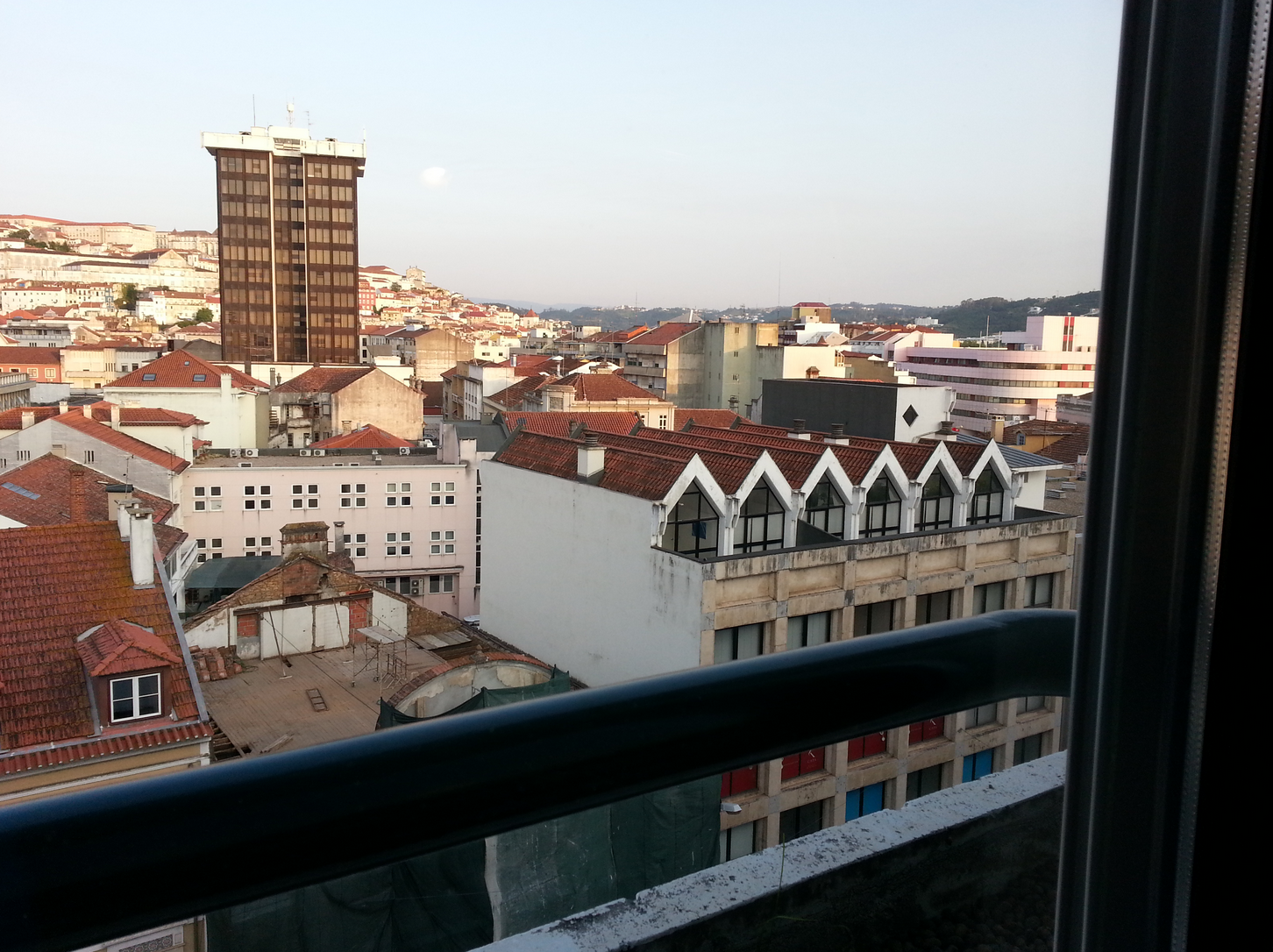
You have until noon on Tuesday to guess it. City and/or state first, then country. Please put the location in the subject heading, along with any description within the email. If no one guesses the exact location, proximity counts. Be sure to email entries to contest@andrewsullivan.com. Winner gets a free The View From Your Window book. Have at it.
“Suicide is an event of human nature, which, whatever may be said and done … in every epoch must be discussed anew,” said Goethe, as quoted in Alexandra Kimball’s thoughtful exploration of media coverage of suicide. She examines the idea that heightened coverage – including social media – correlates with increased suicide rates:
What gets lost in the discussion of suicide coverage is the logic behind contagion—why news of one suicide might cause a domino effect, especially in young people.
On a sunny day in May, I returned to Kids Help Phone to interview my old boss, Alisa Simon, VP of counselling services, and the new director of Program Development, Carolyn Mak. “Young people have specific vulnerabilities,” Simon tells me; contagion jibes with what we know about adolescent psychology and the way young people process stories. Young people tend to identify with prominent cultural narratives, to position themselves in the stories they hear most often. And “developmentally, [young people] don’t necessarily understand what the outcomes of their [actions] might be,” Mak explains. “Do kids understand the finality of death? Do they really get that?”
Think about it, Simon says: you’re young, “you’re struggling with significant challenges, and part of that is feeling like nobody cares, you’re not noticed. [Then], you see that another young person has taken an action that is getting them attention, and the attention you potentially want… Their picture is all over the place, there are thousands of people expressing grief and making admiring comments.” When enough stories about teen suffering end in suicide, she says, death begins to seem like a natural solution. “One of Rae’s pet peeves,” wrote Leah Parsons on a Facebook memorial page for her daughter, Rehtaeh, “was that when someone passed away, suddenly they were liked and people cared.” The risk is that readers will understand suicide as a type of redemption.
But there is another narrative to be told:
Suicide contagion is often called the “Werther effect,” after the rash of suicides that followed the publication of Goethe’s novel [The Sorrows of Young Werther], but there is another phenomenon named after Papageno, a character in Mozart’s The Magic Flute. In the opera’s final act, Papageno is dissuaded from suicide by three spirits who invoke images of the future. Clinicians use the term “Papageno effect” to describe how stories about people who choose against suicide can actually reduce the suicide rate.
[Dr. Jitender] Sareen sends me links to a number of recent studies, the most interesting of which is a 2005 Austrian study that compared how different kinds of suicide narratives link up with suicidal behaviour. Repeated exposure to traditional kinds of media suicide coverage, including stories that focused on suicide epidemiology or expert opinions, were positively associated with suicide. But one type of suicide story was negatively associated with suicide, meaning people who consumed it were less likely to take their lives than people who heard nothing: the “mastery of crisis” narrative, which describes people who think about suicide but, like Papageno, decide against it. Understood thusly, the tendency of young people to identify with dominant narratives can be harnessed for good.
“Little Sonnet to Little Friends” by Countee Cullen:
Let not the proud of heart condemn
Me that I mould my ways to hers,
Groping for healing in a hem
No wind of passion ever stirs;
Nor let them sweetly pity me
When I am out of sound and sight;
They waste their time and energy;
No mares encumber me at night.
Always a trifle fond and strange,
And some have said a bit bizarre,
Say, “Here’s the sun,” I would not change
It for my dead and burnt-out-star.
Shine as it will, I have no doubt
Some day the sun, too, may go out.
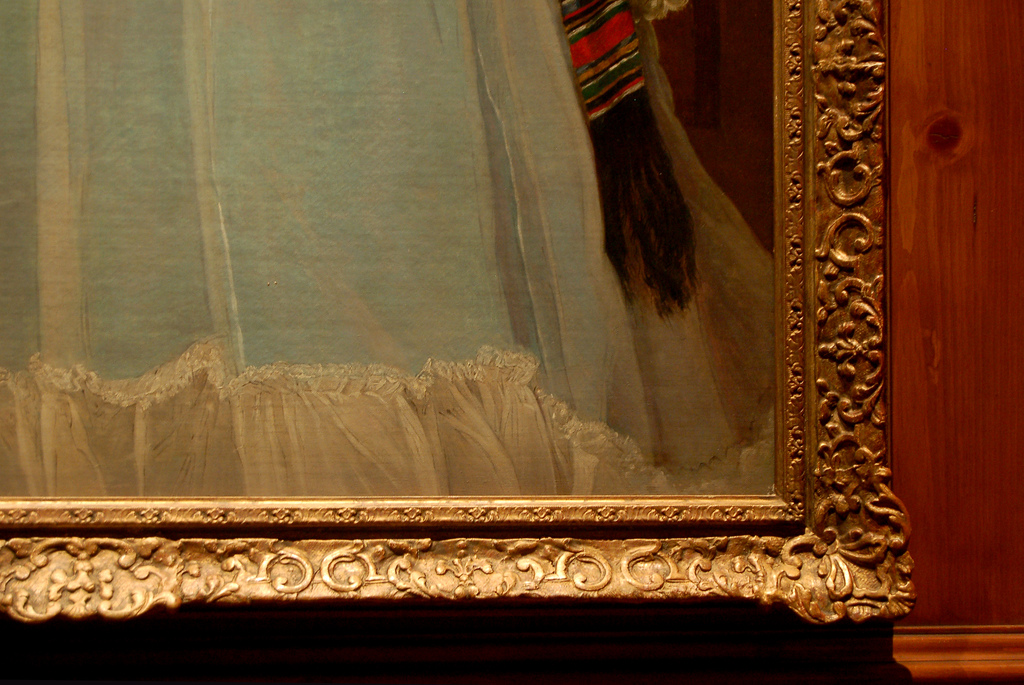
Although [Michael] Crichton viewed his tale as a general warning that “science is too important to leave to scientists,” as he put it in a 1993 interview, he was particularly worried about the explosive and largely unchecked growth in the biotechnology industry that was already evident by the 1980s. Crichton, like so many since, saw the primary danger of man’s attempted power over nature as one of unintended consequences: the power is always to some extent an illusion. This is the real fear about “playing God” that several of Crichton’s characters articulate, and that the movie powerfully depicts from several angles: there is nature’s intrinsic power; man’s original vulnerability before it; his ability to overcome and harness it; and his ultimate vulnerability again before it.
In one scene, when the visitors are first introduced to the dinosaurs, [paleontologist character Alan] Grant collapses to the ground in shock, and then slowly gazes back up, with an expression, all but perfectly portrayed by Sam Neill, that manages to evoke each of these ideas at once. He is filled with awe and terror at the power he is witnessing — just whose power neither he nor we are quite sure.
But what is all but absent from a movie and a novel that purport to warn us about the excesses of the biotech industry is any sense of the true ultimate aim of that enterprise. The real biotech future will not be defined by genetic engineering of hardier crops and exotic pets, or even animal cloning and de-extinction. It will be, and in many ways already is, defined by bringing these powers to bear not on external nature but our own natures: by genetic enhancement of ourselves, selection of our children to fit our preferences, babies made not just in petri dishes but artificial wombs, children drugged out of normal behaviors in order to be easier to manage in schools, the medicalization and subsequent “treatment” of anything about ourselves and others we see as disadvantageous or simply dislikable.
Peter Orszag is troubled by new research on college graduates taking low-skilled jobs:
It’s a parent’s nightmare: shelling out big money for college, then seeing the graduate unable to land a job that requires high-level skills. This situation may be growing more common, unfortunately, because the demand for cognitive skills associated with higher education, after rising sharply until 2000, has since been in decline. … This reversal in demand has caused high-skilled workers to accept lower-level jobs, pushing lower-skilled people even further down the occupational ladder or out of work altogether.
He considers the drivers of the change in demand:
One possibility, as I’ve previously written, is that the effects of a globalizing workforce are creeping up the income scale. Many jobs that once required cognitive skill can be automated. Anything that can be digitized can be done either by computer or by workers abroad. While the “winner take all” phenomenon may still mean extremely high returns for workers at the very top, that may be relevant for a shrinking share of college graduates. Whatever the explanation, the Beaudry team argues that an excess of skilled workers has led them into the “routine” job market — such as sales and clerical jobs — reducing wages there and pushing less skilled workers into “manual” jobs in construction, farming and so on. …
The cold comfort I can offer is this: Going to college may still be worthwhile — if not to be sure of qualifying for skilled jobs, then at least to avoid the even worse prospects of those who don’t get a degree.
Yglesias distinguishes between a college education and skills that prove useful in the workforce:
[I]f there’s more and more automation, more and more job opportunities will end up having that quality where it’s not that you couldn’t be replaced by a machine (because soon everything will be in the category “can be replaced by a machine”) but because sometimes people just strongly prefer to interact with an authentic human being.
At that point your wage is going to be determined primarily by your customer service skills. Are you pleasant to deal with? When people think to themselves that they’d rather interact with a human being, they typically don’t have a grumpy and dyspeptic human being in mind—they’re thinking of a nice, cheerful, helpful human being. And obviously this is a real skill. We’ve all had really good customer service experiences in our lives and also had really bad ones. But I’m not sure this is a skill that’s well-acquired by getting a high SAT score and then hanging out with other people who had high SAT scores for four years while listening to lectures from very distinguished academic researchers.
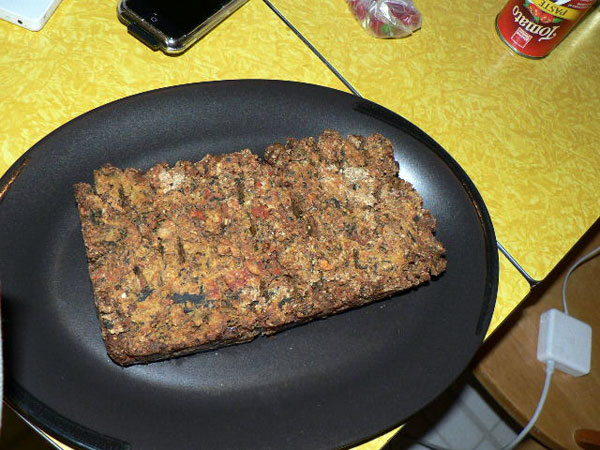
Jesse Smith visits Philadelphia’s Eastern State Penitentiary to investigate Food-Loaf, or nutraloaf, a common prison food:
The idea is to create a food product that fulfills an inmate’s caloric and nutritional needs but does not require utensils. The goal is not to create a food product that tastes good. In fact, prisoners around the country have filed multiple lawsuits claiming nutraloaf violates their eighth amendment protection against cruel and unusual punishment.
But fight the nutraloaf and the nutraloaf wins … usually. Earlier this year, the Milwaukee Journal Sentinelreported on an inmate who sued Milwaukee County, claiming that rancid nutraloaf made him violently ill. Food service giant Aramark, who supplied the nutraloaf, settled out of court. … Pennsylvania is careful to avoid the suggestion that it punishes with its seasoning-free Food-Loaf. “Food shall not be used as a disciplinary measure,” according to the commonwealth’s Department of Corrections policy statement on food service (PDF). … Serving an inmate Food-Loaf … requires the written approval of the facility manager, who must first consult with the Corrections Health Care Administrator (CHCA). And the prison can serve an inmate Food-Loaf for only 21 consecutive days. If the inmate continues to demonstrate the same behavior that got him (or her, though in Pennsylvania and around the nation, usually him) on Food-Loaf in the first place, a seven-day extension can be granted. If he persists, the CHCA conducts a Mental Health Assessment. Still, it’s difficult to see how withholding salt is anything but punitive.
It may be the case statistically, for all I know, that avid and careful readers of good or great fiction become better people on the whole than they would otherwise be if they were not readers. But this isn’t the same thing as the claim that readers are invariably better people than non-readers are. We know from ordinary experience that that isn’t true, since there are plenty of people who don’t do much reading and are kind, helpful, compassionate and possessed of many other ordinary virtues, while at the same time there are some very well-read selfish bastards or worse than selfish bastards.
His other big point:
The thesis that reading makes us either human or more human – because it is ‘the most spiritual of all human activities’ – is more dubious still. What is one to say, then, about people who can’t read or can read but don’t? That they aren’t human, or aren’t fully human, or aren’t as human as (we) readers are? It isn’t a good way of talking. One method of defining human nature is – more or less empirically – as constituted by those characteristics which human beings share in common. On this basis, reading good fiction can’t be one of the constituents of human nature, given how many members of the human species haven’t read Proust, Tolstoy, F. Scott Fitzgerald or whoever else it might be.
I’ve been following this thread and I have to wonder: I’m a straight guy who is dying to have sex with a beautiful, 100% passable, pre-op transsexual. What in the bloody blue hell does that make me??? I’d love to know if there’s a term (or a “letter”) for me!
Another:
I am a bisexual male who has been completely comfortable with his sexuality for over 25 years. I exist, I am real, and I happily have sex with both men and women – sometimes separately, sometimes together. My experiences with each gender are very different, as is my role in each encounter. I would not be complete without both of them. I am not monogamous; I am not gay; I am not straight. In fact, my most satisfying sexual encounters have been with people who don’t identify as either male or female. These transgender people don’t fit within the binary, and explode the whole notion of being attracted to a single sex.
Another:
Argh! I both love and hate this discussion. Human sexuality is so wonderfully fluid. And all the pronouncements about whether there are true this or true that just drives me nuts!
For the record, I’ve long identified as a gay-identified bisexual (despite my occasional forays, I’m part of the gay community). I love having sex with women even if it’s not frequent. And as an HIV+ person, I find the opportunities more difficult given that:
1) there are more gay men with HIV expanding my horizons and 2) I prefer all-out sex that is stymied by either some women’s rejection of sex as fun or my own coding of women as not to be purely sexualized (I’m from the South and our coding of gender roles was strong). I recently dated a guy who is bisexual and had an easier time having sex with women but is dating men exclusively right now to get better at it. And I have recently been having sex with and dating a good many FTMs who identify as gay men. The crux of the matter is that I like, um, pussy. And I also like masculine energy – at least that part that sort of is animalistic and allows us to nearly devour each other.
What does that make me? A freak. And I’m quite fine with that.
Another:
What I’d like to reinforce from all of the comments about bisexuals is that sexuality is complicated, and complex. Sexuality is different from gender, yet we define it based on gender. I know I myself can’t find a label, but use bisexual because it’s the most encompassing.
I’m a male, but I tend to be attracted to women. More specifically, I tend to be attracted to boyish-looking women. Small breasts, small hips, short hair. Sometimes they’re butch, sometimes they’re trans men. And then there are the men I find attractive, which I can’t even define well. But I would say, as a whole, that it tends to be people that are not typically masculine or feminine, are gender-bending, or are non-gendered or androgynous.
I don’t know the term for this. I also know that butch women have been fetishized and I want to be aware of that. But at the end of the day, there’s my broad level “type”, and then there’s the individual who I get to know and have a relationship with. I call this being bisexual.
Another:
My husband and I are bisexuals, but we identify as gay. We have been together for over 20 years and are less promiscuous then we used to be, but in our younger days we did have several threesomes with female friends. While I find women attractive, I have a hard time forming emotional bonds with them. I am also attracted to individuals that defy gender stereotypes, particularly feminine men and masculine women.
Another:
It goes to show the connection to your audience that I’m writing these thoughts down for the first time. I’ve been married for over 15 years and yet here I share them with you.
I’m 35 years old and male. My earliest memory of an erection was seeing Christie Brinkley in Vacation on home video. That led to finding guy-on-girl porn in my dad’s extensive video and magazine collection. All through growing up, and looking back, my infatuation was with girls. I lost my virginity at 16, had only a few partners, then met my wife at 20 and have been monogamous ever since.
In the last few years I have found myself increasingly intrigued by anal play. But here’s the rub: I feel a longing in my prostate for stimulation. Over the last few years that need has started to grow more intense. Going back even five years I never had these feelings. The more I explore the area more convinced am that the biology is asking for things I haven’t felt since the first time I found masturbation. I suppose toys are the next step and asking my wife for a good hard pegging. The problem is that approach feels weird in a way that anal sex with a man does not. Toys have never been fun. I want human contact.
So am I gay? I love the thought of multiple female partners, which my wife and I have discussed. I can’t say I’ve ever been infatuated with a guy or would love a guy. But would I fool around with a guy in a threesome with my wife? I don’t see any reason why not. And I expect we’ll soon be talking about that. If I really enjoy that experience, what does it make me? Is a biological urge for stimulation reducible to identity? What if my prostate is simply enlarging with age and so now I’m now just more aware of the pleasure it can lead to.
Honestly, I don’t see why I need an identity here. I am happily married. And to this point our sex life has been more than I need. But here I am with biological urges that my wife doesn’t have the equipment to satisfy. Going outside the marriage for that satisfaction seems like an exploration in the same way that different drugs, foods or travel might be. I just don’t see the sexual categories as adding anything of substance for my life.
Isn’t it enough that we’re sexual beings, and in a way in which morality doesn’t apply among consenting adults?