A trippy train ride through Tokyo:
Hyper Drive YURIKAMOME from darwinfish105 on Vimeo.
There’s a Kickstarter for that.
Noting that “it’s easy to never be alone and yet very lonely,” Lane Wood relays an anecdote:
I meet someone interesting at an event and return home to find they’ve already added me on Facebook. I’m nosy, so I want to see what friends we have in common. Turns out, we know 89 of the same people. Which begs the question: How on earth is it possible to have 89 mutual friends with someone I’ve just met?
The experience prompted him to ponder the meaning of genuine friendship:
True friends are our best personal brand consultants, the ones that sit us down and tell us the truth about our lives. They understand not just what we do, but who we are becoming. They help expose the lies we tell ourselves and breathe life into moments that need encouragement. They’re not pursuaded by high levels of “epicness” or exclusive invites. Friends are content to navigate the mundane and the everyday together, because not everything can be “crushed.”
The world needs more friends. More specifically, the world desperately needs more “connections” to become true friendships.

A fascinating nugget from the post-revolutionary Iran era, as that country’s clerics dealt with the West. At one point in 1986, Rouhani was enticed by Manucher Ghorbanifar (remember him?) to talk with someone he thought was an American official in Paris. In fact, it was an Israeli, Amiram Nir. And he had a secret microphone. Here are some things Rouhani said a long time ago that might have some salience for today:
“I feel very uncomfortable over Imam Khomeini’s extremist speech yesterday,” Rouhani added, “I think it was his most hard-line speech since he seized power. He demanded to break and cut into pieces all those who don’t hold with his extremist anti-American stance, but it’s your fault: you Americans sit and watch what goes on between us and Iraq and do nothing to help us. You won’t get a thing from Iran until you start moving about and supply us what we need.”
At this point, however, Rouhani admitted: “It should be clear to you that what I said now is what Rafsanjani demands I say. If I will not do so, it will be the end of me. Of late, we’re led by extremists such as Khomeini and his son. I’m surrounded by guards. I want nothing to myself, least of all money, as I can’t spend it in my position: it would draw suspicion. I’m seeking what’s best for my country. You should know who you are dealing with.”
“If you analyze Khomeini’s character you’ll see that a strong opponent makes him go 100 feet back; while a weak one impels him to drive forward. Unfortunately, you’ve taken the wrong stance: you are too soft on him. Had you been tougher, you’d be in a position of superiority. You didn’t show power.”
All the moderates in my country are walking a thin line. We can’t meet with you every week. Not even every month. We are ready for a real cooperation with you, but first you’ll have to help us nurture the true Islam in our country, and for that we need your money and assistance to finish the war with Iraq.”
And Reagan’s envoy, Donald Rumsfeld, delivered chemical weapons to Saddam in response. More here.
(Photo: Behrouz Mehri/AFP/Getty Images)
Another Dish thread is born:
I stopped shaving in my mid-20s. Back then, I would joke to people that I am a Grateful Deadhead lesbian with a German mother, making it a triple threat for not being allowed to shave my legs and arms. Though I’m nearly 50 now I still, after 25 years, sometimes worry about people judging me for my unshaven legs and armpits. Not enough to actually shave them, mind you, but that thought is always there. Part of me revels in the rebellion of it and that I get to say an internal “Fuck you and your rules, man,” like any good hippy should. But part of me knows I’m being judged and I cringe a bit. How many ways can I create to get stared at and judged as a 6’2″ butch lesbian in a Grateful Dead t-shirt?
But here’s the thing I notice about not shaving. Deadheads and hippies mock women who don’t shave. Other hippy women mock not shaving. Many lesbians shave, to be attractive for other lesbians, though at least they don’t care or even blink when a women with hairy legs walks past them at Pride. And even my female German cousins now shave their legs and armpits (they didn’t up until we were about 30). If it’s just straight men asking for this, they have even more power than even the wildest of far-left radical hippies and feminists could ever imagine.
Another female reader:
I shave my legs only because I’m straight and hairy legs signify otherwise. I don’t feel shame about having hair on my legs (or armpits), nor do I feel that appearing lesbian is objectively bad. It’s just factually incorrect in my case. The haircuts, clothes shopping, hair products, makeup, hairdrying, face tweezing, jewelry, “accessories” (ugh) and on and on are just so fucking time-consuming, and it’s not fair. And I say this as someone who lives in Seattle, where my no-makeup, no-manicure, minimal jewelry, sensible-shoe, perpetual-bad-hair-day look makes me a pretty normal-looking straight woman. I don’t think it matters how girly you look otherwise; sporting hairy legs immediately labels you as gay – such is the ridiculously strong cultural expectation of bare-leggedness for straight women. (Considering how few of my lesbian friends/acquaintances currently have hairy legs – that’d be zero of them – it’s even more nuts that hairy legs remain a signifier of lesbiantasticness, but a signifier they remain.)
Another sends the above Youtube:
This song by Keb’ Mo evokes a strong positive reaction from his female fans whenever he plays it. It’s my favorite song of his (and I’m a big fan).
Another:
I have four reasons why women enjoy shaving their pubic hair:
1. Oral sex, the runaway winner. Both giving and receiving. I give you a pass on knowing this, Andrew, but this is probably the #1 reason why women in relationships go bare.
There is no comparison in the amount of enjoyment for the giving party. No comparison. It also feels better and more sensitive receiving (at least with a clean-shaven man or a soft-skinned woman as the giver; I can’t speak to receiving from a bearded man as that’s the one experience I haven’t had). If the giving partner is happier to give, the receiving partner is happier – full stop. What percentage of women cannot achieve orgasm through intercourse alone? More enjoyable foreplay makes for more orgasms, which makes for stronger relationships.
2. More comfortable during hot humid weather. Hair sweats. Sweat chafes.
3. Lochia! I’ve given birth five times. Lochia is a comparative BREEZE without hair (especially during the first few weeks when you’re not physically able to shower very often).
4. Less hygiene maintenance during the gloppy, mucousy week around ovulation, less annoyance during that slow 24-hour trickle after sex, and obviously less odor and cleanup during menstruation. The normal gooey hassle of femininity is hugely reduced when you don’t have individual curly strands of hair to keep clean.
Maybe you read all that and went, “ew, I don’t want to hear about this.” Well, I don’t want to live it! Female bodies are full of icky-feeling liquid messes, and shaming me into accepting a life without modern, unnatural conveniences like tampons and razor blades isn’t un-repressing me.
Another:
I’m a female ginger, and I have hairy arms and hair on my chest. The latter is quite fine and downy, and when I was younger, it really bothered me. I was relieved whenever I ran across another female whose arms were also noticeably hairy and I shied away from two-piece bathing suits because of the hair on my torso, which probably only I noticed according to my husband whose attention I had to direct to the issue, and being quite the bear, he laughed.
I don’t worry about the hair anymore. Mostly because I am older and I long ago stopped caring about culture and its norms, but this conversation reminded me that as a female, there are a lot of inane “rules” we are expected to adhere to in terms of our bodies that are largely dictated by men. Men are free to be apes, which happens to suit me (except for the ear and nose hair – pluck that, seriously).
Another:
I have dark hair, and lots of it. Dealing with upper lip and even underarms is no big deal; it only takes a few seconds. But shaving my legs takes 5-10 minutes every time. That doesn’t sound like a lot, but it essentially doubles my shower time on days when I do it. On the other days, my legs don’t show, period. I recently wore jeans on a 90-degree afternoon because I was rushed that morning. I cringe at my arm hair, too, but I learned in middle school that shaving your arms is somehow even more shameful than leaving them hairy.
Given the extent to which leg hair affects my life, I’ve considered laser. But the dilemma is my daughter. She’s 5, and a carbon copy of me. Her hair will get darker, and she’ll probably have the same issues that I do. Maybe she’ll want to laser it off, too. What would I say? Half of me would want to challenge the notion that a significant portion of her body hair should be removed permanently – no need to adopt my hangups. But the other half thinks back on my own experience and would love to save her the trouble of shaving through all those years before she can afford to pay for removal herself, if that’s what she’s going to do anyway. So I keep shaving, and hope to find her some better role models in the meantime.
One more:
There’s another element to this, which is what many women do to keep hair off other parts of their body – like their faces. I have dark, curly, thick hair; I’m Ashkenazi Jewish on my mother’s side. Since I was a teenager I’ve grown facial hair, and as I aged, it got worse. I had highly-visible hair on and under my chin; on my cheeks; on my upper lip; and I grew a pair of thick sideburns that would be the envy of many men.
As an adult I finally felt I had to confront this – I’d started going everywhere with my eyes down, unable to look people in the eye – and so I had it lasered off. This is a painful, slow, and expensive method to permanent hair removal; basically you are burning out the melanin in your hair follicles with a laser. It hurts like hell, like being snapped repeatedly with an electric rubber band (though the degree of pain varies by person and treatment). Some of the hair grows back, but less of it each time, and it’s thinner, lighter, and weaker. After an intensive initial treatment period lasting about a year, I now go back for a treatment about every eight months or so.
It’s been unpleasant, but I can honestly say that it has changed my life. I feel good; I look good; I walk with my eyes up, meeting people’s gaze.
But I did leave the sideburns. They were so thick I frankly didn’t see how they could be unobtrusively lasered away, since between treatments they would grow back and be obvious to anyone who saw me over time. It was too embarrassing. Now they are the only remnant of my prior hirsute self, and I don’t actually mind them (and I’ve had partners who found them downright hot.) So I trim them down and forget they’re there, and that mostly goes okay except for the occasional incident where I hear a whisper, or catch a stare on the street or on a train.
Still, I imagine my experience isn’t that unusual. For women, facial hair is common, and what we go through to get rid of it – and the judgment we suffer for it, much of it from other women – would surprise you. Behind many a perfectly smooth female face lie thousands of dollars and hours of pain in treatments.
Thanks, as always, for hosting such a fascinating discussion.

This file photo taken on October 15, 1990 shows African National Congress leader Nelson Mandela sitting beneath Mahatma Gandhi portrait in New-Delhi. By P. Mustafa/AFP/Getty Images.
The labeling of deadly pathogens is more contentious than you might think:
Human disease is littered with examples of fractious, sometimes furious rows over what emerging pathogens are called. Some 30 years ago, when the human immunodeficiency virus, or HIV, was discovered, it was named “GRID,” or “gay-related immune deficiency,” helping to spread the slur “the gay plague.” It was not until it became clear the sexually transmitted virus was also infecting heterosexuals and haemophiliacs, that GRID was replaced with the more accurate HIV.
More recently, the scientific “H1N1″ was the name that stuck for the pandemic flu strain that swept the world in 2009/2010 after earlier suggestions proved too sensitive. An Israeli health minister objected to “swine flu” on religious grounds and “Mexican flu” caused offense to a nation. When scientists called a “superbug” enzyme that makes bacteria resistant to almost all known antibiotics “New Delhi metallo beta lactamase,” or NDM-1, the Indian health ministry called it “malicious propaganda” to put India in the name.
Update from a reader:
It’s scientifically and historically nonsensical to say that “GRID” was replaced by “HIV”. I recognize, it’s not your error, but the above passage should be more accurately written:
Human disease is littered with examples of fractious, sometimes furious rows over what diseases and pathogens are called. Some 30 years ago, when AIDS was first described, it was initially referred to as “GRID,” or “gay-related immune deficiency,” helping to spread the slur “the gay plague.” It was not until it became clear the sexually transmitted virus was also infecting heterosexuals and hemophiliacs that GRID was replaced with the more accurate AIDS.
As you no doubt remember – I certainly do – both GRID and AIDS were described years before the discovery of the causative organism, and by the time HIV was discovered, GRID had long been relegated to the waste bin of formerly-useful-yet-now-recognized-as-inaccurate terms. And neither AIDS nor GRID can accurately be described as pathogens, let alone emerging pathogens.
Or as another reader puts it:
The article you cite is confused. The name of the bug and the name of the disease are two different things. The virus that causes AIDS, now generally called HIV, has at times been called LAV, and also has been called HTLV III. But it has never been called GRID. GRID would be an early synonym of AIDS, not HIV.

Yglesias sees a “pretty strong” case for the war on coal in the above chart from the Hamilton Project, which shows the total social cost of a kilowatt-hour of energy from a variety of resources:
[T]he only way to consider new coal-fired plants a remotely plausible undertaking is to completely ignore the social costs of burning the coal. By the same token, simply throwing all my garbage into my neighbor’s backyard could look like a cheap and appealing alternative to proper trash disposal if I were allowed to completely ignore the costs to my neighbor.
Existing coal plants are a closer call since the private costs of a plant you’ve already built are naturally quite low. But we can see quite clearly that phasing out existing coal in favor of new natural gas is a clear winner. It’s worth dwelling on that for a moment, since it’s actually quite extraordinary for the cost of a brand-new infrastructure project to be lower than the cost of continuing to run what you’ve already built. The moral of the story here is that if you were able to completely ignore political considerations, the case would be very strong for an aggressive and robust war on coal even if you don’t care a whit about renewable energy.
Meanwhile, David Brodwin tires of climate change’s “environment vs. economy” storyline:
Many politicians and journalists will frame this issue in a misleading way. It will be positioned as a question of “promoting growth and jobs” versus “protecting the environment.” Those who oppose action on climate will ask if we can really “afford” to take action on climate at a time that the economy is still in recovery. This framing is misleading because it implies that taking action to protect the climate will cost more than it saves. Nothing could be more wrong. Stabilizing the climate by reducing carbon emissions saves the economy much more than it costs.
Katy Steinmetz describes an outing for returning veterans:
Then they sat shoulder-to-shoulder on a long plank, loaded their guns, and waited in silence for the snow geese to appear. Though seven men sat in the blind on that February morning, the hunting trip was really for just three of them: combat-wounded veterans invited by Freedom Hunters, one of dozens of non-profit groups across the U.S. who believe that hunting can be therapeutic for returning troops. …
The three men say that hunting reminds them of the camaraderie and ritual that defined their time in the service. On the ground in Maryland, they became a makeshift platoon. “You’re replicating the training, the kind of thing that you love to do,” Corbett says, “almost like that guard duty that every sailor and soldier and Marine goes through.” Lamke calls the long stretches of quiet in the goose blind “shared solitude” because he knows he’s with other veterans who feel like they’re at a listening post again. “Even if we never say a word to each other,” Lamke says, “we’re always looking out for each other.”
But it’s not without its dangers:
Military psychiatric experts say that mental health issues make hunting a dangerous hobby for some veterans. “Watching [an animal] die may trigger a lot of intense emotions and impulses,” says Nash. “And having a loaded gun in your hand when you’re feeling intense emotions is probably not a good thing.” Ritchie warns that the smell of gunpowder or ring of shots might trigger flashbacks and that veterans who have had suicidal or homicidal thoughts shouldn’t be going afield. Freedom Hunters tries to screen for potential problems by asking veterans basic questions about hunting experience and combat injuries. But they do not outright ask if a potential hunter has suicidal tendencies or known flashback triggers.
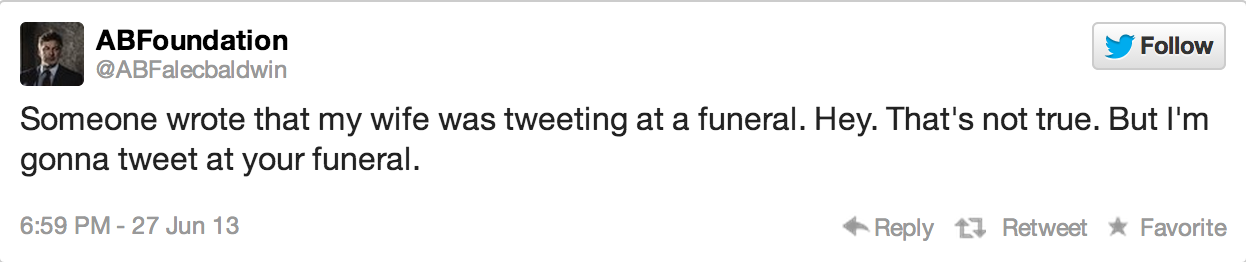
I can understand the man’s rage at a reporter, but what’s with the anti-gay shit?
“George Stark, you lying little bitch. I am gonna f%#@ you up … I want all of my followers and beyond to straighten out this fucking little bitch, George Stark. @MailOnline … My wife and I attend a funeral to pay our respects to an old friend, and some toxic Brit writes this fucking trash … If put my foot up your fucking ass, George Stark, but I’m sure you’d dig it too much … I’m gonna find you, George Stark, you toxic little queen, and I’m gonna fuck…you…up.”
This is not just hate speech; it’s a specific call for other people to physically attack a gay man. It’s a call to violence against a specific person, which, last time I checked, was a crime. He’s a pro-gay liberal, so he may get a pass for this. He shouldn’t.

