
Bologna, Italy, 7.15 am
Bologna, Italy, 7.15 am
Amanda Hess doesn’t think the new app that gives women instructions on how to masturbate is going to close the gender gap:
Female masturbation is a logistical challenge, particularly for women who share their bed with a partner every night of their lives. When a single woman fails to orgasm from a one-night-stand, she’s free to go home and privately finish herself off; once she’s partnered up, she has no other bed to run to. As the developers of HappyPlayTime note, “women in longer relationships tend to masturbate less.” And it’s not just because they’re getting enough pleasure from their partners.
According to a 2007 study on the sexual behavior of people age 45 and older, single men and women masturbate more frequently than those in relationships. Partnered men who are physically dissatisfied in their relationships also compensate by masturbating more. Not so for sexually frustrated females: Women who claim to be physically dissatisfied in their relationships still don’t turn to their own (battery-powered) devices. …
[B]ecause men orgasm a lot quicker during sex—and some of them are still unwilling to admit that their female partners aren’t coming along with them—it can be awkward for women to get caught engaging in some furtive postcoital activity. The same women who profess to be sexually dissatisfied with their partners are also unlikely to be in the position to start a frank conversation about needing some private time. When it comes to increasing the rates of female masturbation, locating the clitoris is just the beginning. Women also need to find some time alone—and some long-term partners who are, once in a while, willing to make a graceful exit. I’m not sure you can make an app for that.
Liel Leibovitz looks into the videogames distributed by authoritarian regimes throughout the Middle East:
The PC game, Special Operation 85 [seen above], came out in 2007, and is virtually indistinguishable from any American-made, war-themed first person shooter. The only difference is that instead of being named Huxley or McCullin, your character is Bahram Nasseri, Iran’s top agent, and his enemies—portrayed with the same silly relish reserved almost exclusively for Bond villains—are nefarious Americans and Israelis. The game sold tens of thousands of copies, a tremendous achievement in a country where technology is not frequently accessible and copyright laws are not frequently obeyed.
The game’s success was encouraging.
That same year, the Islamic Republic inaugurated the government-sponsored Iran National Foundation of Computer Game, which has proven to be instrumental in commissioning, financing, or otherwise supporting scores of games designed to promote the regime’s values at home and abroad. There’s Breaking the Siege of Abadan, which recreates one of the bloodiest battles of the Iran-Iraq War, or, for the more timid, Sara’s New Life, in which a young woman must “protect her morality” from carnal temptations.
But gaming only goes so far as propaganda:
Games, even the best ones, have no room for such uncertainties. They depend on a rigid and algorithmic progression. Couple that with an overt attempt at indoctrination, and you get the crudest sort of propaganda, the kind that appeals to none but the already convinced.
More recent Dish on the emerging complexity of video games here.
Obama’s trip to Africa begins today. Like Howard French, Charles Kenny worries about China’s advantage in Africa. Kenny offers some suggestions to close the gap:
Beyond supporting expanded trade and investment links, the president should suggest how he’s going to ensure a greater movement of people from the U.S. to Africa and in the other direction. Migration has proven one of the most powerful tools for strengthening economic links between countries. Bill Easterly (PDF) points out that many of Africa’s “big hits” in nontraditional exports have been due to the personal connections of exporters who spent considerable time in other countries. For example, Andrew Rugasira, the founder of major exporter Good African Coffee, studied law and economics in London, and Harko Bhagat, the founder of the first fish exporter from Lake Victoria, studied in Canada. …
President Obama should use his trip to make clear how America will engage Africa as a dynamic economic partner while undertaking the moral imperative to support the region in overcoming the remaining—and tragic—human costs of absolute poverty. That would be a presidential journey well worth the jet fuel bill.

Dish-reading bisexuals told all; women with unshaved legs told even more. I gave Peggy Noonan some actual, you know, evidence that debunks her conspiracy hysteria. The prospects for immigration reform looked a little weaker, given the state of the white, old, nationalist faction now dominating the GOP. I loved Wilkinson’s brief description: “The tea party is interested in bald eagles, American flags, the founding fathers, Jesus Christ, fighter jets, empty libertarian rhetoric, and other markers of “authentic” American identity and supremacy.” Empty libertarian rhetoric. And dolphins should never be kept in a pool. Never.
Oh, and tips for a) avoiding a bath and b) picking a font for an exam paper.
The most popular posts were my take-down of Noonan (now almost a regular feature, but she keeps being ridiculous); and my dismay at the craven Washington careerism of David Gregory. The home page, by the way, still garners around 90 percent of the traffic.
I still can’t keep this post out of my head. Window view above: Bushwick, 3.43 pm.
The jet-lag is clearing. And tomorrow we will find out the future of marriage equality in America. Stay tuned. Amazing how this stuff never leaks, innit?
See you in the morning.
Despite the fact that “it is not an auspicious time to begin a dialogue on national service,” Michael Gerson thinks it’s necessary (WaPo):
Instead of giving 18-year-old males a meaningless (to them) Selective Service number, why not also give all 18-year-old men and women information on the five branches of the armed forces, along with the option of serving a year or more in a civilian service program? National service, while not legally mandatory, would be socially expected.
Daniel Larison pushes back:
Conservatives should feel gratitude for our inherited traditions and institutions, and conservatives should want to contribute to the common good, but that doesn’t mean that they should want or support national service organized by the federal government. A person forced by law or social convention to do such service isn’t going to feel gratitude or affection. It is more likely that he will be made to resent the authority or the convention that so compels him. National service isn’t a “devolution of responsibilities.” It is an unwelcome redefinition of what a “responsible” citizen is expected to do.
Jordan Bloom argues that advocates are attacking the wrong problem:
Our betters at the Aspen Institute and other defenders of national service say the public suffers from a sort of civic ennui. But contra David Brooks, this has less to do with a nation fragmenting along economic or cultural lines a la Charles Murray’s Coming Apart, and more with the fact that the civic institutions where meaningful participation is actually possible have been stripped of much of their significance. And not just in the sense that state and local governments have abrogated many of their roles upward, but also because the more mobile a society gets, the less those local affinities matter.
Pascal-Emmanuel Gobry takes on the dissenters:
[T]he only reason you enjoy this incredible, unimaginable privilege is because people who lived before you sacrificed, and toiled, and gave their lives so that you would have it. They fought wars and they gave their blood and their lives so that a certain political community to which you belong shall not perish from the Earth so that you could enjoy this. We owe this incredibly charmed modern life not just to scientific progress and capitalism. We also owe it to the stubborn fact that many of our forefathers were willing to put on a uniform, swear an oath, and lay down their lives, for us, their children and their children’s children. Your blessed life is built on the blood and bones of your forefathers. …
Tell me national service is too expensive. Tell me it won’t work. Tell me you want smart ways to deal with true conscientious objectors. Tell me it’s wankery, even. Heck, tell me why as a Christian you refuse to take up arms against anybody. Tell me all these things—really. But don’t tell me that there’s no social contract. Don’t tell me that you don’t owe anything to your country.
Paisley Rekdal, who has a Chinese-American mother and a Norwegian father, ruminates on how being biracial has informed her poetry:
First: I believe that we are all fragmented, we all live “in between” identities at any one moment in time. Biracialism merely literalizes this metaphor we daily experience: the difference between how we understand ourselves, and how others understand us. Because of this, I am interested in the postmodern fragmented and multi-layered self, but I believe strongly in my need to write from a coherent, cohesive first-person position. In this sense, perhaps this most antiquated feature of my poetry is its most political: I get enough post-modernism walking into the classroom and being asked where I was born. The “I” in my poems may not always be me, but it is a cohesive self.
Second: I, too, am anxious about language’s inherent instability, the slippery ways in which it does not always connect with the world we experience. But when race, whether formally or thematically, enters into the poem, it serves no one’s interest to make the language more opaque to sound intelligent since the stakes (like it or not) have now been raised. Bad writing about race—including racist writing—is often unclear. For me the question has become: how can I allow people to experience the complexity of race, while never muddying my own thoughts? Clarity is just another expression of language anxiety.
(Hat tip: The Poetry Foundation. Video is of Rekdal reciting her poem, “Swallows,” which you can read here.)
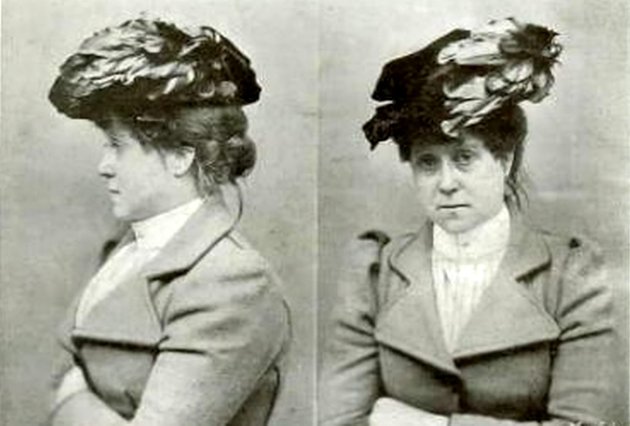
Elizabeth Thompson, after her arrest for being drunk in public – from a cache of mug-shots of habitually drunk female patrons in pubs in Birmingham, England, in the early 1900s. Money quote:
Many of the women on the Black List had scars, missing teeth or other deformities, including Kate Kibble, 50, with her eyepatch and crooked fingers. Surprisingly, most of the women on the list held down jobs, working as charwomen (cleaners), woodchoppers, polishers or grease merchants. One street performer ‘played tin whistle outside licensed premises’, while some also worked as prostitutes to bolster their income.
The eye-patch drinker below the jump:

(Hat tip: Ancestry.co.uk)
Here’s a charming, unintentionally amusing 1933 essay from Harper’s, “What the Young Man Should Know.” Among the many skills a gentleman should possess? Drinking:
American social habits being what they are, there is one indoor skill which seems to me not only far more important than bridge or dancing, but actually compulsory — drinking. A young man who could convince me that his lips really would never touch liquor might be let off my required course in drinking. But he would be an exceedingly rare bird, and alcohol is so much more evident a liquid in the United States than water that it is probably quite as necessary for a young man to learn how to drink as it is for him to learn how to swim. If the youth of the country had been taught how to drink, just as they were taught not to eat between meals or swallow before they had chewed, we should never have had Prohibition. It is a more difficult art than most, for every man reacts differently, and every man should know, long before the time when (according to our customs) he indulges in his first collegiate binge, whether liquor goes to his head, his legs, or his morals, whether he is the type that sings, fights, weeps, climbs lamp-posts, or pinches the girls. Furthermore, he should learn his capacity and stick within its limits; he should know something about the different kinds of drink, and which drinks produce chaos within him when mixed. By all means let him leave drink alone if he wants to. But since, nine times out of ten, he will drink, let him do so sensibly.
Read the rest for Depression-era thoughts on gambling, swimming, driving, dancing, and more.
According to this NSFW clip of David Cross as Todd Margaret, yep, pretty dangerous:
[youtube http://www.youtube.com/watch?v=kfPReIAKxeQ]A reader responds to the previous post with his professional opinion:
I have about one referral per year to my cardiology practice where the patient had acute and severe symptoms after consumption of a high-caffeine “energy” drink. I’ve also seen them sitting in my clinic room about to shake themselves silly with tremor and palpitations. These patients have had to be hospitalized for symptoms on at least one occasion, and you might be interested to know that in some of my cases these people work as long-haul truck drivers on the interstate highways. I get that you can ingest a high daily quantity of caffeine by going to Starbucks. Please consider, however, that the people I see are downing their energy drinks after they have already ingested their normal daily quota of coffee or tea – it is not one or the other.

