“The difficulty for me in writing—among the difficulties—is to write language that can work quietly on a page for a reader who doesn’t hear anything. Now for that, one has to work very carefully with what is in between the words. What is not said. Which is measure, which is rhythm, and so on. So, it is what you don’t write that frequently gives what you do write its power,” – Toni Morrison.
Mental Health Break
David Lynch and Lykke Li take you on a hypnotic road trip:
The Good, Dirty Book
Jamie Quatro discusses her O. Henry prize-winning short story, “Sinkhole” – which, like much of her work, explores “the intersection of faith and sexuality in Judeo-Christian orthodoxy”:
“Sinkhole” is the only story I’ve ever written that came to me as a grand-scale, amorphous idea: to write a combination loss-of-virginity/exorcism scene in which neither person realized what was happening to the other. That was all I had. No image or character, not even a fragment of dialogue…
Growing up, I was flummoxed by the church’s strictures on sexual behavior on the one hand and the rampant scriptural use of sexual image and metaphor on the other. It seems there’s something inherently erotic about the way we’re supposed to think about God (bridegroom) and the way he thinks about us (the return of Christ as Consummation, the church as his Bride, etc). Many (most?) Christians might say the two are mutually exclusive—that sexual love is tied to flesh, love for God to spirit—but I’m convinced they’re very closely aligned.
This spring, Nina Schuyler reviewed Quatro’s collection, I Want To Show You More, and found these themes in abundance:
One of the most prevalent themes is adultery, which is sprinkled throughout the book through a series of stories. The collection opens with “Caught Up,” in which the narrator reveals her affair to her mother. The narrator has spent ten months talking daily to her lover on the phone. The affair never is consummated, but in her mother’s view, it might as well have: “It’s all the same in God’s eyes,” says her mother.
Throughout, Quatro is not cynical about God or Christian beliefs. The narrators (women) in the adultery string of stories grapple with lust, passion, guilt, and God. The adulterous narrator appears again in “Imperfections,” a two-page story in which the man kisses the narrator’s forehead. The kiss makes her right eye burn, “Like you put a seal on my forehead, I wrote to him later, and hot wax dripped down into my eye.” And she returns again in other short pieces, which begin to feel like the heavy, complicated breathing of two lovers held apart.
Larkin’s Literary Afterlife
Reviewing Philip Larkin’s Complete Poems, which contains everything from his most polished publications to scraps from his notebooks, James Fenton confesses his suspicions about such volumes:
It is very strange that a poet whose key work lies in three rather short volumes should have caused such difficulties for his editors and such controversy among his readers. But the readers pay him the tribute of a sort of possessiveness and concern: they want their poet to look his best. And it’s hard for a poet to look good in his Collected Poems, if by “collected” we mean anything like “complete.” Most poets’ collected works will include things that would make the author cringe. Presented in untidied form, such gatherings remind me of nothing so much as those yard sales characteristic of recession America, in which families set out on their front lawns the contents of their closets and dens—the Frisbees, the old scooters, the clothes neither wanted nor needed, the dreadful joke presents—all in the hope of raising a little cash.
Painters are known to curate their oeuvre by means of occasional bonfires of botched canvases, and experience has taught us that the better the painter, the better advised he is to stand over that bonfire and make quite sure that what he wants burnt does indeed go up in smoke, and is not squirreled away by his admirers and assistants, whether through misguided motives of preserving the legacy, or by the thought of providing for their old age.
I touched on Larkin’s poetry last week here. The above audio is of me reading Larkin’s “Whitsun Weddings” at a celebration of his work described here.
A Spiritual Cleansing
Judith Shulevitz sees echoes of religious observance in the juice cleanse craze:
These new cleanses are “religion without theology,” my friend Ruby quipped. But now that I’ve read Junger’s Clean, the best-selling text of the cleansing movement, I’ve decided I don’t agree. Clean is theology all the way down. As in many a devotional text, fasting is presented as a way to embody a purer social order. We live in an age of what William James called “medical materialism,” so instead of fretting about a fallen world, we speak of a poisoned one. … Distrustful of our surroundings, we try to close ourselves off to malign influences and to purge them. It is no accident that Clean dwells obsessively on defecation and elimination. Junger wants us to flush out shit, “toxic waste,” even mucus, which he says has “a dense and sticky quality; it resonates with and attracts dense, toxic thoughts and emotions.”
Stumbling Towards Success
Reviewing Worldly Philosopher: The Odyssey of Albert O. Hirschman, Malcolm Gladwell spots this arresting passage from one of the thinker’s essays:
While we are rather willing and even eager and relieved to agree with a historian’s finding that we stumbled into the more shameful events of history, such as war, we are correspondingly unwilling to concede—in fact we find it intolerable to imagine—that our more lofty achievements, such as economic, social or political progress, could have come about by stumbling rather than through careful planning. . . . Language itself conspires toward this sort of asymmetry: we fall into error, but do not usually speak of falling into truth.
How his embrace of failure, doubt, and the unexpected, spurred heterodox economic ideas:
Hirschman published his first important book, “The Strategy of Economic Development,” in 1958. He had returned from Colombia by then and was at Yale, and the book was an attempt to make sense of his experience of watching a country try to lift itself out of poverty. At the time, he was reading deeply in the literature of psychology and psychoanalysis, and he became fascinated with the functional uses of negative emotions: frustration, aggression, and, in particular, anxiety. Obstacles led to frustration, and frustration to anxiety. No one wanted to be anxious. But wasn’t anxiety the most powerful motivator—the emotion capable of driving even the most reluctant party toward some kind of solution?
In the field of developmental economics, this was heretical. When people from organizations like the World Bank descended on Third World countries, they always tried to remove obstacles to development, to reduce economic anxiety and uncertainty. They wanted to build bridges and roads and airports and dams to insure that businesses and entrepreneurs encountered as few impediments as possible to growth. But, as Hirschman thought about case studies like the Karnaphuli Paper Mills and the Troy-Greenfield folly, he became convinced that his profession had it backward. His profession ought to embrace anxiety, and not seek to remove it.
Recent Dish coverage of Hirschman here.
Face Of The Day
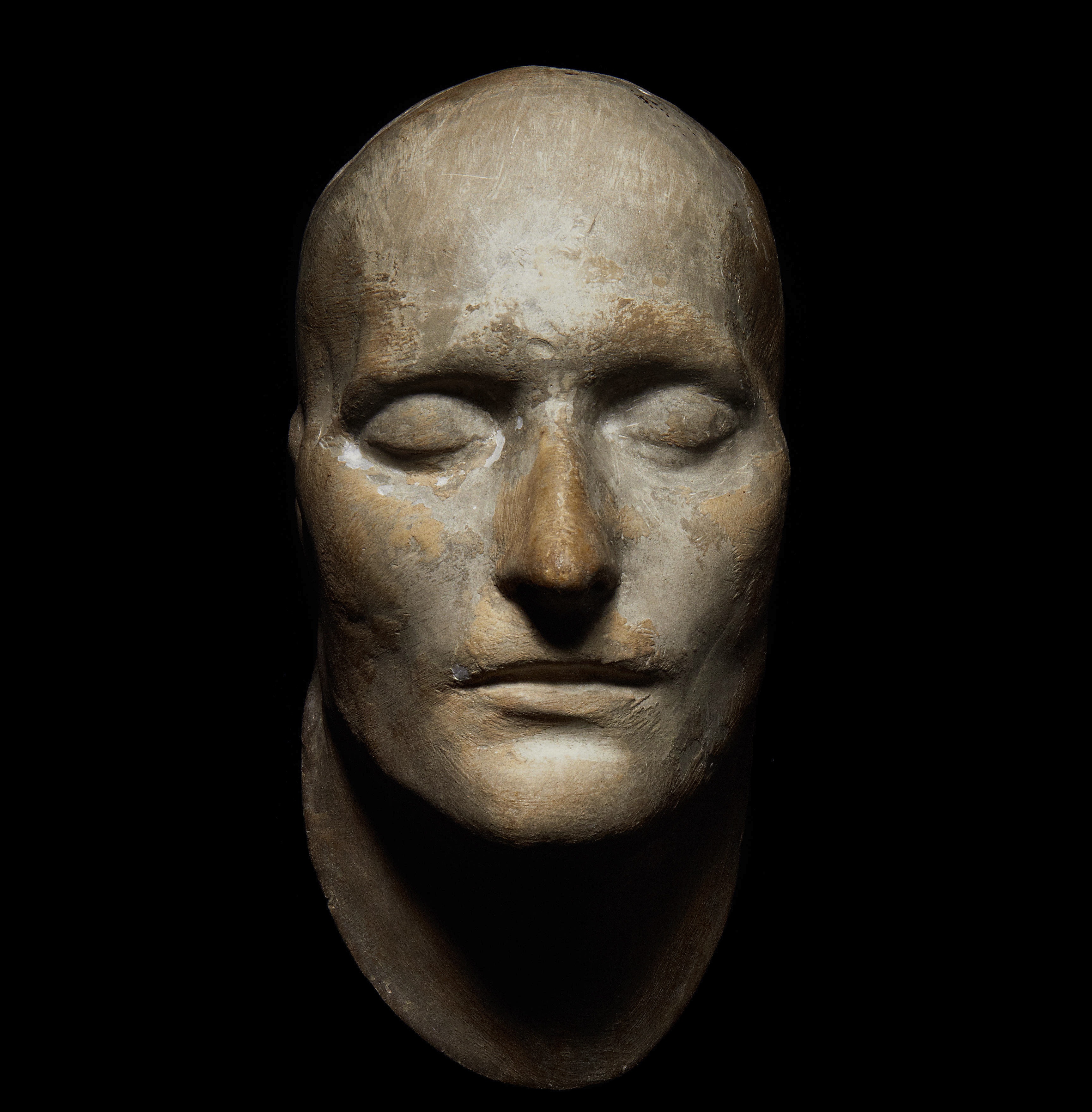
A “death mask” of Napoleon sold last week for £169,250 (about $260,000):
After Napoleon’s death, there was a protracted wrangle over whether his physician, Francesco Antommarchi, or the British doctor, Francis Burton, should make a death mask. Practical difficulties also meant that this was not done until 7 May, two days after the former Emperor had died.
The mask was given to the Rev Richard Boys by the portrait painter, J.W. Rubidge, who assisted Antommarchi in making the mask. Boys received it before Napoleon’s entourage left the island towards the end of May. The mask is inscribed “Rev Mr Boys” on the inside of the cast, and comes with a note by Boys reading: “This Cast was taken from the Face of Napoleon Buonaparte as he lay dead at Longwood St. Helena 7th May 1821 which I do hereby certify/ R. Boys M.A. Sen.r Chaplain/ By Rubidge”.
(Hat tip: Tara McGinley)
Sinning Against The Earth
In an excerpt from his new book, The Fanaticism of the Apocalypse: Save the Earth, Punish Human Beings, the French philosopher Pascal Bruckner tears into ecological “catastrophism” as pseudo-religious in form and self-hating in content:
Consider the meaning in contemporary jargon of the famous carbon footprint that we all leave behind us. What is it, after all, if not the gaseous equivalent of Original Sin, of the stain that we inflict on our Mother Gaia by the simple fact of being present and breathing? We can all gauge the volume of our emissions, day after day, with the injunction to curtail them, just as children saying their catechisms are supposed to curtail their sins.
Ecologism, the sole truly original force of the past half-century, has challenged the goals of progress and raised the question of its limits. It has awakened our sensitivity to nature, emphasized the effects of climate change, pointed out the exhaustion of fossil fuels. Onto this collective credo has been grafted a whole apocalyptic scenography that has already been tried out with communism, and that borrows from Gnosticism as much as from medieval forms of messianism. Cataclysm is part of the basic tool-kit of Green critical analysis, and prophets of decay and decomposition abound. They beat the drums of panic and call upon us to expiate our sins before it is too late.
In a companion profile, Emily Eakin connects these arguments to Bruckner’s broader intellectual concerns:
He abandoned his faith as a teenager and eventually completed a Ph.D. with Roland Barthes, by which point he’d concluded that Christian concepts of guilt and redemption were inescapable. “Baudelaire said that civilization is the abolition of the original sin,” he told me. “In fact, it’s not true; we haven’t abolished original sin but rather spread it all over.” In Bruckner’s scenario, Marxism transposed the idea of Christ onto the working class; paradise would come after the revolution. Then, with third-worldism, colonized peoples became the embodiment of virtue. Now, he says, it’s Mother Earth: “She is suffering, the metaphor of all victims.”
A Not So Grim Reaper
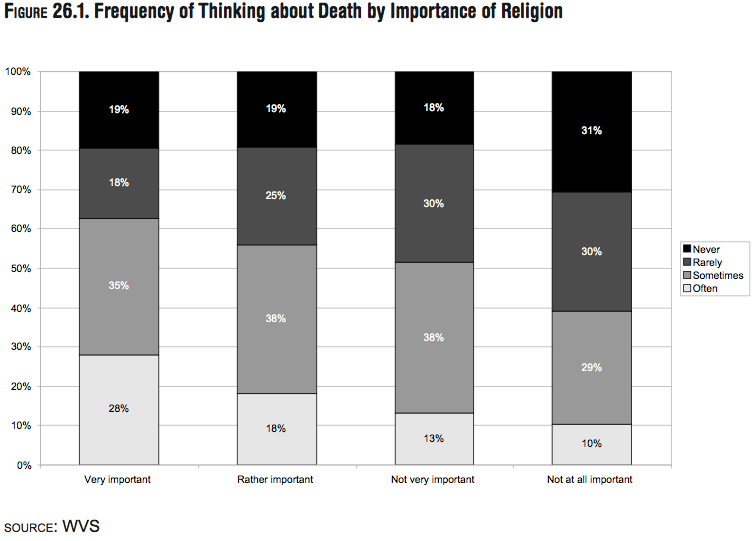
Hemant Mehta, who posts the chart above, turns to an excerpt from sociologist Ryan T. Cragun’s new book, What You Don’t Know about Religion (but Should) to support his case that atheists die “better” than the religious:
A growing body of evidence seems to support the idea that the nonreligious have an easier time coping with death than do the religious, at least with their own mortality. Religious people appear to be more afraid of death than are nonreligious people. Nonreligious people are less likely to use aggressive means to extend their lives and exhibit less anxiety about dying than do religious people. That seems remarkably counterintuitive since the nonreligious are much less likely to believe in an afterlife, which is supposed to help people cope with death. But factor in that religious people are contemplating their eternal fate and it begins to make more sense. Even if they have done everything their religion says they are supposed to do, there is always a bit of uncertainty about where they might end up. As a result, religious people appear to have a greater fear of dying than do nonreligious people.
In a related video post, Mehta answers questions about what atheists believe happens when the fateful day comes:
Related Dish coverage of atheist funerals here.
Fighting Religion With Religion?
Rabbi Jonathan Sacks argues that it will take more than science and atheism to stave off fundamentalism:
In one respect the new atheists are right. The threat to western freedom in the 21st century is not from fascism or communism but from a religious fundamentalism combining hatred of the other, the pursuit of power and contempt for human rights. But the idea that this can be defeated by individualism and relativism is naive almost beyond belief. Humanity has been here before. The precursors of today’s scientific atheists were Epicurus in third-century BCE Greece and Lucretius in first-century Rome. These were two great civilisations on the brink of decline. Having lost their faith, they were no match for what Bertrand Russell calls ‘nations less civilised than themselves but not so destitute of social cohesion’. The barbarians win. They always do.
The new barbarians are the fundamentalists who seek to impose a single truth on a plural world. Though many of them claim to be religious, they are actually devotees of the will to power. Defeating them will take the strongest possible defence of freedom, and strong societies are always moral societies. That does not mean that they need be religious. It is just that, in the words of historian Will Durant, ‘There is no significant example in history, before our time, of a society successfully maintaining moral life without the aid of religion.’
In response, Jerry Coyne calls Sacks an “ignorant fool”:
Here is a partial list of countries that have a very high percentage of nonbelievers. This is all it takes to rebut Sack’s claim that if one loses Judeo-Christian sanctity of life (note that he doesn’t mention Islam) we will descend into evil, barbarism, and perfidy:
- Sweden
- Denmark
- Norway
- Japan
- Finland
- France
- Germany
- South Korea
The last time I looked, these countries were remarkably sane, well-behaved, and their inhabitants generally moral.

