When In Rome, Don’t Phone Home

New research confirms that cultural immersion is the best way to learn a language, since influences from home tend to slow down development:

[T]he researchers examined particular objects with names that can be tricky to translate from Chinese to English. The Chinese word for pistachio, for example, translates literally as “happy nut,” while the word for lollipop translates as “stick candy,” and the researchers wanted to see how prone to using these sorts of original Chinese linguistic structure the students would be under various conditions. … The researchers showed photos of these sorts of objects to 85 Chinese-speaking students who’d only been in the country for about 3 months. Some students saw familiar images from Chinese culture, while others saw American or neutral images. All groups demonstrated the same level of accuracy in describing objects like pistachios, but they proved to be much more likely to make incorrect overly literal translations (calling pistachios, for example, “happy nuts”) when shown Chinese imagery first than with either of the other two categories.

The researchers explain the results as an example of “frame-switching.” In essence, for the native Chinese speakers still learning English as a second language, being exposed to faces or images that they associated with China unconsciously primed them to think in a Chinese frame of reference. As a result, it took more effort to speak English—causing them to speak more slowly—and perhaps made them more likely to “think in” Chinese too, using literal Chinese linguistic structures instead of translating into the correct English words.

Does “British Art” Exist?

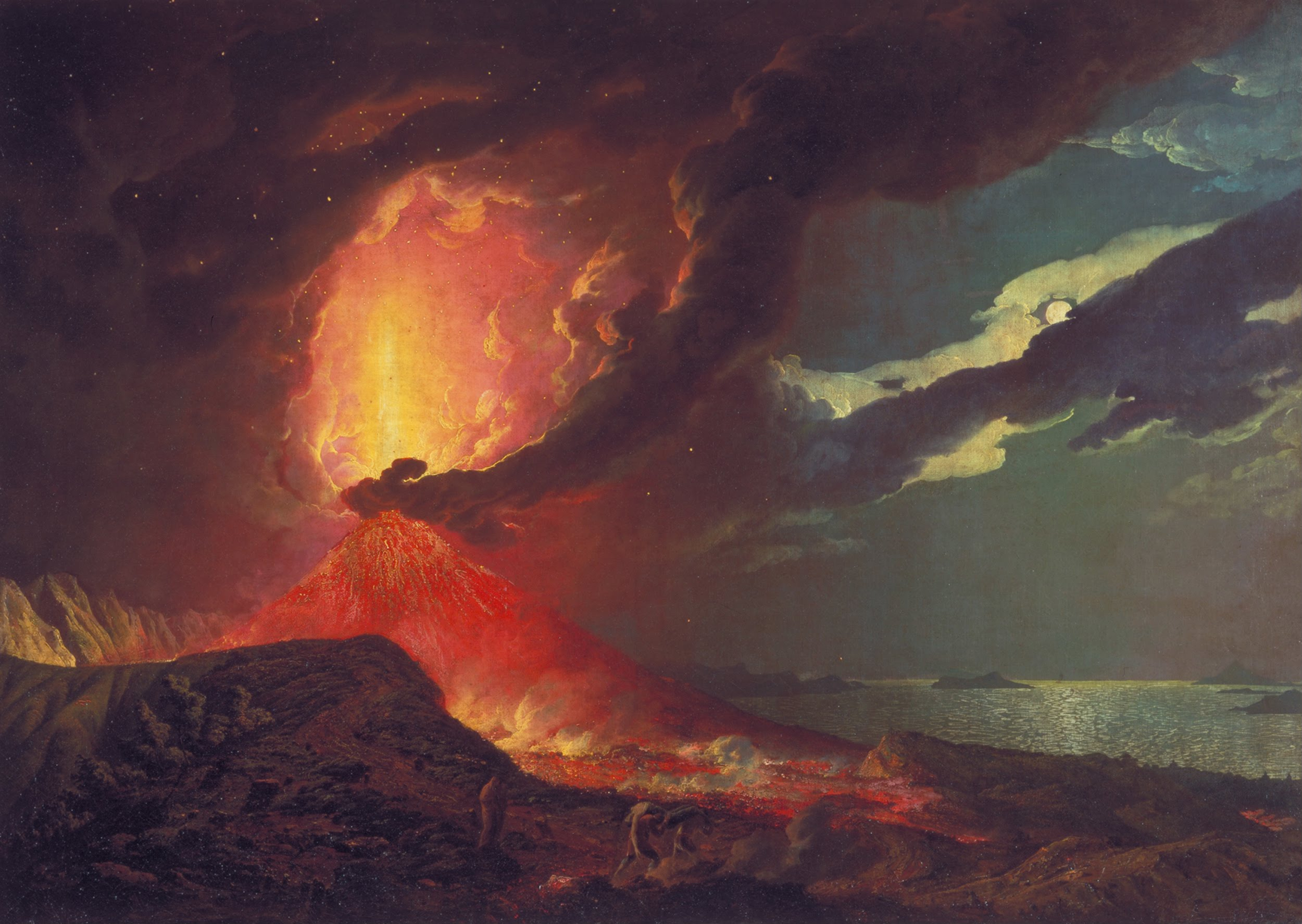
Vesuvius

After walking through the recently reorganized permanent collection at the Tate Britain, which invites visitors to “Meet British Art,” James Polchin isn’t so sure:

What makes this work distinctly British is not so clear. Some of the earliest works are done by artists born outside of Britain. Consider the grand landscape of a newly formed St. James’ Park by the 18th century Venetian painter Giovanni Antonio Canal, known as Canaletto. His early paintings of architecturally precise palazzos of Venice became popular souvenirs for British tourists. In London, he continued his distinctive bird’s-eye view of the landscape with scenes in and around the city. But what makes St. James’ Park distinctively British, I wondered. It cannot be considered as part of “the British School.” The work is much more an import or rather an immigrant into the history of British Art. There are other such immigrant artists here, such as the Dutch born van Dyck, the American Whistler, and Zoffany, a German Romantic painter who, as a short text indicates, “Travelled to paint the Empire” in India in the early 19th century.

I thought perhaps it was subject matter that anchored a definition of British art in this collection, until I arrived at Joseph Wright of Derby’s “Vesuvius in Eruption” (1776-80), an imagined view of the volcano’s burst of brilliant molten light. This was a view of Naples, stuck here in the history of British Art. Or consider the more contemporary David Hockney’s “A Bigger Splash” (1967) offering the flat tones and minimalist forms of a Southern California house and pool, the flutter of a splash in the water breaking the painting’s geometry. These are not British subjects, but composed by British born artists. The term “British Art” remains in quotations throughout these galleries as both artists and subjects confuse any firm idea of what makes this art so British. As so often happens, nationalism is something we just have to believe in here, with little evidence of its meaning or importance. Instead, this collection is an imagined community of British art. But like any imagined community, constructed from fragments and ruins, from alien forces assimilated into a whole, it is fragile idea to hold together.

(Image: Vesuvius in Eruption by Joseph Wright of Derby, 1776, via Wikimedia Commons)

A Mini Military-Industrial-Complex

Balko provides a short history of the “police-industrial-complex.” He blames its creation on federal programs that funnel military hardware to our nation’s police departments:

As the [Center for Investigative Reporting (CIR)] reported in 2011, military contractors now market directly to police agencies with messages that encourage the mindset that the military and the police are fighting the same battle. And it’s lucrative. The spokesman for Lenco, which makes armored personnel vehicles, told me last year that thanks to DHS, the company has sold at least one of its “Bearcats” to 90 of the 100 largest cities in America. The CIR reports that, “The homeland security market for state and local agencies is projected to reach $19.2 billion by 2014, up from an estimated $15.8 billion in fiscal 2009, according to the Homeland Security Research Corp.”

That not only means that there’s fortune to be made arming domestic police departments for battle, there’s also plenty of money left over to set up lobbying offices in D.C., hire former politicians and their staffs, and generally lobby Congress, the Pentagon, and the White House to ensure that these programs not only stay around, but that they grow in size and influence going forward.

The Marketing Of Obamacare

It’s about to begin in earnest:

The exchanges need roughly 2.7 million healthy 18-t0-35-year-olds to sign up to be solvent. The majority of that group is nonwhite and male, according to Simas’ data, and a third are located in just three states: California, Texas and Florida. If too few choose to enroll because they don’t know about the law, don’t like it, or feel they don’t need insurance, the exchanges will fail. And so will the law.

The Administration has plotted an extensive social-media campaign designed to reach the young and healthy and is soliciting sports teams to help raise awareness. More than 10 staffers in the Office of Public Engagement are marshalling the help of Latino and African American groups and community nonprofits. And [David] Simas has spent countless hours surrounded by maps of media markets and demographic data on the uninsured trying to remind prospective enrollees of the benefits available to them: “It’s that guy in Dallas, it’s the woman in Los Angeles, it’s the family in Miami-Dade,” he says.

Kyle Cheney reports that the “Obama administration has reached out to the NBA about a potential marketing partnership to promote the health law.” Jonathan Cohn comments: 

[I]f the NBA signs on, a model for the project might be a campaign that the Boston Red Sox undertook in 2007, when Massachusetts was rolling out the health reforms that became a model for Obamacare. The Red Sox ads for health reform in Massachusetts have a certain legendary status in health policy circles—and for good reason. They leveraged the celebrity status of beloved sports heroes, not to promote the reforms themselves but to make two very simple points: Everybody can get sick and, for the first time, everybody can get health insurance.

Sandhya Somashekhar looks at how attaching Obama’s name to the law changes approval of it:

According to the poll, overall favorability of the law jumps from 35 percent to 42 percent when the term “Obamacare” is used. That’s almost entirely due to the enthusiastic reception it gets from Democrats, 58 percent of whom responded favorably to “health reform law,” compared with 73 percent for “Obamacare.”

Independents in the poll reacted about the same to both descriptors (about a third responded favorably while around a half responded unfavorably). Among Republicans, 76 percent responded unfavorably to “the health reform law.” That number jumped to 86 percent when “Obamacare” was used.

The ad above was created by a pro-Obama group:

The ad highlights the ways the Affordable Care Act is already helping some Americans as part of a “major education campaign” by the issue advocacy group Organizing for Action, founded out of Obama’s 2012 campaign. The group is spending seven-figures on a series of ads, which complement White House and administration efforts to build support for the law.


His Coop Runneth Over

Chicken

Meet Paul Bradshaw, who raises 19 breeds of rare chickens, ranging from “the American Bresse to the Tolbent Polish,” which are in such demand that they “often come with waiting lists.” He even has helped pull some types of chickens back from the edge of near extinction. Who buys the birds?

He caters to a finicky crowd: Eighty to ninety percent of Greenfire’s customers, Bradshaw says, are backyard hobbyists. Backyard hobbyists tend to get classed as dilettantes more concerned with the aesthetic appeal of the $1,500 chicken coop they’ve ordered from Williams-Sonoma. Not so, says Bradshaw. “They have very specific ideas of what they want in a chicken. They want the best. They’ll pay $1,000 for a chicken if they know they’re getting the best.

“They’re hardcore,” he says. “They weigh their eggs and count them, and they’ll butcher a chicken. They’re serious about retaining the food value of these birds, and that’s really kind of our market.”

The reasons for the uptick in their popularity:

Bradshaw credits the boom in business to three factors that converged over the past several years. “There’s been the broad environmental movement trend, which has been going on for the last 50 years. Then there was the recession, which gave rise to the self-sufficiency trend, where it was destabilized enough that people started to worry about their own food supply. And then there was the local food movement. Chickens,” Bradshaw says, “became the gateway livestock for people in America.”

(Photo by Katie Brady)

HIV Treatment As HIV Protection, Ctd

A reader adds to the growing discussion thread:

I feel I should chime in on the discussion of PrEP as a HIV prevention strategy.  I’ve just gotten enrolled in the PrEP demonstration project put on through UCSF and the San Francisco city Tenofovirclinic.  Your reader who had a month-long course of PEP probably took Combivir, which is a much harsher drug than Truvada.  A few folks in my social circle have also gotten on board, and although this is anecdotal, I know of nobody who has stopped taking the drugs because of side effects.  I’ve been encouraged about the efficacy of PrEP from the conversations I’ve had with clinicians and volunteers, and there are a lot of folks who are very excited about PrEP.

This is my second week on PrEP, and after a bit of nausea and an upset stomach the first week, the side effects have basically dissipated.  The clinicians tell me that when folks do experience side effects, nearly all patients report that after the first month the side effects have gone away. It should also be reiterated that Truvada has been approved by the FDA for this purpose, so it’s not as if the promotion of PrEP is some wild-eyed, off-label drug use.

Another:

I’m a Ph.D. student, in my fourth year, studying viral evolution. In a nutshell, our lab studies emergent viruses – viruses that jump from one host species to another and often cause disease in the new host. While I don’t specifically study retroviruses, other members of the lab do, and I’m pretty well versed in the population genetics of disease emergence and resistance.

Coming from this background, my gut reaction is that preventative treatment with anti-retrovirals is a really bad idea. The reason is simple: you can’t trust people to take medication exactly as they’re directed, and this promotes the spread of resistant strains of viruses/bacteria/etc.

Most people are familiar with this concept because of our overuse and misuse of antibiotics. Someone gets sick, takes antibiotics for a few days, feels better, and stops before the treatment is done. They’ve eliminated most of the bacterial population that made them sick. However, the fraction that’s left is composed of individuals that survived the antibiotic treatment. Those bacteria may or may not be resistant to that drug. This doesn’t mean immune; at some dosage or duration, the drug will still kill them. But it takes more or longer. A curtailed treatment regimen fails to clear that threshold for some fraction of the bacterial population.

These resistant strains normally aren’t common because they tend to be less fit than non-resistant strains. They grow more slowly, require more resources, etc, which makes them less competitive than the non-resistant, or wild-type, individuals in the absence of antibiotics. But remove those individuals with three days of what should have been a five-day course of antibiotics, and the resistant part of the population can now flourish, since they don’t have to compete with the non-resistant strains. Next time that individual gets sick, the entire population is resistant, and treatment with a higher dose, a longer duration, or a new drug is required. Over the long term, this is a BIG problem (see TB, gonorrhea, MRSA, malaria, the list goes on and on).

The situation for viruses is pretty much the same, with a few wrinkles. First, viruses evolve faster. Retroviruses are at the high end of the spectrum, though not at the peak. Fast-evolving viral populations, like HIV, harbor a high degree of within-host genetic diversity, meaning that within any one infected person, there are many, many slightly-different strains of HIV, increasing the likelihood that a resistant strain is present.

Bacterial infections are usually treated with a single drug, at least until resistance is identified, while HIV is treated with a combination, as you know. This should make the presence of a resistant strain, one resistant to every drug present, less likely. And such an emergence is an extremely low-probability event.

The problem with the proposed preventative treatment, as I see it, is that while it doesn’t make the presence of such a strain any more likely, it greatly increases the likelihood of it spreading through the intra-host population, should it appear, for the same reason resistant bacteria can take over after an incomplete course of antibiotics. In this case, failure to adhere to the anti-retroviral regimen would allow multiply-resistant strains of HIV to circulate in the absence of competition from non-resistant strains.

Initially, this would probably happen at low levels, but as the proportions of each strain shifted in favor of the resistant strain, the treatment could conceivably cease to be affective. It’s possible, and I’d say probable, that over time, a resistant strain (probably slow-spreading and with low virulence, due to the trade-offs involved with resistance), previously found very rarely within individuals, might be found and transmitted with much greater frequency.

I could go on and on thinking about this for hours, but I’ll stop there. The short short version is that people don’t take medication as directed, which has led directly to multiply-resistant forms of many diseases. Preventively prescribing anti-retrovirals is just asking for history to repeat itself.

Update from a reader:

Re: the Ph.D. student’s concerns: He’s absolutely right. A researcher here at the University of Nebraska Medical Center has said much the same thing, which is why he is working on weekly or twice-monthly injections, rather than a regimen of pills, which could be stopped or forgotten. It’s currently only in animal trials, but it works: The latest breakthrough in the project is that the ART injection proved successful both as a treatment in HIV-infected mice, and as a preventive measure to keep healthy mice from contracting the virus. The news of Truvada broke just as he had a major paper coming out, and it garnered most of the attention. As he said: different drugs, different routes of administration, different formulations, but the goals are the same. But, he’s talking about a shot every other week, and you’re done, thus taking all the perils of a daily pill off the table. More info here and here.

A much more personal perspective:

I just wanted to take a moment to thank you for writing your post on PrEP and bringing this back into light. In the past 14 months about five friends of mine have seroconverted.  The consistent level of HIV infections in my community shocks me considering the fact that many could have possibly been protected simply by taking a pill.  Not to mention the fact that most of them had the means to cover the cost of the prescription.

In January I had a close brush with HIV, after a partner seroconverted 10 days after we had sex, and 15 days after a negative HIV test for both of us (which we didn’t have the results on yet).  We had played bare in the past, but I preferred using a condom pending the result of HIV test.  This close call caused me to become more serious and look into PrEP.  What I was not prepared for was a complete lack of information and resources for gay men in Austin, Texas considering PrEP as an option.  I found nothing regarding PrEP on Aids Services of Austin resource pages, and not the on the local city/county health web sites I had to rely heavily on friends from Seattle for advice and point me to better information.

I had to change from a doctor I had thought would be very good for me and my unique health needs as a gay man. My doctor’s nurse actively dissuaded me from requesting an appointment after I told her my intention was to seek PrEP. Even though I believed that I was a good candidate for PrEP based on my research.  She said that he probably wouldn’t be comfortable prescribing this course of meds, and suggested I find a doctor with an HIV specialty.

So I did, and after all was said and done, I found a new doctor that I’m more confident he will be able to address my needs. So my point is … why is it so damn hard for those that seek PrEP to get it?  Isn’t the goal to curb transmission and treat the positive?

This week, a good friend found out he slept with a guy in late May, didn’t use protection, and his partner just tested positive.  My friend had flu-like symptoms and went to the doctor.  His results were negative, but he’s still within the window period for anti-body testing. Once again, he knew about PrEP, but didn’t have the information make it happen.
A Dominant Dimension

A study of chimp behavior using five human categories – “extroversion, agreeableness, conscientiousness, neuroticism and openness” – produced the need to create a sixth:

[Analysis] showed that human personas have five dimensions. Chimps’ personas, by contrast, seem to have six. These are extroversion, agreeableness and openness, which match human dimensions, and reactivity … dominance and methodicalness, which do not. Reactivity is similar to the human dimension called neuroticism, though not similar enough, in Dr Freeman’s view, to justify the same label. And methodicalness, which measures the way animals approach things like using tools and making the nests they sleep in, resembles conscientiousness—though Dr Freeman’s raters found this difficult to assess because such activities are not much available to the chimps in Texas. But there is, intriguingly, no human dimension that resembles chimpanzee dominance.

The Purging Of Syria’s Moderate Rebels

Reuters reports that Jihadist rebels are sidelining and even disarming more moderate rebels within Syria. Allahpundit asks how the US plans to address this issue:

If the jihadis are intent on isolating and purging the moderates, what exactly is the strategy for getting them to fight in concert against Assad? The assumption thus far has been, I guess, that once U.S.-armed units start to put a hurt on the regime, the jihadis will leave them alone and will try to multiply the effect by focusing on the regime themselves. But in light of this story, maybe that’s naive. Maybe the jihadis will launch a two-front war, one against Assad and one against the proxy army of their western archenemy, which in turn will make things easier for Assad’s forces by letting them fight a divided enemy. That would be the exact opposite of what the U.S. is out to do here, i.e. help the rebels beat up on the regime and drag out the war until Assad sues for peace.

The British public, by the way, is overwhelmingly against their leaders’ current posture. Only 24 percent back Cameron’s loony idea. My impression among friends in London is that they are terrified that this could lead not just to a regional but global war, if Russia, Britain, France and the US go to war old-school by elbowing their way into Syria’s civil war. Allahpundit continues:

Even in a best-case scenario, in which the CIA somehow builds a small moderate force and turns it into an effective army, what’s the plan for the obviously inevitable civil war after the Assad falls between the U.S.-backed Sunni moderates and the Sunni jihadis? You’re going to have to fight and kill them too, apparently, or else they’ll fight and kill you. That means committing to years of supplying one side here, and maybe doing more than that if/when things don’t go their way. How long, roughly, is all of this going to take?

Nicholas Thompson wishes the US had stayed out of the war altogether:

There were other options. Obama could have continued imposing sanctions and sending non-lethal aid to rebel groups. If the goal is to save lives and give comfort to the victims, we should give further support to the refugee camps. Joining the battle, though, transforms it. Now our weapons will be killing people. We will be tied by blood to one side in a sectarian civil war that seems likely to spread in an unpredictable fashion. We are now part owners of the pain it will cause—in Syria, Lebanon, and elsewhere.

James Gandolfini, RIP

Last night, Gandolfini, the terrifying yet relatable Tony Soprano, passed away. Alyssa eulogizes:

If you write about television, as I do, or watch it frequently, Gandolfini’s performance as Tony Soprano on the titular show that helped remake HBO and prestige television along with it was a major contribution to the world we inhabit together. … [M]ore than anything else, it was Gandolfini, who gave us a man who fascinated us and commanded our sympathy despite the enormity of his crimes, reminding us that people whose only sins are against each other’s hearts deserve our attention, too.

James Poniewozik reflects on how he changed television drama:

James Gandolfini was our usher into that new TV era, by taking a performance that could have been cartoonish (remember Analyze This?) and making it psychologically layered and unshakeable. This was a man who could show us a brute throttling a Mafia turncoat while looking at colleges with his daughter and make us think: I want to know this guy better. He could lead us, mildly contemplating an onion ring, to the finale’s famous cut-to-black, to the tune of “Don’t Stop Believin’,” and leave us wondering whether he lived or died, and what he deserved, and what it all meant. We can only wonder what more Gandolfini would have done with a more fair measure of years.

Suderman nods:

Certainly [the show] was among the most influentual, with its creators and core ideas still reverberating through the so many of the high-quality dramas produced today.

And that influence, and it staying power, has a lot to do with the way Gandolfini payed Tony: powerful but conflcted, angry and often menacingly violent but not wholly heartless, driven and determined yet fundamentally confused about what he wanted out of life. Was he a monster? Or just the man next door? Gandolfini’s performance helped provide the only possible answer to that pair of questions: Yes. It was the perfect role, and he was the perfect actor for it. It’s impossible to imagine The Sopranos without Gandolfini, and nearly as difficult to imagine the modern TV drama landscape — with its emphasis on brooding serials led by aging male antiheroes — without his work on the show.

Marc Tracy wants critics to remember that Gandolfini wasn’t Tony:

I can hear the laptops clacking: obituarists are saying that the [Sopranos]’s obsession with death (“In the midst of death, we are in life. Or is it the other way around?”) has prepared us for Gandolfini’s death as we are prepared for nobody else’s death; that the final scene blah blah blah; that, indeed, “Whaddya gonna do?” No. At least when we ascribe attributes of a fictional character to her author, it is not always a fallacy—the author has created the character, and so it is fair to ask what he has invested her with. Gandolfini’s achievement was different: while Tony may share things with Gandolfini, ultimately what Gandolfini does is completely efface himself, disappearing into the role completely in order to make the entire thing work.

“The Sopranos” likely would have been a pretty good show no matter who was playing Tony (unless it was Steve Van Zandt, who played Silvio and reportedly auditioned for the part). Would it have been the American masterpiece it was with anyone other than Gandolfini? To ask the question, as Christopher Hitchens used to write, is to answer it.