A Temporary Victory For Voting Rights

On Monday the Supreme Court invalidated an Arizona law passed in 2004 that requires people registering to vote to provide proof of citizenship at the time of registration. But, as Lyle Denniston explains, Scalia’s majority opinion suggested a way around the ruling:

On the particular point at issue in this case — Arizona’s requirement of proof of citizenship before one may register to vote or actually vote — the Scalia opinion said that a state was free to ask the federal government for permission to add that requirement.  And, Scalia said, if that doesn’t work — either because the federal agency that would deal with such a request is either not functioning or says no — then a state would be free to go to court and make an argument that it has a constitutional right to insist on proof of citizenship as an absolute qualification for voting, in all elections.

Arizona officials have already begun (pdf) to pursue this suggestion. Emily Bazelon zooms out:

As Jonathan Alter points out in his new book, The Center Holds, voter ID and other impediments led to a backlash against Republicans in 2012, energizing minority voters to go to the polls in the key states of Pennsylvania, Ohio, Virginia, and Florida.

[University of California, Irvine, law professor Rick] Hasen cautions against getting too giddy, however. “It’s a mixed bag,” he says of the current state of make-it-harder-to-vote laws. A lot of the voter ID laws that spruced up versions of the voter ID laws that were on hold in the last election will probably be enforced next time around, including in Pennsylvania, Texas, and Wisconsin. Take a look at this handy map and you’ll see that 11 states require photo ID to vote, and 19 states impose other kinds of requirements. Monday’s Supreme Court ruling doesn’t change any of that. It knocks down four states’ extra requirements for one form of voter registration. But to actually show up and cast a ballot, in a lot of places, you still have to prove who you are.
Pumped-up Politics, Ctd

Chris Mooney builds on the study showing how more assertive political views correlate to physical strength:

Cortisol: This stress hormone may also influence us politically, according to recent research by Hibbing and his collaborators. “You can see people’s cortisol levels go up dramatically when you stress them out,” Hibbing says—for instance, by requiring them to prepare to give a speech that is going to be videotaped. “We are finding there are relationships between cortisol and not voting. Those people who don’t vote are the people who tend to have fairly high cortisol levels. Because politics is pretty stressful.”

Testosterone. “There is genetic variance in how much testosterone someone has at birth, and there are certain things that can enhance or diminish that,” explains Brown University political scientist Rose McDermott, a prominent researcher on the science of ideology who authored a recent book chapter on hormones and politics. “One of those things that enhance that is muscle mass—if you build muscle mass, you enhance” your testosterone levels.

What might this have to do with politics? While direct research linking testosterone to ideology is lacking, researchers have recently published data tying muscle mass to political preferences. One study shows that rich men with large biceps are more opposed to wealth redistribution than rich men with small biceps. Another study finds that weightlifting ability correlates with support for, er, a more muscular foreign policy. Plus, get this: Men with wider faces (an indicator of testosterone levels) have been found to be more willing to outwardly express prejudicial beliefs than their thin-faced counterparts.

What’s A Bisexual Anyway? Ctd

In our latest Ask Anything video from Dan Savage, he defends himself against charges of biphobia:

Another reader adds to the ongoing discussion thread:

I’m a bisexual woman, so I guess I should speak up. There aren’t enough bisexuals who do, IMO, and we don’t get enough role models, fictional or otherwise. And we are often derided by both sides – from the gays for “being in the closet”, and by the straights, for whom we aren’t straight enough. The irony is, bisexuals are the ones who are confused by all this angst over sexuality. Both totally-gay and totally-straight people get “disgusted” by the idea of physical love with (whichever they’re not). But we don’t know what the fuss is all about, since we’re not “disgusted” by any of it.

Here’s what I wanted to write about, though: for circumstances having nothing to do with my sexuality, I’ve been celibate for several years. And it’s been interesting to note that on my own, with no outside influence of whom I’m dating at the time, my desires will flip back and forth between men and women. For a few weeks or months at a time, I primarily desire men, and then for another few weeks or months, women. It’s enough that I’ll think, “You know what? I’m really straight,” or “I’m really a lesbian.” After a few years of this, I’ve decided that yes, I’m definitely bi, because the other side of me always comes back. It’s been very curious to witness this in myself, and I wouldn’t have discovered it without celibacy. Curious.

Another:

Like the original reader, I am male and have had occasional sexual experiences with other men. My wife of 15 years is aware of these experiences and more often than not has been involved in them. Similarly she has had sexual experiences with women. I suppose we are what Dan Savage calls “monogamish.”

Here’s the thing though:

while technically I guess I am bisexual, I do not identify that way, or see it as integral to who I am. You’ve said in the past that homosexuality is an emotional identity. I accept that this is true, but perhaps bisexuality is not.

Or, more likely, perhaps Kinsey was right and there is a fluid scale to human sexuality and some people are emotionally bisexual (and would be comfortable in a relationship with both men and women) and some people are “predominantly heterosexual, with only incidental homosexual contact.” Incidentally, most of the guys we have encountered that engage in sexual activity with other men consider themselves straight. A few of the younger guys have started using labels like “heteroflexible” to identify themselves. Chris Ryan, whom you previously profiled on your site with a series of “Ask Anything” questions, has a new relationship site, Kotango, where in addition to straight, gay and bi, users can identify as heteroflexible, homoflexible, queer or pansexual.

I agree that for some bisexuals, blending in with the straight community is easier than identifying as a often victimized sexual minority, essentially hiding in plain site. On the other hand, for me and my wife, this is just something we like to do behind closed doors, but that doesn’t really define us emotionally. Most people aren’t out about their sexual proclivities. Their parents and friends don’t know about their open marriages, foot-fetishism, interest in BSDM, cosplay or that they’re secretly furries. I’d argue this is the case for some bisexual, or heteroflexibles as well. It’s not anyone’s business what we do, and we don’t believe it’s defining to who we are, so why talk about it?

As always, thank you for initiating a frank and provoking discussion I’m quite certain would be impossible to find anywhere else on the web.

Read the whole discussion here. My recent conversation with Dan about sex and marriage at the New York Public Library is here. His previous Ask Anything answers are here. Our full AA archive is here.

Wi-Fi From On High

Derek Markham highlights a potential solution for the lack of Internet access in developing countries:

Google has a plan to deliver the internet to everyone, using balloons that fly in the stratosphere and use specialized radio frequency technology to offer internet connectivity to the ground surrounding them using solar power. … The Project Loon balloons, measuring 12 by 15 meters, are carried on the winds at about 20km above the surface of the Earth, and can be directed by ascending or descending to an altitude that has winds moving in the preferred direction. The electronics are powered by an array of solar panels that are situated between the balloon envelope and the hardware, and the Loons are said to be capable of providing an internet connection on the ground in a 40km radius around their location.

Lisa Wade applauds:

The very first launch of a gas balloon was in 1783.  Two hundred and thirty years later, the company aims to deliver what is arguably the defining feature of our age — the internet — with helium-filled balloons.  That technology will then bring almost countless other technologies, such as medical advances and agricultural information, to people who are largely excluded from them now.  A fantastical plan.

The Core Reasons For Killing Yourself

The first major study of suicidal motivations has found that “many motivations believed to play important roles in suicide are relatively uncommon”:

For example, suicide attempts were rarely the result of impulsivity, a cry for help, or an effort to solve a financial or practical problem. Of all motivations for suicide, the two found to be universal in all participants were hopelessness and overwhelming emotional pain. The study also finds that suicide attempts influenced by social factors — such as efforts to elicit help or influence others — generally exhibited a less pronounced intent to die, and were carried out with a greater chance of rescue. In contrast, suicide attempts motivated by internal factors — such as hopelessness and unbearable pain — were performed with the greatest desire to die.

Recently, Stephen Fry revealed that he attempted suicide last year:

‘You may say, “How can anybody who’s got it all be so stupid as to want to end it all?” That’s the point, there is no “why?” That’s not the right question. There is no reason. If there was reason for it, you could reason someone out of it. … Sometimes it’s the expression I imagine on my mother and father’s face – both of whom are alive and happy – that stops me. But there are other occasions when I can’t stop myself, or at least I feel I can’t.’

His full comments are seen above. Recent Dish on mental illness here, here, here, here, and here.

Tragedy Of The Musical Commons

Bob Ostertag explains why he no longer gives away music for free:

[E]veryone who is deeply into music has figured out how to download music for free, despite the best efforts of the record business to stop them, and has far, far more music downloaded to their laptops and iPods than they will ever have time to listen to in their entire lives. Gigabytes and gigabytes of meaningless data. These same students invariably report that they have actually listened to all the music they paid for. If a virtual tree falls in a virtual forest and no one opens the file, does it still make a sound?

For most people for whom new music is an important part of their lives … the most relevant commons has become iTunes, Spotify, Pandora and so on – Web sites that allow the user to begin from their favorite music and then link outwards to music that has been somehow identified as similar. College kids and fanatical collectors might work late into the night figuring out how to get their files for free, but for most people, the sites listed above are the main way they discover new music. And these sites do not accept music that is free. They are all about making money. By giving away my music for free, I seem to have shut myself out of the new “commons”.

Citing Ostertag, Frank J. Oteri suggests a way to reconcile the aesthetic and economic sides of music production:

[M]usic creators should look to the fair trade coffee movement of the past decade as a model for how to proceed. Many coffee drinkers are willing to pay more money for their coffee if they believe that their money will reach the farmers who actually produced the coffee. The creators of the music are like those farmers in that, as [songwriter] Eddie Schwartz put it, “We create the one essential element in an enormous value chain. Creators need to determine fair compensation; it shouldn’t be imposed on us from anyone else.”

(Hat tip: ArtsJournal)

How Much Do Helmets Help? Ctd

A reader writes:

Re: your post on bicycle helmets, it’s much worse than you think. See this article, which pretty conclusively proves that helmets don’t do a damn thing for many kinds of head injuries and the government isn’t doing a damn thing to enact better standards. People are being lulled into a sense of safety with helmets that they just don’t have.

Another differs:

I hate when people cite small studies that do not jibe with meta analyses. Here’s one on bike helmets from NIH. I work in public health, so I obviously have a stake in the game. But even further, my daughter fell off a skateboard two years ago and was med-flighted to Boston Children’s Hospital.  The hospital asked us to bring her helmet, which was completely shattered.  Needless to say, she is completely fine now but would not have been without the helmet, according to hospital physicians.

Wear a helmet; don’t wear a helmet.  I don’t care.  But don’t be so arrogant as to tell others not to by hiding behind one small study.

Another:

As someone whose life was saved by his bicycle helmet four years ago, I must object to your post.  The benefits of using a helmet are quite clear, and the study you link to doesn’t change that conclusion. It addresses a narrower question: the benefits of mandatory helmet laws.

Its conclusions are intriguing, but mainly because it sees helmeting laws as introducing factors that nullify the benefits of helmet use, such as discouraging bicycle use, improper use of helmets, or (that handy all-purpose explanation) moral hazard – which I frankly find nonsensical (my head came out OK, but I still had serious leg and neck injuries; why would anyone increase their risk of those just because they’re wearing ahelmet?).

I might add that helmet use doesn’t appear to be associated with riskier behavior – indeed the contrary, since helmeted cyclists tend to engage in prudent cycling practices generally, like obeying traffic laws, using lights at night, etc.  The big problem (certainly it was mine) isn’t risky cyclist behavior so much as risky motorist behavior (after all, they ride around wrapped in a two-ton, full-body helmet).

Finally, as Eric Jaffe points out in The Atlantic, while the Canadian study makes a good point about helmet laws, it doesn’t make any sort of case against actually using a helmet.  Rather, it makes a case that other measures to improve bike safety are more important, because they reduce the likelihood of accidents in the first place.  A post like this that discourages helmet use is actually a disservice to cyclists, including yourself.

Another helmet booster tells his horror story:

I can’t and won’t question the mentality of those who do or do not wear helmets while riding a bicycle, but I will say for those concerned with protecting their noggin, helmets do help. Back in the ’80s I rode bicycles competitively and while out on a training ride one February day in Boulder, Colorado, and started to climb a hill in the Rocky Flats area known as The Wall. It was a chilly day and I had chosen to wear a hardshell helmet instead of the old style leather-bound “hair net” because it provided some level of warmth. I had just gotten up off the saddle and started to crank up this ridiculously steep hill when my front wheel came off, my mistake for not checking the wheels before I set out.

I crashed and was lucky someone saw it happen who then drove home and called 911 and returned and waited. I had a flight-for-life to a local emergency hospital and was out cold for 20 hours. I awoke to learn I had 450 stitches with 7-layer closures on the right side of my face done by a masterful plastic surgeon on duty. The helmet saved my ear, part of my scalp, and more than likely prevented my skull from cracking. If you could have seen the scrapes on the side of that helmet, you’d wear a helmet too.

Update from the first reader, who elaborates on his point:

The three anecdotes after the quip you posted from me entirely miss the point. The article from Bicycling magazine shows that bike helmets do exactly what your other readers say they did for them – keep your skull from splitting open in a catastrophic crash, and maybe reduce some scrapes and bleeding in a minor one. What they don’t do is prevent concussions, because the hard material does transmit force to your skull – it absorbs enough so that it breaks instead of your head but not enough to keep your brain from getting rattled. The government could set standards for safer helmets – the technology is being developed – but it hasn’t, so nobody has an economic incentive to sell a new kind of helmet that it can’t say is government or privately “safety certified.” But those certifications are hardly based on the latest science.

Not Cutting It

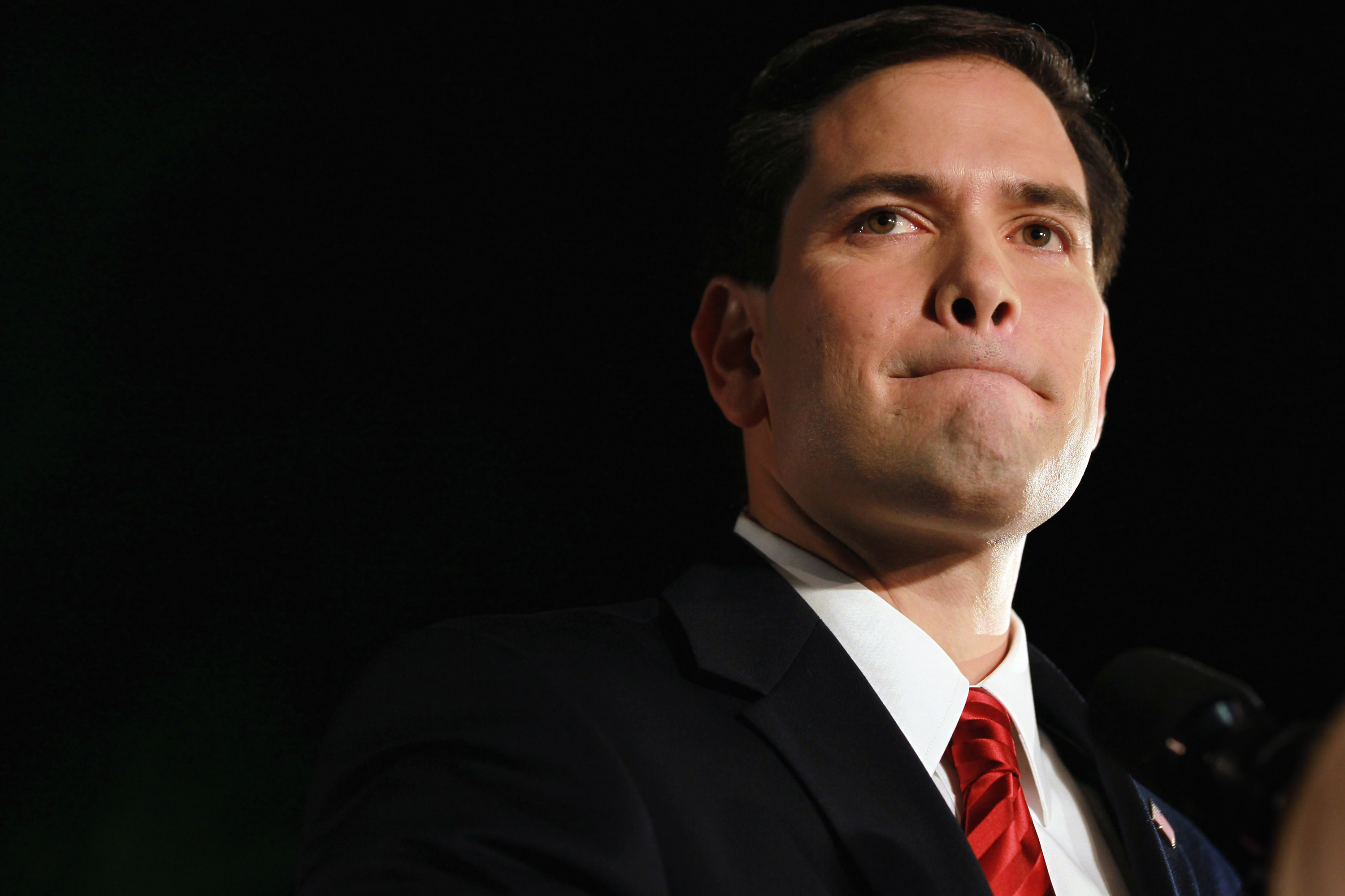
Senate Candidate Marco Rubio Attends Election Night Event

This excerpt of Lizza’s new piece (paywalled) on immigration reform is attracting a lot of attention:

“There are American workers who, for lack of a better term, can’t cut it,” a Rubio aide told me. “There shouldn’t be a presumption that every American worker is a star performer. There are people who just can’t get it, can’t do it, don’t want to do it. And so you can’t obviously discuss that publicly.”

Allahpundit sighs:

Remind me again: Passing the Gang of Eight bill is, theoretically, supposed to increase our chances of winning, right? Is “some of you can’t cut it” a message that sounds like a winner in, say, Ohio or Pennsylvania or any of the other 48 states where middle-class voters are already nervous about competition for jobs turning even fiercer in a high-unemployment economy?

Chait calls the Rubio aide quote “not only a piece of shocking candor, but also the biggest single blunder the pro-reform coalition has committed so far”:

Party elites may nod along when they read it, but there’s a reason nobody in politics ever says anything like this. The quote comes at a precarious moment for immigration reform. Conservatives have formed the most plausible basis for a counterattack against the bill — they are demanding draconian restrictions on the ability of legalized immigrants to obtain any kind of subsidized health insurance, for years to come. If they can successfully frame immigration reform as an expansion, or even a tacit recognition, of the hated Obamacare, they’ll unleash the right-wing fury that has thus far failed to materialize as expected.

Rubio’s defenders are claiming that the aide’s quote has been taken out of context. Lizza has released a partial transcript of the conversation so readers can judge for themselves.

(Photo: Joe Raedle/Getty)

Is Climate Change On Hiatus?

Brad Plumer warns against complacency when interpreting the latest data on global temperature:

We’re still on pace to blow past that 2°C climate target. Intricate arguments about climate sensitivity often bypass a crucial point. Humanity is on pace to do a lot more than simply double the amount of carbon in the atmosphere by the end of the century (compared with pre-industrial levels). Doubling means going up to 560 parts per million. We’re currently at about 400 ppm and rising fast.

Nate Cohn describes how the slowdown in global warming over the last 15 years is improving scientists’ ability to model climate change by forcing them to rethink how heat is stored in oceans, the effects of aerosols, and variations in the sun’s output:

What all of these discoveries hint at is that scientists, at long last, have developed a better understanding of year-to-year climate variations. In a way, you could think of it like the stock market. Watching Wall Street, we see the indices rise and fall, and we know the news that has influenced the swings. Watching annual temperatures, scientists could see the fluctuations but, until recently, knew little about the news–even though they were confident that increased carbon dioxide would ensure a bull market over the longer run. With an updated understanding of deep ocean temperatures and stratospheric aerosols, that has changed. [MIT Professor Susan] Solomon thinks “we’ve learned a lot about interdecadal variability” as a result of the hiatus.

He worries, however, about the political implications of this continuing learning process:

[T]he so-called scientific consensus on global warming doesn’t look like much like consensus when scientists are struggling to explain the intricacies of the earth’s climate system, or uttering the word “uncertainty” with striking regularity. … In the current political climate, debates about things like climate change are carried out in broad-brush assertions. The challenge for scientists is that the more they understand the climate system, the more complex it gets, and the harder it gets to model with precision—not to mention making the kinds of sweeping statements the news cycle requires.