Running Against The President

Walter Shapiro recommends that the Democrats’ presidential hopefuls take Obama to task:

If you wait until late 2015 to criticize part of the president’s record, your dissent will come across as craven rather than courageous. Think of Hillary Clinton’s awkwardly distancing of herself from the Iraq War in 2008, even though Democratic primary voters knew that she had voted for it in the Senate. Howard Dean rose from nowhere in mid-2003 because he was the only major Democrat running who had been unalterably opposed to the invasion of Iraq from the beginning. Sometimes in presidential politics, when matters more than whether and right from the start trumps being correct right now.

That’s why 2013 is a perfect time to express skepticism about portions of the Obama record. If you say something now with the right tone, it will be perceived as a sincere expression of deep conviction. The longer you wait, the more poll-tested and political your critiques of Obama will be regarded.

New Hope For Nuclear?

Michael Specter is coming around on nuclear power:

[L]ife is about choices, and we need to make one. We can let our ideals suffocate us or we can survive. Being opposed to nuclear power, as [Richard] Rhodes points out, means being in favor of burning fossil fuel. It’s that simple. Nuclear energy—now in its fourth generation—is at least as safe as any other form of power. Fukushima was a disaster, but was it worse than the fact that our atmosphere now contains more than four hundred parts per million of carbon dioxide, a figure that many climate scientists believe assures catastrophe? Sadly, we may soon find out.

Razib Khan points to polling data indicating that nuclear is more popular among liberals that you might expect. Meanwhile, David Roberts tries to change the debate:

Nuclear or coal is not the choice that faces us going forward, but were I convinced it was, I’d be a big nuke supporter. I am leery of them for several reasons that I’ll touch on below, but life is about risk, and the risks of coal and climate change are a hell of a lot worse than the risks of nuclear power. … But the reason I and most people I know are not nuke boosters is [economics]: Nuke plants are hellishly expensive to finance, build, insure, and decommission. It’s one of the most expensive ways to reduce carbon emissions and it’s not getting any cheaper. If anything, nuclear has exhibited a negative learning curve.

The response to this from supporters usually amounts to, “Yeah, but you can’t get all the way there on renewables.” This may or not be true. There are credible models of large-scale renewable penetration, but ultimately we won’t know until we try. If we reach a point where nuclear power is cheaper than the next increment of conservation, energy efficiency, demand shifting, renewables, cogeneration, and/or storage, then yay for nukes. But right now there are lots of cheaper options and more on the way. Renewables are plunging in price; nuclear prices are static or rising. You don’t need a weatherman to know which way the wind blows.

Will Latinos Give The GOP A Second Look?

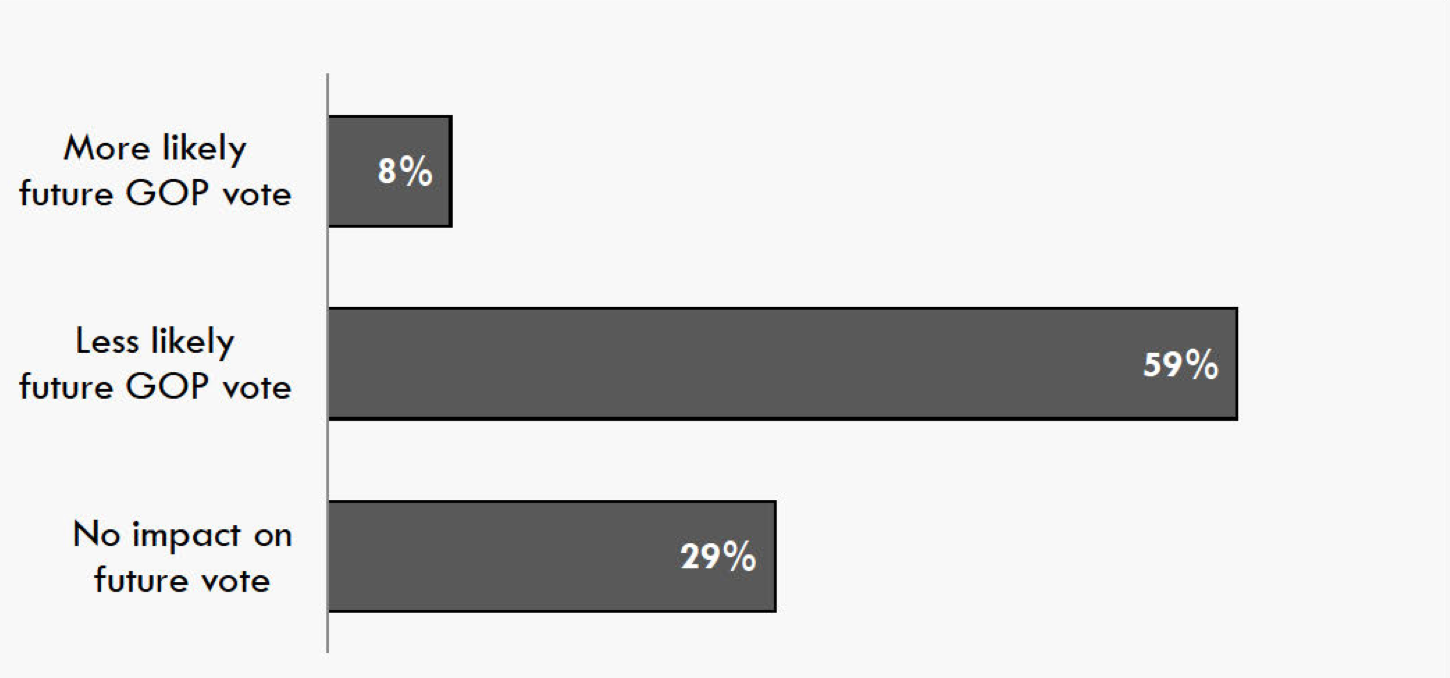
A recent poll (pdf) asked Latinos how they would respond if Republican senators opposed and blocked the immigration bill:

Latinos Immigration Reform

Yesterday Lindsay Graham claimed that, if the GOP doesn’t “pass immigration reform, if we don’t get it off the table in a reasonable, practical way, it doesn’t matter who you run in 2016”:

We’re in a demographic death spiral as a party, and the only way we can get back in good graces with the Hispanic community, in my view, is pass comprehensive immigration reform. If you don’t do that, it really doesn’t matter who will run, in my view.

It’s not just demographics. Dan Hopkins reviews “panel data, data which surveys the same individuals at multiple points in time”:

As it turns out, Latino McCain supporters were more likely to leave the GOP camp than any other demographic group analyzed here.

McCain supporters who were not Latino stuck with Romney 84 percent of the time, while the senator’s Latino backers only stayed with Romney 70 percent of the time. … [W]hat the panel does show is that changes in Latino voting are the product of changing minds as well as changing demographics. To some extent, to say that Latinos voters are lost to the GOP is to ignore recent electoral history.

Meanwhile, Ezra argues that, even if immigration reform is taken off the table, there is one big reason many Latinos will stick with Democrats:

Obamacare is really popular in the Hispanic community. Polling often shows support in the 2-to-1, and even 3-to-1, range. It could just be that Hispanics like President Obama and so they like his law. But it could be that 30 percent of nonelderly Hispanics are uninsured, as opposed to 11 percent of whites and 21 percent of African Americans. Hispanics stand to gain a lot from health reform, and so it’s important to them.

He notes that Republicans are currently “making a point of demanding that legalized immigrants can’t get Obamacare” and are “considering a crushingly punitive version of the individual mandate, in which undocumented immigrants need to purchase private health care on their own, without subsidies, or they can’t even become legal residents”:

The Hispanic community might find this year that Republicans aren’t as opposed to immigration reform as they thought. But they’re also going to find that Republicans are much more opposed to helping the large group of uninsured Hispanics than they ever imagined.

Obama Caves On Syria, Ctd

In a post noted yesterday, Marc Lynch predicts that the president’s decision “will have only a marginal impact on the Syrian war — the real risks lie in what steps might follow when it fails”:

The Syrian opposition’s spokesmen and advocates barely paused to say thank you before immediately beginning to push for more and heavier weapons, no-fly zones, air campaigns, and so on.  The arming of the rebels may buy a few months, but when it fails to produce either victory or a breakthrough at the negotiating table the pressure to do more will build. Capitulating to the pressure this time will make it that much harder to resist in a few months when the push builds to escalate.

In response to Lynch, Larison observes that neither hawks nor doves endorse the president’s decision:

It is telling that virtually no one thinks it is worth doing by itself. Most Syria hawks have been demanding this measure only as the first step towards greater U.S. involvement, and everyone else in the debate has been rejecting it as useless or harmful, but there is no one that believes that this is what U.S. Syria policy ought to be. That is why the decision is so disturbing and foolish. The U.S. almost never scales back a foreign commitment and sooner or later opts for increased direct involvement. The administration has put itself in an untenable position of promoting a policy that no one can defend in good faith while ceding the initiative to the hawks that want a much bigger commitment. Syria hawks recognize the capitulation for what it is, and have wasted no time in clamoring for much more.

Rania Abouzeid points out that other countries’ attempts to organize the rebels by supplying arms have failed:

For the past year or so, Saudi Arabia and Qatar have sponsored a structured effort, with U.S. and Turkish backing, to funnel weapons—mainly light armaments like rifles, rocket-propelled grenades, and ammunition—to select rebel groups. The conduits have been the rebel F.S.A.’s various hierarchical structures, including military councils in each of Syria’s fourteen provinces. These were supposed to be the main tap for weapons, and an instrument of control over the men on the ground; they never were. The Saudis and the Qataris had conflicting ideas about which groups should be armed, and sent weapons in different directions. The operation was plagued, too, by claims of favoritism in the distribution process. Instead of being a model, the experience may provide a cautionary tale of what might go wrong with a U.S. effort to arm the rebels.

John Dickerson looks back:

The president has already confronted this complexity in Libya, where he tried to justify intervention to a war-weary nation on the basis of norms. In that instance, the president said that the international community had the responsibility to intervene when a state fails to protect its population from mass atrocities. The president described protecting the innocent in Libya as an American value. And allowing Qaddafi to massacre his people would have “stained the conscience of the world.”

But he added a second variable to the equation—the United States was taking action in Libya because it had the unique military capability to do so. In Syria, it doesn’t look like the president is going to add that second element; his advisers say he has ruled out boots on the ground or a no-fly zone (although that may be slipping, too).

How The People See The Parties

Party Perception

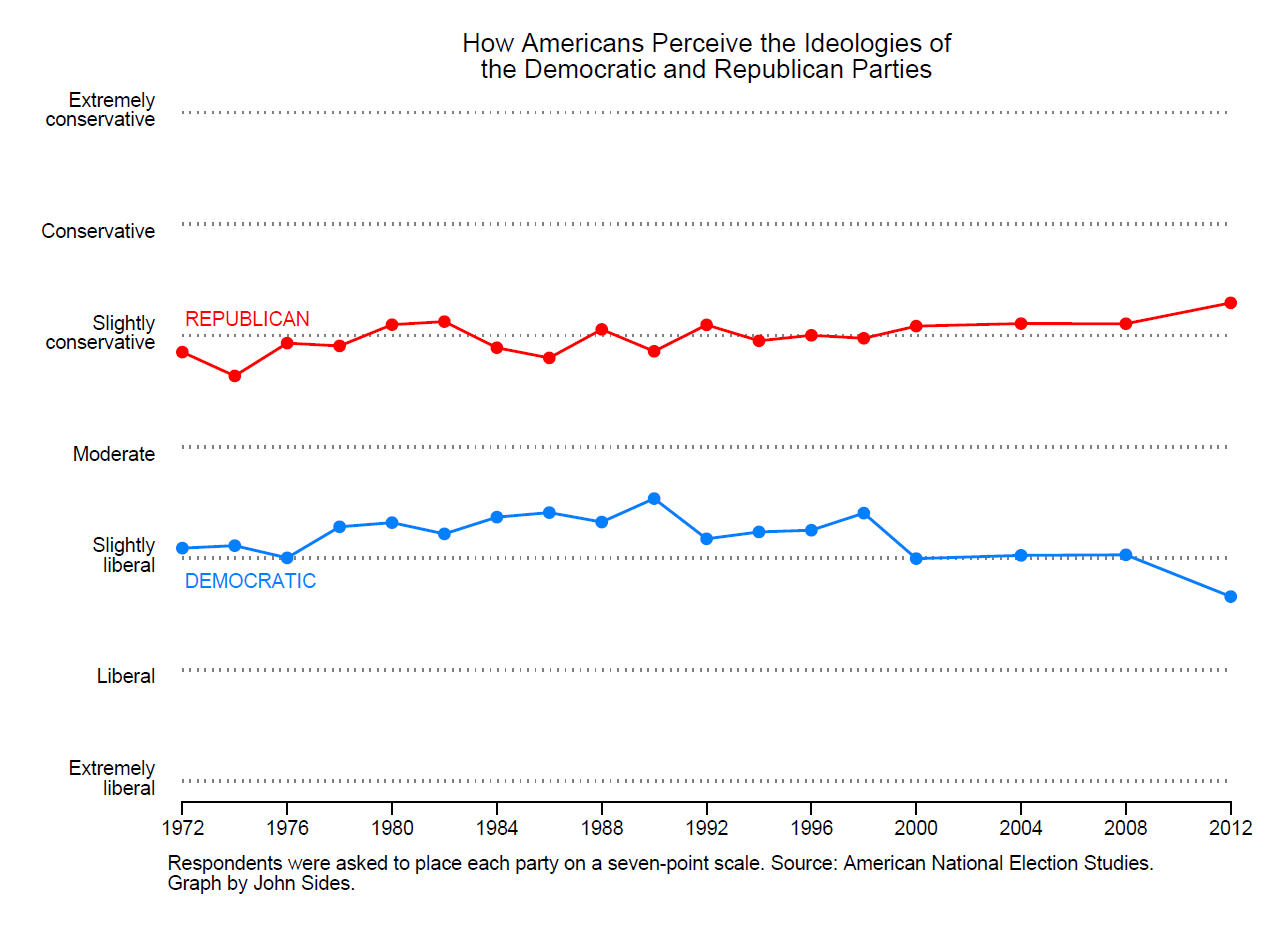
John Sides highlights how little it has changed over time:

Two features of this graph deserve emphasis, I think. One is how poorly the trends conform to prevailing narratives about how the parties have changed. In particular, there is precious little evidence that Americans perceived the Democratic Party’s “re-boot” in the late 1980s and 1990s—when many observers believe that the party moved to the center under the influence of the Democratic Leadership Council and Bill Clinton. This is one reason why I’m skeptical that ideological “re-branding” is all that consequential.

That skepticism is even more justified by the second, and overriding, feature of the graph: just how little change in perceptions there has been over time. The GOP is perceived to be only slightly more conservative than it was forty years ago. As of 2008, the Democratic Party was perceived to be as liberal as it was when it nominated George McGovern. As of 2012, it was perceived to be only a bit more liberal than in 1972. We can have an argument about whether the Democratic Party has shifted left or right. The point is that the public doesn’t see much of any shift.


Do Millennials Give A Damn About PRISM? Ctd

A reader writes:

Please no more of the “it’s modernity, get used to it” argument. That kind of argument from apathetic helplessness is lazy and illuminates nothing. Talk about the trade-offs between security and privacy; talk about the pros and cons of using our identity as a product of commerce. But your inability to conceive of a modern Internet that also protects privacy is simply not a justification for programs like PRISM. Just because you can’t imagine it, doesn’t mean it’s not possible. The technology is there to encrypt and protect private communications and to enforce chain of custody and access to data. It’s only a matter of deciding that this is something we value as a citizenry, and then vote with our wallets and at the ballet box, and it will happen.

Maybe people aren’t willing to pay for online services, and would rather commodify their personal information in exchange.  But this is a value judgment and it is incorrect to argue that this is an inherent property of networked society. It’s not a fact of modernity; it’s just the way we’ve allowed corporations and our government to develop the Internet.

The second thing I find problematic is when people invoke the opt-out argument in reference to the Internet as a whole.

When dealing with private institutions, an individual can opt in or opt out on a service-by-service basis, which makes the ability to opt out easier. If you don’t agree with a particular terms of service, you don’t have to use that service. I know plenty of people who are not on Facebook and choose not to share their personal information with that company. But when you think about it, Facebook is really not an essential service and most of us can do without it. This government surveillance program, on the other hand, is an entirely different bargain: there are no terms of service, and if you want to opt out, you’d need to opt out of the whole Internet.

I work with street-engaged youth, and the Internet is one of the basic tools used to help them problem solve things like employment and housing. Lack of access to the Internet is a real barrier, and I think that people who easily dismiss the Internet as a non-essential service do so from a point of stability in their lives where they don’t really need to locate new resources or make new connections to people. You can do it for a time, but eventually you will run into a situation where you will need to interact with the modern world and then you will be stuck. Point is: it’s very difficult to opt out of the Internet entirely, and it’s not fair to say, “well then don’t use the Internet!”

Another:

I’m a 26-year-old who’s been reading your blog daily since your coverage of the Green Revolution in Iran, and who’s been a tech nerd for much longer. I couldn’t possibly disagree more with the comments you posted from other millennials. The idea that we should accept and understand the Internet as a free, open tool that also allows both private entities and governments to collect and monitor all of our data is absurd and contradictory on its face. The Internet really can’t be considered “open” or “free” without complete transparency from governments and private corporations about exactly how/when/why they’re using our data, and without our explicit permission to do so.

Which is exactly why Edward Snowden’s revelations are so profoundly troubling to me (and every other millennial I’ve talked to about this): back when we first started using the internet, we could expect almost complete privacy. Websites that wanted to keep your data would have to ask you about it. You could send emails, place purchases, read blogs, search Google, etc. without the fear of having those actions tracked – either by the sites you used or your own government. But now we no longer have a real choice to opt out of this kind of tracking and monitoring, and both the government and the companies that collect and use our data are unapologetic about doing so.

I mean, I find myself at the same place as your first millennial commenter – if you’re uncomfortable with data collection, you can choose to not use the Internet – but I come to the polar opposite conclusion about that place. The Internet is now so ingrained in my generational cohort’s lives that not using it is not a realistic option. So we must use the knowledge that our every digital move is subject to surveillance (knowledge that we now have thanks to Snowden) to have an actual debate about how far we’re willing to go to protect ourselves from a threat that, even at its worst, pales in comparison to the lethality of more pressing concerns (gun violence, obesity/disease, traffic accidents).

Snowden’s revelations have, in my mind, breathed new life into FDR’s warning that “the only thing we have to fear is fear itself.” This is something this county has been struggling with ever since 9/11: to what extent do we let our fear of the unknown incrementally drive us somewhere horrifying? To the point where we decide it’s fine for the government to collect data on all of our phone calls if we’re assured it’s being used to save us from the all-powerful terrorists? To the point where we let the NSA read all of our emails? Let them listen in on all of our phone calls (because our phone companies allow them to listen in when their own call monitoring programs pick up on patterns of speech that they find threatening)? Let them control who we can and can’t talk to or associate with (people who talk to politically troubling people have a chance of being problematic themselves, of course)? Let them decide which party we support (our Amazon wishlists and Facebook likes should predict that accurately, so why even bother to vote)?

Yes, that’s hyperbolic, but it seems to me that we’re still shamefully quaking in our boots about the threat of terrorism, based on fear and fear itself. We are better than that, and it is fundamentally wrong for us not to be outraged about blatant invasions of our privacy (legal or otherwise).

Rock And Roll’s 1%

Top Artists Sales

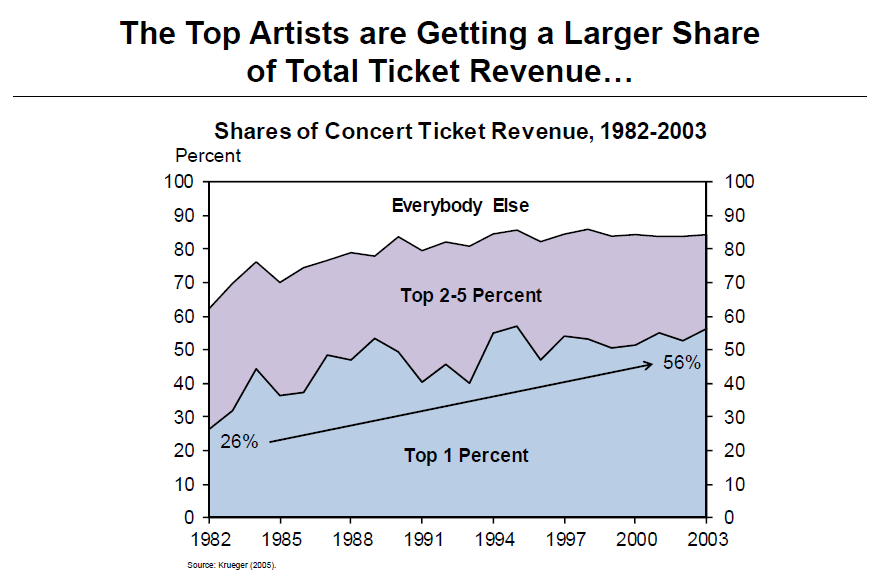
Neil Irwin recaps an “exceedingly rare” speech on music by White House chief economist Alan Krueger:

“The music industry is a microcosm of what is happening in the U.S. economy at large,” Krueger, chairman of the White House Council of Economic Advisers, says. “We are increasingly becoming a ‘winner-take-all economy,’ a phenomenon that the music industry has long experienced. Over recent decades, technological change, globalization and an erosion of the institutions and practices that support shared prosperity in the U.S. have put the middle class under increasing stress. The lucky and the talented – and it is often hard to tell the difference – have been doing better and better, while the vast majority has struggled to keep up.” …

A century ago, a musical performer could only reach as many people as his or her vocal range and travel schedule would allow. Now, high-quality recordings can be distributed to billions with the flip of a switch. The result: Everybody has access to the very best music, or at least the music that most precisely suits their tastes.

Which would be great if the music industry were a meritocracy. Unfortunately, it isn’t:

Luck plays a shockingly important role in which songs and artists become mega-successes, Krueger shows. He points to research by sociologists Matt Salganik and Duncan Watts. Participants in their study were able to log in to listen to songs and download those that they liked. The researchers played a little trick on them: Some of the participants saw an actual ranking of which songs had been downloaded the most previously. Others saw a random ranking. It turns out that just the appearance that something was popular drove more people to download the song. Rather than a pure meritocracy where the best songs rise to the top, music seems to have strange effects in which popularity breeds greater popularity.

How Much Do Helmets Help?

Probably less than you think:

People who are forced by legislation to wear a bicycle helmet … may not wear the helmet correctly, seeking only to comply with the law and avoid a fine. Secondly, their behaviour may change as a consequence of wearing a helmet through “risk compensation,” a phenomenon [where increasing safety measures will lead people to engage in more risky behaviors]. One study — albeit with a single author and subject—suggests that drivers give larger clearance to cyclists without a helmet.

Vaughan Bell notes how, in general, safety measures may be offset by the behavioral changes they inspire:

Known as self-licensing [this effect] is where people will allow themselves to indulge in more harmful behaviour after doing something ‘good’. For example, people who take health supplements are more likely to engage in unhealthy behaviours as a result.

Stations Of The Kryptonian

In a review of the latest Superman retread, Dana Stevens compares superhero blockbusters to medieval religious art:

Both rely on rigidly fixed iconographies drawn from a narrow range of canonical subject matter. The individual creator may vary the style, but the terms of the representation are governed by a larger divine or quasi-divine cosmic order: hence the endless variations on the Annunciation, the descent from the cross, the first appearance of the cape and tights, the final fistfight atop a skyscraper. Zack Snyder’s Man of Steel doesn’t aim to turn that cosmic order inside out; this is the work of a man of faith, a director whose whole career has been predicated on his love for the comic and graphic-novel form. But Snyder (300, Watchmen, Sucker Punch) provides an elegantly illuminated retelling of the origin story of that most saintly of superheroes, Superman.

Elsewhere, from a more humanist perspective, a team of psychiatrists concludes after examining Superman’s childhood that he is “more human than superhuman”:

According to Abraham Maslow’s hierarchy of needs, a person must first meet basic needs, like food and shelter, before focusing on such higher-level needs as relationships and career development. So, Superman’s near-limitless powers may actually free him up to focus on being super. An even higher-level need is self-actualization, or reaching one’s full potential. Superman’s self-proclaimed never-ending battle for Truth, Justice, and the ever-changing “American Way” seems to sum up his pursuit of self-actualization. The rub: the pursuit is never-ending. There are always more of Lex Luthor’s plots to foil, more invasions from Apokolips to stave off.

This experience isn’t unique to Superman; we are all works in progress. Whether Superman, at least, illustrates that despite the numerous challenges along the way, a path towards realizing one’s full potential exists. Indeed, as a character Superman transcends his own self-actualization by inspiring us – his fans – to achieve our own self-actualization and be the best people we can be.