This pug is not impressed:
Going To The Source
John Villasenor worries that the details of the NSA’s surveillance programs will open US companies to increased corporate espionage:
In addition to spurring discussion on the tension between civil liberties and antiterrorism policies, the NSA leaks will have another, less widely recognized consequence: They will significantly increase the level of state-sponsored economic espionage directed against American companies. Why? Because many people overseas will view the NSA’s data collection itself as the defining attribute of the story, with less consideration of the larger American security context that frames it. Some of them will conclude that leveling the playing field requires ramping up their own countries’ efforts to eavesdrop on data from American companies.
Benjamin Wittes agrees, pointing to the US’ double standard on matters like these:
[T]he U.S. position on cybersecurity is not exactly a model of consistency—amounting in effect to shock that anyone would conduct cyber attacks on us. Our position on espionage is similar: We engage in it unapologetically for our strategic purposes but we object strenuously to other countries—whose strategic purposes may be more economic than ours—conducting espionage against our companies.
Obama’s Betrayal On Syria: Reax II
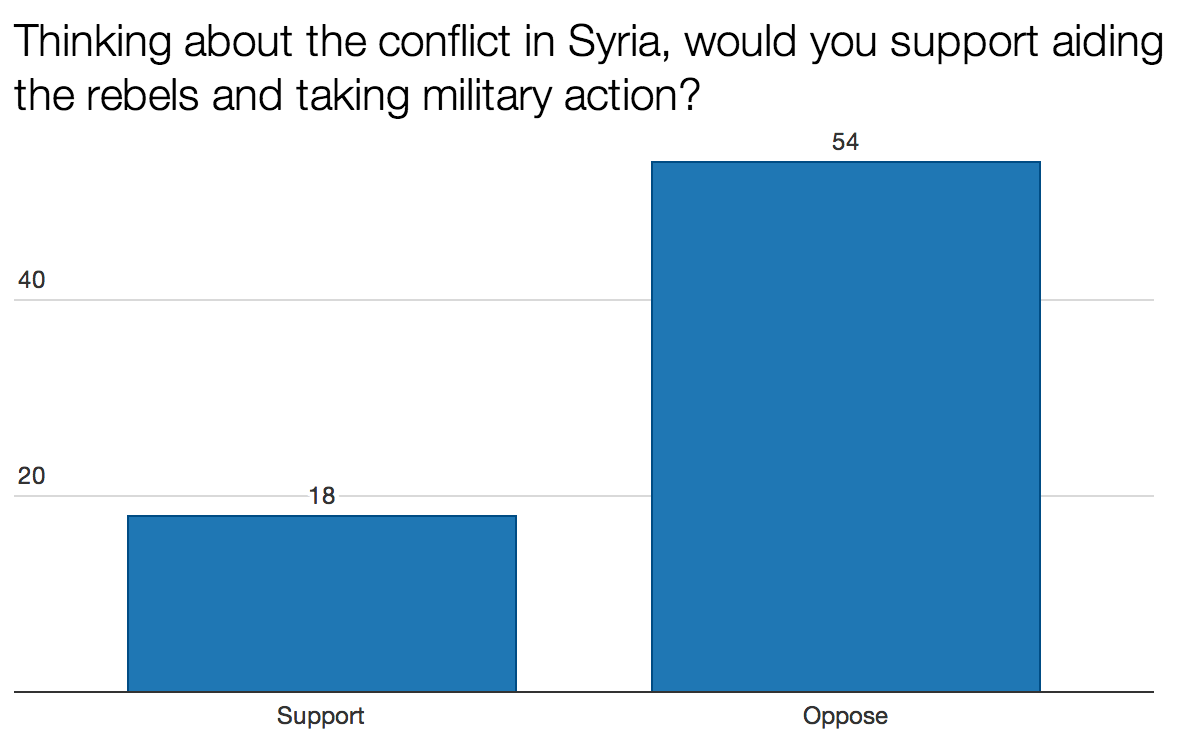
YouGov finds that Americans oppose intervention in Syria:
Jeffrey Goldberg thinks that Clinton’s remarks forced Obama’s hand:
From the president’s perspective, in fact, it would be best not to get involved at all. But the pressure on him this week became too much to bear. Former President Bill Clinton essentially called Obama a dithering coward because of his unwillingness to enter the Syrian conflict, and the intelligence community found evidence that Assad’s regime has definitively crossed the chemical weapons “red line” the president had spoken of — surely to his everlasting regret — last year.
Obama sees no clean way out, and no clear rationale for deepening U.S. involvement. He also sees a rebel coalition that is both dysfunctional and radicalized, and he knows that there is an outcome to this war that is worse than the continuation of Assad’s rule: the dissolution of the Syrian state and its replacement, in some locations, with al-Qaeda havens. Even an all-in move by Obama to make the rebels’ cause his own probably wouldn’t prevent the country’s collapse (it has, in fact, already collapsed as a unitary state). And he knows that if terrorist groups establish footholds in Syria — geographically close to our crucial allies, Jordan and Israel — he will have to act against them.
Matt Steinglass hopes that Clinton’s comments didn’t play a role:
I dearly hope that the policy documents the State Department is now drawing up regarding American military aid to Syrian rebel groups do not read “Goal: Keep POTUS from looking like a wuss.”
Larison rejects arguments, like Drezner’s, that Obama’s actions qualify as Realpolitik:
As long as the war goes on, the demands for “decisive” action will increase every week, and the administration has just decided to do something that is intended to prolong the war. Meanwhile, containing and limiting the effects of the war on Syria’s neighbors, which is what ought to matter far more to the U.S., will become more difficult as the U.S. directly contributes to regional instability. I suppose one could call this Realpolitik, except that it ignores U.S. interests, the stability and security of allies and clients, and commits us to the losing side in a civil war where we have nothing at stake. I wouldn’t expect this realist policy to please many realists.
Justin Logan agrees that intervention in Syria isn’t realist foreign policy in action:
I don’t think it’s right to read realists as advising Washington to fuel the Syrian civil war in the hopes of bleeding Hezbollah and Iran white. It’s this sort of operationally realist but strategically grandiose foreign policy that has given realism a bad name. Sometimes, in the name of conservatism and defraying the costs of war, realists advise deeply cynical policies that force those costs onto others. But in a similar spirit of conservatism, and indeed ethics, they tend to define the national interest in such a way that a profoundly secure country like the United States doesn’t have to do terrible things across the globe all the time.
Max Fisher doubts that giving the rebels small arms will accomplish much:
Rebel leaders say that small arms will do them little good and that they need heavier weapons. Whether or not greater U.S. involvement is a good idea, two things appear to be true: that the rebels are losing ground against Assad’s forces, backed by Iran and Hezbollah, and that small arms would not turn the tide.
Michael Weiss and Elizabeth O’Bagy are already calling for a no-fly zone:
Any swift and decisive decision to materially aid the Free Syrian Army will necessarily include degrading or destroying the runways and infrastructure of Syria’s military airbases and commercial airports. The fact is, Assad’s warplanes and helicopters aren’t just bombing rebel strongholds, civilian homes and bakeries, they’re also being used for domestic and international resupply efforts. Whenever the regime wants to bolster its conventional military presence in restive areas in the north or northwest of Syria, it dispatches reinforcements of crack troops via air transport. (Ground transport is still dangerous for Damascus given the supply routes now controlled by the rebels).
James Traub claims that Obama won’t commit American troops to Syria:
Obama has now crossed a line that he had hoped not to cross. Those who wish he had not done even that much will say that a slippery slope leads to U.S. boots on Syrian soil. That’s not a serious argument; this is a president who is focused on reducing American troop deployments, not finding new pretexts for combat. The real question is how much the United States and other outside actors can do to stop the killings, to force Assad to reconsider, to stabilize a region now facing the threat of sectarian war. You can’t help feeling that Obama is trying to simultaneously satisfy incompatible moral and strategic calculations. There’s a very real danger that he will fail on both counts.
And Josh Marshall comes out against intervention:
The only thing which gives me some pause are the advantages the US and US allies would gain by severing the Syrian-Iranian alliance. That’s a big thing. But to put it in really surgical terms, I think we’ve learned, at great pain and loss, that the US doing surgery on the Middle East creates scar tissue and complications way out of proportion to the hoped for gains.
Hysteria Repeats Itself
The debate over Obamacare is giving Aaron Carroll déjà vu:
Let’s all take a deep breath and appreciate what’s going on. Health care is expensive, and changing the health care system is scary. But when Medicaid was passed, tons of people panicked. They claimed that it would bankrupt the states. They claimed that the feds would renege on their promises. They claimed that it was a backdoor to socialism. They claimed that doctors would be paid much less. They claimed that doctors would leave the program in droves. They claimed that no one liked the law. They predicted doom. It didn’t happen.
It’s easy to scream that the sky is falling. Remember when Ronald Reagan told us that Medicare was the death of freedom?
At some point, though, you have to look around and realize that things just ain’t that bad. We’ve heard these arguments before. They didn’t come to pass. States have all embraced Medicaid. The feds never broke the bargain. Docs made a fortune in the 80’s. There are more medical school applicants than ever before. At some point, we have to stop giving these arguments so much weight. Obamacare will not be perfect. Neither will the Medicaid expansion. We’ll need to fix them. But neither will bring about the end of the republic, just as no health care reform in any other country resulted in the end of democracy itself.
Ask Fareed Zakaria Anything: Grading Obama’s Foreign Policy
It’s worth noting that we recorded this answer before Obama’s new stance on Syria, and we already know how opposed Fareed is to intervention there. Nonetheless, in today’s video, Zakaria evaluates Obama’s record on foreign policy record thus far:
Fareed Zakaria GPS airs Sundays on CNN, as well as via podcast. Zakaria is also an Editor-at-Large of TIME Magazine, a Washington Post columnist, and the author of The Post-American World, The Future of Freedom, and From Wealth to Power: The Unusual Origins of America’s World Role. Our Ask Anything archive is here.
Will We Ever Be “Majority-Minority”?
Despite the fact that the Census predicts that the white majority in the US will be gone by 2043, Jamelle Bouie expresses skepticism that we’ll ever really be “a country where most Americans have nonwhite heritage”:
The fastest growing group of Americans—by far—fall under the “multiracial category.” If past research is any indication, these Americans are likely the product of intermarriage betweens whites and Hispanics (the most common interracial pairing) or whites and Asians (the next most common one). While we identify them as nonwhite, we don’t know how they’ll identify themselves in the future. My hunch is that—as (certain groups of) Latinos and Asians integrate themselves into American life—a good number will identify themselves as white, with Hispanic or Asian heritage, in the same way that many white Americans point to their Irish or Italian backgrounds. …
While there’s no doubt the United States will become a place where people of Asian and Hispanic heritage are common, that’s not the same as saying it will become a “majority-minority” country. Given our history, and continued assimilation, intermarriage, and upward mobility among Latino and Asian Americans as a whole, there’s a good chance the United States will remain a “white” country, where “white” includes people of Hispanic and Asian heritage.
However, Josh Marshall argues that, with the white vote getting smaller, inciting racial panic has become less and less politically effective:
Let’s just talk about the 1990s or really any other time up to the last few years. It’s not that any of this stuff is new. It’s that until pretty recently we had this stuff and on balance it was successful. That’s the key. And now, though it’s a very close run thing, it tends not to be successful. And by successful I mean in a purely electoral sense. Does it get you more votes than it loses you. And at a certain level that’s all that matters.
Republicans invested heavily in voter suppression for the 2012 cycle. And while it is very important to note that a big reason why it didn’t ‘work’ was that courts struck down a lot of the most egregious laws (and huge kudos to the myriad civil rights and voting rights lawyers who made that possible), it also didn’t work because the attempt itself massively energized the growing non-white electorate. So every time a little Mexican-American kid dares to sing the national anthem at a basketball game wearing a mariachi suit and freaks start telling him on Twitter to go back to Mexico, it’s gross and it’s a bummer, but you also realize that it’s probably marginalizing the white racist freakshow vote more than it’s empowering it.
Can We Improve Payday Lending?
First, a primer on the subject:
Despite the fact that they are “pretty inefficiently provided today“, Felix doesn’t expect the terms of payday loans to get any more favorable for borrowers:
[I]f I have a job, and bad credit, and short-term cashflow issues, and a bank account, and my paycheck gets directly deposited into that account, then my bank knows with a high degree of certainty exactly when I’ll be able to repay what [Raj Date, former deputy director of the Consumer Financial Protection Bureau], calls a “deposit advance”. Indeed, it can take the money it’s owed directly out of my paycheck before I get any access to it at all. This product is as low-risk as an unsecured loan to a person with bad credit can ever be. Since it’s low risk, banks ought in theory to be able to make such loans at relatively low interest rates. And because everybody loves being able to borrow at a low interest rate, a “competitive dynamic” could then drive rates down.
But that’s not the world we live in.
In this world, banks have no interest in banking the kind of people who need payday loans — unless they can extract a large amount of fee income from them. Indeed, Chase launched its Liquid prepaid debit card in large part because it no longer wanted to offer checking accounts to these customers at all, and wanted some other product to move them into. The last thing that banks want to do is to create a new product which will in any way incentivize low-income customers to open new checking accounts, which are likely to always hover around the zero balance level.
Yglesias thinks Wal-Mart should step up:
The solution to this problem, I think, would be for banking services to be performed by a firm that already has low-income clients and would have an interest in increasing its level of engagement with them even if the payday lending operation wasn’t profitable per se. In a word, you need Wal-Mart. … [I]f low-end retail chains were allowed to get bank charters, you could imagine one or more of them wanting to offer discount payday lending services for similar reasons—it’s a great way to get customers in the door at a time when you know they have money to spend.
What Do We Hope To Accomplish In Syria?
Prior to yesterday’s announcement, Marc Lynch asked, “What does it mean for U.S. policy to ‘work’ in Syria?” One strategy he outlined:
If Washington endorses the goal of bleeding Iran and its allies through proxy warfare, a whole range of more interventionist policies logically follow. The model here would presumably be the jihad against the Soviet occupation of Afghanistan — a long-term insurgency coordinated through neighboring countries, fueled by Gulf money, and popularized by Islamist and sectarian propaganda.
“Success” in this strategy would be defined by the damage inflicted on Iran and its allies — and not by reducing the civilian body count, producing a more stable and peaceful Syria, or marginalizing the more extreme jihadists. Ending the war would not be a particular priority, unless it involved Assad’s total military defeat. The increased violence, refugee flows, and regionalization of conflict would likely increase the pressure on neighboring states such as Turkey, Jordan, Lebanon, Israel, and Iraq. It would also likely increase sectarianism, as harping on Sunni-Shiite divisions is a key part of the Arab Gulf’s political effort to mobilize support for the Syrian opposition (and to intimidate local Shiite populations, naturally). And the war zone would continue to be fertile ground for al Qaeda’s jihad, no matter how many arms were sent to its “moderate” rivals in the opposition.
Questions For The Day

A reader writes:
Great idea on being able to give a Dish subscription for Father’s Day. Two quick questions: (1) the gift doesn’t automatically renew, right? To be sure, I have no doubt that your blog would be worthwhile in the years to come, but I’m loath to sign up for too many auto-renew things, and (2): does the recipient get an email right away noting the gift? If so I might hold off until Sunday morning.
The gift subscription does not auto-renew. And the recipient receives the gift email immediately upon purchase (though in the future we hope to give readers the ability to time its arrival). So if you want dad to get his present on Sunday, click here on Sunday morning or Saturday night. It will be up to him if wants to renew in a year’s time.
Quote For The Day
It’s from Juan Cole:
Clinton compared what the US could do in Syria to Ronald Reagan’s effort against the Soviets in Afghanistan in the 1980s. But that covert operation of giving billions of dollars and high-tech weaponry to Afghan jihadis was a huge catastrophe, contributing to the creation and rise of al-Qaeda and setting the background for the emergence of the Taliban. It surely would have been far preferable to let the Soviets try to build a socialist state in Afghanistan, as they tried in Uzbekistan. The whole thing would have fallen apart in 1991 anyway. (There is no truth to the notion that the Afghanistan war bled the Soviet Union or contributed to its collapse. Soviet military spending was flat in the 1980s). The Reagan jihad destabilized both Afghanistan and Pakistan and left us with a long term terrorism problem. We let the Soviets alone in Kazakhstan, and we never worry about today’s Kazakhstan.
You never, ever want to encourage the rise of private militias and flood a country with high-powered weaponry.
Unless you’re John McCain. What Bill Clinton did in backing McCain – and his wife’s neocon instincts – was a real case of the establishment fighting back. But that establishment – including both Clintons and McCain – backed the Iraq catastrophe. Funny they talk about Bosnia and Afghanistan in the 1980s but never mention that, isn’t it?

