I get it. I do. All I have to do is see our friends’ kids—plural—playing together, caring for each other, sharing a secret language. All I have to do is watch Dahlia’s joy and tenderness when she gets to hold their baby brothers and sisters. Justin sees it too, and he knows what she’s missing. But he reminds me often how the sacrifices we’d need to make to raise another child would impact Dahlia’s happiness—not to mention our own.
In an interview with NPR, Sandler addresses common concerns about having only one child:
“I think that there’s the concern that only children are lonely children. And I think that when parents consider having a second child as a gift to their first, that is probably the thing that they are most often concerned about, which I understand. I think that we have a very visceral response to seeing a child alone in a sandbox.
“But it was interesting, speaking to psychologists about the experience of loneliness for only children, a lot of them believe that we have the strongest primary relationship with ourselves, which is incredible armor against loneliness; that for a lot of only children, being alone is the experience of solitude, which is a very rich thing, instead of loneliness, which is a very painful thing.
In an interview with Salon, Sandler admits that she’s “still shocked at how this topic rankles people”
I mean, I wrote a book about Evangelicals from a feminist atheist perspective and did a ton of Christian radio — and the blowback I got was nothing compared to when my Time cover story came out saying, quite simply, that only children are OK. It’s like I’m suggesting that people should have aborted their own children — or that their parents should have aborted their siblings. It’s fascinating to me how emotional, how fraught the topic is. At a conference I spoke at recently, a professor hugged me and told me how “brave” I was to take this on — when the conference had been focused on family planning and poverty … and this is what’s brave? That’s nuts. Listen, I‘m not telling anyone how many kids they should have — lord knows, we have enough people telling women what to do with their bodies — just saying that if this is a choice you want to make, or that your body is making for you, then you should know that only children aren’t fundamentally rotten, or no more rotten than anyone else.
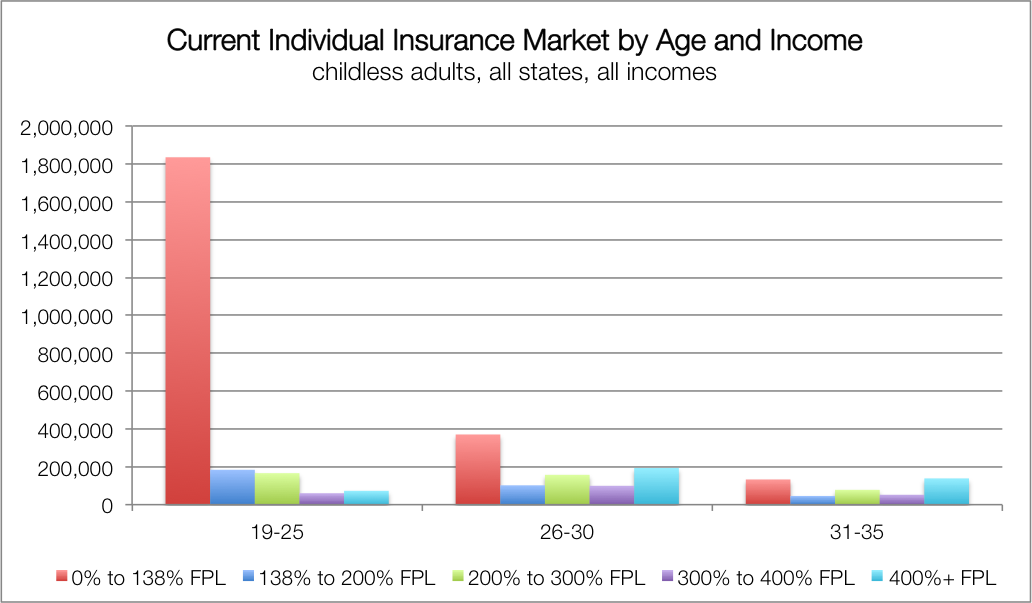
Aaron Carroll focuses in on the above chart from Adrianna McIntyre and Josh Fangmeier to bolster his claim that the ACA’s rate shocks (or “the plight of the bros”, as he calls it) are “a distraction”:
Weep for the bros, if you like, those “lucky duckies” who earn too much to qualify for subsidies. Me? I can’t believe how many of those who are 19-25 live in poverty. All of those red column young adults on the left side earn less than 138% of the poverty line. All of them would qualify for the Medicaid expansion. Yet many of them, possibly most of them, won’t get it because of all the states who are refusing the expansion.
I think they are who health care reform was about. I think it’s pretty horrific that next year a large chunk of them will continue to be uninsured. But I guess the tragedy du jour will remain the “rate shock” for the bros.
Previous Dish on the distributional effect of Obamacare here and here.
Cass Sunstein sees Uber – the app that connects people to luxury car service – as an existential threat to “taxi dinosaurs,” if it can get past the various regulatory hurdles that keep popping up:
[T]here is an important place for rules designed to promote safety and to prevent fraud or deception. But regulation of the taxi industry goes far beyond those goals. That regulation is a dinosaur; it should become extinct. Uber’s innovative approach raises a still more fundamental question. In countless domains, people have to spend a great deal of time and effort on searching and matching. For auto repairs, home repairs, household help, tutors and even child care, it can be difficult to find a convenient and reliable service. Wouldn’t it be a great improvement, indeed an amazing boon to people (and the economy as a whole), if a wide range of services, available on simple apps, emerged to decrease the costs of search?
Because of the happy combination of new technologies and private entrepreneurship, that possibility is getting more realistic every day. We shouldn’t allow pointless regulatory barriers, and self-interested private groups, to delay its time of arrival.
Commenting on the recent wildfires in Colorado tied to climate change, Tom Kenworthy looks ominously toward the summer:
The past decade has seen a sharp increase in the number of acres burned by wildfires. In 2012, 2007 and 2008 more than 9 million acres were burned, and the half dozen worst fire years since 1960 have taken place since 2000. A recent Department of Agriculture report predicts that the acreage burned by wildfires will double by 2050 to about 20 million acres annually.
The report’s findings are in line with previous studies on climate change’s relation to fire risk: a 2012 study found that wildfire burn season is two and a half months longer than it was 40 years ago, and that for every one degree Celsius temperature increase the earth experiences, the area burned in the western U.S. could quadruple.
(Photo: The Montana sun through forest fire smoke by Flickr user Julia Manzerova)
I’d like to respond to the reader who wrote in with this criticism of the Bechdel Test. It’s not designed to be a screenwriting guide, or to suggest that all movies that don’t pass the test are unfairly sexist. It’s designed to show how disquieting the proportion of films that don’t pass it is. If the number of films in that video that pass the test were closer to 50%, it wouldn’t be making much of a point. It’s not meant to encourage screenwriters to add arbitrary scenes into movies to pass the test; it’s to encourage screenwriters to write more films about women in the first place, precisely what your reader claims to want.
Another:
I agree with the commenter that the Bechdel Test is problematic. Consider this scenario:
Two neurosurgeons who are also female are collaborating on a complicated case. The patient is male. The conversation they have about the treatment particulars technically fails the Bechdel Test.
Despite this issue, I still think the test can identify problems in writing female characters. The real problem it shines a light on, however, is that we don’t have enough protagonists who are female and the few we do have operate in a very narrow field of character types. An even more valuable tool to me as a writer is to flip the gender or ethnicity of my characters and see what’s left of their conflict in the story. If not much is left, then that can be a problem depending on the point of the story. Inevitably, flipping a character’s gender or ethnicity can show us how the default is to have characters who are white, male and straight.
Casting Helen Mirren as The Doctor would shake the franchise up in a good way, just as casting Judy Dench as M in the 007 movies did. I’m disappointed in how the casting was handled for Dench’s replacement. Sure, go back to M being male, but then make the new Q female. (However, note that they did cast Moneypenny as a black female.)
For a great example on how shaking up traditional expectations on gender, ethnicity and sexual orientation can create a great cast of characters, see Syfy’s Warehouse 13. It’s ensemble cast includes quite a range of characters from a young female computer hacker (and Runaways fan) to a Russian Jew to a gay Buddhist ATF officer to an older Black female in charge of everyone. Oh, and in this show H.G. Wells was female writing under a male pseudonym.
Another:
It can also be enlightening to look at the “reverse Bechdel test,” in which you look at the number of times men talk with each other about something other than a woman. A friend of mine has been tracking this in some movies and TV episodes – here.
Of course, that doesn’t quite address what your screenwriter correspondent was saying; he (I’m guessing he’s male) was claiming that secondary characters in movies always talk about the protagonist, and that the protagonist is too-often male. The reverse Bechdel test doesn’t take that theory into account. But it’s nonetheless true that secondary male characters in movies and TV shows do very frequently talk about things other than the protagonist – and it’s also true that there’s almost always more than one male character in any given movie or show.
Here are ten famous films that surprisingly fail the Bechdel Test (note that Run Lola Run features a female protagonist but she never talks with other women)
Here are some examples of things real women talk about, other than men.
Here are some suggestions on writing good female characters, especially in comics.
Here are some problems I saw with female characters in stories submitted to my magazine.
Here are more of my thoughts on female characters.
Alex Moore notices that caffeine withdrawal is listed as a mental disorder in the new DSM-5:
Withdrawal “conditions are considered mental disorders when they impair a person’s ability to function in daily life,” writes the Wall Street Journal. It’s not exactly clear to me why this is being classified as mental disorder rather than just a physiological reaction. But if you’ve ever felt caffeine withdrawal, “impairing a person’s ability to function in daily life” is not hyperbole.
Caffeine withdrawal was upgraded from its previous status as pending in the last DSM. Researchers have concluded that in order to have full-on caffeine withdrawal a person needs to experience at least “three of five symptoms within 24 hours of stopping or reducing caffeine intake: headache, fatigue or drowsiness, depressed mood or irritability, difficulty concentrating, and flulike symptoms such as nausea or muscle pain.”
Researchers at the Institute of Economic Affairs in the U.K. have … recently identified “negative and substantial effects on health from retirement.” Their study found retirement to be associated with a significant increase in clinical depression and a decline in self-assessed health, and that these effects grew larger as the number of years people spent in retirement increased.
Similarly, a study published in 2008 by the National Bureau of Economic Research found that full retirement increased difficulties with mobility and daily activities by 5 percent to 16 percent and, by reducing physical exertion and social interactions, also harmed mental health.
The broader literature on the question of whether retirement harms health has been more mixed. The big question is whether the observed physical deterioration after retirement occurs because it is underlying poor health that leads people to end their working life. Some studies that try to control for this reverse causality, such as a 2007 paper by John Bound of the University of Michigan and Timothy Waidmann of the Urban Institute, find that retirement doesn’t harm health — and may actually improve it. Another study, by Esteban Calvo of the Universidad Diego Portales in Chile, Natalia Sarkisian of Boston College and Christopher Tamborini of the Social Security Administration, finds harm from early retirement but no benefit from delaying retirement beyond the traditional age.
Despite a torrent of engaging and passionate dissent in the in-tray, the Dish’s readership is pretty evenly split on the implications and seriousness of the latest NSA revelations. 65 percent thought the program should continue if it prevents terror attacks; only a third deemed Edward Snowden a hero; but 80 percent worried about the future growth of such meta-data gathering. Full poll results here – and you can still vote above.
Well, that’s how Sam Harris has often described me – so I might as well repay the back-handed compliment. But what makes Sam’s work about religion so compelling is that, unlike my old friend, Hitch, he actually grasps what faith can be at its best. He doesn’t dismiss it – or its spiritual aspirations – as somehow inherently absurd. In fact he has spent years of his life exploring the possibility of sublime spirituality without God. And his argument, it seems to me, is mainly with intolerant, fundamentalist forms of religion, of which Islam is easily the most troublesome at this point in history. Glenn Greenwald recently said that Sam could feel no empathy for Muslims, that his worry about Jihadism was a function of not getting their point of view, a sweeping generalization based in tribalism. Sam cannily responds in a post worth reading and listening to at length:
Let us see where the path of empathy actually leads…
First, by way of putting my own empathy on my sleeve, let me say a few things that will most likely surprise many of my readers. Despite my antipathy for the doctrine of Islam, I think the Muslim call to prayer is one of the most beautiful sounds on earth. Take a moment to listen:
I find this ritual deeply moving—and I am prepared to say that if you don’t, you are missing something. At a minimum, you are failing to understand how devout Muslims feel when they hear this. I think everything about the call to prayer is glorious — apart from the fact that, judging by the contents of the Koran, the God we are being asked to supplicate is evil and almost surely fictional. Nevertheless, if this same mode of worship were directed at the beauty of the cosmos and the mystery of consciousness, few things would please me more than a minaret at dawn.
Sam gets it because he’s been there, having engaged in thousands of rituals and countless hours in meditation for much of his adult life. This is why he of all the new atheists was the one I most wanted to have a dialogue with. (You can read it here.)
The whole new post is full of that sum of religious and spiritual experience. But this is what he also gets:
Islam marries religious ecstasy and sectarian hatred in a way that other religions do not. Secular liberals who worry more about “Islamophobia” than about the actual doctrine of Islam are guilty of a failure of empathy. They fail not just with respect to the experience of innocent Muslims who are treated like slaves and criminals by this religion, but with respect to the inner lives of its true believers. Most secular people cannot begin to imagine what a (truly) devout Muslim feels. They are blind to the range of experiences that would cause an otherwise intelligent and psychologically healthy person to say, “I will happily die for this.” Unless you have tasted religious ecstasy, you cannot understand the danger of its being pointed in the wrong direction.
I too understand that ecstasy, having experienced it myself in my life. There was a time as I was cast adrift in my teens when I clung to doctrine even more ferociously as a bulwark against shifts and changes I could not yet master. I see this now. I didn’t then. I believed God was telling me I had to enforce countless tiny things – avoiding cracks in the pavement, painting the Crucifixion repeatedly in art class, annotating my school books with little tiny crosses, praying constantly. I never reached the total subservience demanded by Islam, but I saw enough of why that appeals to be alarmed by it.
Belief, when severed from healthy doubt, when grasped as a psychological crutch to keep reality at bay, reaches inevitably for totalism. In fact, the bewildered and conflicted may need that totalism to keep their lives under any sort of order. Think of those 9/11 mass murderers, attending strip bars, then shaving their entire bodies, then flying planes into building.
Think of the staggering sectarian carnage now metastasizing in the Muslim Middle East. Think of how total your devotion must be to do the things some Jihadists do – like hacking a person down in the street and bragging about it.
To argue that we should not associate those actions with religious extremism, but be more aware of our own alleged Islamophobia, seems simply perverse to me. But – and this is a crucial qualifier – that does not mean that ratcheting up rhetoric against this fundamentalism necessarily helps. Nor does treating their crimes as different. Nor does invading Muslim countries, or torture. We can both recognize the unique threat Jihadism represents as the Muslim world attempts to navigate a modernity beyond their control – and we can be very cool, calm and collected in deciding how best to stymie it, defuse it, prevent it.
But we will not stop it. I suspect this phenomenon – and its concurrent violence – may last as long as the savagery of the European wars of religion in the sixteenth and seventeenth centuries. The difference is that this time, our technological capacity for mass slaughter is exponentially greater than it was four centuries ago. And the likelihood of a mass-casualty catastrophe occurring at some point is extremely high. We must simply hope it happens, if it must, somewhere other than here.
(Thumbnail photo: Minaret at sunset by Flickr user Dingopup)
Sushi Yasuda, an upscale restaurant in New York City, is attracting attention for its decision to get rid of tips for waitstaff. Instead of a line for diners to write in a tip amount on their receipts, Sushi Yasuda has printed the following statement: “Following the custom in Japan, Sushi Yasuda’s service staff are fully compensated by their salary. Therefore gratuities are not accepted.” Indeed, Sushi Yasuda’s waitstaff enjoy rare stability in an industry that justifies its long-standing minimum wage of $2.13 an hour by factoring in tips. …
Sushi Yasuda’s benefit package is also a rarity in the industry. Nearly 90 percent of servers do not get health insurance through their employer, a dangerous status quo many restaurant chains have fought hard to maintain in the face of new Obamacare requirements. Other upscale restaurants have also eliminated tipping, instead using a flat service charge that can then be distributed fairly among the staff. But it remains to be seen if this practice will become the norm or stay the exception in an unjust industry.