Do Mascots Need Modernizing? Ctd

Pareene dissects the reasoning behind Redskins owner Dan Snyder’s reported hiring of Frank Luntz to conduct focus groups on the Redkins’ controversial name:

You hire Luntz not to merely poll, but to figure out how best to sell people on something. It seems reasonable to assume that team owner Daniel Snyder, who has vowed to never change the name, is working now on how best to convince people that his team’s name is not a repellent racial epithet. Luntz’s specialty is renaming things to sound more appealing, but in this case he’ll be crafting the best possible language to use when explaining why something shouldn’t be renamed. …

That Snyder is hiring Frank Luntz suggests a certain amount of concern that nationwide blasé acceptance of his team’s name may be coming to an end.

He certainly didn’t seem to take criticisms particularly seriously before — his team’s P.R. desk has usually just pointed to a couple of polls and dismissed critics as unimportant — but now he is writing letters to Congress and working out a P.R. strategy. That’s good. It means he’s losing. But it doesn’t mean he’ll lose. The team has successfully fought public pressure for decades, and the NFL has other high-priority P.R. nightmares distracting it from taking the controversy seriously. And soon we’ll begin hearing some much more convincing arguments in favor of the name, courtesy of Luntz and whatever other high-priced professional spinners Snyder hires.

Jonathan Mahler predicts the result:

We can expect his research to reveal that most Americans don’t think the name “Redskins” is especially offensive. (A recent ESPN poll has already concluded as much.) Then Luntz can write a strategy memo advising Snyder on the most effective way to deflect the controversy. Among other things, Snyder will surely want to avoid reminding the public of the history of the term “Redskins.” Football fans love tradition. But it’s hard to root for a team named after the bloody scalps of American Indians butchered by bounty hunters.

See the entire Dish thread here.

Face Of The Day

1370919609-0

Jill Harness explains:

Prince worked as a therapy dog at Portage High School in Indiana for four years before retiring this spring. To honor the pup’s service, the school opted to include him in the yearbook among all the graduating seniors and let him lead the pack of students during the graduation ceremony last Sunday.

A Dubious Designation

Sarah Kliff passes along new research suggesting that being a designated driver is “[e]asy in concept but apparently a bit difficult in execution”:

About one-third of designated drivers have at least one drink while carrying the title, according to a new paper in the Journal of Studies on Alcohol and Drugs. Twenty percent, breath tests showed, had a blood alcohol level higher than 0.05, enough to impair their driving skills. … As the researchers note, this study has limitations: It was done at a set of college bars with a relatively homogeneous population. It doesn’t speak to designated driving in other situations. Still, it does suggest that there’s at least a decent-sized segment of the population that doesn’t have a strict idea of what it means to be the designated driver.

J.K. Trotter notes the novelty of the “designated driver” concept as a possible explanation:

The concept of “designated driving” is actually a fairly recent invention — it originated in northern Europe before spreading to North America in the late 1980s, via Harvard’s famous Alcohol Project — so it’s conceivable that kinks still need to be worked out. But millions of Americans have been educated about the effects of alcohol, thanks in no small part to the lobbying power of Mothers Against Drunk Driving. Indeed, the Florida study’s authors suggest that their findings “identify the need for consensus across researcher, layperson, and communication campaigns that a [designated driver] must be someone who has abstained from drinking entirely.”

Nancy Shute explains why “not legally drunk” is a bad metric for DDs to use:

In Europe, a designated driver is widely considered to be the less inebriated driver, not an abstainer. And surveys of drivers in the U.S. have found that they think it’s fine for the designated driver to drink, as long as her or his blood alcohol level is below the legal limit.

But when people’s driving skills while drinking are tested in laboratories, they start getting messed up much earlier than many people think. Some studies have found driving skills impaired with a blood alcohol level of 0.02 percent — much lower than the 0.08 percent that’s the current legal limit across the U.S. At 0.05 percent, pretty much everyone’s unable to drive very well.

The Changing Geography Of Beer

Beer Production Growth

Daniel Fromson heralds the nationwide rise of the craft brewery:

The pioneering “microbreweries” of the seventies and eighties—among them Anchor Brewing, New Albion Brewing, Sierra Nevada Brewing, and the Boston Beer Company—were mostly founded in California and New England. Current trends reflect this history: twenty-seven of the country’s fifty largest craft breweries are located in California, Oregon, New England, or the Mid-Atlantic (with eleven in the Golden State alone). … But [as the map above shows] from 2011 to 2012, annual production grew faster in the South than just about anywhere else, with the fastest-growing producers including Alabama (first out of all fifty states), Tennessee (fifth), Florida (seventh), and Kentucky (eighth). Other rapidly growing producers include Minnesota, Nevada, and Oklahoma.

Mark Perry celebrates the spread of breweries:

There are now more breweries in the US than ever before – 2,416 as of March 2013 (including 2,360 craft breweries) – according to the Brewers Association (“A Passionate Voice for Craft Brewers). Compared to the low of 89 US breweries in the late 1970s, there’s been a 2,600% increase in US breweries, primarily because of craft breweries.

Interactive version of the above graphic here.

The Road Finally Taken

Robert Frost’s influence on the generations that followed him seemed limited, but the last several decades have yielded renewed interest:

Narrative was the road not taken for Modernism, and Frost’s powerful examples were ignored by the few poets who did major work in the narrative mode. … Then, in the 1980s, just when it would have been safe to declare the matter of Frost’s narrative influence dead, something unexpected happened. A new generation of American poets began to revive verse narrative, and they chose Frost as their chief model.

Born seventy years after Frost and steeped in Modernism, they felt that he had opened up possibilities for a contemporary style of narrative poetry that had never been exploited. They admired both Frost’s technique (blank verse, conversational tone, understated diction, direct dialogue) and his powerfully psychological characterizations. “The New Narrative” became one of the signature movements of the period, and a significant group of young poets emerged, including David Mason, Andrew Hudgins, Mark Jarman, Marilyn Nelson, Sydney Lea, Robert McDowell, and Christian Wiman. All explored the Frostian narrative tradition—often in strikingly different ways. Some of their poems, set in rural locations, such as Lea’s “The Feud,” McDowell’s “The Pact,” and Wiman’s “The Long Home,” pay deliberate homage to their master. Others set in urban or suburban milieu adopt Frost’s techniques to new subject matter. His approach proved both fresh and flexible—​a rich vein of Modernism that had remained untouched.

Previous Dish on Frost here, here and here.

(Video: Robert Frost reads “Birches“)

Why No Cure For Severe Morning Sickness?

Jessica Grose is disappointed by the lack of interest in treating hyperemesis gravidarum, “otherwise known as unrelenting nausea and vomiting during pregnancy, or the Kate Middleton disease”:

[W]hy is there so little information about a malady that sends around 285,000 women to the hospital every year? Fejzo says that research stalled after the 1950s, when women with severe pregnancy nausea were given thalidomide, which turned out to cause major birth defects. “After that, studies with pregnant women pretty much came to a halt. Drug companies stopped doing research and so did universities.” Even though the thalidomide scandal was more than half a century ago, the research Fejzo does is funded through the Hyperemesis Education Research Foundation, which runs pretty much on donations. She was hoping Kate Middleton’s publicizing of the disease would help the cause, but so far there hasn’t been much movement. “It’s the second leading cause of hospitalization in pregnancy,” Fejzo says, but “it’s just not thought of as a serious problem.”

Could cannabis help?

Dr. Wei-Ni Lin Curry published a first-person account documenting her own use of therapeutic cannabis to alleviate symptoms of hyperemesis gravidarum (HG), a potentially life-threatening condition characterized by severe nausea and vomiting, malnutrition, and weight loss during pregnancy. (While general nausea and vomiting, colloquially known as ‘morning sickness,’ is experienced by an estimate 70 to 80 percent of all expectant mothers, approximately 1 to 2 percent are struck with the persistent vomiting and wasting associated with HG.) Curry recounts:

“Within two weeks of my daughter’s conception, I became desperately nauseated and vomited throughout the day and night. … I vomited bile of every shade, and soon began retching up blood. … I felt so helpless and distraught that I went to the abortion clinic twice, but both times I left without going through the with procedure. … Finally I decide to try medical cannabis. … Just one to two little puffs at night, and if I needed in the morning, resulted in an entire day of wellness. I went from not eating, not drinking, not functioning, and continually vomiting and bleeding from two orifices to being completely cured. … Not only did the cannabis save my [life] during the duration of my hyperemesis, it saved the life of the child within my womb.”

Most recently, survey data collected by the directors of the Vancouver Island Compassion Society (The VICS) and the BC Compassion Club and published in the journal Complementary Therapies in Clinical Practice reported that cannabis is therapeutic in the treatment of both morning sickness and HG. Of the 84 women who responded to the anonymous questionnaire, 36 said that they had used cannabis intermittently during their pregnancy to treat symptoms of vomiting, nausea, and appetite loss. Of these, 92 percent said that cannabis was “extremely effective” or “effective” in combating their symptoms. Investigators noted that although most women chose to self-administer cannabis by smoking, many (31 percent) also reported consuming hempen edibles, and eight percent reported using cannabis-based oils or tinctures.

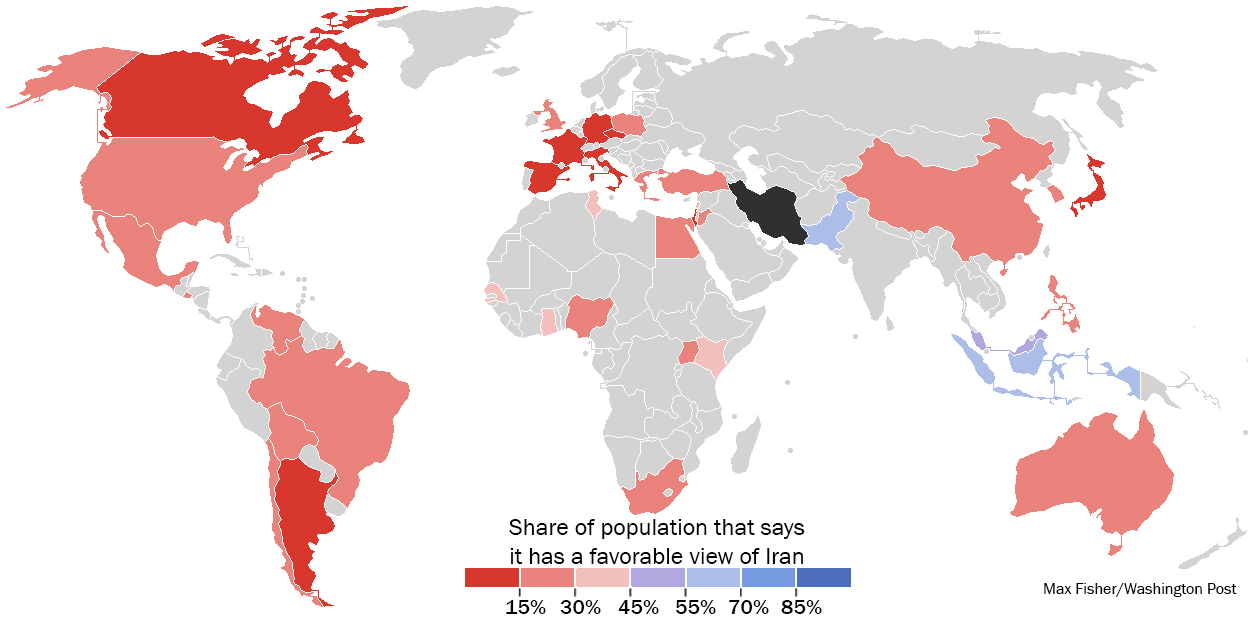
Iran’s Popularity Problem

Iran Popularity

Max Fisher finds “bad news for Tehran” in the results of a recent Pew survey on views towards Iran:

Perhaps most consequential for Tehran are the negative views of Iran held in East Asia, particularly Japan and China, two crucial buyers of Iranian energy resources. While Asian economies have not joined the severe European and American sanctions against the Iranian energy industry and do not appear poised to do so soon, they do seem to be increasingly reluctant about importing from Iran.

Even the data from countries with a favorable view of Iran showed a troubling trend:

Pakistan, the one surveyed country where Iran is popular, appears to be slackening in its support for the fellow Islamic state and bastion of anti-Western resistance. The January Pew poll found that 79 percent of Pakistanis support Iran, but the new number is 69 percent. That’s still pretty high in both absolute and relative terms, but it’s hard to miss the significant quick drop in pro-Iranian attitude.

Repeating Akin’s Mistake?

Congressman Trent Franks said on the Hill today, “The incidence of rape resulting in pregnancy are very low.” Chait steps in to clarify and defends Franks from charges of Akinism:

Franks didn’t say the “rate” of pregnancy from rape is low. He said the “incidence” is low. He didn’t say it’s hard to get pregnant when you’re raped. He said rape-induced pregnancy doesn’t happen very often.

Is that claim, which is different than Akin’s, true? Well, there are about 30,000 pregnancies from rape a year. I’d say that’s a lot. I suppose that if you’re comparing it to the total number of abortions, a figure that’s 20 to 30 times larger, you could argue it isn’t so many. From Franks’s starting point, in which which abortion is murder, the United States allows massive murder of human beings on an unthinkable scale, next to which 30,000 annual pregnancies looms small. If (like me) you don’t share his view of abortion, that 30,000 pregnancies looms large.

In related news, Amanda Marcotte comments on the story of a 13-year-old girl who was impregnated through rape, chose to keep the baby, and has gotten shamed for it:

This sort of thing reveals the inescapable contradiction at the heart of the anti-abortion movement: The very same sexual conservatism that gives rise to anti-abortion sentiment also produces slut-shaming and social ostracism of pregnant young and single women (not to mention rape victims). Avoiding the shame may actually drive a woman to get an abortion—not exactly the end result the anti-choicers want. For single pregnant women who are grown adults, this contradiction is finally collapsing under its own weight, contributing to the rise in single motherhood in red states. But for teenagers, the loving support for “choosing life” promised by the anti-abortion movement remains elusive.

The NSA’s Unofficial Ombudsman

Alexander Nazaryan’s profiles of long-time NSA chronicler James Bamford:

“I have a love-hate relationship with the N.S.A.,” Bamford joked when I spoke to him last week, in the wake of the revelation that the N.S.A. is gathering metadata from telecommunications and Internet companies. “I love them, and they hate me.” They have good reason. Bamford, who divides his time between Washington, D.C., and London, is a slightly mischievous character whose obvious persistence and curiosity have served him well. He talks with the relish of a child who has entered a forbidden room and knows that he will do so again. He decided to write about the N.S.A., which is believed to receive ten billion dollars in annual government funding and employ some forty thousand people, because no one had done it before—and because it was probably more fun than reading case law.

On the allegation that the NSA isn’t very good at what it does:

Bamford said it has “failed badly” in preventing attacks since the Cold War, missing everything from the first World Trade Center attack in 1993 to the recent Boston Marathon bombing. That’s partly because, as the agency has been inundated with so much data, it has perhaps lost the ability to evaluate information in a timely manner. You need people to point out patterns, to say what is relevant and what is not. Or, as Bamford puts it in “A Pretext for War,” the “N.S.A. needs human intelligence sources to help tell it where, and to whom, to listen.” In the past, a rivalry with the C.I.A.—which is largely responsible for human intelligence, in contrast to the N.S.A.’s general focus on data—had prevented that sort of symbiosis.