Being Conscious Of Your Own Circumcision, Ctd

Readers continue to provide the best MGM conversation out there:

This is in response to this reader. The condition that worries the dads is called phimosis. Until my mid-twenties, I couldn’t see more than a dime-sized area of my glans when I pulled back my foreskin. I didn’t even realize my foreskin was supposed to retract until I stumbled upon information about the condition online.

I recommend the dads look at the archives of this forum. It contains many first-hand accounts of successfully overcoming phimosis with stretching exercises. After stretching my foreskin twice per day for a year, I was able to fully retract my foreskin when flaccid. My sensitivity decreased, but that was necessary. I was overly-sensitive, and now I’m able to retract to wash my glans every shower with soap and water, which any healthy uncircumcised man will tell you is simple and necessary. I don’t stretch now, years later, and my frenulum is still a bit tight when erect, but I was amazed by the improvement.

The forum is sometimes antagonistic to doctors, with the allegation that American doctors are too willing to circumcise in phimosis cases because they don’t know any better. Some extreme phimosis cases may need circumcision, but I recommend the dads do extensive research of their own before subjecting their son to a scalpel.

Another reader is pretty antagonistic toward American doctors:

America just doesn’t know how to deal with foreskins.  We didn’t circumcise my son and his foreskin didn’t retract by age 5.  We were told that it should by age 3, and the cure for a non-retracting foreskin was circumcision.  No other advice was offered in England or America.

Then we moved to Bulgaria.

The doctor said we should pull the foreskin back to the point of gentle tension every day in the bath.  Now, it’s a bit awkward for a mother to be handling her son’s penis, so I tried to get my son to do this himself, with so-so results.  Not many months later, my son got an infection in his foreskin, from sloughed off skin cells trapped under the foreskin. He didn’t tell me in time, because he was an accident-prone kid and his solution to avoiding the doctor was to ignore the infection until he had a fever and was walking funny.

I checked on the web, consulted my home medical books, and called my American insurance company’s hotline.  All the advice was to lop off that useless (and, it was hinted, disgusting) foreskin.  But we were in Bulgaria, so we went to a Bulgarian hospital.  The doctor was built like a weight lifter and had odd English. I explained my husband’s preference was to try to save the foreskin, if possible, expecting to be told it wasn’t.  The doctor was absolutely horrified at the barbaric notion that anyone would consider removing a part of a man’s or a boy’s penis, especially for a trivial problem like a nonretracting foreskin with a treatable infection.

He forced the foreskin back, disinfected the infection, slathered antibiotic cream and told us to keep putting the cream on and that the foreskin now retracted. The procedure took under 5 minutes, cost $60 (10$ fee, 50$ tip) and solved the problem.  That was years ago.  My son remains intact.

I think it’s the cultural value that foreskins are useless at best and otherwise potential for disgusting reservoirs for grunge that makes the American and English solution to be lop it off at the slightest hint of any problem – and better yet, before there’s a problem.

And back Stateside:

I have been reading your circumcision thread and thought your readers may want a perspective from a female pediatrician who actually performs circumcisions on a regular basis.

My patient base is semi-rural, mostly white, blue collar, in the heart of Appalachia. They feel that their newborn sons are not “normal” if they are not clipped, and in fact that is sometimes the only question they ask when their son is just born – “Will he be circumcised?” Typically my partners and I will do a circumcision before the child leaves the hospital, but it can be done with local anesthesia up to two months of age in an office setting. There are different types of circumcision procedures that can be done and different doctors are trained on different procedures, but the basic principle is the same: the foreskin is loosened from the glans, a dorsal slit is performed and the foreskin is either placed in a clamp, or tied off around a plastic ring. There are pluses and minuses to each procedure, but it is mostly doctor preference regarding which one is done. And as I said, local anesthesia is given.

As part of my practice, I want my patients’ parents to make the right decision, and so I typically perform a thorough explanation of the risks and benefits of the procedure. But I do get frustrated that despite letting them know they don’t need the procedure, the parents feel it must be done.

Reading your readers stories, I am sad and a little disappointed because although I was not involved in these cases, I feel like the medical field have let them down.  And I think the reason is because the majority of males in the US are circumcised, and that creates a bias and a misunderstanding of the true nature of the foreskin and the male sex organs. If you only see circumcised boys, you may not really know when the foreskin should protract, and you would view something that is completely normal as abnormal just because it is different.

First off, ALL males are born with a natural phimosis. With time the phimosis loosens. This can vary, but there is a key ingredient needed and that is TESTOSTERONE. That is why the doctors of the various readers gave them steroid cream, but that is just not as effective as your own production of testosterone. Now some mothers with uncircumcised boys are aggressive with “cleaning”  and that traction will loosen the foreskin. Some boys are more playful, and that too will loosen foreskin, but a boy of age 3, 5, 7, 8 – even sometimes 14 – has very little testosterone flowing, so it is needed to mature the the male sex organ to function like it should. (As a side note, we recommend not pulling the foreskin down to clean, as that may cause it to rip from the glans but stick, swell and potentially cause loss of blood to the glans, which is bad.) Once the testosterone is flowing, the adolescent maleusually provides enough friction that any minor tightness will also loosen.

Obviously there are some exceptions to this rule, and a circumcision may need to be performed for medical reasons, but that is the exception. I would highly question any physician who tells you a prepubertal boy needs a circumcision if they are urinating with no problems. I also feel very sorry for the man that had a circumcision as an adult with just a local anesthetic that is cruel. No child or adolescent would get a circumcision out of the newborn period without general anesthesia, so why would we do that to an adult?

One more thing: I am surprised that nobody has mentioned circumcisions that had complications. Commonly I see penile adhesions where the foreskin has reattached itself to the glans of the penis, sometimes making it appear as though the child has never been circumcised.  Unfortunately I actually had a mother re-circumcise her son due to this very issue, despite my explaining that this was completely unnecessary, as the boy was two and thus had no testosterone, and that it will get better with time. Unfortunately she became obsessed with it and insisted it be done. I will never forget that boy. (Interestingly enough, prepubertal girls have a similar condition in which the labia minor fuse together, because there is no estrogen blocking the opening of the vagina and even the urethra, but of course we would never perform procedures to separate that.)

So that’s my two cents, for what it’s worth. I found you a few years ago and have thoroughly enjoyed reading your blog.

And we never cease to enjoy these incredible contributions from readers. Update from another:

(Interestingly enough, prepubertal girls have a similar condition in which the labia minor fuse together, because there is no estrogen blocking the opening of the vagina and even the urethra, but of course we would never perform procedures to separate that.)

Actually, this is exactly what my daughter’s pediatrician recommended when she was less than a year old; we were told to put estrogen cream on it (don’t worry if your infant develops breasts, that’ll be temporary … never mind the people freaking out about exposing their children to tiny amounts of estrogenic compounds in BPA plastics and possible links to the obesity epidemic). And if that didn’t work, we were told surgery might be necessary. Thank god for the Internet. The problem went away on its own at about 18 months. Never caused any trouble.

Ethically-Sourced Junk Food Still Junk Food

4333271953_df97a34904_b

Alice Robb flags a new paper in the Journal of Public Policy and Marketing:

A team of researchers led by John Pedoza, an associate professor of marketing at the University of Kentucky, found that we assume that food made by a socially conscious company is also healthy.

Pedoza and colleagues asked 144 students to evaluate a new brand of granola bar after reading a fictitious newspaper article about the company behind the product. Half the participants read an article describing a company that had won awards for its corporate social responsibility; the other half read about a company whose charitable activities were more modest. (This company had only recently begun donating to a charity.) The newspaper articles also portrayed the companies as having either selfish or altruistic motives for their charitable activities: “selfish” managers admitted that they were hoping their philanthropy would enhance their company’s reputation; “altruistic” managers were motivated primarily by a desire to help the community.

After reading the articles, the students were shown a fact sheet about the granola bars, with details on proposed flavors, launch date, and suggested price, but nothing on nutrition. Then they had to indicateon a scale of 1 to 7how much they agreed with statements like, “I expect this product will contain few preservatives,” “I expect this product will be made with natural ingredients,” and “I expect this product will be very healthy.” They also ranked their expectations of its “deliciousness” on a 7-point scale.

As Pedoza expected, students assumed that the more socially responsible companies were also producing a healthier snack food: The average composite score of the granola bar produced by these companies was 4.58, compared to 3.9 for the less socially responsible brand.

(Photo by David Berkowitz)

The Costs Of Fighting Climate Change

Elizabeth Kolbert takes to task Naomi Klein’s latest book for downplaying those costs:

The need to reduce carbon emissions is, ostensibly, what This Changes Everything is all about. Yet apart from applauding the solar installations of the Northern Cheyenne, Klein avoids looking at all closely at what this would entail. She vaguely tells us that we’ll have to consume less, but not how much less, or what we’ll have to give up. …

To draw on Klein paraphrasing Al Gore, here’s my inconvenient truth: when you tell people what it would actually take to radically reduce carbon emissions, they turn away. They don’t want to give up air travel or air conditioning or HDTV or trips to the mall or the family car or the myriad other things that go along with consuming 5,000 or 8,000 or 12,000 watts. All the major environmental groups know this, which is why they maintain, contrary to the requirements of a 2,000-watt society, that climate change can be tackled with minimal disruption to “the American way of life.” And Klein, you have to assume, knows it too. The irony of her book is that she ends up exactly where the “warmists” do, telling a fable she hopes will do some good.

Previous Dish on Klein’s book here.

Signed By An Algorithm

This embed is invalid


Derek Thompson highlights a remarkable tool that “may soon further diminish the importance of actually hearing artists perform”:

Next Big Sound, a five-year-old music-analytics company based in New York, scours the Web for Spotify listens, Instagram mentions, and other traces of digital fandom to forecast breakouts. It funnels half a million new acts through an algorithm to create a list of 100 stars likely to break out within the next year. “If you signed our top 100 artists, 20 of them would make the Billboard 200,” Victor Hu, a data scientist with Next Big Sound, told me. …

The company has discovered that some metrics, such as Facebook likes, are unreliable indicators of a band’s trajectory, while others have uncanny forecasting power. “Radio exposure, unsurprisingly, is the most important thing,” Hu says. It remains the best way to introduce listeners to a new song; once they’ve heard it a few times on the radio, they tend to like it more. “But we discovered that hits to a band’s Wikipedia page are the second-best predictor.” Wikipedia searches are revealing for the same reason Shazam searches are. While getting a song on the radio ensures that people have heard it, Culbertson says, “Shazam tells you that people wanted to know more.”

What To Think Of Bill Cosby? Ctd

Whoopi Goldberg, a diehard Polanski defender, is skeptical of the allegations against Bill Cosby:

Readers react to the disturbing story:

I certainly understand Barbara Bowman’s anger. I think the answer to her question, of course, has more than a little to do with race. In this country, accusing a black man of raping a white woman comes with the burden of our racism and history of oppression. And when that man is a beloved entertainer and symbol of American fatherhood? You are right that his accusers had and have absolutely nothing to gain and everything to lose. I just can’t imagine what these women have gone through emotionally.

Hannibal Buress, by virtue of his gender and race, made it possible for us to have this conversation at long last. That it took a man to legitimize their stories is most unfair. We owe Buress our gratitude nonetheless.

Another wonders why Cosby didn’t get his comeuppance sooner:

Ten years ago we still had more of a top-down media structure. “Going viral” was not a thing yet. YouTube hadn’t even started. Instead, shocking things generally had to pass through gatekeepers, whose incentives were basically not to piss off the wrong people. Rape accusations at the time were considered not appropriate for polite company unless it reinforced an existing narrative. I’m sure many media outlets heard of these accusations, but dismissed them because they weren’t “truthy” enough.

How another reader on our Facebook page views the story:

He said / she said, she said, she said, she said, she said, she said, she said, she said, she said, she said, she said, she said, she said, she said, she said.

But a couple readers share Whoopi’s skepticism:

You wrote, “Believing Bill Cosby does not require you to take one person’s word over another – it requires you take one person’s word over 15 others.”

I have no idea what Cosby did back in the day.  It would seem highly risky for a black man in the ’60s and ’70s to force himself on a white woman, but people have done risky things before.  It was a long time ago, however, and it seems like too long a time to determine the truth of his or any other case without any real evidence.

The reason I’m writing this email however is to point out the problem with the “15 others” claim.  The longer the time period, the more numerous the false claims/false memories.  Did they get drunk and have sex with Cosby and regret it later and they have now over the years convinced themselves he must have slipped something into their drink 30 years ago?  Did Cosby just hit on them years ago and grabbed a boob and they story grew in their mind?  (Still bad, still inappropriate, but not as bad as rape).  Did they have a sleazy experience with Cosby, believe that he could have raped somebody and embellish their story to help other victims?

Another:

If Bowman really wanted her story to come to light, she should not have settled and allowed the other assaulted women to testify in a trial.  She accepted a settlement, and the reason to settle something like this is so the perpetrator can keep it as quiet as possible.  She had a hand in keeping this quiet, and was financially rewarded for doing so.  To complain about it now is disingenuous.

Update from a reader:

Cosby’s settlement was with Andrea Constand, not Barbara Bowman. She came forward to testify on behalf of Constand in a potential trial. That trial never took place because of the settlement, but Bowman has every right to speak up and is under no obligation to keep anything quiet.

Another adds:

As Bowman states in her Washington Post op-ed, “I have never received any money from Bill Cosby and have not asked for it.”

A torn reader rightfully falls on the side of the many female accusers:

I’ve been having a hard time dealing with the evidence that Bill Cosby is a rapist, but at the very minimum its helping me to understand why people sometimes defend and even excuse celebrities that are caught doing horrible things. Cosby was a fixture of my childhood. His public persona wasn’t just a source of humor for me, growing up, but also of comfort. I didn’t have an admirable father, so having someone like him as an example of what a father could be was meaningful to me. It’s not an exaggeration to say that he helped me through some hard periods.

Realizing that the real Cosby isn’t the same as the person I admired is hard. I’m feeling a profound sense of loss because that man I admired isn’t an admirable man. So what do I do with all of the positive experiences and, yes, values that I got from him? Is it still possible to admire the message while being disgusted with the messenger? Does the hypocrisy and evil negate the virtue?

Ultimately, I must side with the victims. If he hurt people (and I think he did), then he’s scum. And he’s a worse sort of scum for pretending to be a friendly, fatherly figure. I won’t make excuses and I won’t try to seek out some sort of false balance. But I also can’t do that without feeling hurt and without having to fight an urge to defend the man that I thought he was, even though that man was just an illusion.

Another update from a reader, who spreads the blame around:

I think NBC – who had a show in development with Cosby – is getting off awful lightly.

Yes, the accusations against Cosby slipped out of mainstream consciousness – but it was certainly no secret at NBC! For years, women have alleged that he used his position at the network in the 1980s to host private counseling sessions in which he drugged and raped them. These claims must’ve made at least some impression when they were aired in court just eight years ago.

Consider also that the claims against Cosby stretch into 2004(!) when Andrea Constand, a young employee at Cosby’s doting alma mater, says she was drugged and assaulted in his Philly mansion. Is it any mystery what Cosby had in store for the young female professionals that NBC was prepared to hand over to him? Do 67-year-old rapists not become 77-year-old rapists? Is this how cataract-eyed octogenarians find new verve for a career comeback?

The shameful truth is this: the only thing that stopped NBC from furnishing a serial rapist with a new crop of eager young professional women was a 90 second cell phone video of a stand-up routine. And that’s a scandal.

In the renaissance age of feminist, woman-focused journalism, how was that allowed to happen? Why did spaces like Vox, Gawker Inc. and Slate XX devote coverage to the sexism of The Amazing Spiderwoman, but let NBC announce a deal with a prolific rapist without a peep? Why was gamergate covered like the modern triangle shirtwaist fire, but the new Cosby show ignored entirely? Why dig so obsessively into nerdy, off-the-beaten-path subcultures when fucking NBC is setting Bill Cosby loose on a new group of subservient girls?

NBC, for their part, announced the cancellation of the Cosby project in the protective wake of Netflix’s announcement. They’re now attempting to quietly tip-toe away from this mess as the public descends on Cosby. They should not be allowed to.

The Best Of The Dish Today

America isn’t the only place where immigration is now an extremely hot issue. In Britain, it’s threatening to destroy the Tory party. On Thursday another parliamentary defector to the UK Independence Party, which is anti-immigration and anti-EU, is fighting for a very safe Tory seat. The Tory candidate is busy pandering to the worst xenophobic impulses in the electorate … and could still lose. Massie despairs of the pandering:

Consider these extracts from her own election leaflets: “I wanted to bring the prime minister to this constituency to show him that uncontrolled immigration has hurt this area. I told him we need action, not just talk.”

And: “Most people I know here have worked hard their lives, played by the rules and paid their fair share, but we sometimes struggle to access the services we need because of uncontrolled immigration. Others don’t feel safe walking down the high street of our town.

I suppose this is just another example of no-one ever being allowed to talk about immigration. I don’t know if it counts as progress that we’ve moved on from Oh My God, Muslims! to Oh My God, Roman Catholics from Eastern Europe! but there you have it.

The president is taking a huge gamble tomorrow night.

Today, we tackled the gender debate again – here and here. Whatever my own position, we hope we’re airing plenty of points of view from all sides. On marriage equality, I bemoaned increasing polarization and incivility. A deeper dive on the foul murders in Jerusalem yesterday is here. Why vaping is now as cool as blogging was in, well, 2007. And why drilling has indeed brought gas prices down, whatever some liberals say. Plus: the strange phenomenon of the Welsh Jihadist.

The most popular post of the day was Lumbersexuals: The Triumph Of The Bears; followed by What To Think Of Bill Cosby?

Many of today’s posts were updated with your emails – read them all here.  You can always leave your unfiltered comments at our Facebook page and @sullydish. 16 more readers became subscribers today. You can join them here – and get access to all the readons and Deep Dish – for a little as $1.99 month. Gift subscriptions are available here. A newbie writes:

For first time I can recall, I can’t get to the “Read On” content without subscribing.  So I will subscribe. Is this a new policy?  I hadn’t encountered it until today (and I was on the Dish yesterday). I was completely surprised. One thought is that it forces my lazy ass to sign up.  The second is that you are confident in your business model and you’re upping the ante requiring us voyeur readers to pay if we want to see anything beyond the “Read On” button.  Sneaky, but effective.

I guess we need to tighten up the meter a bit.

See you in the morning.

Terror, Terror Everywhere

Screen Shot 2014-11-19 at 12.49.04 PM

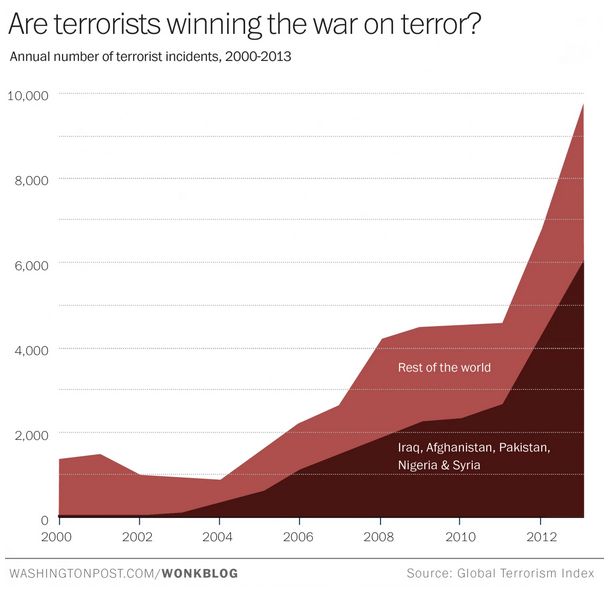
Ingraham introduces the Institute for Economics and Peace’s latest Global Terrorism Index, which counted 10,000 terrorist incidents worldwide in 2013, most of them in Iraq, Afghanistan, Pakistan, Nigeria and Syria. As his chart illustrates, that compares to just 1,500 incidents in 2000. Why the dramatic increase? Well, you know:

The report suggests that U.S. foreign policy has played a big role in making the problem worse: “The rise in terrorist activity coincided with the US invasion of Iraq,” it concludes. “This created large power vacuums in the country allowing different factions to surface and become violent.” Indeed, among the five countries accounting for the bulk of attacks, the U.S. has prosecuted lengthy ground wars in two (Iraq and Afghanistan), a drone campaign in one (Pakistan), and airstrikes in a fourth (Syria).

The same five countries account for a full 80 percent of deaths from terrorism last year. Adam Taylor expects the report to generate some controversy because of how it distinguishes “deaths from terrorism” from other deaths in conflict zones:

The report explains that it is not including deaths in Syria caused by conventional warfare, for example. However, in a complicated civil war such as Syria’s, the line between conventional and nonconventional warfare often gets blurred.

As the report itself notes, “Terrorism has been deployed as a tactic by some of the rebel forces to bring about a political, economic, religious, or social goal rather than purely military objectives.” Perhaps even more controversially, the IEP finds that only four terrorist organizations — the Islamic State, Boko Haram, the Taliban and al-Qaeda — had asserted responsibility for more than 66 percent of the deaths. The United States has been involved in the military battle against all of these groups.

Juan Cole criticizes the study for how it decides which incidents are “terrorism” and which are not:

Let’s just take Mexico. Between 2006 and 2013, roughly 10,000 people a year were killed in drug gang violence (substantially more than have died annually in terrorism in Iraq in recent years). The IEP report counts those as homicides, not terrorism. But many of these killings are committed for political reasons– to control a city like Ciudad Juarez, e.g. Moving drugs on a large scale cannot be an enterprise divorced from politics. … Let’s face it, if Mexico were a Middle Eastern country its drug war would be depicted as terrorism and it would join the five countries listed above at the head of the class, with a third more deaths than Iraq every year.

Keating wonders if the index is blurring the line between “terrorism” and civil war:

While these five countries dominate global terrorism, the report also notes that there were nine additional countries last year that had more than 50 terrorism deaths, bringing the total number to 24—the highest in 14 years. These were: Algeria, Central African Republic, China, Egypt, Lebanon, Libya, Mali, Sudan, and South Sudan. Algeria is on that list largely because of one horrific incident. Lebanon’s terrorism is closely tied to Syria’s. CAR, Libya, Mali, Sudan, and South Sudan are all experiencing various states of intrastate warfare. So the issue here may be less a global increase in terrorism than a set of worsening civil wars (one war in particular) in which the traditional tactics of terrorism—kidnappings, suicide bombings, etc.—are employed by the combatants.

And Kathy Gilsinan highlights another important finding from the report, about how to stop terrorism:

[A]s the U.S. winds up its war in Afghanistan—a country that saw a 13-percent increase in terrorism-related fatalities last year—and considers the extent to which it wants to intervene militarily to halt the spread of ISIS, it’s worth asking: How does terrorism actually end? The question is one that the Rand Corporation addressed in a 2008 study that the Global Terrorism Index authors cite. That report examined 268 terrorist groups that halted their attacks between 1968 and 2006. In only 7 percent of those cases, the report found, military intervention brought about the end of a terrorist group.

Face Of The Day

IRAQ-CONFLICT

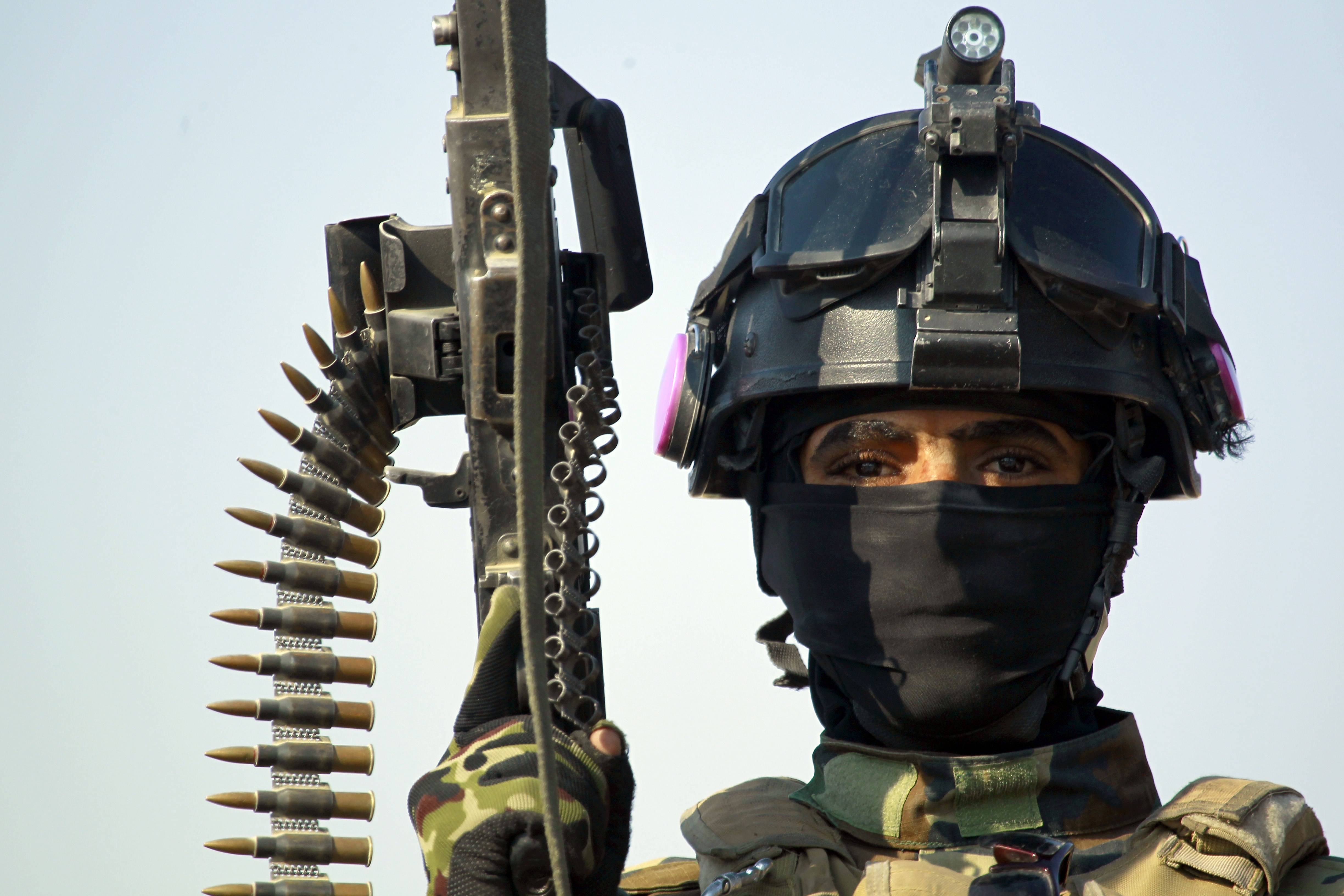
A member of the Iraqi police special forces holds his weapon as he rides a car during a parade in Iraq’s holy city of Najaf before heading to fight Islamic State (IS) group jihadists on November 19, 2014. The previous week Iraqi forces broke a months-long siege on the nearby Baiji oil refinery, the country’s largest, and joined up with elite troops who had been holding off IS onslaughts for months. By Haidar Hamdani/AFP/Getty Images.

How Clinton Undercuts Obama

Beinart takes note of Hillary’s silence on Barack’s upcoming immigration actions and the deal with Iran. He suspects she is “avoid inheriting Obama’s baggage in 2016”:

But whether or not keeping her distance is good politics for Clinton, it’s bad politics for Obama. By distancing herself from Obama’s efforts, she encourages Democrats in Congress to do the same, especially those in more conservative states or dependent on more hawkish donors. And given the furious opposition Obama’s efforts will spark among Republicans, a public split among Washington Democrats will make it harder for him to prevail.

All of which shows why it’s important that Clinton face a primary challenger. It’s the only way that progressives, who overwhelmingly support Obama on immigration and Iran, can influence her behavior.

Slavery Is Still With Us, Ctd

Rick Noack discusses the above map, indicating the portion of the global population currently enslaved, as per a recent report:

About 60,000 people suffer under modern-day slavery in the United States. According to the authors of the report, in the U.S. “men, women and children are exploited as forced laborers, and in the commercial sex industry — In 2013, potential modern slavery cases were reported in fifty states.” The report explains that slaves are forced to perform domestic work and home healthcare, they work in the food industry, as well as in construction, agriculture, nursing, factories and garment-manufacturing, among other sectors.

Neighboring Mexico struggles with about 270,000 slaves, and Japan surprises with a staggering 240,000 enslaved people — a number that is the highest in any developed country. Japan is primarily confronted with sex slavery, a problem which has not been tackled seriously enough in the past by the country’s government, as rights groups have repeatedly criticized.

Larry Elliott comments on the findings as they relate to Britain:

Modern slavery is a live political issue in the UK, with a bill on the issue moving through parliament and David Cameron highlighting it in his speech to the Conservative party conference this year.

“But there’s still more injustice when it comes to work, and it’s even more shocking. Criminal gangs trafficking people halfway around the world and making them work in the most disgusting conditions,” Cameron said. “I’ve been to see these houses on terraced streets built for families of four, cramming in 15 people like animals. To those crime lords who think they can get away with it, I say ‘no, not in this country, not with this party’

And The Economist hones in on Mauritania:

Biram Dah Abeid…, a self-proclaimed descendant of slaves who was runner-up in Mauritania’s presidential election in June, albeit with only 9% of votes to the incumbent’s 82%, was detained along with a clutch of fellow members of his Initiative for the Resurgence of the Abolitionist Movement.

On paper, Mauritania abolished slavery in 1981, though without passing legislation to punish slave-owners. In 2007 it made slave-owners liable to prosecution. But Mr Abeid, who says that half of Mauritania’s population are descendants of slaves (or are still slaves), insists that the law continues to be flouted. Amnesty International, among other advocacy groups, has protested against his recent arrest. The Walk Free Foundation, an Australia-based lobby that published its latest global slavery index on November 18th, reckons that around 150,000 people out of Mauritania’s total population of 3.8m are still enslaved.

Previous Dish on modern-day slavery here.