After John Oliver’s first night hosting, Brett LoGiurato thinks the Daily Show “will be in good hands this summer”:
The John Oliver era started off with a bang, as he was on point in ripping the National Security Agency’s extensive surveillance operations. Oliver said that the NSA is surveilling “vastly more information than even George Orwell wet the bed over,” reassuring his viewers that NSA surveillance only affects people who “make calls or use the Internet.”
There’s an obviousness outsiderness to Oliver which works brilliantly when he’s commenting on America’s foolishness. Or really, anyone’s foolishness. Note for instance how his accent played a role as he called out Jon Stewart for not lampooning Anthony Weiner back in 2011. Even the way he uses his accent is a joke on us: according to The Guardian’s Oliver Burkeman, “most Americans… hear his distinctively Brummie accent as standard Posh English.” Or, as Kevin Fallon wrote in The Daily Beast, “By merely speaking with a British accent, he comes off as a superior know-it-all explaining American politics to us when, in fact, he’s talking out of his ass. Err … arse.”
But aside from the fact that Oliver gets to call America (and Stewart) out, the NSA scandal also fits into Oliver’s Daily Show oeuvre in other ways. Oliver has a knack for tackling complicated stories that deal with America’s role on an international scale. Surely, he if anyone can lend sensible humor to the hunt for Edward Snowden.
Laura Bennett believes that Oliver’s stint will be exactly what the “increasingly insidery, decreasingly funny Daily Show needs”:
[A]t first glance, Oliver seems like a somewhat surprising choice to take over a show that relies on the host’s highly personal outrage at the American political landscape. But as “The Daily Show” has become increasingly rooted in Stewart’s umbrage, it has also become less funny. So Oliver’s outsiderness might be just what the show needs. … In a sense, Oliver may be set to channel “The Daily Show”’s earliest instincts: the old David v. Goliath attitude that targeted large subjects with small-bore satirical marksmanship and a clear sense of fun. Those were the days when Stewart was animated by scrappy underdog enthusiasm, before he started to feel the weight of his own influence.
Meanwhile, Jaime Weinman takes the opportunity to wonder why the show “eliminated virtually all the recurring bits”:
There’s the perennial “Back in Black” for whenever Lewis Black appears, and more recently John Hodgman’s appearances were titled “You’re Welcome” after they hit on the idea of characterizing him as an entitled, bubble-dwelling rich person (which made his appearances much more consistently funny). But otherwise, almost everything is gone. Even “The Toss” between Stewart and Colbert is gone. Instead, the first act is almost always an extended version of what Kilborn and Stewart used to call “Headlines,” and the second act is often the same, unless it’s a pre-taped field piece. Free-form riffing on the day’s news, field pieces and interviews; that’s pretty much all she wrote.
My contest submission is McGrath, Alaska, USA or some other town in central Alaska. Key identifiers: river, with low balding hills on the other side. The housing looks a little too nice, unfortunately, but I’ll go with my guess anyway.
Another:
When I saw this photo, the hills immediately made me think of the region (Umbria) surrounding Lake Trasimeno in central Italy. There are several small towns surrounding the lake, a famous lake from antiquities when Hannibal drove a Roman army into the lake and turned it red; and Passignano sits on a part of the lake where across from the town you would see this type of view. Europe has had a very late spring, so the green foliage seems just about right instead of the normal brown you’d typically see in central Italy at this time of the year. If it’s not Lake Trasimeno, please don’t tell me. I’m having a flashback to my time there more than a decade ago. Don’t ruin it for me.
Another:
Answer: The picture was taken from the lounge room at the Tom-na-Creige Bed & Breakfast located between the towns of Onich and North Ballachulish, Scotland, PH33 6RY. The B&B’s website even has a picture taken from the same window with a cat sitting next to the model boat (though the picture seems dated because the building on the foreground on the right has a newer roof in the contest photo):
I love that this week’s picture is from the Glen Coe area. We took our daughter, then almost two years old, to Scotland before our son was born. This week’s contest brings back so many great memories. I started flipping through our photos from the trip and looking at our AA road map. It turns out that we drove over the Ballachulish Bridge (on the left side of the contest picture) and right past the Tom-na-Creige B&B on our way from Glen Coe to Ben Nevis four years ago yesterday on June 7, 2009. I’m attaching a picture of Glen Coe from that day. A beautiful landscape that pictures just can’t capture:
I suspect, however, that you will receive many correct answers because of the flyer for Mayfest at the Clachaig Inn in Glen Coe (about 9 miles away) resting on the table. We drove by that Inn too on our way to and from the Three Sisters in Glen Coe. And I’m also sure that I’m not alone among your readership for that either.
Unfortunately we didn’t notice the very faint but visible lettering on the flyer until after posting the contest photo, and by the time we cropped and replaced the photo (seen above), scores of readers had submitted their entries. Oops. Exact details from the submitter:
I am the reader who submitted the photo of this week’s View From Your Window contest. Looking forward to see what the readers say! (I wonder if the pamphlet resting on the window sill will be of any help to them.) Seeing it in the contest made me nervous, however. I figured I had better make sure I have the location details correct, especially considering that when I first sent you the photo I had the wrong loch identified, which I corrected in a followup email. Anyway, here are the details:
This photo was taken from the breakfast room of the Tom-na-Creige Bed & Breakfast in Scotland. It is located on the A82 in Onich, between Ballachulish and Fort William. The body of water is Loch Linnhe. The innkeepers told us that Tom-na-Creige means Hill of Rock in Gaelic.
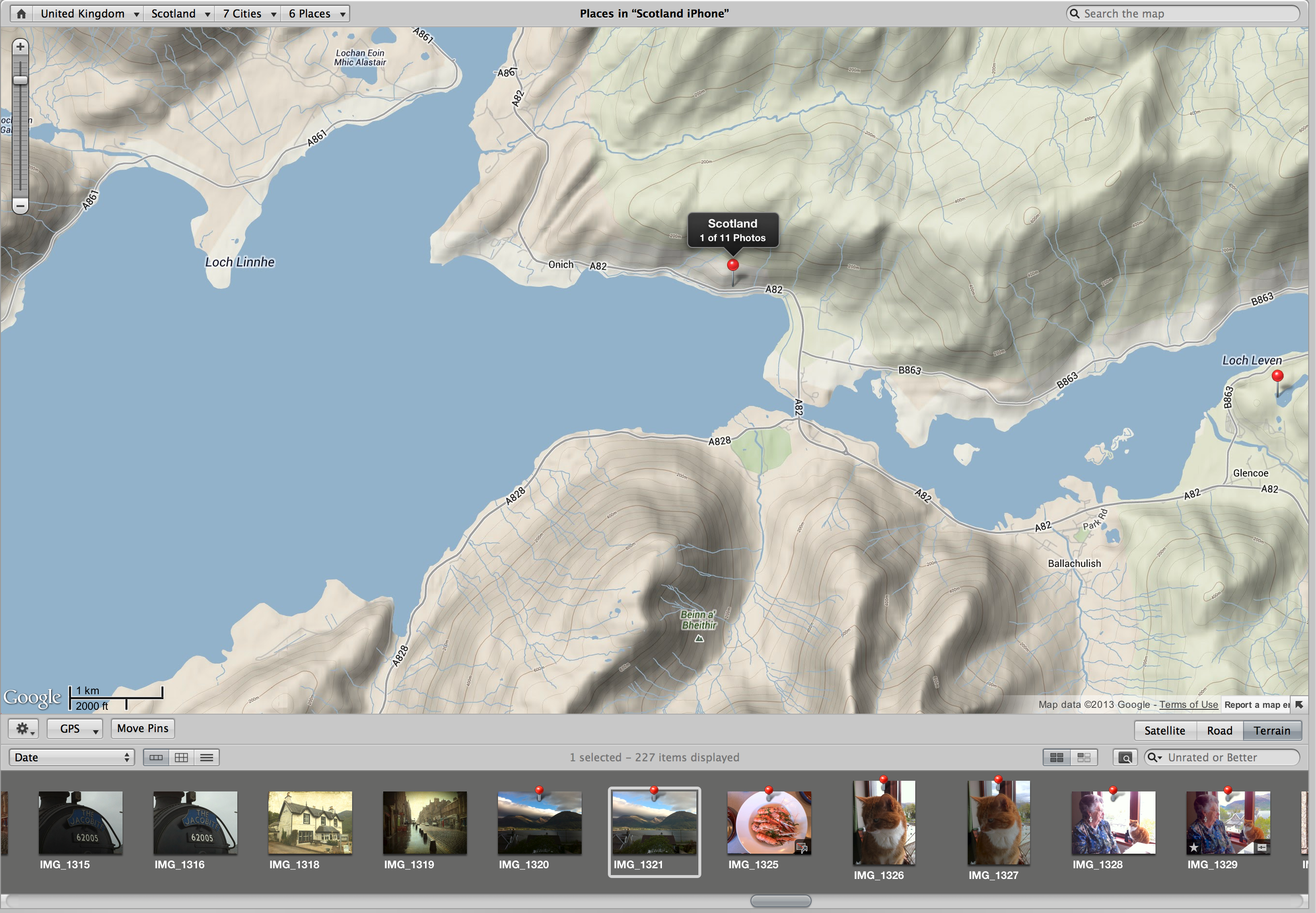
The attached photo shows the window from which the photo was taken. I also attached some maps based on the GPS coordinates of photos I took at the B&B:
A reader tells a story:
When I saw the house to the left I thought it’s got to be Scotland and, by the landscape, the west coast. Then I saw the bridge and instinctively exclaimed Ballachulish. I was disappointed later to notice the flyer for Chlachaig Inn and to realise that everyone will quickly come to Ballachulish (it’s the first hit).
My Ballachulish story goes back to the sixties and seventies when I was a boy living in Bridge of Allan, Scotland. Every year we would holiday with my paternal grandparents who lived in Glenbeg, Ardnamurchan. The holidays were dire – it invariably rained, the food was awful (reconstituted powdered milk on my cornflakes and every meat dish was based on venison offal), and my grandfather and father would have blazing rows.
Worst though, was the journey. According to Google maps the distance is only 119 miles but it took all day. The last 30 miles were on vomit-inducing, winding single-tracked roads with passing places. Before we got there, though, were the ferries at Ballachulish and Ardgour. These were a treat – a chance to get out of the car and feel the wind in your hair. Occasionally the queues were so long at Ballachulish that Dad would decide to drive around the top of the loch. This was very bad news – not only missing the brief joy of a ferry break but an extra hour’s driving in Dad’s Hillman Hunter (and, later, a Triumph PI).
In 1974 we moved to the US and there were no more holidays in Ardnamurchan. I believe the bridge was completed the following year. I only once drove over it – an early-morning dash from Edinburgh to my grandparents’ house which took under three hours (including the Ardgour ferry) in my beaten up Alfa Romeo GTV on empty, pre-speed-camera roads. The horrible journey of my youth had become a glorious pre-breakfast run.
We can’t really pick a winner for this contest view, since the flyer gave away the location for so many readers, so below is a redo view, which we will score on Thursday at 1 pm:
You have until noon on Thursday to guess it. City and/or state first, then country. Please put the location in the subject heading, along with any description within the email. If no one guesses the exact location, proximity counts. Be sure to email entries to contest@andrewsullivan.com. Winner gets a free The View From Your Window book. Have at it.
What has emerged in the past few days is a fascinating snapshot of a shifting political landscape. On the one side, we have a libertarian-civil liberties left alliance. On the other, a strange world where Bill Kristol and Joe Klein are on the same page. Personally, I think it’s a shame that this alliance has emerged over PRISM because it seems to me to be one of the less worrisome anti-terrorism policies. My general inclination is to back the liberaltarians on these questions, but I have never been a purist, appreciate the political balances required and wish this debate were not also wrapped in accusations of treason and heroism.
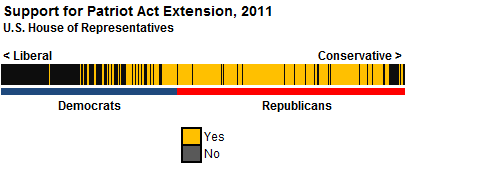
But we have a truly remarkable development here. The president, while defending PRISM, is open to ending it – or debating it more widely. That’s of a piece with his recent speech on terrorism. So he’s inviting more scrutiny of the issue in general – and encouraging, therefore, both Republican and Democratic opposition. Nate Silver gets the strange moment here:
But this is the money graphic:
What we’re seeing here is a two-pronged pincer from the liberal conscience and the libertarian mind against the current center – from two years ago. I wonder what this chart would look like today. What we’ve outed this past week is the potential for a serious alliance, led from behind by the president.
Of course, there are two obvious caveats:
Some of the Republican opposition is so brazenly partisan its cynicism almost blows you away. But since they seem only to care about wounding Obama, it’s still a politically potent force, susceptible only to the possibility that Obama might at some point agree. The second caveat is that the public backs the security-over-surveillance center by a hefty margin – for the moment – and so it may not be a propitious moment for this emergent potential realignment to bear fruit.
But it may be the start of something, no? Nate looks at party primaries, where cross currents will shake up both parties from within. And you can imagine this alliance becoming more cohesive if we continue success in foiling terror attacks, withdraw from Afghanistan and ease back to a more conventional pre-9/11 mindset. It is not beyond Obama to be dragged toward this liberaltarian axis, and it is almost certain that Rand Paul may inject this theme very powerfully in the GOP presidential primaries.
I’m not shocked by PRISM. But if the president began to argue that he thinks it may be time to retire such and similar programs – and he already has – then he could leave a civil liberties legacy much better than the one that now seems likely. So while defending his past practice as justifiable, I have two words for those on the right and the left who want to unwind our overweening security state: Make him.
This afternoon, the full U.S. Senate holds its first vote on the bipartisan immigration legislation, which seeks to bolster border security and establish a pathway to citizenship for the nation’s millions of undocumented immigrants. This vote on the motion to proceed requires 60 votes, and it’s expected to cross that threshold. But the question is whether there are potentially as many as 70 senators who support the final legislation, which would give the legislation lots of momentum, putting pressure on the GOP-controlled House of Representatives to take up the Senate version. Today’s vote COULD give us a hint. A reminder: This is just the first full Senate vote; the vote for final passage won’t take place until before the July 4 holiday.
Brett LoGiurato passes along a good sign regarding the bill’s chances in the House:
In an interview with ABC’s George Stephanopoulous that aired Tuesday morning, House Speaker John Boehner hinted that he would clear a significant hurdle to immigration reform passing through the House of Representatives. During the interview, Stephanopoulous asked Boehner if he would let the bill in the House come to a vote, even if it means he has to break the so-called “Hastert Rule” — meaning that he would let it come to the floor even if he wasn’t sure it would have support form a majority of Republicans.
There is no doubt that conservatives will revolt against the bill. The major question is whether John Boehner really wants to kill reform, whether he wants to cast a symbolic vote against reform while letting Democrats pass it for him, or whether conservative opponents will force him to keep a bill from coming up. The back-from-the-brink signals sent out by Establishment Republicans suggest Boehner and the party’s Establishment don’t want to kill it.
Allahpundit is unhappy about Rubio’s refusal to “demand border security before legalization”:
I think he’s calculating, unfortunately quite rationally, that conservatives are far more likely to forgive him for selling out their core interest in the name of winning over Latinos than general-election voters are if he becomes known as The Man Who Killed Reform. So he’ll give the Dems “legalization first” and focus instead on making the border security in step two as tight as he can. That’s the best way to balance general-election voters and Republican primary voters. It’s also why, I assume, Rubio would never agree to Mickey Kaus’s idea to give up on a big comprehensive bill and start small with a confidence-building compromise that would institute E-Verify in exchange for DREAM amnesty for younger illegals. Anything short of a big bill at this point will be used against him by Democrats eager to frame him as in thrall to conservatives and therefore “too radical” to get things done in Washington as president. For Rubio it’s comprehensive reform or bust, even if that means selling out on the key legalization provision.
The calculation now, for Rubio, is a bit complicated. If it looks like something close to the Senate bill can pass the House with Republican support, Rubio is no longer the sole conservative responsible for it happening. He escapes blame. If the Senate bill passes with Rubio’s support and then Boehner decides to get the bill through the House with Democratic votes, Rubio will be branded a traitor to the conservative cause for the rest of eternity. If it passes the Senate and dies in the House, Rubio stuck his neck out for nothing.
In the latest video from Josh, he has some suggestions for Republicans and Democrats:
Josh Barro is currently the Politics Editor at Business Insider. He has previously written for Bloomberg View, and before that was a Senior Fellow at the Manhattan Institute. Previous Dish on Chait’s recent profile of Barro here and here. Watch Josh’s previous answers here. Our full Ask Anything archive is here.
I understand your willingness to stand behind surveillance schemes when they gain court-approval, but hanging your hat on FISA court-approval seems misguided. A quick search through the Electronic Privacy Information Center’s nice table on FISA court applications submitted, accepted, and rejected shows that this is no more than a kangaroo court. Between 1979 and 2012, 33,942 applications were submitted. Of those, a mere 11 were rejected. (The difference between applications proposed and accepted is only 7, but I decided to go with the upper bound they report in their ‘Applications Rejected’ column to give the government the benefit of the doubt.) So the government has a whooping 99.967% batting average in these courts.
Now it could be selection bias going on here, that the government only goes to these courts when they have solid cases. But I doubt these lawyers are so stellar that they have never made clerical errors that invalidate many non-FISA court briefings. If we hope to find a balance between privacy and security, let’s at least have an advocate on the side of privacy who is willing to stand up and say no once in a while.
I, like you, am underwhelmed by the NSA revelations. Frankly, this is confirmation of what I’ve always thought since the Patriot Act was passed, and I personally believe anyone who thought otherwise is incredibly naive or fatally misinformed. Or both.
But here’s what I don’t get: the sudden consternation over this from libertarians. Really? You’re shocked – shocked! – to find that there’s data mining going on here? You have no problem voluntarily posting your life’s narrative and personal information on Facebook, Twitter, Amazon, eBay, PayPal, etc., and you’re ticked at the federal government, which cannot get out of its own way?
Devil’s Advocate: We hand over our names, checking accounts, credit card numbers, social security numbers, birth dates, photos, interests, political leanings, browsing histories, etc. to hundreds – if not thousands – of private companies without batting an eye. We’ve been doing it for upwards of 20 years now. And now we suddenly get angry that the government can see that information? What about the companies themselves? It’s not like they have the best track record of “protecting” their customers over the past five to ten years. Where has the anger been over that?
Since when did we as a society place absolute trust in private companies, whose lone basic motivation is monetary profit, to handle our information better than the government?
I can do nothing to oust the CEOs of Facebook or Google. But I can change (or at least have a hand in changing) the CEO of the Federal Government once every four years, and the board members once every two years. A government’s overarching motivation, in my opinion, is to protect its citizens from threats internal and external. If a government fails to do that, it ceases to be a government.
I realize there’s a bunch of Revolutionary 1760s Bostonian types that will scream “Give me liberty or give me death” back at me, but on the face of it, it makes no sense to me. Maybe that’s because it’s 2013, I’m a millennial, and we have the Internet now and whatnot. But I actively participate in the workings of my government at the very least by voting. I cannot participate in the workings of ANY company I interact with. (And don’t tell me I can just stop buying stuff from them. I’m not going off the grid any time soon.)
So I’m supposed to trust them with my information more than the government? Am I missing something here, or am I just as naive?
Another is more succinct:
The outrage over potential abuse of the system is actually pretty funny when it comes from a population that tweets every breath it takes and posts the most private facts (with pictures) on Facebook for total strangers to view and comment. Twitter gives others access to every aspect of our lives as we live it and Facebook lets the whole world be your intimate friend to know your thoughts, actions, and mood. Every time I order online, some company tracks my data so they can custom tailor my advertising. Every class I take or research on a subject I am interested in becomes information for someone. Why get all bent out of shape over the government jumping on the band wagon? As for abuse, I’ll take the government over Amazon or Google. Less chance of my information being used for evil purposes, quite frankly.
The government isn’t spying on us; Google is spying on us, and the government is asking Google for certain results. We need to think coherently about what we find scary here. The problem isn’t so much that we haven’t set up a legal architecture to preserve our online privacy from the government; it’s that we haven’t set up a legal architecture to preserve our online privacy from anyone at all. If we don’t have laws and regulations that create meaningful zones of online privacy from corporations, the attempt to create online privacy from the government will be an absurdity.
How another reader boils it down:
What a strange, pathetic country we live in that private companies, whose sole goal is profit, are more trusted than the government, whose main goal (at least, in this instance) is to prevent the killing of Americans.
Another differs:
You’ve mentioned multiple times something to the effect of “We entrust our data to private companies, so why shouldn’t we entrust it to the government?” I think this line of reasoning is mistaken for two main reasons:
1) Consumers are making an informed decision to let companies like Apple view their location data from their phone. Part of that tradeoff is that Apple’s motivation is to provide them with better products with that data. If people want to make the decision to allow the government access to this information, let them make it with the full knowledge that’s what they’re doing.
2) From a technical standpoint (and I’ll try not to get too technical), data, including the contents of phone calls, can be encrypted from the starting point (a person’s PC) to the end point (a server at Microsoft’s datacenter). Nobody can have access to that data unless they have encryption information from one of the two endpoints. If a terrorist wanted to have secure communication, all they would need to do is to use a service from outside the U.S. That would require the NSA to have physical access to the person’s PC to get the encryption keys, which may not still exist by the time they search the apartment. This could all be done with inexpensive technology that would have been the dream of 1950s Soviet spies. The only “terrorists” that would be caught by this kind of program are the ones who are naive enough to believe that entrusting an American-based company with their sensitive communication doesn’t pose a security threat to their operation.
Overall, this kind of program may scare up a few arrests from idiot would-be terrorists, but it would do very little to disrupt well-planned and well-coordinated attacks like 9/11, and at a cost of a massive secret database that, as other readers have pointed out, is ripe for abuse.
I’m open to arguments for the abolition of PRISM, if my reader’s claims about it are true, and the balance of evidence suggests it does far more harm than good. Heck, I’m open to arguments about getting rid of the CIA altogether. But a general fear of Big Data – when it comes to protection from terrorism as opposed to when it comes to protection of your porn watching habits – is not something that terrifies me. Unless you’re terrified by modernity itself. I don’t like it and would probably have been happier when all information was on paper and tied to a physical object that can be protected by the Fourth Amendment. But this is our world. We want our smartphones; we have to deal with Big Data. If we have Big Data, it’s crazy not to use it for reasonable ends.
Far too many people get their notions of what our government is all about from Hollywood; the paranoid thrilled is a wonderful form of entertainment, but it’s a fantasy. The idea that our government is some sort of conspiracy, that it’s a somehow foreign body intent on robbing us of our freedoms, is corrosive and dangerous to our democracy. This remains, and always will be, an extremely libertarian country; it’s encoded in our DNA. We now face a constant, low-level terrorist threat that needs to be monitored. A great many lives are potentially at stake…and our national security is more important than any marginal–indeed, mythical–rights that we may have conceded in the Patriot Act legislation. In the end, the slippery slope, all or nothing, arguments advanced by extreme civil libertarians bear an uncomfortable resemblance to the slippery slope, all or nothing, arguments advanced by the National Rifle Association.
There were moments in Snowden’s explanation for his actions when I thought: uh-oh. Much of it seemed sincere; but some of it – an “architecture of oppression” – seemed a little paranoid to me.
Look: I understand the paranoia. For twenty years, I lived on a visa which could have been revoked at any moment because of my health; I had to report my address regularly; I eventually had to give them my blood; I was an object of the immigration security state. At least every three years, I went before nameless officials who could go through any and every aspect of my life and health records and decide whether I should keep my current life in America or lose it. It remains grueling. Even now, I am taken aside and interrogated every time I enter the US where I am now a legal permanent resident. But was anyone as such out to get me? Nah. Just a system based on a false analysis of what HIV is – an analysis originally made by Jesse Helms. In that sense, someone was, I suppose, out to get me. But that was from 1987, as that bigot triumphed over science and the first, humane, Bush administration. What was in place since was just a system staffed by people doing their jobs following rules constitutionally and legally applied.
You have to let go of the idea that this is some architecture of oppression – which suggests an active agency of persecution – and a system of laws (misguided or not) that we the people have endorsed through our representatives. And could repeal at any time. You have to let go of it for one reason alone: it simply is not true.
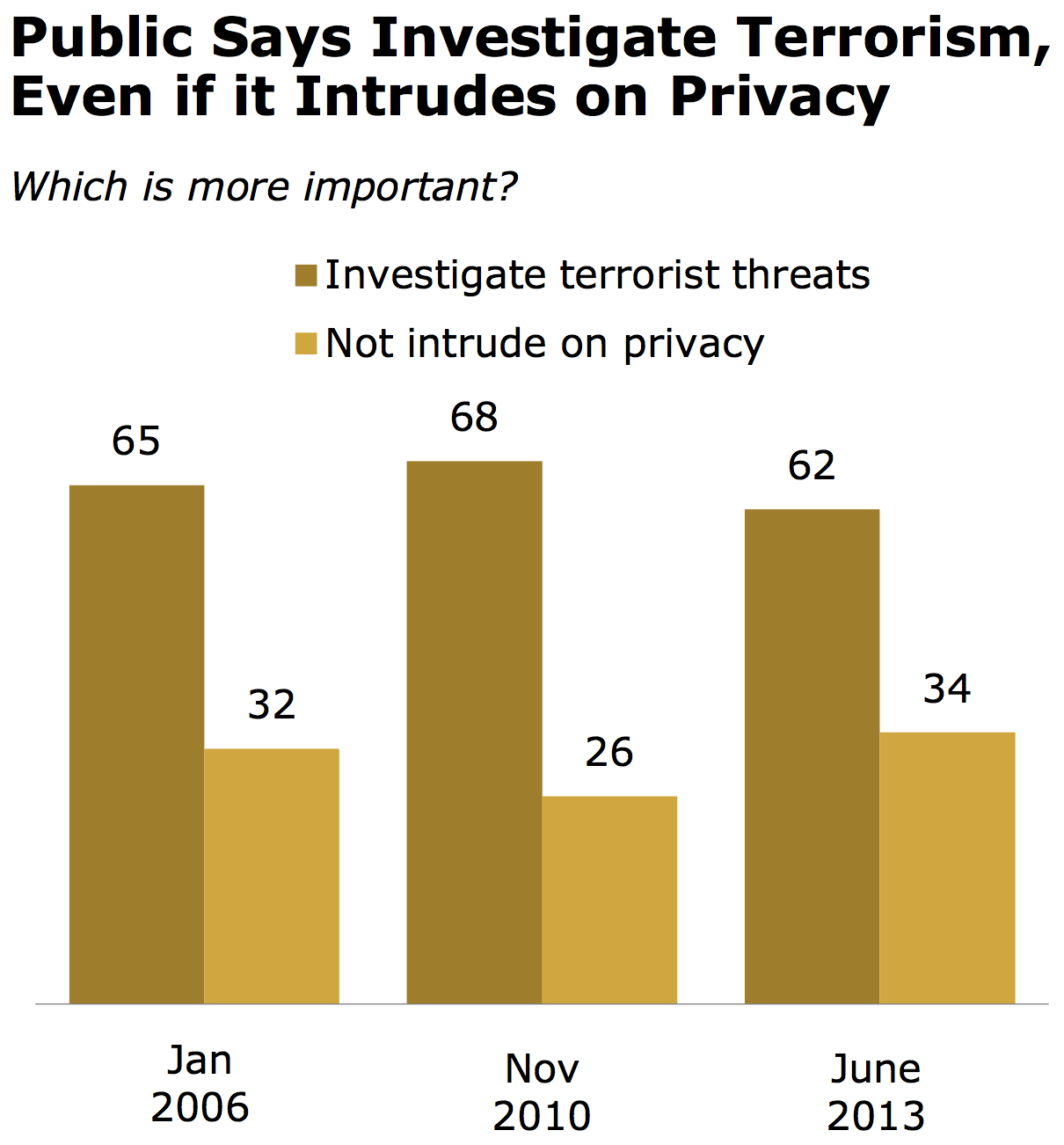
One interesting aspect of these poll results is the partisan hypocrisy: Having a Democratic president has made Democrats more inclined toward surveillance and Republicans less so. But the more important finding is simply that public support for intrusive surveillance is high, under both Republican and Democratic presidents.
I’m surprised anyone is surprised. What’s truly noteworthy about this poll, I think, is how many people felt comfortable telling a pollster that they support surveillance of phone records and e-mails. I figured every poll on this subject would be more in line with Rasmussen’s result this morning, in which 59 percent of likely voters said they oppose government collecting phone records. That’s the answer many people will sense they’re “supposed” to give when a stranger’s pressing them on their tolerance of governmental invasions of privacy. And yet here’s Pew finding 56 percent willing to tell them okay on phone records and 45 percent on e-mails. If that’s what people are willing to say out loud, how much more are they secretly willing to accept? And even if, somehow, those numbers accurately reflect opinion, how likely is it that significant policy changes will happen on a 50/50-ish issue? Not much to be happy about here if you’re a civil libertarian.
Alas, no. Unless you believe, as I do, that this kind of meta-data gathering is actually preferable to the traditional wire-tapping techniques as a first option and can get you information that minimizes the risk to innocent third parties. And I just want to say that this was not something I objected to under Bush either, when I objected to a lot. This is not partisan on my part.
Malcolm Harris remains unsatisfied by the administration’s latest effort to address the rising student debt crisis:
President Obama, Senator Warren (D-MA), and Congressional Republicans have offered different plans that tinker with rates and/or tie them to the Treasury’s borrowing costs. These solutions might depress the embarrassing government profit and save borrowers a few here or there, but none of them even begin to address the root causes of the student debt crisis. They’re Band-Aids on broken limbs, and any answer that includes former students—it’s important to remember not everyone who takes out debt graduates with a degree—paying back the entire trillion-dollar outstanding total is downright cruel. And until policymakers start talking about forgiving existing debt and actively reducing higher education costs, anything else is simply a distraction.
David Dayen emphasizes that student loans aren’t even loans in the traditional sense:
Students currently paying high interest rates should be able to refinance, and reap the rewards of the Federal Reserve’s quantitative easing that asset-holders have enjoyed for so long. Sen. Kirsten Gillibrand’s bill would mandate refinancing on all federal student loans into fixed 4 percent loans, which would benefit 90 percent of all current loans, and save 37 million borrowers around $14.5 billion in the first year alone. The Consumer Financial Protection Bureau has proposed a similar refinancing scheme for private student loans, which the government backstops anyway. The president constantly talks up the glories of refinancing for homeowners to reduce payments; students deserve the same lifeline.
My generation got a cheap college education when we were young, and we’re getting good retirement benefits now that we’re old. Pretty nice. But now we’re turning around and telling today’s 20-somethings that they should pay through the nose for college, keep paying taxes for our retirements, and oh by the way, when it comes time for you to retire your benefits are going to have to be cut. So sorry. And all this despite the fact that the country is richer than it was 50 years ago.