We have the picture of you in mind,
when you were young, posturing
(for a photographer) in scarves
(if you could have done it) but now,
for none of you is immortal, ninety-
three, the three, ninety and three,
Mary, Ellen, and Emily, what
beauty is it clings still about you?
Undying? Magical? For here is still
no answer, why we live or why
you will not live longer than I
or that there should be an answer why
any should live and whatever other
should die. Yet you live. You live
and all that can be said is that
you live, time cannot alter it–
and as I write this Mary has died.
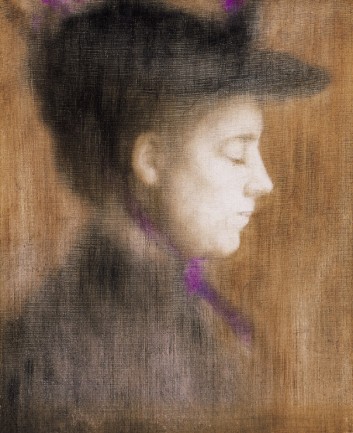
(Image: Woman in Paris with Purple Scarf, József Rippl-Rónai, via Wikimedia Commons)
A new study suggests that meeting online is eclipsing more traditional matchmaking methods, and it’s even associated with a higher likelihood of staying together:
About 35% [of study participants] reported that they had met their spouse online, more than through introductions by friends, work and school combined. The study revealed that people who used this method to meet their spouses were slightly older, wealthier, more educated and more likely to be employed than those who went with tradition. But only about 45% of these online meetings took place on a dating site; the rest occurred through social networks such as Facebook and MySpace, as well as chat rooms, online communities, virtual worlds, multi-player games, blogs and discussion boards. …
About 94% of marriages that had started online lasted at least until the time of the survey in 2012, compared with about 92% of those in the offline group. The difference was still statistically significant after controlling for other demographics such as age, race, religion and income.
And something to consider while choosing an online dating service:
[T[he study examined differences between 18 individual dating sites, including eHarmony, Match, Plenty of Fish and Yahoo Personal. After controlling for demographic factors, they found no significant differences in the number of reported break-ups by people using the various services. But there were notable differences in marital satisfaction between users of different sites. For example, those who married a spouse they met on eHarmony rated their marriages more highly than did those who met on Match, who were in turn more satisfied than those who met their spouse on Yahoo Personals.
Previous Dish on marriages forged online here and here.
April Bernard regrets that Sylvia Plath died before exploring “political themes nascent in her final work, which many readers ignore or misread as only ‘personal'”:
Take “Daddy,” a key example of how, in her last poems, Plath’s politics began to emerge more clearly. Of course many will already have its catchy thumping iambs imbedded in their minds—“You do not do, you do not do…” Here’s a stanza from later in the poem:
I have always been scared of you,
With your Luftwaffe, your gobbledygoo.
With your neat mustache
And your Aryan eye, bright blue.
Panzer-man, panzer-man, O You—
Plath can cause embarrassment through overstatement—going a little too far is her signature move. (One line from “Elm,” another late poem, that best captures her veer towards overstatement is, “I have suffered the atrocity of sunsets.”) But if we consider embarrassment as an aesthetic strategy rather than as a mistake, we begin to see how funny Plath often is. I confess I had read and admired Plath for several years before her humor struck me full-force—the first time I heard a now-famous BBC radio recording in which she reads “Daddy” with a discernible wave of laughter in her voice. (And yes, there is also rage, and profound sorrow.) I re-read the poem, and realized for the first time that her exaggerations and preposterous claims, which link the Holocaust with an American middle-class “family romance,” were meant to be an elaborate joke, one in extreme bad taste, right on the edge of kitsch. …
At the time of the poem’s writing, in the early 1960s, the first psychoanalytic studies of Hitler’s childhood were appearing in print; and this poem also has to do with how the Teutonic, rigidly patriarchal, model of the family affects the culture at large. When Plath says, “I may be a bit of a Jew,” she may indeed, as some critics have said, be speculating about her own origins; but more likely she is asserting that, for the purposes of her family, she contains the seeds of the “other” that must be eradicated. In the comic-grotesque scenario of “Daddy,” the bullying father is Hitler, the at-last rebelling daughter a Jew who is deciding, after all, not to be wiped out in the threatened genocide. “Daddy, Daddy, you bastard, I’m through,” as the final line ringingly announces, is a political rejection of patriarchal bullying at least as much as it is adolescent foot-stomping.
David C. Ward honors the friendship of mid-20th century poets Robert Lowell and Elizabeth Bishop:
Both Lowell and Bishop were extraordinary correspondents. Does anyone write letters anymore? But Lowell and Bishop were among the last of the generations that considered letter writing an art form. Composing experiences and thoughts in a way that was coherent and reflective, Lowell and Bishop viewed letters as minor works of art, as well as a way to keep the mind alert to writing poetry. … [T]he other great thing about Bishop and Lowell: they wrote poems in response to each other. Their letters were private communications but the poems were a public dialogue carried out in counterpoint.
Their call-and-response verse exchange includes Bishop’s “The Armadillo,” to which Lowell replied with “Skunk Hour.” Then it was Bishop’s turn:
Lowell never read Bishop’s response: it came in a memorial poem called “North Haven,” a poem like “Skunk Hour” about the seacoast. It’s a lovely tribute, full of rueful knowledge of Lowell’s character: “(‘Fun’—it always seemed leave you at a loss. . .)” and ends with
You left North Haven, anchored in its rock,
afloat in mystic blue. . .And now – you’ve left
for good. You can’t derange, or rearrange,
your poems again. (But the sparrows can their song.)
The words won’t change again. Sad friend, you cannot change.
It’s uneasy to cite sadness or depression as a cause of artistic creativity; most depressives aren’t great poets. Both Lowell and Bishop were sad in their various ways. Poetry, Robert Frost wrote, provides a “momentary stay against confusion.” But that’s not all it does. Indeed, in the case of Bishop and Lowell it could be argued that it was the letters that provided a structure of meaning and feeling for both poets that helped them make sense and order their experience. The poems themselves are something else entirely: expressions of feeling and self-knowledge that appear as art.
For more on their poetic back-and-forth, head here.
This [book] has some of the same faults as Dark Star Safari, including the sweeping overstatements (Cape Town is not the only city in Africa to aspire to grandeur) and generalisations about Africa and Africans: imagine how annoying it would be to read a book set in England where the natives are constantly referred to as Europeans. And yet it is hard to put down The Last Train to Zona Verde, for no other reason than for its core of brutal honesty, about the author himself as much as about the places he visits.
Far less forgiving is Hedley Twidle, an instructor at the University of Cape Town, who dresses down Theroux from a local perspective:
Theroux is unwilling to let go of his African fantasies. … As Theroux-watchers will know, his sub- Saharan travelogues read as if he had taken Binyavanga Wainaina’s sarcastic instructions on “How to Write About Africa” literally. He is, as the sharp-eyed blog Africa Is a Country remarks, “so reliable that way”. He mints generalisations and insults at such a clip that they soon begin to outstrip even the most gifted parodist. Africa “can be fierce”, we are told, but “in general … turns no one away”. Game animals have all but disappeared from war-torn Angola but human specimens substitute, “many of them, in their destitution, taking the place of wildlife”. He is told to avoid eye contact with hustlers at the border, which proves “strangely prescient” – “Animal behaviourists agree: stare at a chimp and he is likely to attack you.” …
The rhetoric is so offensive and plain bizarre to anyone making her or his life in “Africa” that I had no option but to pretend that we were in a different genre, to keep imagining the book as a comic novel with a deliberately unlikeable narrator.
The final verdict?
Bankrupt in more ways than one, then, this is a book I would recommend only as a teaching aid or to someone interested in tracking the final sub-Conradian wreckage of a genre, rusting away like the hulks of tanks that so fascinate the narrator along the roads in Angola. It is imbued not just with the narrator’s old age but the senescence of an entire genre.
Michael Kazin explains why Woodrow Wilson, who took office 100 years ago, isn’t celebrated like FDR or even LBJ:
Despite his academic background and cerebral image, Wilson, like Obama now, was a masterful orator. Unlike nearly all his predecessors, he thought the public deserved to hear their elected leader explain, in a variety of venues, what he was doing and why. … He bet that a massive army and compelling ideals would cleanse the world of autocracy, empire, and, with the new League of Nations, perhaps even war itself. Yet Wilson famously lost that bet—as the other victorious Allies retained their colonies, the Senate voted against the U.S. joining the League, and the lethal movements of fascism and Communism emerged from the ashes.
That great failure was the last public act of Wilson’s life. It tarnished his reputation for years to come and is still the primary reason why he gets no love from liberals today. More than his dour demeanor, his excessive moralism, or his paternalistic racism, it demonstrates the peril of thinking that a war made by Americans can magically turn the world from the darkness of oppression toward the light of tolerance and democracy. Having gained the presidency as a critic of the disaster in Iraq, Barack Obama, another former academic, seems to grasp that truth.
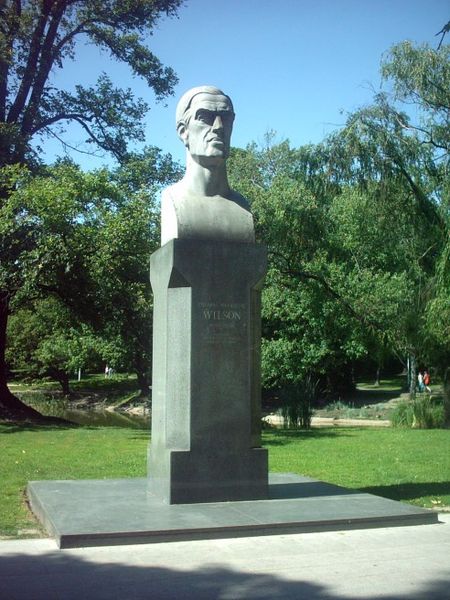
(Photo: A monument of Woodrow Wilson in Poznań, Poland, via Wikimedia Commons)
Josh Jones digs up an old cartoon version of “The Happy Prince”:
He uses the story to contextualize Wilde’s moral sensibilities:
Wilde was ridiculed for the many of the same reasons he was feted—his flamboyant public persona and devotion to aestheticism, which satirists caricatured as a kind of decadent navel-gazing. But careful readers of Wilde’s diverse canon of poetry, prose, and drama will know of his critical looks at solipsism and superficiality. Some of his best works as a moralist are his children’s stories, such as the 1888 book of fairy stories The Happy Prince and Other Tales. In the title story, a prince is transformed into a glittering statue on a pedestal high above a city, where residents look up to him as an example of human perfection. But the prince, we learn, spends his time weeping in compassion for the poverty and suffering he sees below him. Made in 1974 by Canadian company Potterton Productions, and featuring the voices of British actors Christopher Plummer and Glynis Johns, the animated short film above is a faithful rendering of Wilde’s story.
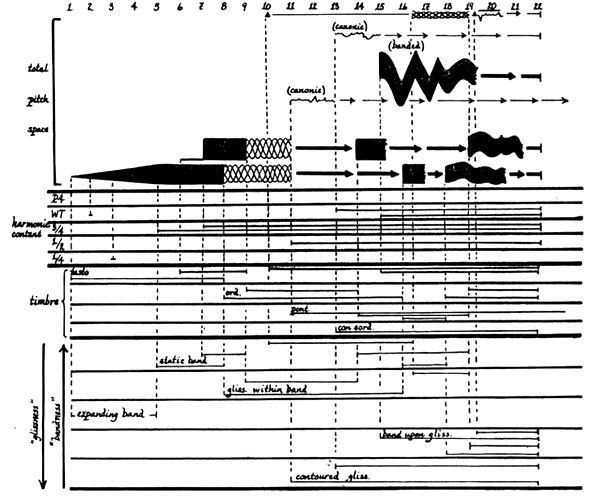
Jimmy Stamp reviews some of the stranger deviations from standard notation, like the sheet music to Krystof Penderecki’s “Polymorphia,” based on measurements of brain activity:
As the name suggests, the piece does indeed take various forms and changes dramatically from section to section. With “Polymorphia,” Penderecki was searching for new sonic possibilities and, if those possibilities include “terrifying haunted house music,” he absolutely nailed it. The composition is intended for 48 string instruments and emphasizes timbre rather than pitch, and the collision of sound generating bodies made of metal, wood, or leather – what music scholar Danuta Mirka refers to as the composer’s “primary materials”. The notation was inspired, in part, by electroencephalograms –visual measurements of brain activity. It eschews traditional measures in favor of a score divided into sections of variable length and, in some sections, further vertical divisions to mark each second, with a “total pitch space” describing the relative pitch of each instrument.
We have the picture of you in mind,