You have until noon on Tuesday to guess it. City and/or state first, then country. Please put the location in the subject heading, along with any description within the email. If no one guesses the exact location, proximity counts. Be sure to email entries to contest@andrewsullivan.com. Winner gets a free The View From Your Window book. Have at it.
You Probably Won’t Finish Reading This Post
Manjoo is on to you:
Only a small number of you are reading all the way through articles on the Web. I’ve long suspected this, because so many smart-alecks jump in to the comments to make points that get mentioned later in the piece. But now I’ve got proof. I asked Josh Schwartz, a data scientist at the traffic analysis firm Chartbeat, to look at how people scroll through Slate articles. Schwartz also did a similar analysis for other sites that use Chartbeat and have allowed the firm to include their traffic in its aggregate analyses.
Schwartz’s data shows that readers can’t stay focused. The more I type, the more of you tune out.
And it’s not just me. It’s not just Slate. It’s everywhere online. When people land on a story, they very rarely make it all the way down the page. A lot of people don’t even make it halfway. Even more dispiriting is the relationship between scrolling and sharing. Schwartz’s data suggest that lots of people are tweeting out links to articles they haven’t fully read. If you see someone recommending a story online, you shouldn’t assume that he has read the thing he’s sharing.
OK, we’re a few hundred words into the story now. According to the data, for every 100 readers who didn’t bounce up at the top, there are …
Hey, that’s what the Dish is for! We edit the web for short-attention spans. Longer form pieces really do belong on the tablet instead. But you can always dig deeper if you want. That’s what hyper-links are for. If you’re still with me.
Maps Of The Day
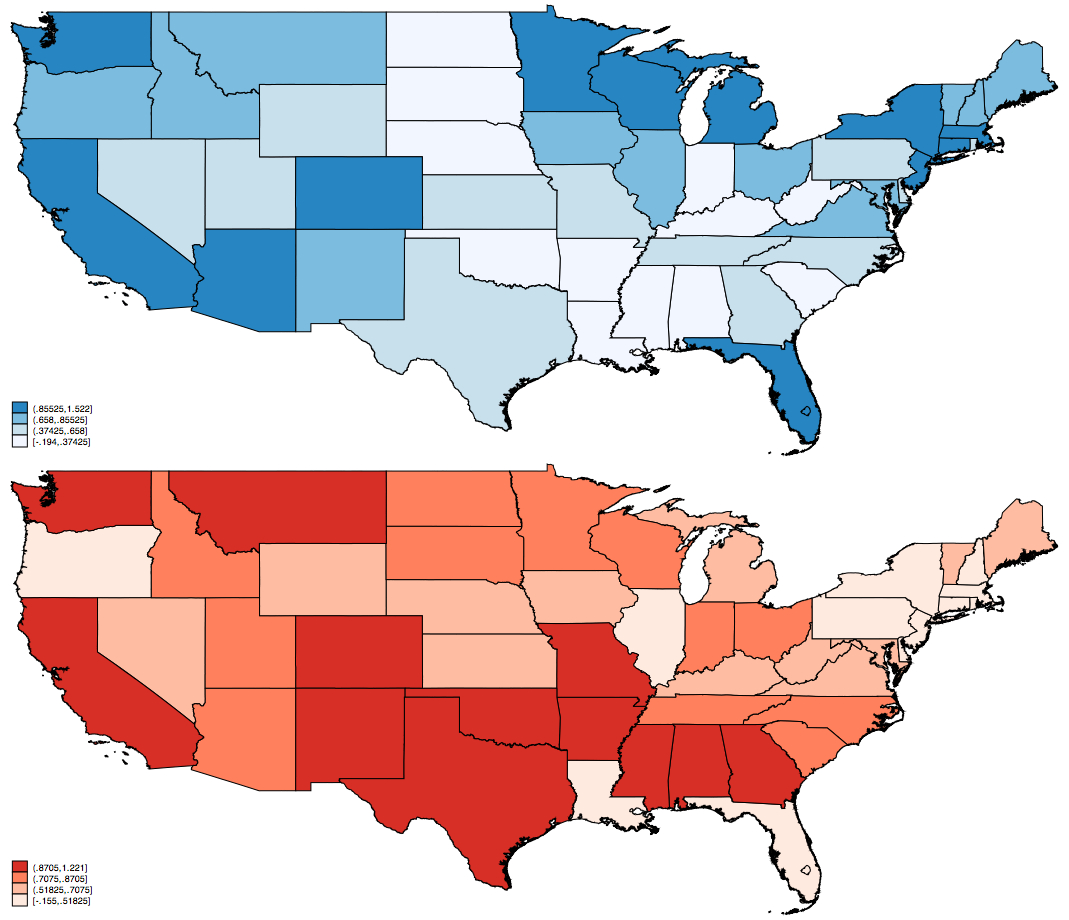
Seth Masket constructs the above maps, which show the median ideological score for state legislators (darker states are more extreme), taken from what he calls “one of the most important datasets on state politics, legislatures, and parties to be released in a long, long time”:
[T]hese graphs don’t really tell us why a state might have extreme or moderate legislators. The Republican parties of the deep South are probably very conservative because they represent some of the most conservative voters in the country, while the extremism of parties in more moderate states may be more an indicator of the strength of party organizations in screening out moderates in primary elections.
Still, this sort of data is extremely useful if we want to understand the political context of a state party and the politicians who emerge from it. Barack Obama was an Illinois state senator (yep, he’s in the dataset — ideal point of -.695), although they’re far from the most liberal group of Democrats in the country. George W. Bush got along famously well with Texas Democrats when he was governor, but those are among the most conservative Democrats in the land. How has Chris Christie survived in blue New Jersey? Well it probably helps that his state’s Republicans are moderate by national standards, keeping pressure off him to veer rightward.
Getting In The Muck
Anas Aremeyaw Anas went undercover to report on disturbing stories of crime and corruption in Ghana:
Certainly Anas’ immersive tactics can be extreme. While working on a story on the Accra Psychiatric Hospital, Anas played the part of the patient, taking prescribed drugs that left him impotent for a week after he left the hospital. And in his most recent story, on Nsawam Prison in Ghana, Anas shows footage of queuing for a “proper” toilet — a manhole in the middle of the yard, around which four men are squatting, back to back. The footage, which he showed for the first time at TED2013, also contains a harrowing shot of a room within the prison piled high with dead bodies.
In the TED talk seen above, Anas speaks from behind a wire mask to conceal his identity. Below you can watch his short film, “Ghana’s Madhouse Story”:
How Do We Know What We Want?
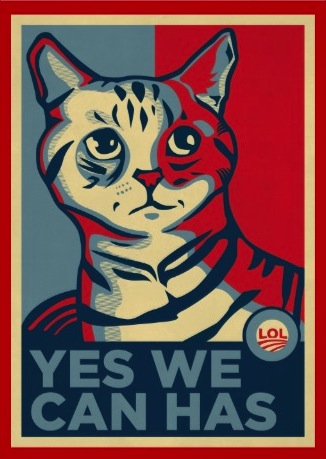
Do college kids prefer Monet and Van Gogh to lulzy cats? UVA researchers asked two groups of students to rate five posters (two art posters, three humorous and cartoon- or cat-themed) and pick one to take back to the dorm. The test: how would results between groups differ if only one group of students was asked to reason about their preferences?
This “reasons” group liked the art posters less [than the control group] … and the humorous posters more. … Most of them still chose an art poster to take home, but it was a far lower proportion – 64% [vs 95%] – than the control group. That means people in this group were about seven times more likely to take a humorous poster home compared with the control group.
Here’s the twist. Some time after the tests, at the end of the semester, the researchers rang each of the participants and asked them questions about the poster they’d chosen: Had they put it up in their room? Did they still have it? How did they feel about it? How much would they be willing to sell it for? The “reasons” group were less likely to have put their poster up, less likely to have kept it up, less satisfied with it on average and were willing to part with it for a smaller average amount than the control group. Over time their reasons and feelings had shifted back in line with those of the control group – they didn’t like the humorous posters they had taken home, and so were less happy about their choice.
But Tom Stafford insists that “the moral of the story isn’t that intuition is better than reason”:
We all know that in some situations our feelings are misleading and it is better to think about what we’re doing. But this study shows the reverse – in some situations introspection can interfere with using our feelings as a reliable guide to what we should do.
And this has consequences in adulthood, where the notion of expertise can mean struggling to discern when introspection is the best strategy. The researchers who carried out this study suggest that the distorting effect of reason-giving is most likely to occur in situations where people aren’t experts – most of the students who took part in the study didn’t have a lot of experience of thinking or talking about art. When experts are asked to give reasons for their feelings, research has found that their feelings aren’t distorted in the same way – their intuitions and explicit reasoning are in sync.
(Image: Lolcat poster available here)
Faces Of The Day
The faces of two women in a window display advertisement peek out from floodwaters in a street flooded by the nearby Elbe river in the historic city center of Meissen, Germany on June 6, 2013. Eastern and southern Germany are suffering under floods that in some cases are the worst in 400 years. At least four people are dead and tens of thousands have evacuated their homes. By Sean Gallup/Getty Images.
Peak Faggot? Ctd
A reader writes:
I wonder whether your perception of “faggot” would change if you considered the continuing debate on reddit over the use of the “OP is a faggot” meme. This meme appears (and is usually upvoted to the top of the thread) almost without exception in cases where the original poster (OP) of the thread is suspected of wrongdoing – usually lying about the nature of the post, reposting old content without acknowledging the source, or making things up to get karma. These things happen a lot on reddit and so you don’t have to spend much time there to see “OP is a faggot.”
Many redditors will tell you that they are only using the term as you describe it – a “general term of abuse for straight women and straight men” that is “jokey” and “has been drained of any explicit homosexual meaning.” All you need to do to see the dishonesty of this claim is to look at one of the most popular ways to call OP a faggot – using an image meme. Search Google images for “OP is a faggot” for some representative examples. These images almost universally involve homosexual sex, gay stereotypes, or other direct allusions to a man being gay. Generally they consist of a man who has been caught in a situation that reveals that he is homosexual, with an arrow labeling the man as “OP.” And yet on the very same thread where they post and upvote these images, redditors will tell you with a straight face that “OP is a faggot” has “nothing to do with being gay!” and, often, what a faggot you are for ruining their fun by pointing out that it does.
Earlier perspective from readers on “No Homo” here.
The Best Of The Dish Today
The second shoe in government surveillance of meta-data dropped, this time through a leak to the Washington Post. I remained underwhelmed – but was glad this was now in the open so we can actually have the conversation David Foster Wallace wanted. The latest job numbers were between meh and yay; and with the emergence of a transgender former Navy Seal, a cultural watershed was passed, something one could not say about the new movie, The Internship (unlike TV’s Breaking Bad).
The most popular posts of the day were Fareed Zakaria on Turkey (again!) and The FBI May Have Your Phone Records. The most popular posts of the week were When Rape Triggers An Orgasm and my chat with Dan Savage on sex, monogamy, love and marriage.
Oh and I don’t hate Glenn Greenwald.
See you in the morning.
How Much Does Campaign Cash Really Matter?
Lee Drutman uses one of the Koch brothers to illustrate the difficulty of tracking political donations:
The case of Charles G. Koch is a nice lesson in just how hard it is to determine who is breaking and who is abiding by campaign finance limits. It’s hard to make accurate tallies of individual aggregate campaign contributions when the Federal Elections Commission doesn’t require donors to have a unique ID, and when campaigns don’t always reliably report donor names. … It’s also challenging because recount funds are exempted from aggregate individual donation limits, but the FEC doesn’t provide data in a form that makes it easy to separate out those contributions from ones that do count. The only way to effectively enforce the law is to spend endless hours hand-verifying individual FEC records. It’s almost as if the system were designed to make enforcement impossible.
Seth Masket, in contrast, wonders why we’re “still getting worked up over the Citizens United decision”:
A lot of political commentary, particularly that emanating from the combination of journalists, politicians, and activists he calls the “campaign finance community,” claimed that the growth of Super PACs and other well-heeled political organizations in the wake of the Citizens United case would overwhelm the voters’ voice. Yet despite unprecedented sums spent by these groups on behalf of Mitt Romney and many Republican congressional candidates, the votes ended up going almost exactly as we would have otherwise expected.
This isn’t a new pattern. It has generally been very difficult to pinpoint any specific effect of campaign spending on a general election outcome. … Now, none of this means that campaign spending doesn’t matter at all, of course. Even with very small effects, an absurdly huge expenditure of money could be critical. But there is a saturation point where you just can’t get any more ads in front of people’s eyes. And we really don’t have a sense of whether the ads put together by Super PACs are as effective as those aired by the campaigns themselves. … But the idea that voters can be bought with enough money just doesn’t hold water. And given that recent efforts to make campaign finance more fair just seem to result in more byzantine rules and less transparency, maybe we should stop trying to do that for a while.
I tend to agree that the wave of Super-PAC money didn’t alter the core dynamics of the campaign – a major relief, as well as a major blow to campaign finance reformers. Meanwhile, Kay Steiger makes the case that “the Citizens United ruling has led to to the unprecedented amount of state-level anti-choice legislation in the last several years”:
[Crow After Roe author Jessica Mason] Pieklo explained [on Democracy Now] that National Right to Life, Americans United for Life, Liberty Council and the Tomas Moore Center are groups whose goals are either to overturn Roe v. Wade, making abortion once again illegal, or to make abortion so inaccessible that abortion is legal “in name only.”
“One of the reasons that the book looks at the onslaught of legislation after 2010 is that there is an explosion at the state level, and that is in large part due to one of the driving forces, and that is James Bopp Jr., who is one of the legal forces behind the challenge that created the Citizens United decision,” Pieklo said. “He sparked — and his group, National Right to Life — sparked a lot of the initial campaign finance challenges through conservative groups, so as a result of unrestricted funding at the state level, that’s where we’re at right now as a result of it.”
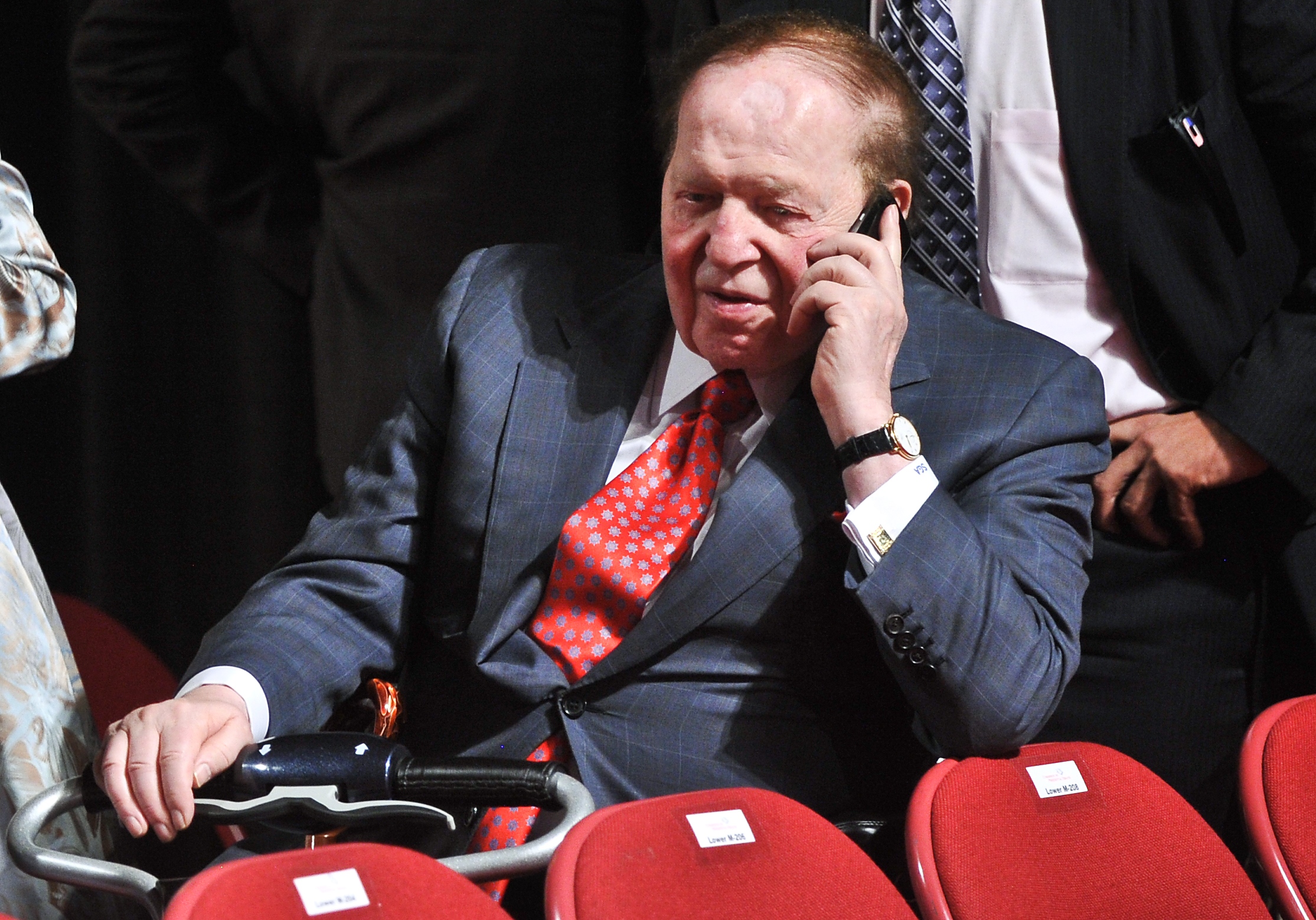
(Photo: US business magnate Sheldon Adelson speaks on the phone after attending the first presidential debate between US President Barack Obama and Republican challenger Mitt Romney in Denver, Colorado on October 3, 2012. By Nicholas Kamm/AFP/Getty Images. Adelson shelled out more than $100 million on failed GOP candidates during the 2012 cycle.)

Chart Of The Day

Brian Merchant unpacks it:
The useful thing about this graph, though, is that we’re then treated to a window of how these carbon sources are tied to crucial industrial and social functions, and how closely interlinked and therefore how massively difficult to unlink they are. As David Roberts notes at Grist, “Industry uses coal for high-heat operations like coking for steel production and it’s difficult to replace that kind of thing with electricity.” That’s a tough one indeed.
The vast majority of our oil is pumped directly into the vast majority of our cars, and that’s another 15% of the problem. Energy-guzzling residences and commercial buildings are another 20%.
And, as you can see here a full third of global warming is caused by “direct” emissions—methane emitted by agriculture and waste degradation, and our nasty habit of chopping forests down, which releases the CO2 they were storing before we ship them off to Home Depot.