Senators For Life

Barro encourages greater turnover in Congress and looks for a “politically salable option”:

Frank Lautenberg missed most Senate votes this year because of ill health. Still, when Newark’s mayor, Cory Booker, announced his plan to run for Senate whether Lautenberg retired or not, some Democrats were aghast. Lautenberg aides told reporters that Booker was being “disrespectful,” and Lautenberg himself mused about spanking Booker like a disobedient child.

This is nuts.

Senate seats aren’t property, and Lautenberg wasn’t entitled to cling to his job even as he became too old and infirm to carry it out. We should have an expectation about Congress, as we do with other high-powered and demanding jobs, that people will retire when they are no longer up to the demands. …

[T]he best option is to change our norms about incumbency. Booker had this one right: being a good team player shouldn’t always mean waiting around for your party’s incumbents to retire. More politicians should be willing to make primary challenges, and state political parties should be more tolerant of them. And voters should recognize that “senator” is a job that benefits from turnover.

Claire Potter adds:

[P]erhaps the real question is not how old the Senate is, but how young it is not. If 37 senators are older than 65, only 12 senators are younger than 50. Demographically, the middle-aged, old and elderly are governing a nation entirely unlike the one they were formed by and educated in. Our most urgent policy questions – education, health care, immigration, communications technology, climate change, social security, long-term care for disabled veterans of Afghanistan and Iraq – are about what country the young will inherit.

Isn’t this why we could use some retirements in the Senate?

Recent Dish on the political age gap in Britain here.

Chart Of The Day

Opinion Immigration

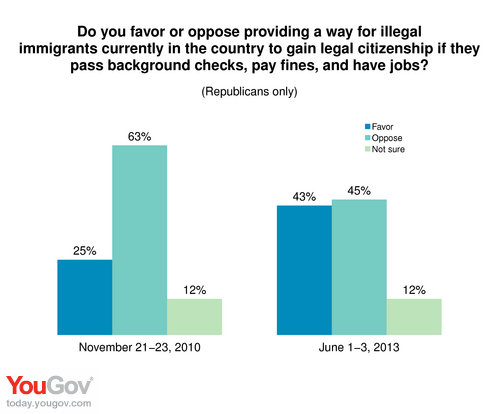
YouGov compares public opinion on immigration from 2010 and 2013:

[I]n 2010, Republicans overwhelmingly opposed opening up a pathway to citizenship; now, perhaps worried about their party’s weakness with Hispanic voters in recent elections, they divide evenly. Those in the West are among the most likely to say that immigration is a serious problem in their community (and 27% admit they know someone in this country illegally); they support this kind of path to citizenship 53% to 32%.

Know hope.

Can This Party Be Saved? Ctd

Pascal-Emmanuel Gobry summarizes the goals of reform conservatism:

Reform conservatives believe that the GOP should put forward serious and credible policies that directly address the issue of family formation and breakdown. It will be good for the economy, good for people, A Surabaya Zoo health worker checks theand is a prerequisite to shrinking government over the long term since voters will not acquiesce to shrinking public handouts if they do not feel that they have private safety nets available, first among which is the family. Furthermore, as Jonathan V Last has pointed out, it’s good politics since family formation is a key driver of voting for the GOP.

The reform conservative blueprint, then, goes something like this: Address family formation seriously -> win elections -> make it easier to start families and have kids -> more families and more kids -> a better economy, a healthier society, less demand for big government, more GOP voters -> win more elections -> shrink government, grow the economy and civil society -> win more elections -> rinse, lather, repeat.

The alternative scenario would go something like this: Don’t address middle income voters’ day-to-day concerns seriously, don’t make family formation more affordable -> concede the field to Democrats -> increase economic and social insecurity -> increase demand for government -> lose elections -> government grows bigger -> social pathologies get worse -> keep conceding the field -> increase demand for government -> etc. 2012 was Act I of that nightmare scenario.

I need to fess up. I endorsed Ross’ and Reihan’s book, but took longer than they did to let go of my libertarian instincts in the face of yawning social inequality. It’s only been since the impact of the Great Recession sank in that I have truly come to terms with the fact that, say, flat taxes are irrelevant right now to our major problems, or that publicly subsidized private health insurance is an important response to a middle class facing an epic (if much predicted) employment and economic crisis.

I do believe, with Reihan and Ross, that supporting family formation is vital – hence my support for marriage equality (and my bafflement at Ross’ ambivalence). But my preference is for government to stop doing things that actively harm family life, rather than using money transfers to shore it up against some resilient social trends that may actually be helping marriage become more moral over time. Hence my passionate support for welfare reform in the 1990s. But there’s a core agreement: the times demand a different response than that imprinted on so many of us under Reagan-Thatcher; and encouraging self-government is the best way to keep big government at bay. If the GOP were to accept the principles of Romneycare/Obamacare, for example, they could then help reform the architecture to control costs better, empower individual choices more, and win people like me back.

Bouie makes the rather obvious but no less potent point that conservative reformers have almost no actual, you know, power:

The Republican Party is broken, and fixing it is the only way to bring long-term sanity to our politics. Unfortunately, there’s no sign of change. Last week, writers on the left and the right engaged in a debate over the conservative “reform” movement, and who counted as a “reformer.” It was a fascinating conversation with one major takeaway: Regardless of who “counts” as a reform, the obvious fact is that they have little influence over the current direction of the GOP. They lack the power necessary to challenge Republican leadership, break the party’s “fever,” and begin to reestablish it as a mainstream institution.

There is, as yet, no Tony Blair of the American right, grabbing his party by the scruff of the neck and forcing it to adapt to a new reality. And there is the persistence of the fundamentalist psyche which regards any sort of pragmatic accommodation to new political and economic realities as psychologically destabilizing. Yes, I agree with Thomas Mann and Norman Ornstein that the current nihilist extremism of the current Republican Party is “the central problem in American life.” And yet I find the chances of getting reform from within close to impossible, given how far they’ve now gone over the edge. And this is a tragedy not just for America, but for the GOP itself.

The greatest failure of the GOP is not realizing that Obama is a president they could have worked with on policy grounds, and whose relationship with them could have actually defused some of the very traits that suburban voters and most generations under 40 still find so disturbing in the GOP base.

Here, for example, was a man whose family life would make him a cult hero if he were a Republican, but who has been demonized as an alien threat to America from the get-go. Here’s a Democrat who adopted Heritage Foundation ideas for healthcare exchanges. Here’s a Democrat who has actually cut Medicare. His stimulus was one-third tax cuts. Domestic energy production has soared under Obama, even as record numbers of illegal immigrants have been deported. There were and are so many ways in which the GOP could have used Obama for their own advantage – both strategically and culturally. But they refused to, opting instead for visceral, dumb, self-defeating short-term tactical political advantage. All tactics and emotion; no strategy and reason.

And even the reformers are constrained. Have Ross or Reihan ever said that although they’d prefer a different healthcare reform, Obamacare is better than nothing? If they did, they’d be Frummed out. Or take Yuval Levin, recently tackled by Chait:

Levin may arrive at conclusions that gratify the tea party, but he does not merely rant against big government. He presents his analysis as the considered result of careful study. He harnessed himself, at least rhetorically, to a series of falsifiable claims. They are being falsified, but the restraints of his ideology give him no room to do anything but obfuscate.

I’d qualify that as the restraints that partisanship imposes on him. But they rode this tiger for so long it’s hard to feel pity as they try both to get off and not be eaten at the same time. Previous thoughts on the subject here.
Obama’s Second Term – In Cartoon Form

My now ancient cartoon analogy of the relationship between the GOP and president Obama was the road-runner (el presidente) and Wile. E. Coyote (think Tea Party). Then the other night, as I was thinking about the challenges of the second term – specifically the legit and nutso scandal investigations by Ailes/Issa – another classic cartoon duo came to mind:

He even walks like the Pink Panther, when you think about it. Or rather glides. But I’ll probably stick to the meep and the meep.

Baseball’s War On Steroids

Major League Baseball recently announced the suspension of “about 20 players” for their connection to the performance-enhancing drug clinic Biogenesis. Update from a reader:

The MLB has not yet officially announced any suspensions, and the article you linked to references only leaked reports about potential upcoming suspensions. For a more in-depth discussion of the potential effect the suspensions may have on future labor relations you should check out this Grantland piece by Jonah Keri.

Pareene compares the MLB’s efforts to eliminate steroids to the war on drugs:

Years after BALCO, it looks as if just as many players are using. The league’s stricter enforcement has simply led to players getting more creative, and apparently relying on even less reliable sources. … Like the federal War on Drugs, enforcement is draconian and unequal (minor leaguers don’t get the protection and defense provided by the MLBPA). It is also occasionally incoherent: Marijuana use subjects players to suspensions and bans, though drunk driving doesn’t. There’s no concrete evidence that HGH does much for players beyond making them look really cut. At least Major League players have access, unlike your typical subject of the criminal justice system, to the best defense money can buy.

I’d say Alex is under-rating HGH, but his general point stands. Travis Waldron weighs in:

There exists … virtually no evidence that drug testing deters drug use.

Baseball doesn’t have records of drug use from before the testing era, so there isn’t any way to measure its efficacy. But the existence of tests and suspensions obviously hasn’t stopped Rodriguez, who admitted to steroid use in 2009, from associating with shady figures like Bosch, and it hasn’t stopped countless other players from using drugs either. Drug use is rampant in sports like cycling and the Olympics that have aggressive testing policies, and academic research has suggested that “testing alone is not a sufficient deterrent to eliminate drug use among college athletes.”

As for aggressive drug testing and busts of professionals serving as a deterrent for young athletes, Dr. Linn Goldberg testified in front of the House of Representatives in December that his two-year testing of high school athletes had no deterrent effect on their use of performance enhancing drugs. If drug testing young athletes doesn’t stop them from using drugs, should we really expect that drug testing professional athletes is going to stop young athletes from using drugs?

Obama’s Foreign Policy Shake-Up

The above comments will mean the usual brutal attacks on Power from the usual sources. But I have written similar things, and believe passionately that acquiescence to Israel’s continued settlement policy – designed to create a permanent Greater Israel – must be challenged by the United States. The constantly expanding occupation is against our values and against our interests. We should be using all our leverage to stop it, rather than funding it, as we continue to do. But Larison argues it’s the realists rather than the neocons who should be upset:

The one major issue that distinguished Rice and Power in the first term was their support for the Libyan war, and in spite of backing that misguided intervention both of them are being promoted. That tells current and future officials that there is no penalty in supporting unwise military action, and indicates that ambitious officials should push for more aggressive policies whether they are in the national interest or not. I don’t understand the selection of Power for the U.N. unless it is simply a reward to a long-time Obama loyalist. I suppose that the position has sometimes been filled in the past to make a political or ideological statement (see Bolton, John), and appointing Power to this post might be an exercise in placating liberal hawks disaffected with Obama’s recent foreign policy record. If so, I doubt it will work, since it will just make Obama’s liberal hawkish detractors more vocal in their demands that the U.S. intervene in Syria.

I suspect it won’t. Both Rice and Power have taken an anti-interventionist position on Syria, for the usual sane reasons (even if we could do something, what would that something possibly be? Arming branches of al Qaeda?). Besides, foreign policy under this president is made in the Oval Office. I’d say the reason behind these appointments is, as my shrink will often say, multi-determined. Rice and Power have extraordinary minds, moral clarity and the kind of self-discipline that Obama rewards. (Samantha’s campaign outburst against Hillary was, I like to think, the Irish in her temporarily escaping.)

I also think their gender matters. With Kerry replacing Clinton, the need for female prominence in foreign policy is all the more politically astute. While Erick Erickson is opining that women should naturally submit to their husbands as a matter of science, and the GOP wanders off into la-la land on abortion and contraception, Obama is shrewd to balance John Kerry at State with Rice and Power at the NSA and UN. (Full disclosure: I’ve known and admired Samantha ever since I turned her down for an internship at TNR way back when, but am not that close. And yes, that was a dumb mistake in retrospect.)

And if you were a president with a conscience but also a very cold, realist approach to foreign policy, wouldn’t you do exactly what he’s done? Find those most likely to argue for liberal intervention and bring them closer into the tent rather than risk them smoldering from a distance? They act as liberal buffers to an inherently conservative foreign policy (by which I mean the antithesis of neoconservative.)

Max Fisher sees the point:

[E]ven if Power and Rice did disagree with Obama on Syria, he’s already overruled more senior and experienced officials who wanted to upgrade U.S. involvement. He shot down a 2012 plan, backed by Defense Secretary Leon E. Panetta, Secretary of State Hillary Rodham Clinton, CIA chief David H. Petraeus and Gen. Martin E. Dempsey, chairman of the Joint Chiefs of Staff, to directly arm the Syrian rebels. Even if they wanted to, it’s not clear that Power and Rice would be better positioned to change U.S. policy.

Ali Gharib expects Power to be attacked, once again, over her comments about Israel (some of the most controversial seen above):

Will re-hashing these 2008 attacks squash Power’s nomination? Probably not. But will those segments of the pro-Israel right that attacked her in 2008 have at it again in 2013? Most definitely. And if the first salvos are any indication, they’ll use the exact same playbook they did five years ago. Like Chuck Hagel’s embattled nomination as Defense Secretary, Power will survive. But she’ll take some shots and come out hesitant to say ‘boo” about Israel.

Fisher puts Power’s old comments in context:

It appears that Kreisler asked Power how she, if she were a presidential adviser and human rights atrocities broke out in Israel-Palestine, would advise the president to “put a structure in place to monitor that situation [where] at least one party or another [may] be looking like they might be moving toward genocide.”

That last part is important: the hypothetical she’s addressing is about what to do if genocide appears imminent. He’s not asking Power, hey, do you think we should invade Israel to impose a two-state solution? Still, even remembering that she was being prompted with an extreme and unlikely worst-case hypothetical, Power’s answer was not ideal.

And James Gibney previews Power’s confirmation hearings:

Even if this doesn’t end up putting U.S. boots on the ground in Syria, Power’s confirmation hearings will showcase cognitive dissonance on both sides of the bench: Power as she bobs and weaves to avoid criticizing the administration’s relative inaction to stop the slaughter in Syria, and Republican Senators John McCain and Lindsey Graham as they hammer away at a nominee whose more robust views on intervention they doubtless have great sympathy for.

Samantha can take it. As long as she doesn’t get her Irish up.

I have to say on a personal note that I’m also moved by this Irish immigrant with such brilliance and passion representing the United States. In some ways, we actual immigrants, born abroad, represent a quintessentially and uniquely American experience: we chose this country because we love it and wanted to start our lives over. And it rewards us by treating us (if not in my case for a long time because of HIV) as if we belong here. That’s uniquely American.

(Thumbnail photo by Eric Bridiers, United States Mission Geneva)

What’s Up With Immigration?

The bill’s chances appear to have taken a turn for the worse. Chait assesses the situation:

Is the deal exactly what Rubio wanted? No. It wasn’t exactly what anybody wanted. But, again, that’s called “negotiation.” That’s why Democrats had to vote for utterly obnoxious provisions excluding gay couples. They didn’t like the things they voted for, but were under the impression that both sides were bound by the terms of the deal. Now Rubio is saying only they’re bound by it.

The question for Democrats is, at what point do they insist that a deal’s a deal? The dynamic here is that Republicans have a mainly political objective, and Democrats a mainly policy objective. The Republicans do want some changes to the law that would benefit businesses, but mainly they want to take immigration off the table as an issue in order to give themselves an opening to court Latino voters. Democrats are willing to take the issue off the table in order to get a substantive policy accomplishment.

He follows up here. My worry is that if this doesn’t get done by the fall, we’re entering primary season on the right and the lunatic choke-hold on pragmatic reform will tighten. Allahpundit analyzes Rubio’s recent demands for border-security guarantees:

If Rubio’s decided the bill’s current border-security provisions are untenable, it’s not because he’s been troubled by them all along and feels obliged to keep his initial promise. It’s because, despite his best efforts, the Gang of Eight simply won’t fly as-is among conservatives. He did his best to sell it and he couldn’t pull it off. Time for Plan B.

Drum is growing pessimistic:

“Those amendments” [that Rubio wants] are poison pills that would require 100 percent operational control of the border before any new green cards are issued, a standard that’s pretty obviously impossible to meet. The only reason to insist on them is to give Rubio a plausible exit strategy from his own bill.

Or so it seems. Maybe Rubio has something else in mind. But it’s sure starting to look like Rubio has figured out that his support for immigration reform is doing him more harm than good with the tea party folks he needs if he ever wants to become president. What’s more, he’s probably less confident than he used to be about the chances of getting the House to go along anyway, which makes it pointless for him to keep taking damage over the issue.

Ezra searches for a silver lining:

Letting Republicans break the bill into pieces makes it likelier that some of those pieces will pass. It also makes it easier for Republicans to vent their anger against certain parts of immigration reform — like the path to citizenship — without imperiling the whole bill. It makes it likelier that something, anything, passes the House.

Bernstein’s bottom line:

What Rubio’s apparent defection could mean is that the vote in the Senate will be a lot less overwhelming. But that only really matters to the extent that it puts pressure on the House. And what really matters in the House probably isn’t media pressure, but the basic calculation by mainstream conservatives about whether passing a bill is better than not passing a bill.