Crossing The Red Line

AFGHANISTAN-UNREST-ATTACK

Jason Lyall reads into the recent attack on the International Committee of the Red Cross’ (ICRC) headquarters in Afghanistan:

[I]n the words of Kate Clark, the attack has “crossed a red line” in the war, for the ICRC occupies a unique position as the most respected NGO in Afghanistan — including by the Taliban itself. Relying exclusively on its reputation for neutrality for protection, the ICRC monitors compliance by all sides with the laws of war; arranges for the return of war dead to their homes for burial; conducts site visits of prisons; and provides medical assistance to civilians and combatants regardless of their allegiance. Wednesday’s attack represents the first time that its offices have been targeted since the ICRC first arrived in Afghanistan in 1987. There’s little question that this attack was deliberate rather than accidental. …

[W]hile new facts will undoubtedly come to light, the 29 May attack against the ICRC may foreshadow the changing nature of war over the coming year in Afghanistan. If the ICRC attack is any guide, we are likely to witness a continued shift away from insurgent violence against dwindling foreign forces and toward a deliberate targeting of aid organizations and government ministries in high-profile attacks. These attacks, in conjunction with efforts to destroy or subvert Afghan security forces, will place international organizations and NGOs in an increasingly tight bind: continue programming and suffer losses, or head for the exit?

(Photo: An Afghan policeman stands guard beside the burnt out wreckage of vehicles of the International Red Cross after an attack in Jalalabad on May 30, 2013. Militants launched a two-hour suicide and gun attack on a Red Cross office in the city, killing one guard, officials said. The assault was the latest in a series of high profile, co-ordinated attacks as insurgents pile pressure on the US-backed government ahead of the withdrawal of 100,000 NATO combat troops by the end of next year. By Noorullah Shirzada/AFP/Getty Images)

Poverty’s Cash Flow Problem

Charles Kenny extols the benefits of handing out cash to the deeply impoverished:

[Columbia University’s Chris] Blattman and colleagues looked at a program that gave $150 cash grants to 1,800 of the very poorest women in northern Uganda. Most began some sort of retail operation to supplement their income, and within a year their monthly earnings had doubled and cash savings tripled. The impact was pretty much the same whether or not participants received mentoring; business training added some value, but handing over the money it cost to provide would have added more.

Most cash-transfer programs do impose conditions—like requiring kids to go to school or get vaccinated, which does improve school attendance and vaccination rates considerably. But Blattman’s research suggests conditions aren’t necessary to improve the quality of life of poor families.

In fact, while analysis by the World Bank’s Berk Ozler shows that making cash transfers conditional on kids being in school has a bigger impact than a no-strings-attached check, even “conditionless cash” considerably raises enrollment. Conditional programs increase the odds of a child being in school by 41 percent; unconditional programs, 23 percent. Other studies of cash transfers in developing countries have found a range of impacts that had little or nothing to do with any conditions applied: lower crime rates, improved child nutrition and child health, lower child mortality, improved odds of kids being in school, and declines in early marriage and teenage pregnancy.

Do Mascots Need Modernizing? Ctd

NCAI-ad-mascots-racial-equality

Readers continue the debate:

Congress wants to be involved because the topic seems national, seems important (aggrieved minorities), seems controversial (big biz vs tribes), and gives the politician a platform on which to look important (spouting). The whole farce is just a simulacrum of doing the real work of legislating (which is slow, quiet, and requires hard work), and further proves that Congressional DC is becoming a theatre of the absurd, only play-acting in their mission to serve the people.

Another reader:

I wanted to write in as an alum of the Central Michigan University Chippewas. Your reader who worried about an overreach of political correctness – “Are the Atlanta Braves next? What about the Florida State Seminoles?” – might want to reconsider a few points:

(1) Your reader suggests that stigmas can be removed as a society matures. Would anyone find it appropriate to walk onto a Native American reservation and call the inhabitants “Redskins?”

Would anyone even think to use the term “Braves?” A word that can’t be said to the face of those it represents still carries a stigma. These are words that still hurt.

(2) The Atlanta Braves should absolutely be in this discussion. Another simple test: is it a net good when a 14-year-old Native American can turn on TBS and watch a stadium of predominantly white Southerners perform the “tomahawk chop?” Appropriating exaggerated stereotypes of a marginalized society is a harmful thing, even if the actions aren’t ill-intentioned.

(3) Finally, to answer your reader: it matters a great deal when tribes approve their names to be associated with a school. If the Seminole Tribe finds it positive to have a relationship with Florida State University, that’s their business. The same can be said of my school: having a Native American tribe tied into my identity at Central Michigan was extremely positive. Our student body was able to learn about a culture they otherwise might not have been exposed to and develop a greater appreciation of our neighbors.

Another sends the above image:

More images in the same vein on a website that examines racism in sports here. Bill Moyers speaks to Sherman Alexie about racist sports mascots and lack of power in the Indian communities here. Changing bullshit racism in sports matters, just as changing bullshit homophobia in sports matters. It contributes to what society does and does not think is okay.

(Image: “Mascots” from the National Congress Of American Indians‘ racial equality ad campaign)

Preventing Pill-Chugging

Ezekiel Emanuel believes a small change in packaging could make a big difference in overdoses:

A good way to kill yourself is by overdosing on Tylenol or other pills. About 90 percent of the deaths from unintentional poisonings occur because of drugs, and not because of things like household cleaners or bleach. There is a simple way to make medication less accessible for those who would deliberately or accidentally overdose — and that is packaging…. Pills should be packaged in blister packs of 16 or 25. Anyone who wanted 50 would have to buy numerous blister packages and sit down and push out the pills one by one. Turns out you really, really have to want to commit suicide to push out 50 pills. And most people are not that committed.

He cites a British experience as evidence:

In September 1998, Britain changed the packaging for paracetamol, the active ingredient in Tylenol, to require blister packs for packages of 16 pills when sold over the counter in places like convenience stores, and for packages of 32 pills in pharmacies. The result: a study by Oxford University researchers showed that over the subsequent 11 or so years, suicide deaths from Tylenol overdoses declined by 43 percent, and a similar decline was found in accidental deaths from medication poisonings. In addition, there was a 61 percent reduction in liver transplants attributed to Tylenol toxicities. (Although it was a long and detailed study, some studies got a different result. One in Ireland, for example, found no reduction in overdoses.)

Update from a reader:

Such packaging would be disastrous for one of the largest groups of people who use pain-killers and anti-inflammatories: those with arthritis. Many can’t even manipulate a “child-proof” cap (hence the sale of larger quantities in bottles specifically touted as “arthritis-friendly”); imagine their frustration in trying to get a pill or two out of a blister pack.

The Republican War On Electric Cars, Ctd

We recently covered the controversy in North Carolina over Tesla being barred from selling its cars directly to consumers. A reader highlights a similar situation in Texas:

Given your coverage Rick Perry’s crony capitalism and Tesla’s supposed advantages because of subsidies, I’m surprised you haven’t covered the horrible law in Texas that makes it incredibly tough for Tesla to sell cars to Texans.  The law is designed to protect auto dealers, although in Orwellian fashion they say it is to protect “consumers” from being treated unfairly by auto manufacturers.  To buy a Tesla in Texas one has to order it on the website, then arrange for delivery with no assistance from Tesla itself.  Tesla can (and does) give information about the car in its stores in Houston and Austin, but the company cannot give test drives and cannot “sell” the car in any way, including even helping people navigate the website, without violating the law. To give you some idea of the practical issues involved, here’s a 170+ post thread on Tesla Motors Club (not affiliated with Tesla) about how to register and take ownership of your car without the help of a Delivery Specialist.

Tesla lobbied the state legislature this past session to get the law changed, but the auto dealers association fought hard against them and ultimately ensured there was no vote on the bill, which ensures that Tesla won’t be able to sell cars until 2015 (at the earliest), when the legislature next convenes.

The irony of all this?  Perry travels to California to tell businesses to move to Texas because it’s so much more business friendly than California. SpaceX (Elon Musk’s other company) is putting a facility in Texas, yet the crony capitalism of Texas wins out and allows the auto dealers to maintain this unholy anti-business and anti-capitalist law on the books.

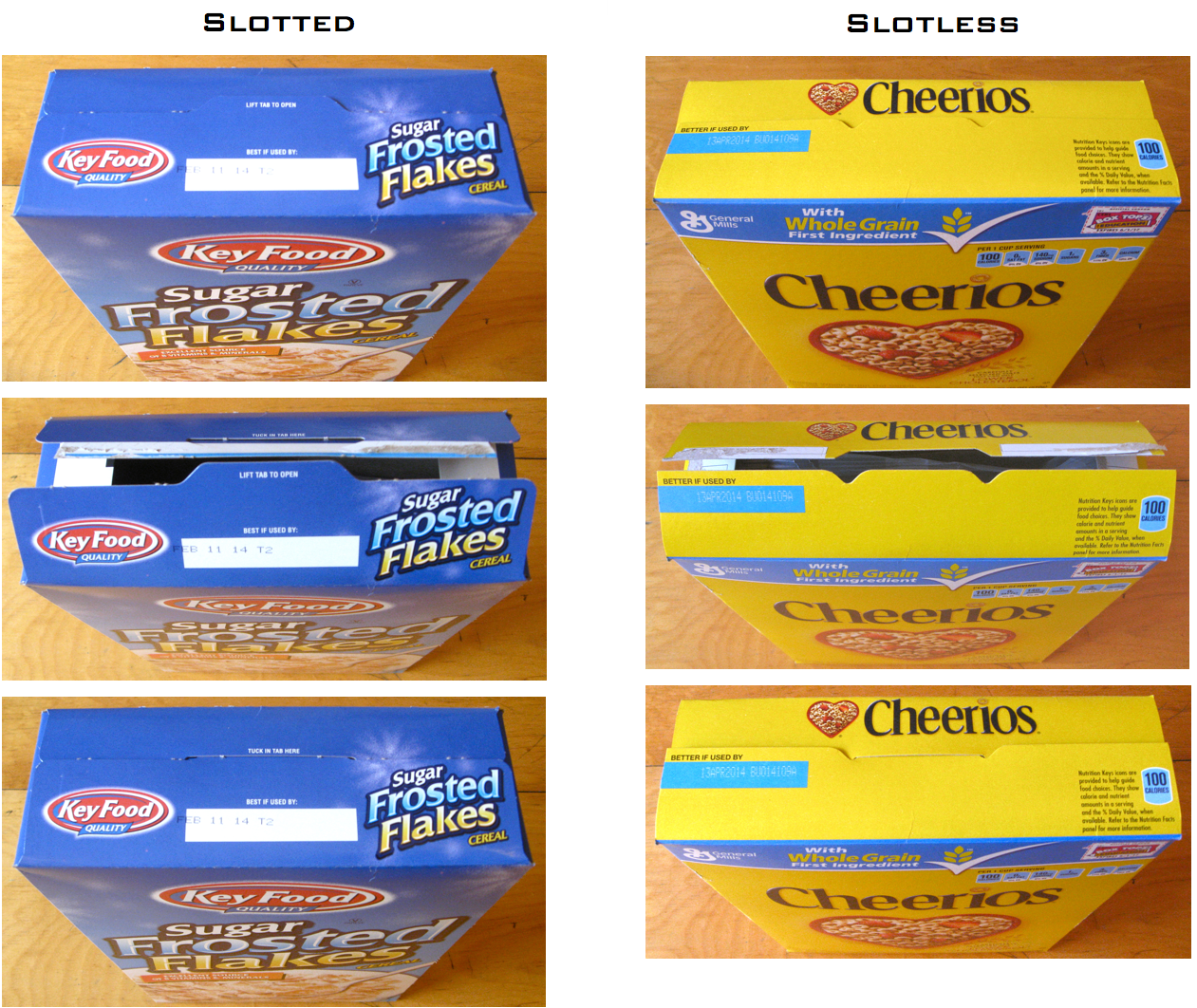
The Great Cereal Box Debate

Paul Lukas investigates the best way to close them:

[E]very source agreed that the slotted style’s tendency to rip and tear is highly annoying. Not only that, but several of the experts identified another important distinction: The slotless style boxesrequires less male/female overlap, so the flaps can be shorter. That saves cardboard — sorry, paperboard — which translates to lower costs, greater sustainability, lighter shipping loads, and so on.

So with the slotless design appearing to offer superior functionality and greater efficiencies, why would anyone stick with the slotted format? “Some people think the slotless version feels less secure, because there’s less overlap and less of a lock,” said Pat Shields, Director of Structural Design at the box manufacturer Rock Tenn. (He also added, “When the slot rips, at least it gives you an outlet for expletives. Hey, we’re there to serve.”) And Lisa McTigue Pierce, Executive Editor of the trade magazine Packaging Digest, said, “For flour-based products, maybe the larger overlap could help prevent insect infestation.”

So that’s what the slotted style has going for it: It offers a false sense of security, gives you an excuse to cuss, and maybe keeps the bugs out.

(Image via Uni-Watch)

Climate Change Trade-Offs

A reader comments on a recent Malkin Award nomination:

I really, really hate that I’m about to defend Exxon CEO Rex Tillerson, but I’m not so sure this qualifies as “shrill, hyperbolic, divisive and intemperate right-wing rhetoric.” Short-sighted, rather ignorant, and driven by deeply questionable motives, sure. But at the same time, there’s actually an important point subsumed here (at least as I read it). Attacking carbon emissions with the utmost gusto, at this point in time and with currently existing technology, could well have implications for lifting the global bottom two billion out of energy poverty; and, it would almost certainly create additional cost burdens for individuals in the developed world. Climate impacts will be most acutely felt by those in the bottom socioeconomic rungs; but so too is it going to be harder for folks at the bottom to pay for higher energy costs – wherever they may live – if they’ve got to rely on renewables, or coal with carbon-capture.

So it’s something of a balancing act, I’d argue.

Contra Exxon, this consideration is not a reason not to act, of course; people just need to be clear-eyed about potential trade-offs. Brad Plumer wrote about this with some concern a while back, and he is surely not worthy of a Malkin Award! There’s a legitimate conversation to be had about the future trajectory of human development, the trade-offs between competing goals, and the advantages or disadvantages of the various supply – and demand-side steps we can take to achieve them.

I also understand the context here. Exxon is probably one of the worst corporate actors on climate. Their record and outlook is shameful, and flies in the face of what IEA, the World Bank, and other bodies say we need to be doing. Obviously Tillerson is using this argument as a shield, not in good faith. But just because he can use this argument as an excuse for poor corporate citizenship doesn’t necessarily mean it belongs with the Malkins.

The Best Of The Dish Today

family_of_saltimbanques

The Dish enjoyed skewering Erick Erickson’s brain-dead form of Republicanism today; and wondering when Bob Woodward had his sense of shame removed. There was a debate about what exactly bigotry is; and whether Obamacare will raise or lower most premiums. The human brain has a unique capacity to see real things in painting; animals not so much with mirrors. And we welcomed my old friend Fareed Zakaria (yes, we met as students at the Oxford Union) to an Ask Anything series.

The most popular posts were about rape and orgasm and, once again, my conversation with Dan Savage.

See you in the morning.

Roy Vey, Ctd

A reader writes:

What continues to burn me about this entire debate is that opponents of Obamacare act like insurance premiums were dirt cheap and totally stable before Democrats started mucking with the system.  Long before Obama was even elected, I had begun the almost yearly ritual of filling out the same draconian health survey so my company could shop around for new insurance.  Our insurer was raising the rates 25-40% over last year’s.  AGAIN.  Or calling to interrogate us after every follow-up doctor visit to see if there was any way they could weasel out of paying for it.

I’ve seen the quality of plans offered go steadily down, even while having to pick up a larger percent of the cost myself.  And when my wife and I finally decided that the cost increases had become too punishing, and tried to find some bare-bones, individual alternative, we were turned down flat.  The reason?  Three months earlier, I had a cholesterol test come back high.

Maybe the exchanges will be a stabilizing force on premiums, and maybe the cost-saving measures will end up lowering health care costs in general, but at least it’s something.  People need to stop talking like there was never a problem to begin with.