Hope, Not Optimism

Nadia Bolz Weber sermonizes on the distinction:

The Easter hope we have, brothers and sisters, the hope that never disappoints has nothing to do with optimism or the avoidance of suffering, is a hope that can only come from a God who has experienced birth, and love and friendship and lepers and prostitutes and betrayal and suffering and death and burial and a decent into hell itself. Only a God who has born suffering himself can bring us any real hope of resurrection. And if ever given the choice of optimism or resurrection I’d go with resurrection any day of the week.  This is the God of whom Paul speaks.  And the Christian faith is one that does not pretend things aren’t bad. This is a faith that does not offer platitudes to those who lost children this week to suicide or a tornado. This is not a faith that produces optimism it is a faith that produces a defiant hope that God is still writing the story and that despite darkness a light shines and that God can redeem our crap and the beauty matters and that despite every disappointing thing we have ever done or that we have ever endured, that there is no hell from which resurrection is impossible. The Christian faith is one that kicks at the darkness until it bleeds daylight.

A Poem For Sunday

Dew_drops_on_spider_web

“Sonnet 71” by Edmund Spenser (1552-1599):

I joy to see how in your drawen work,
Your selfe unto the Bee ye doe compare;
and me unto the Spyder that doth lurke,
in close awayt to catch her unaware.
Right so your selfe were caught in cunning snare
of a deare foe, and thralled to his love:
in whose streight hands ye now captived are
so firmely, that ye never may remove.
But as your worke is woven all above,
with woodbynd flowers and fragrant Eglantine:
so sweet your prison you in time shall prove,
with many deare delights bedecked fyne.
And all thensforth eternall peace shall see,
between the Spyder and the gentle Bee.

(From Amoretti, published in London in 1595 by William Ponsonby. Photo via Wikimedia Commons)

Quote For The Day

“Looking at Western societies I think that if we have religion, we shall have to have religion without God, because belief in a personal God is becoming increasingly impossible for many people. It’s a difficult question actually to know what believing in a personal God is. I know that I don’t believe in one. I don’t want to use the word god in any other sense. I think it’s a proper name. I don’t believe in the divinity of Christ. I don’t believe in life after death. My beliefs really are Buddhist in style. I’ve been very attached to Buddhism. Buddhism makes it plain that you can have religion without God, that religion is in fact better off without God. It has to do with now, with every moment of one’s life, how one thinks, what one is and does, about love and compassion and the overcoming of self, the difference between illusion and reality,” – Iris Murdoch

Home And Our Restless Hearts

In his Jefferson lecture last year, Wendell Berry parsed the distinction between “boomers” and “stickers”:

My teacher, Wallace Stegner…thought rightly that we Americans, by inclination at least, have been divided into two kinds: “boomers” and “stickers.” Boomers, he said, are “those who pillage and run,” who want “to make a killing and end up on Easy Street,” whereas stickers are “those who settle, and love the life they have made and the place they have made it in.” “Boomer” names a kind of person and a kind of ambition that is the major theme, so far, of the history of the European races in our country. “Sticker” names a kind of person and also a desire that is, so far, a minor theme of that history, but a theme persistent enough to remain significant and to offer, still, a significant hope.

Alan Jacobs questions Berry’s categories:

[W]hy does he insist on the validity of this binary code? It’s useless — it’s worse than useless, it’s simplistic and uncharitable. There are many reasons why people stay home, and many why they leave; and probably no single person is driven by one reason only. “There’s no such thing as an unmixed motive,” as Rebecca West is said to have commented.

Jeffrey Bilbro thinks Jacobs misunderstands Berry:

In an earlier essay, “The Conservation of Nature and the Preservation of Humanity,” Berry is more careful to define the terms “boomer” and “sticker” as conflicting internal desires.  He warns against seeing these as categories of people, arguing instead that they differentiate between parts of individuals.

As Berry writes, “All of us, I think, are in some manner torn between caring and not caring, staying and going.”   The choice to root ourselves in place is not a clear-cut, one-time choice.  Rather, it is a long process of refining and ordering our affections, of choosing to submit to the limits of our place rather than to fulfill our individual desires.

The larger problem underlying this sort of misreading of place in Berry’s work stems from a lack of engagement with his fiction.  As Jake Meador observes, Berry’s essays are incomplete without his fiction: “If the only thing you read is The Unsettling of America Berry may well come off as an angry white environmentalist with a shocking streak of naiveté. But if you read Jayber Crow, A Place on Earth, or Fidelity, you begin to become acquainted with the entire world associated with the place of Port William and you begin to understand that the place is more than just a physical place, but an entire world and culture marked by certain long-held-and-now-forgotten beliefs.”  I know for myself that if I had not first read Berry’s fiction, his essays would have seemed incorrigibly grumpy; they are occasional, contrarian, prophetic, and provocative and aren’t meant to offer his full vision.

Confronting Death In The Midst Of Life

crossworship

Amidst the unbearable lightness of prosperity gospel mega-churches and a religious culture obsessed with entertainment, Carl R. Trueman meditates on the centrality of tragedy to authentic Christian worship:

The Church knows how far humanity has fallen, understands the cost of that fall in both the incarnate death of Christ and the inevitable death of every single believer. In the psalms of lament, the Church has a poetic language for giving expression to the deepest longings of a humanity looking to find rest not in this world but the next. In the great liturgies of the Church, death casts a long, creative, cathartic shadow. Our worship should reflect the realities of a life that must face death before experiencing resurrection.

It is therefore an irony of the most perverse kind that churches have become places where Pascalian distraction and a notion of entertainment that eschews the tragic seem to dominate just as comprehensively as they do in the wider world. I am sure that the separation of church buildings from graveyards was not the intentional start of this process, but it certainly helped to lessen the presence of death. The present generation does not have the inconvenience of passing by the graves of loved ones as it gathers for worship. Nowadays, death has all but vanished from the inside of churches as well.

(Photo by Flickr user Forsaken Fotos)

“You Are The Resistance”

In a commencement address at Brandeis University, Leon Wieseltier calls a commitment to the humanities “nothing less than an act of intellectual defiance, of cultural dissidence.” How he valorizes those who study the liberal arts:

[T]here is no task more urgent in American intellectual life at this hour than to offer some resistance to the twin imperialisms of science and technology, and to recover the old distinction — once bitterly contested, then generally accepted, now almost completely forgotten – between the study of nature and the study of man. As Bernard Williams once remarked, “’humanity’ is a name not merely for a species but also for a quality.”  You who have elected to devote yourselves to the study of literature and languages and art and music and philosophy and religion and history — you are the stewards of that quality. You are the resistance. You have had the effrontery to choose interpretation over calculation, and to recognize that calculation cannot provide an accurate picture, or a profound picture, or a whole picture, of self-interpreting beings such as ourselves; and I commend you for it.

Do not believe the rumors of the obsolescence of your path. If Proust was a neuroscientist, then you have no urgent need of neuroscience, because you have Proust. If Jane Austen was a game theorist, then you have no reason to defect to game theory, because you have Austen. There is no greater bulwark against the twittering acceleration of American consciousness than the encounter with a work of art, and the experience of a text or an image. You are the representatives, the saving remnants, of that encounter and that experience, and of the serious study of that encounter and that experience – which is to say, you are the counterculture. Perhaps culture is now the counterculture.

Ron Parlato objects:

Science and technology are not the enemies of learning but the means to greater knowledge and understanding; and from the days of The Enlightenment until the present, a rational, objective analysis of the world in which we live has always provided new insights into human nature and behavior and has always provided the basis on which moral, ethical, and religious discourse has been built.

Face Of The Day

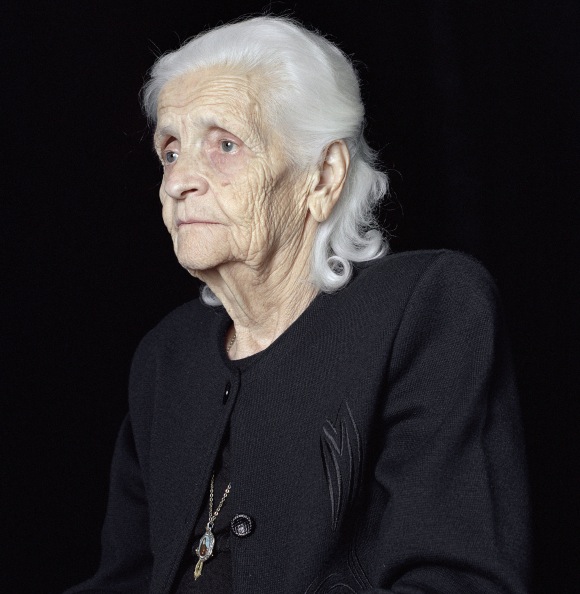
From Georgia Metaxas‘ series The Mourners:

dish_mourners_gmetaxas1

A description of the project:

The Mourners is a series of portraits documenting the ritual of wearing black as a signifier of perpetual mourning. In remembrance of those they have lost, all that sit for a portrait in the series wear black every day for the rest of their lives.

(Photo: Untitled #28 (2010-11), archival inkjet print, Georgia Metaxas. Courtesy the artist and Fehily Contemporary)

Translating From The Future

Tim Parks, in the throes of translating the Italian writer Giacomo Leopardi, muses on how to get it right:

Fifteen years of diary entries. From 1817 to 1832. Some just a couple of lines. Some maybe a thousand words. At a rhythm ranging from two or three a day to one a month, or even less frequent. Suddenly, translating Giacomo Leopardi’s Zibaldone, it occurs to me that if it were written today, it would most likely be a blog. Immediately, the thought threatens to affect the way I am translating the work.

I am imagining the great diary as the Ziblogone—launched from some eccentric little website in the hills of central Italy. I’m wondering if I should suggest to the publisher (Yale University Press) that they might put the entries up one a day on their site; they could use Leopardi’s own system of cross-referencing his ideas to create a series of links. Fantastic! Perhaps I could start embedding the links as I work. Why not?

No, stop. I have to take a deep breath and remember my job description: faithful, accurate translation true to the tone of the original.

But it is impossible to translate a work from the past and not be influenced by what has happened since. Or at least to feel that influence, if only to resist it. I translated Machiavelli’s The Prince during the Iraq war. States invading distant foreign countries with authoritarian governments, Machiavelli warned, should think twice about disbanding the army and bureaucracy that opposed them, since they may offer the best opportunity of maintaining law and order after the war is over. I remember wanting to translate this observation in such a way that even the obtuse Mr Bush simply could not miss the point. If I could have sneaked in the word “Iraq”—or perhaps more feasibly “shock” and “awe”—I would have.