The Voice Of Virginia Woolf

Here is the only known recording of it, from a 1937 BBC radio lecture entitled “Craftsmanship”:

An excerpt on how we live with words:

[Words] are the wildest, freest, most irresponsible, most un-teachable of all things. Of course, you can catch them and sort them and place them in alphabetical order in dictionaries. But words do not live in dictionaries; they live in the mind. If you want proof of this, consider how often in moments of emotion when we most need words we find none. Yet there is the dictionary; there at our disposal are some half-a-million words all in alphabetical order. But can we use them? No, because words do not live in dictionaries, they live in the mind. Look once more at the dictionary. There beyond a doubt lie plays more splendid than Antony and Cleopatra; poems lovelier than the “Ode to a Nightingale“; novels beside which Pride and Prejudice or David Copperfield are the crude bunglings of amateurs. It is only a question of finding the right words and putting them in the right order. But we cannot do it because they do not live in dictionaries; they live in the mind. And how do they live in the mind? Variously and strangely, much as human beings live, ranging hither and thither, falling in love, and mating together.

(Hat tip: Sadie Stein)
Nursing Us Back To Health

Both California and Texas recently passed legislation expanding the scope of responsibilities that can be fulfilled by nurse practitioners. Mike Miesen makes the case that “this is arguably more important” than recent news about California’s low premiums under Obamacare:

We can expect the loosening of regulations to lead to cheaper, more efficient care in the long term; a nurse practitioner’s hourly rate is lower than a physician’s and, assuming they can both conduct a high-quality, basic check-up—and evidence suggests that quality and patient satisfaction is higher along some metrics nurse practitioners compared to physicians—everyone is better off. It’ll also mean shorter wait times, as the supply of available clinicians will rise.

Significantly, both of these factors could lead to clinicians accepting Medicaid patients at a higher rate than before. Worrying research has shown that, increasingly, physicians have been unwilling to take on new Medicaid patients due to the low reimbursement rate relative to Medicare or private insurance. Relaxing scope-of-practice regulations will mean that these patients may soon be able to more easily receive the care they need.

Relatedly, Soltas points out that controlling healthcare costs will mean losing healthcare jobs:

There is no pot of gold at the end of the rainbow where all of our health-care spending has magically accrued. Health care “costs” are really health care jobs. In surveys, hospital managers name labor as their largest cost issue — not the Affordable Care Act.

Achieving any substantial reduction in the cost of care will require what economists call “labor-saving technology.” We will have to find ways to destroy health care jobs — or at least to slow their growth.

A Chip Off The Old Blockbuster

Chris Orr hated After Earth:

Shyamalan’s involvement notwithstanding, After Earth is a vanity project of the burgeoning multinational Will Smith Inc. The movie stars Smith and his 14-year-old son, Jaden. It’s produced by Smith, his wife, Jada Pinkett Smith, brother-in-law Caleeb Pinkett, and longtime friend and business partner James Lassiter. And it’s based on a story written by Smith as a vehicle for his son, one that he conceived while he and his brother-in-law were watching television together. Which is a long way of saying that it might be best to give Shyamalan a pass on this one.

Dana Stevens piles on:

In [Jaden Smith’s] defense, the kid is saddled with a task that even a more experienced actor might have trouble pulling off: He must carry an entire action movie on his slender shoulders, given little more to act opposite than a succession of green-screen predators. Even with his charismatic dad in his earpiece calling the shots, Jaden can’t turn himself into a movie star by sheer force of Will.

When Rape Triggers An Orgasm

Noting that “4-5 percent” of cases result in arousal, Jenny Morber explains the science:

Despite what many rapists would like to believe, arousal does not mean that an assault was enjoyable or that a victim was asking for it. So what does it mean? Quite simply, our bodies respond to sex. And our bodies respond to fear. Our bodies respond. They do so uniquely and often entirely without our permission or intention. Orgasm during rape isn’t an example of an expression of pleasure. It’s an example of a physical response whether the mind’s on board or not, like breathing, sweating, or an adrenaline rush.

Therapists commonly use the analogy of tickling. While tickling can be pleasurable, when it is done against someone’s wishes it can be very unpleasant experience. And during that unpleasant experience, amid calls to stop, the one being tickled will continue laughing. They just can’t help it.

Chart Of The Day

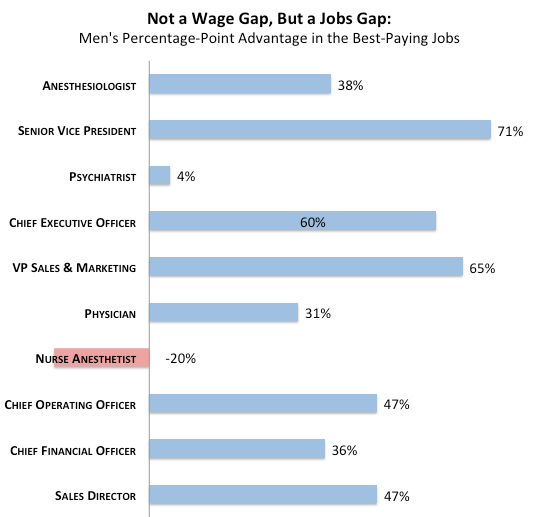
Jobs Gap

Derek Thompson flags a new survey that “finds that the wage gap nearly evaporates when you control for occupation and experience among the most common jobs, especially among less experienced workers”:

Comparing men and women job-by-job conceals the fact that men still dominate many of the highest-paying jobs. PayScale studied more than 120 occupation categories, from “machinist” to “dietician.” Nine of the ten lowest-paying jobs (e.g.: child-care worker, library assistant) were disproportionately female. Nine of the ten highest-paying jobs (e.g.: software architect, psychiatrist) were majority male. Nurse anesthetist was the best-paid position held mostly by women; but an estimated 69 percent of better-paid anesthesiologists were male.

Will Segregation Ever End?

TNC examines two papers on the slow decline of segregation:

Black people are less segregated right now than they’ve been since the dawn of the 20th century. In one sense that should make you happy. In another sense it should scare you. The “good” news means that black people went not from hypersegregated to integrated, but from hypersegregated to very segregated. Progress. Yay. Still let’s live in the good news for just a moment. If black/white segregation has declined over the past two decades–and it has–can we not assume that it will continue to decline on its own?

[Douglass] Massey argues that ultimately segregation is at the root of most of the social ills affecting black people, because it concentrates all of the problems of poverty on the shoulders of one group–whether everyone in that group is poor or not.

Taking Her Name

Liza Mundy looks at how and why gay couples are adopting marriage traditions:

“In the lesbian community, lots of people are changing their name,” said Sheila Alexander-Reid, strolling with her soon-to-be-spouse, Deborah Cummings-Thomas. Both women are officiants and have facilitated same-sex weddings in Washington, D.C., since they became legal in 2010.

Cummings-Thomas said many couples who travel to the D.C. area to marry are from states that ban same-sex marriage. Returning home, they find that “being able to change their name is a way to have their home state recognize their marriage,” in spirit if not in fact. For their own part, the two women had shown up at the courthouse early, the first same-sex couple to get a license in Howard County, Maryland. They were planning to share a name: They just had to figure out which one. Probably Reid, they were thinking.