The Female Breadwinner, Ctd

Erik Erickson’s claim (seen above) about the rise of female breadwinners:

When you look at biology — when you look at the natural world — the roles of a male and a female in society and in other animals, the male typically is the dominant role. The female, it’s not antithesis, or it’s not competing, it’s a complementary role. We’ve lost the ability to have complementary relationships … and it’s tearing us apart.

I’m the furthest from a social constructionist on gender as you can imagine. Any policy that assumes identical needs and wants and temperaments among men and women is doomed to failure. We are biologically different as soon as testosterone arrives (but not before, when we are all default females). But that emphatically doesn’t mean male supremacy. Difference does not have to be hierarchical – and, in my view, tendencies toward making differences into hierarchies are immoral. But Erickson reveals the true beliefs of so many in the fundamentalist GOP. Wilkinson’s reply:

Mr Erickson’s appeal to the natural order points to a … conservative folly: the tendency to imagine the familiar, recent past in especial accord with timeless human nature. Once one considers how far we’ve come since the Pleistocene—what with all our capitalism, nation-states, dentistry and cable news—this sort of biological essentialism seems unbecoming of conservatives who, if they are about anything worthwhile, are about the defence and advancement of civilisation. The defence of atavistic privilege, which invariably proceeds on the basis of specious claims about natural hierarchy, is the hardy, incivil part of conservatism.

Or as someone once put it, art is man’s nature. Derek Thompson adds:

The majority of female breadwinners are single moms, who face an extraordinary tension between working pay and raising children. But I didn’t hear Erickson mention the phrase “single moms.” He was talking about women earning more than men. And the fact that some married women are out-earning their husbands isn’t tragic. It’s inevitable. And it’s good.

After millennia of the subjugation of women, it’s also exhilarating for all of humankind. That today’s GOP doesn’t really feel that at all is a sign of its decay and alienation from modern America.

In the long segment seen below, Megyn Kelly tears into Erickson:

Worth A Thousand Words

How fucking marvelous that in a classically impulsive and dumb trip into Syria, McCain may have unwittingly been photographed next to a known multiple kidnapper of Shia pilgrims. Hey, he’s our multiple kidnapper. Soon, we may have our own Sunni Jihadists too! Larison pounces:

McCain’s spokesman insisted that he wasn’t aware of this, and presumably that’s true, but the episode illustrates how unwise McCain’s overall position on Syria is. McCain went to Syria so that he could vouch for the virtues of the opposition, but at least some of the people he wants the U.S. to arm are already engaged in sectarian and criminal behavior. The standard interventionist line is that U.S. backing for the opposition would enable Washington to discourage and prevent such behavior, but it is far more likely that it would simply make the U.S. complicit in it.

Steve Chapman asks why, after Libya’s slow fracturing into Islamist chaos, Iraq in a post-surge wave of sectarian killing, and, well Afghanistan (enough said), we should even entertain the idea that intervention in Syria could possibly be worth it. Joe Klein makes related points:

A few years ago, McCain made a well-publicized walk through a Baghdad market, didn’t get shot at, and pronounced major progress in Iraq afterward. A few weeks later, I made the same walk but actually spoke to the shopkeepers—all of whom were supporters of Muqtada al-Sadr, the Shi’ite militia leader.

The point is: We just don’t know these places well enough to go over and draw grand conclusions about policy. In a way, McCain’s trip is a perfect metaphor for the problem of involving ourselves with the Syrian rebels. We may be siding with the greater evil. We may be throwing fuel on a fire that could consume the region. Our track record when it comes to such things is dismal.

After reviewing McCain’s case for war, Allahpundit quips:

The fact that he can’t sell his interventionism honestly reminds me again that he’s probably, and inadvertently, a better salesman for isolationism at this point than even Rand Paul is.

Holder Says He Gets It

The president has given him a deadline – July 12 – to rein in investigations of the press over national security leaks. I know that because the details of the “off-the-record” meeting are all over the press today. Heh. The silver lining is that new media protections might actually come out stronger than they might otherwise have. I think, especially after the James Rosen case, that the rules should lean much more heavily against any investigations into reporters’ records. But we’ll see.

James Lipton Was A Pimp?

dish_salon_in_the_rue_des_moulins

Truth be told:

Is it true you were a pimp in Paris in the 1950s?

“I was. It was only a few years after the war. Paris was different then, still poor. Men couldn’t get jobs and, in the male chauvinist Paris of that time, the women couldn’t get work at all. It was perfectly respectable for them to go into le milieu.”

Prostitution?

“Young women desperately needed money for various reasons. They were beautiful and young and extraordinary. There was no opprobrium because it was completely regulated. Every week they had to be inspected medically. The great bordellos were still flourishing in those days before the sheriff of Paris, a woman, closed them down. It was a different time.”

How did your involvement come about? You became friends with one of the prostitutes in Paris?

“We became great friends. When I ran out of money, I said, ‘I have to go home.’ She said, ‘No, you don’t. I’ll arrange for you.’ So she arranged for me to do it. I had to be okayed by the underworld; otherwise they would’ve found me floating in the Seine.”

Did you represent more than one girl?
“Yes, a whole bordello. I represented them all, but her especially. I did a roaring business, and I was able to live for a year. The French mecs didn’t exploit women. They represented them, like agents. And they took a cut. That’s how I lived. I was going through my rites of passage, no question about it. It was a great year of my life.”

(Image: Salon in the Rue des Moulins, Henri Toulouse-Lautrec, 1894, via Wikimedia Commons)

Poor Peacekeepers

David Bosco looks at where UN peacekeepers come from:

While there are exceptions, U.N. peacekeeping is an activity mostly paid for by the rich world and carried out by troops from poorer states. The leading troop contributing states (TCCs) are Bangladesh, Pakistan, India, Ethiopia, Nigeria, and Rwanda. The top funders are the United States, Japan, Britain, Germany, France, and Italy. Combined, these countries cover well over 50 percent of the peacekeeping tab, while offering fewer troops than diminutive Jordan. The United States alone pays 27 percent but provides a grand total of 109 peacekeepers. “With a few exceptions,” notes George Washington University scholar Paul Williams, “the West has basically left peacekeeping operations.” Turtle Bay blogger Colum Lynch recently described the structure as “the U.N.’s own caste system.”

Alex Mayyasi adds that “peacekeepers standing by as battles or massacres occur within miles of them in places like Congo and Sudan can be traced to the mercenary aspect of peacekeeping missions”:

Many governments send their troops without proper equipment, pocketing the UN funds intended for the purchase of arms, radios, and vehicles. States sending troops also often place restrictions on their use, so they cannot respond to active fights or enter dangerous environments. And troops whose governments are merely collecting pay, and do not have a strong interest in the peacekeeping mission, have no incentive to do their job well and no reason to risk their life.

Doing What The Map Decides

Evgeny Morozov is against the plan to make Google Maps “highly personalized, giving preferential treatment to the places frequented by our social networking friends, the places we mention in our emails, the sites we look up on the search engine”:

There’s something profoundly conservative about Google’s logic. As long as advertising is the mainstay of its business, the company is not really interested in systematically introducing radical novelty into our lives. To succeed with advertisers, it needs to convince them that its view of us customers is accurate and that it can generate predictions about where we are likely to go (or, for that matter, what we are likely to click). The best way to do that is to actually turn us into highly predictable creatures by artificially limiting our choices. Another way is to nudge us to go to places frequented by other people like us—like our Google Plus friends. In short, Google prefers a world where we consistently go to three restaurants to a world where our choices are impossible to predict.

What Causes Addiction?

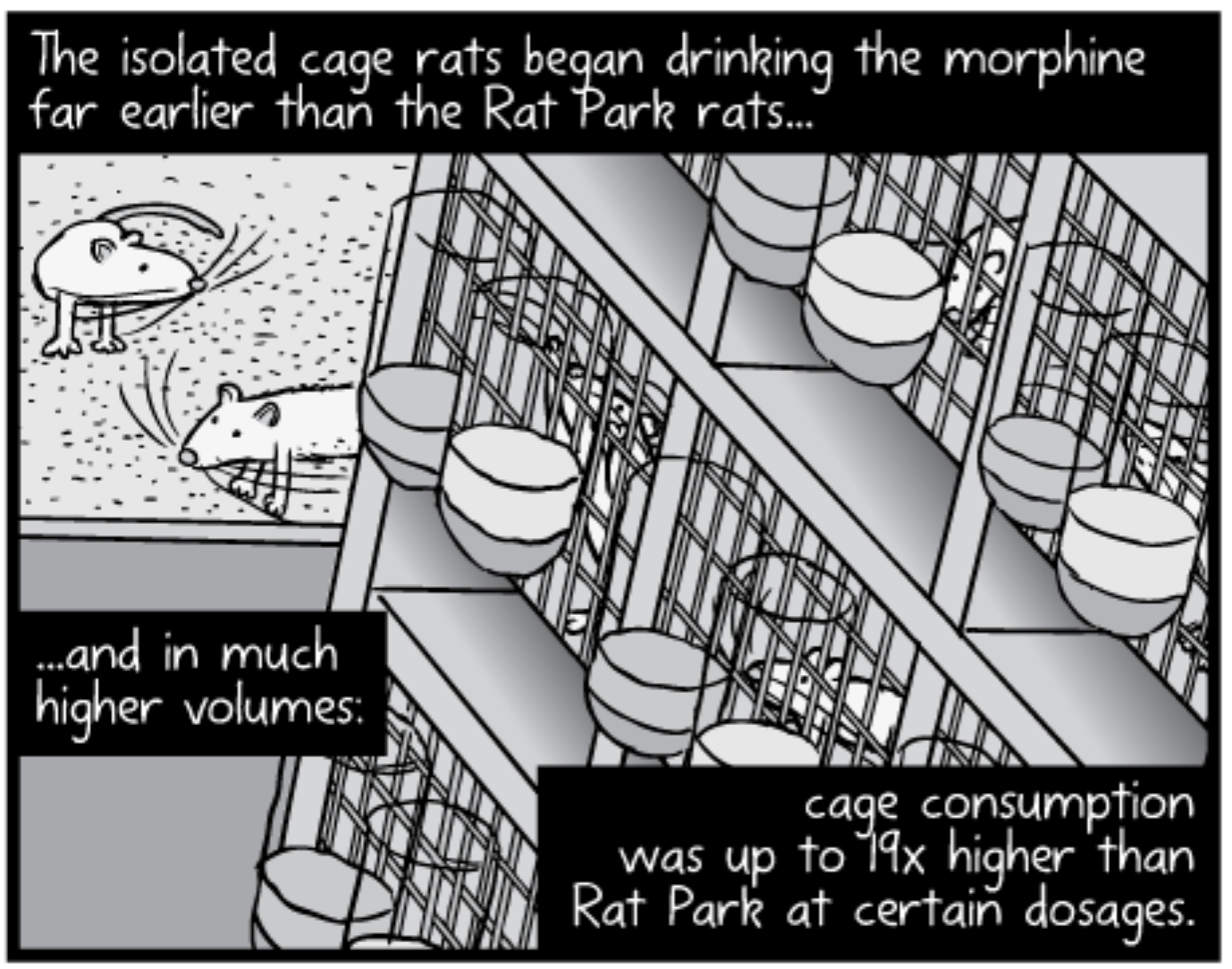
Stuart McMillen has a fascinating new comic on the question. He focuses on the Rat Park research of Bruce Alexander, who compared the drug habits of isolated rats and properly socialized rats. One frame:

Isolated Rats

McMillen discusses the comic:

I am not denying that certain drugs lend themselves to addictions. Alcohol, heroin and methamphetamines seem to be examples of drugs with properties that allow users to dull reality and escape their troubles, albeit temporarily. However, if the drugs themselves are truly the ’cause’, then by definition everyone who tries these substances should become equally addicted. And that is simply not the case.

Read the entire comic here.

For Anyone Having Surgery Today

Best of luck:

Britons who have a planned surgery on a Friday are 44 percent more likely to die. And the few patients who had a leisurely weekend surgery saw that number jump to 82 percent. The skeleton staff working on weekends might be to blame.

Researchers stressed, however, that not only is the weekend surgery sample size small, it is also likely biased in some way—perhaps only the already-most desperate of patients would have an operation on the weekend. Operations scheduled for Friday, though, are more comfortably compared to Monday, and the jump in mortality rates is striking.

It’s not just Britian:

A similar study conducted in American Veterans Affairs hospitals found that the odds of a patient dying in the 30 days following surgery jumped when the surgery happened on Friday.