Ask Dan Savage Anything

This embed is invalid

[Re-posted from yesterday with many questions added by readers]

Dan Savage needs little introduction to Dish readers, but here is his Wiki page to peruse. Dan just came out with a new book this week, American Savage: Insights, Slights, and Fights on Faith, Sex, Love, and Politics. From a recent interview with Logan Lynn:

Savage: Well, the book is about marriage and family, and is a bit more political. I talk about healthcare and Obamacare, gun control, sex education…it originally started out as just a collection of essays, things I had written other places, just bringing things I had written over the last decade together. Then I started revising them and reworking them. Originally the book was going to be 80% old stuff and 20% new stuff, and now it’s 90% new stuff. There’s basically nothing in there that isn’t reworked or brand new. There is a big chapter about marriage, and where we are at right now…and that’s been changing so rapidly, I want the book to come out ASAP. I wrote about adopting, about becoming parents, about Terry and I getting married; and this book has essays about life and memoir-y stuff about my mother’s death, about my son, now 15, coming out to us as straight when he was 12, which was kind-of bizarro hilarious…

Lynn: Alternate universe!

Savage: Yeah, like, how we were so careful all his life to let him know we loved him whoever he was, and yet somehow still he thought we were going to be disappointed that he wasn’t gay. It really broke my heart. So, I touch on all of that stuff. There’s some humor and comedy in the book as well. I wrote a play – a short play – that’s in the book about Jesus and the huge asshole, which is Jesus talking to a fundamentalist Christian who opposes healthcare reform. I think people will enjoy it.

To submit a question for Dan, simply enter it into the Urtak survey after answering all of the existing questions (ignore the “YES or NO question” aspect and simply enter any open-ended question). To vote, click “Yes” if you have a strong interest in seeing Dan answer the question or “No” if you don’t particularly care.
Fracking Ignorant

Very few Americans know much about hydraulic fracturing:

[A]pparently, in 21st century America, nobody pays attention to public demonstrations unless the protesters are wearing tri-cornered hats, nobody watches documentaries but film school snobs, and nobody reads those august publications anymore, period. Which is why we get this, according to the Yale study: “Fifty-four percent of Americans have heard nothing at all or only ‘a little’ about fracking.” Which, wow. And, “Only 9% have heard ‘a lot.'” Toss in the 13% that “don’t know” what they’ve heard about fracking in any way, shape, or form, and you’ve got yourself a portrait of a populace that’s wildly uneducated about one of the biggest energy developments in years. Really, these numbers suggest that 67% of Americans don’t really know what fracking is.

Hollywood’s No Smoking Policy

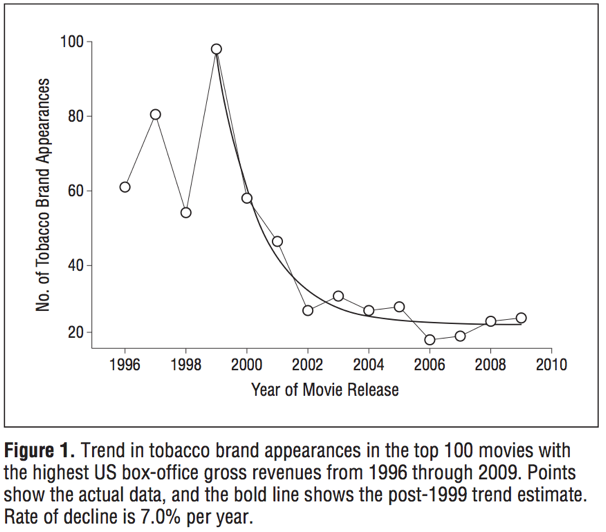
Branded cigarettes have made far fewer appearances on screen since tobacco product placement on TV and in movies was banned in 1998:

tobacco_jama

Alyssa suspects that alcohol would be more resilient:

Even if cigarettes became a model, and all of the vice industries were banned from paying for product placement in entertainment, I suspect the relatively heavy inclusion of alcohol in movies would continue, if only as a way to signal the characters are adults, and as real men, they drink beer, or as real women, they drink some sort of lady-approved cocktail (or, if cool, brown liquor). The social capital of alcohol remains high enough for it to be a useful signifier. And maybe instead of wanting to get all product placement out, we should be more concerned with getting certain kinds in more prominently. I could stand to see Trojan get some free advertising, for example, if movies could be persuaded that it’s as important to show couples using birth control once they get in to bed as it is to show them drinking to prove their grown-up and gender bona fides on their way to the bedroom.

Ah, yes, what every movie-goer really wants: more condom visuals.

Under The Knife And Behind The Veil

Celebrity plastic surgeon Jason Diamond set up shop in Dubai and was surprised by his clientele:

It could seem counterintuitive for these women to invest so much in their appearances given that they are covered most of the day. Diamond explained, “It took me a while to figure out, but in the Middle East many men are allowed to have four wives. The women want to be feminine and beautiful for their men. That is their only job. They are not out working. There’s no women’s lib. There’s none of that stuff. Their job is to look good for their men and that’s all they care about.”

“It’s my opinion,” Diamond added, “and I’m as a big an authority on this as anyone in the world, that they care more about their appearance than Beverly Hills’ women.”

Even though these women are very invested in looking good for their husbands, the men are uninvolved when it comes to the actual surgeries their wives undergo. On occasion women have a mother or sister with them, but more often than not, these women show up alone. “I would say I see more often here [in Beverly Hills] men coming in with their wives saying, ‘She needs to do this, or I really wish her breasts were bigger or smaller,'” said Mani. “The women are very self-directed there; they’re very empowered over their own bodies and know what they want. Men are not driving their wives to have plastic surgery.”

Drug War TOTAL FAIL

Drug Prices And Prisoners

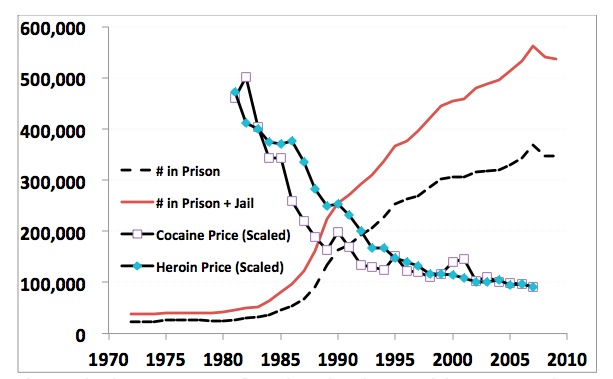
Harold Pollack writes that “this may be the most embarrassing graph in the history of drug control policy”:

Law enforcement strategies have utterly failed to even maintain street prices of the key illicit substances. Street drug prices in the [above] figure fell by roughly a factor of five between 1980 and 2008. Meanwhile the number of drug offenders locked up in our jails and prisons went from fewer than 42,000 in 1980 to a peak of 562,000 in 2007.

A Simple, Not Flat, Tax

James Pethokoukis at NRO agrees with me on the need to simplify the tax code without necessarily flattening it:

It’s an elegant, compelling model that might work splendidly if you were creating a tax code ex nihilo. Flat-tax fever swept across Eastern and Central Europe after the end of the Cold War, when finally independent nations were rebuilding their own economies, and the model has been quite successful, for the most part.

America, however, is in a much different place. Millions of individuals and businesses have made long-term plans based on expectations that the tax code will remain more or less the same. Half the nation, thanks to all those deductions and credits, pays no income tax. And, perhaps most important, an aging population means that the cost of health-care entitlements will grow rapidly, even if health-care inflation slows.

Adding that flat taxes are consistently unpopular with voters, Pethokoukis thinks through some other options:

One solution is to take the essentially flat consumption tax devised by economists Robert Hall and Alvin Rabushka and give it a progressive rate structure. Or we could combine a consumption tax with a flat income tax on wealthier Americans, as suggested by Yale’s Michael Graetz. Both ideas are also flexible enough give needed tax relief to parents. (Call it a “human-capital gains” tax cut.)

The flat tax embodies pro-growth, supply-side principles that are great starting points for tax reform, but it shouldn’t be the destination.

The Right Brain For The Job, Ctd

Michael Schrage applauds software company SAP’s recently announced commitment to hiring more diagnosed autistics:

The firm told the BBC that by 2020 perhaps 1% of its global workforce of 65,000 would be people with autism. Though a medically recognized DSM-5 disorder, many diagnosed autistics apparently bring special cognitive flair to digital details and computational concentration. “We share a common belief that innovation comes from the edges,” said Luisa Delgado, an SAP HR director, who noted the company valued the ability of many autistic people to “think differently and spark innovation.” SAP’s Bangalore office saw its productivity increase after deploying autistic hires.

He wonders, however, “What happens as medicines and therapies for autistics improve?”

If drugs and/or medical intervention effectively treat the awkwardness and dysfunction associated with autism, might they also undermine the cognitive skills and abilities that originally got those autistics hired by SAP and other IT firms? Would autistics feel compelled to cling to their disabilities for fear of losing their jobs?

Previous Dish on autism in the workforce here.

The Female Breadwinner, Ctd

A new report from the Pew Research Center finds yet more evidence that women are becoming the primary earners in their households. Bryce Covert parses the numbers:

Four in ten mothers are either the sole or primary source of income for their families, a new record, according to a Pew Research Center report released on Wednesday. That figure nearly tripled since 1960.

Yet the trend is not necessarily due to women making more than their husbands. Nearly two-thirds of this group of women workers are single mothers, and just 37 percent are married and have a higher income than their spouses. While the median total family income in houses where mothers earn more than their husbands was nearly $80,000 in 2011, much higher than the national median of $57,100 for families with children, it’s just $23,000 for single mothers’ families – just over a quarter of what families with married breadwinner mothers earn.

Joan C. Williams, meanwhile, looks at the differences in the number of hours men and women work per week:

How many employed American mothers work more than 50 hours a week? Go on, guess. I’ve been asking lots of people that question lately. Most guess around 50 percent. The truth is 9 percent. Nine percent of working moms clock more than 50 hours a week during the key years of career advancement: ages 25 to 44. If we limit the sample to mothers with at least a college degree, the number rises only slightly, to 13.9 percent. …

This “long hours problem,” analyzed so insightfully by Robin Ely and Irene Padavic, is a key reason why the percentage of women in top jobs has stalled at about 14 percent, a number that has barely budged in the past decade. We can’t expect progress when the fast track that leads to top jobs requires a time commitment that excludes most mothers — and by extension, most women.

Previous Dish on female breadwinners here.